The Open University’s Art’s Research Centre collaborated with Milton Keynes Literary Festival to train OU staff and MK Lit Fest volunteers to chair conversations with authors ahead of our joint events series, The Long and Short of It: From flash fiction to the doorstop novel.
Here, part-time PhD student, Antonia Saunders, who attended the training on campus, shares with us what she learnt.
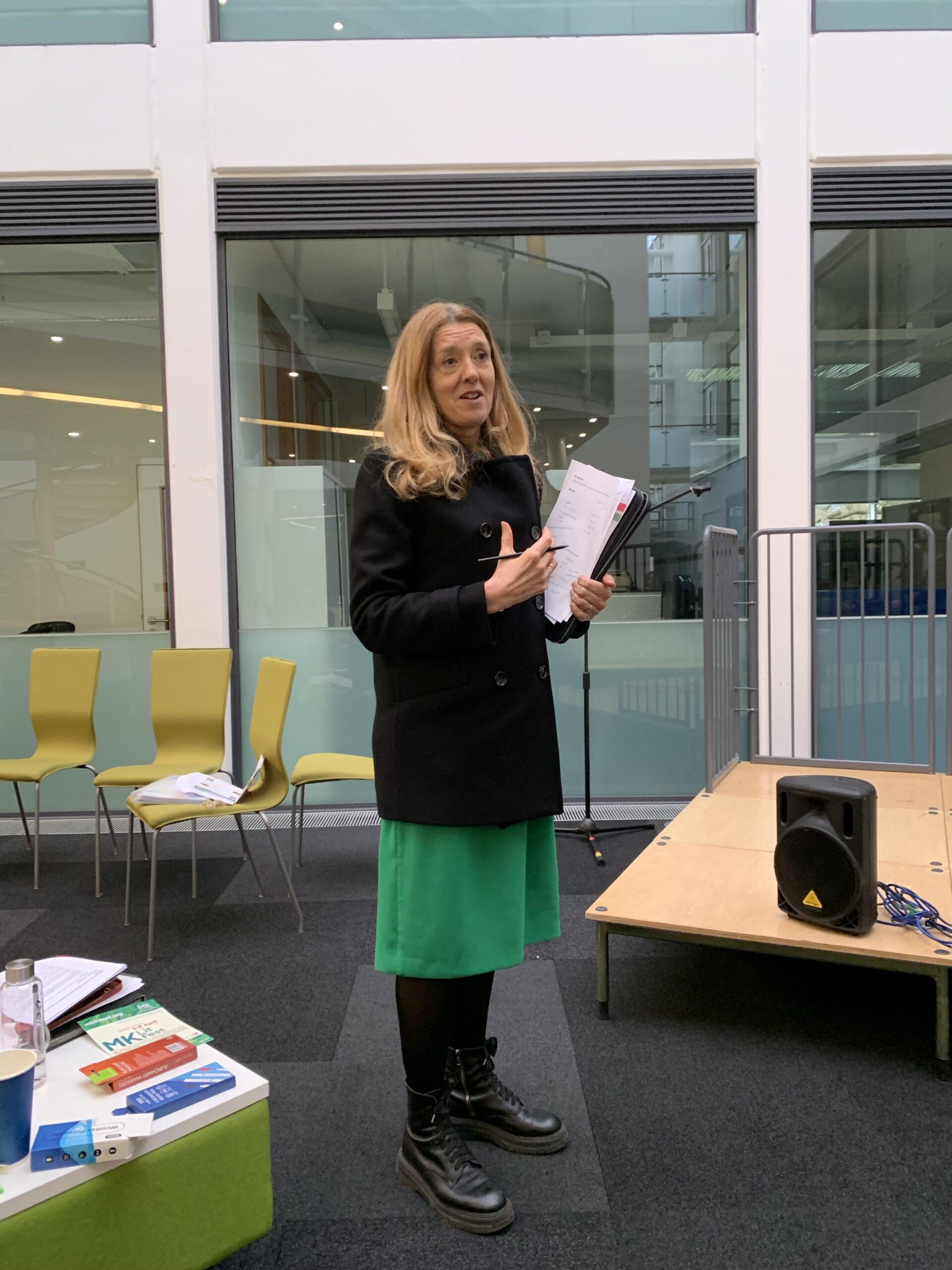
The training was led by Julia Wheeler, a writer, journalist and interviewer who worked for the BBC for more than fifteen years. Julia chairs discussions at festivals across the UK as well as in the Middle East and North America. She has moderated events at The British Library, The Royal Geographical Society and onboard Cunard’s Queen Mary 2.
What’s the role of a moderator?
A great moderator is hardly noticed. You are offering a space for the author to shine. This includes asking relevant, interesting and concise questions. It’s your job to judge and manage the energy of both the audience and the author. A good sense of timing is crucial. Give the author the chance to respond engagingly to your conversation-starters, and leave time for questions from the floor. When an event is going well, you hardly notice the moderator.
How should a moderator prepare?
The weeks before: be the class swot. Become acquainted with the author’s latest work or the book they are promoting. A close reading will help you to form relevant questions related to central themes. It’s also beneficial to have some knowledge of the author’s backlist. Reading reviews can help to open up ideas from another perspective, and previous interviews can help you to avoid well-trodden ground and come up with some fresh and insightful questions. Follow the author on social media. Have they posted something recently that you can ask them about? Tailor your questions to the audience and event. Keep your questions focused on the guest as a writer. Remember, you aren’t revising for an exam, you are preparing for a fascinating conversation. What do you hope to discover about the author and their work?
One week before:be a safe pair of hands.
Contact the author to remind them of the event blurb, time and place. Include your own short bio so that they have a sense of who you are. Tell them how much you are enjoying the book and pull out something specific to praise.
Confirm whether the author is planning to read from their work, making clear that a reading should not last for more than two minutes. With a poet, you might weave a few short readings throughout the conversation, and you might end with a reading too. With prose, one short reading is sufficient.
Be upfront about certain themes you’ll need to cover to be true to the event description. Ask if there is anything the author would especially like you to ask – that dream question, perhaps, that no one has asked about before. Don’t close the conversation down by asking if there’s anything they do not want to cover. If the author happens to raise any no-go areas, though, be sure to respect them.
The hour before: You’re in charge!
Arrange the chairs so that you are angled towards one another while facing the audience. Bring a cookbook stand to position the book the author is promoting. Engage technical staff to check the audio equipment is working. Ensure the stage is clear of any trip hazards. Pour out the water before. Brief any volunteers who might be holding the roving mics. Ask them to keep hold of the mics where possible to prevent an audience member from hogging it, and to allow the volunteer to move quickly to the next question to avoid delays. Show the space to the author and advise them that you will enter the stage first and motion them to their place. Be confident and politely assertive.
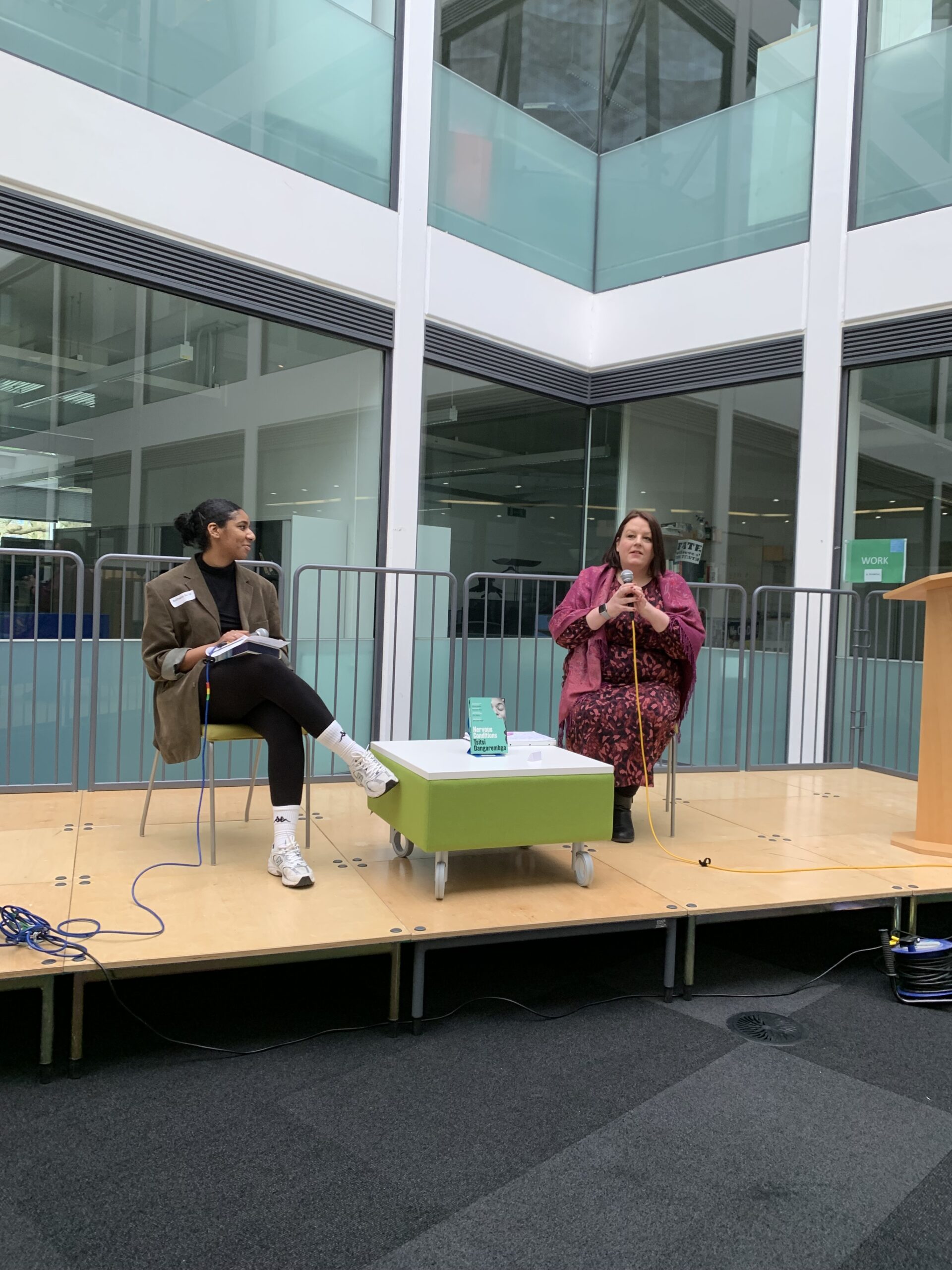
OU PhD student Antonia Saunders (right) is interviewed on stage by an MK Lit Fest volunteer.
How should a moderator handle the event itself?
Introductions: Short and punchy
Your introduction should include your name, the name of the event, and a brief description of the author and their work, ensure you mention their latest book. Three or four lines should do the trick. The audience is there to hear from the author so segue swiftly into your first question.
The conversation: Wear your research lightly
Distill your research into a one-page cheat sheet, which you can hide behind a copy of the author’s book! You should avoid referring to this too often, but it can offer a crutch to remind you of important quotations, or to jog your memory with a question to keep a conversation on track. But it’s important to listen to your guest and respond to their answers appropriately, rather than stick to a pre-formulated list of questions. It should be a conversation not an interrogation! By briefly summarising the author’s answer you can segue into a deeper exploration of that topic, or you can close it off and move onto another area of interest. Don’t necessarily ask your best question first, rather give the author the chance to warm up. Ask open questions (what, why, how, tell us about, to what extent) to encourage the author to open up. Be prepared to keep the conversation going if the author is a little timid or to anchor the conversation if the author is very talkative. Have a phrase to bring things back if things go wrong. Responses like ‘people always ask that’ or ‘That’s wrong’ can be disconcerting, so have a very open question up your sleeve. ‘What would you like readers to take from the book?’ or ‘What inspired you to write about…?’ Try to maintain eye contact and ensure your body language conveys that you are engaged by what the author has to say.
Handling a panel: Create a dinner party vibe
You’ll need knowledge of one or two texts by each author. Keep in touch with all guests on an email chain. Set up the chairs in a curve, with you at one end and the author you expect to be easiest to work with at the other end. Ensure you give each panellist equal opportunity to speak, regardless of status. A question like ‘how does that resonate with you?’ can be a good way of acknowledging one response before moving onto the next author. Allow the conversation to flow, and don’t be afraid of a little controversy. Set some hares running!
Online events: The same but different?
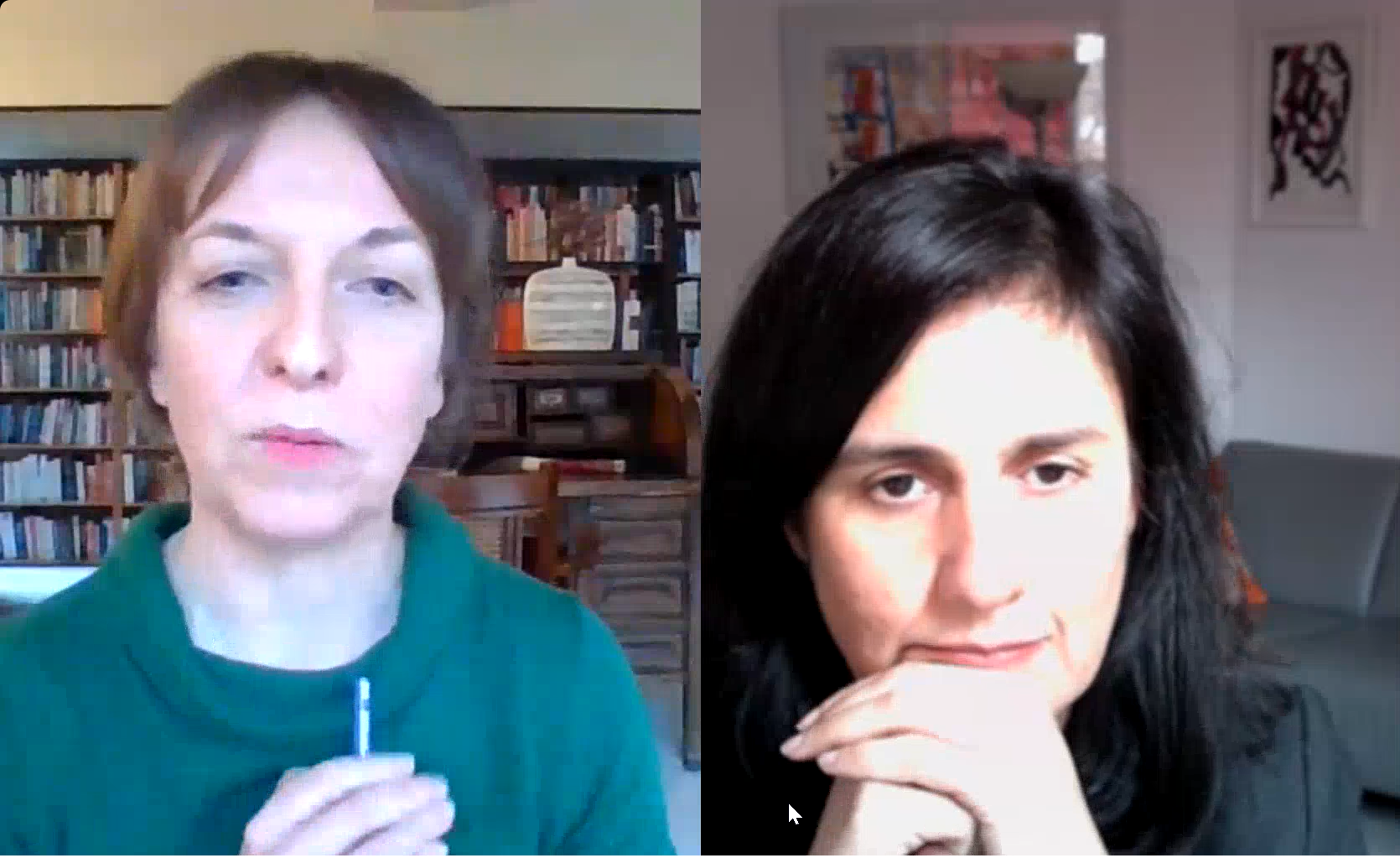
Kamila Shamsie (right) in conversation with Emma Claire Sweeney. Spot the deliberate mistake?…They are not similar distances from the screen!
Check your download speed to ensure your WiFi is working at sufficient speed, and switch off any alerts. Think about the aesthetics of the screen. Lighting should be in front of you, and the author’s book visible behind you. Log in with the author ahead of time to position yourselves a similar distance from the screen. Wear bold un-patterned clothing. Give yourself enough time right before the event to ensure everything is working. Mute and turn off audience cameras during the main discussion. If an event is hybrid, direct one of your first questions to the author dialling in to ensure their voice enters the room early on.
You will need to make extra effort to inject energy into an online conversation to keep it lively and engaging. It’s a good idea to pull questions out of the chat as you go along, rather than saving them all for the Q&A. Remember to nod and smile as the author is talking to show your engagement.
The Q&A: The question in that is…
Establish boundaries at the beginning of the session. Ask the audience, for the sake of time, to keep questions short and punchy. If the audience member gives a comment rather than a question, try to rephrase it as a question. If a question is particularly long, then announce your intention by saying ‘I’m just going to interrupt you there’. This takes the heat out of the interaction. Avoid saying that you have time for one more question in case that question is a dud! And have a supplementary question ready in case the discussion dries up.
Closing: End on a high
Keep to time. Audience members might have other places to be, and event organisers often have a swift turnaround between events. Put as much thought into your closing word as your opening ones. Thank the audience for coming. Give clear directions about where the book is on sale. Thank the author too, of course.
Afterwards: Be kind to yourself
There are almost always things you might have done differently in hindsight. But if you’ve kept your own ego in check, and helped the author take centre stage, then it will have been a job well done.
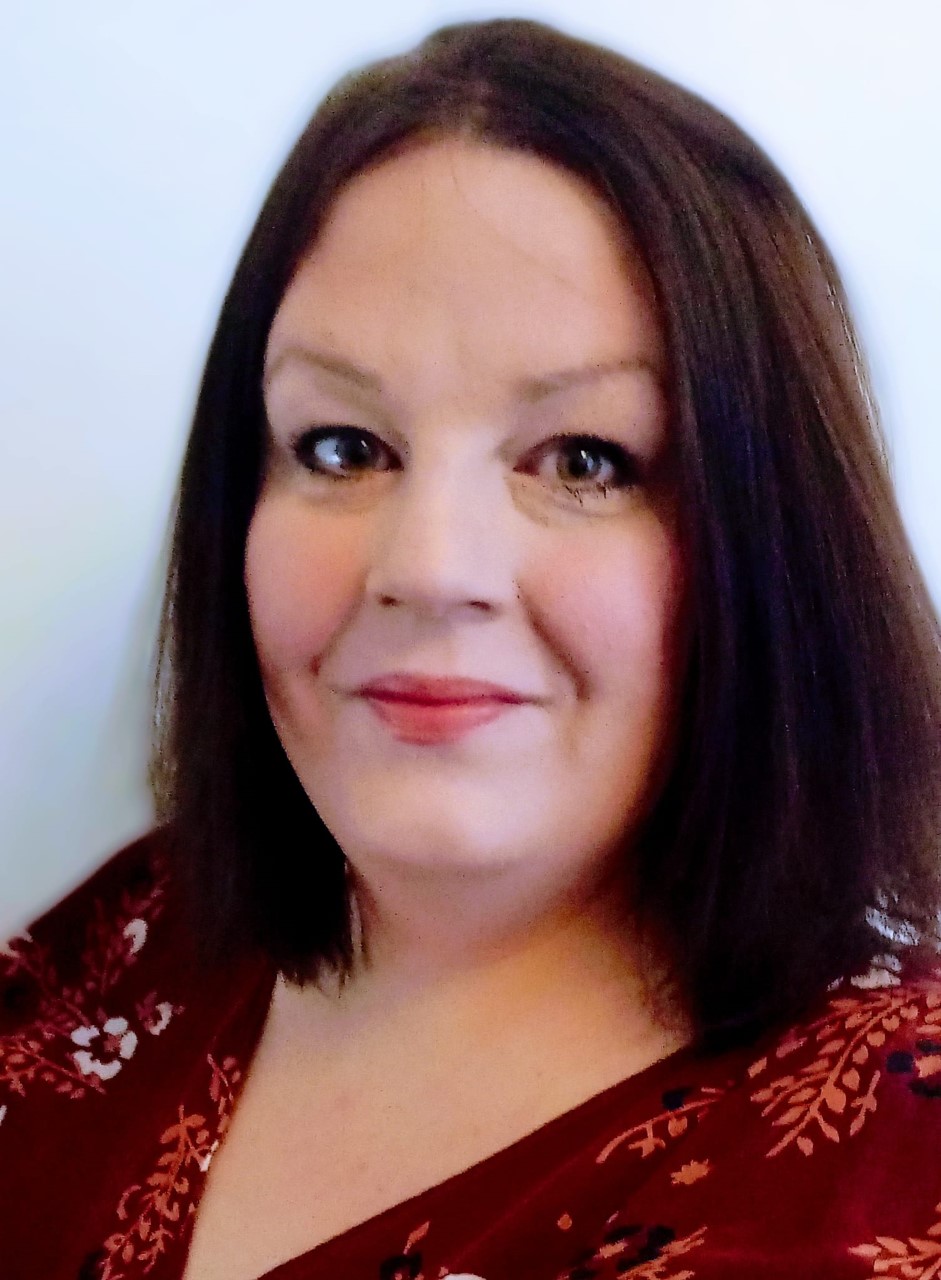
Antonia Saunders
Antonia Saunders studied for both her BA and MA at The Open University. Her part-time PhD looks at the construction of a Jewish Identity in histories and novels of the nineteenth century, and considers the literary and historiographical contexts of representations of Jewish people and Jewish Identity. She is co-convenor of the GOTH (Gender and Otherness in the Humanities) Postgraduate Forum, and she’s chaired discussions on the trope of the ‘Madwoman in the Attic’, gender fluidity in the arts and humanities, the non-human as other, and most recently, feminist readings of fairytales. Her supervisors are Prof. Delia Da Sousa Correa and Prof. Suman Gupta.
Part-time postgraduate researcher, Antonia Saunders, kicks off our series on the PhD journey and beyond with her reflections on a recent trip to Oxford’s Bodleian Libraries. As Antonia reveals, her visit not only furthered her research into how 19th-century historians and novelists constructed an idea of Jewishness, it also offered broader and more unexpected rewards.
As a part-time PhD student with a full-time job in corporate banking, I sometimes feel as if I am snatching snippets of time to follow my aspirations of becoming a full-time academic.
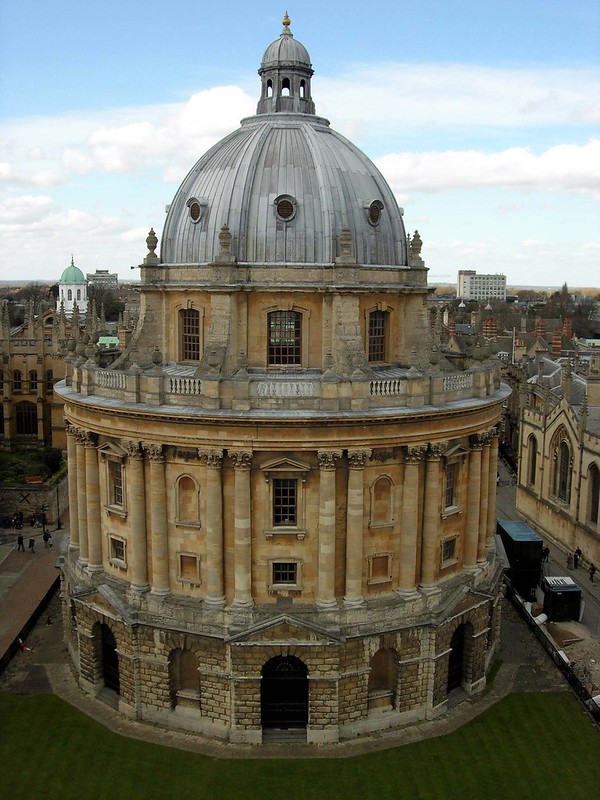
So, when my supervisors suggested that I use some of my Support Grant to facilitate a three-day research trip to the Bodleian Libraries, I got onto it straight away. The prospect was overwhelmingly appealing: access to materials relating to my research on Maria Edgeworth, Benjamin Disraeli, and George Eliot; accommodation in college rooms; an uninterrupted period to focus on my research.
I needed to apply for a Bodleian Reader card ahead of my visit, and my supervisor very kindly supplied me with a letter of introduction. I could order materials for my visit up to five days before. My list of archival materials has over forty items, and you can only order up to ten items at a time. So, I selected what I thought might be the most relevant ones to look at on my first visit.
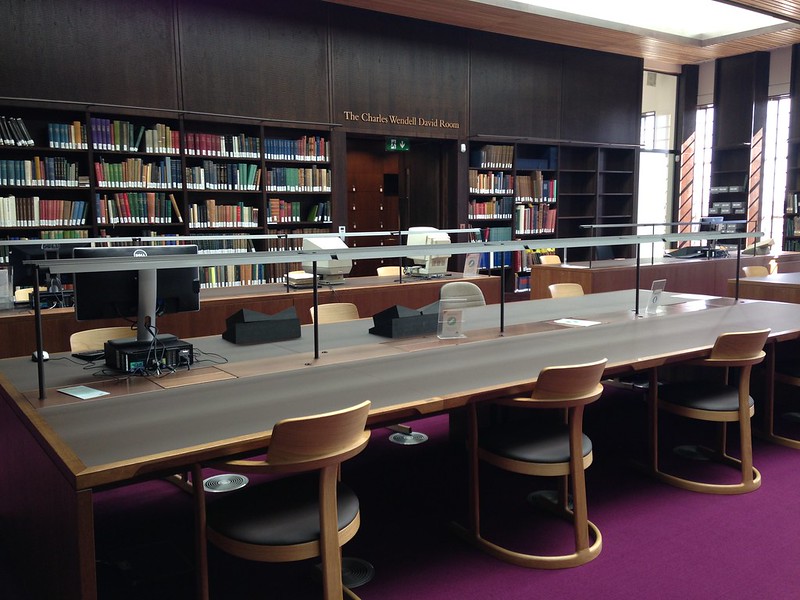
These included handwritten manuscripts and typed proofs of Disraeli’s novels, and one of George Eliot’s notebooks from 1861, and two for 1868 when she first conceived the idea of her long poem The Spanish Gypsy. I also wanted to consult Gordon S. Haight’s seven volumes of George Eliot’s letters in the Old Bodleian Library as these have not, as yet, been digitized.
I spent most of my visit in the Weston Library with the resources I had ordered. The ability to search through Disraeli’s papers and George Eliot’s notebook was thrilling. At first, I found Disraeli’s handwriting illegible – horizontal lines in brown ink with occasional bumps and tails. I had a sinking feeling that I wouldn’t be able to make out anything. But I tried comparing his handwriting to his novels on Project Gutenberg, and – slowly, very slowly – I began to be able to decipher his handwriting, and to note some changes between the manuscript and the finished novels.
George Eliot’s handwriting in her notebooks was meticulously neat, but she had written some pages in Latin, German, and Italian, so I copied down some passages with names and words I recognised to translate later on. I also spent some time in the Old Bodleian Library reading through Haight’s volumes of George Eliot’s letters.
I didn’t get through all of the material I ordered for my visit. Now that I know what is held there, I am planning my next trips with a more focused approach to specific materials – perhaps visiting for one day at a time,
I do, however, highly recommend staying overnight in college rooms. I booked into St. Stephen’s House, a theological college, about a twenty-minute walk from the centre of Oxford. The students were welcoming, and I had some very interesting conversations over breakfast. One of the students had a diamond pin on his lapel with the figures 1897. I asked him of the significance of the year, and he told me it was from the diamond jubilee of Queen Victoria and that he collects Victorian merchandise from the golden and diamond jubilees. I also spoke to a visitor who is an Egyptologist translating a ceremonial text held at the Ashmolean Museum.
I completed both my BA and my MA at the Open University, and I am passionate about the egalitarian principles the university is founded on, especially because of the opportunities it has afforded me. However, the chance to sit down and meet other students in a relaxed atmosphere, and to talk about interests beyond my own research, gave me a feel of what it might have been like had I attended university in my youth.
The benefits reaped during my visit went beyond the academic. I also experienced a boost to my mental health. I found it invaluable to clear space in my schedule to focus on my research, to be able to think a thought through without being interrupted by pressures of work or home life, and to be surrounded by such a wealth of learning and knowledge.
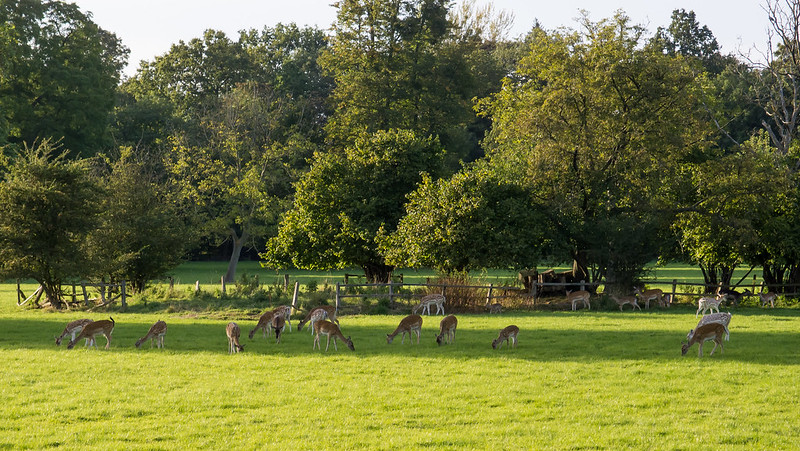
One of my supervisors, who lives in Oxford, met me for a walk on two of the days. She gave me a tour of Magdalen College, including a walk around the deer park and through a field of snake’s head fritillaries. She also took me to her own alma mater, New College, where we heard the choristers practising.
I started my research in 2020 during lockdown, and I think I have inadvertently adopted sedentary habits – always a potential risk for bibliophiles. But it felt so good to be out and about, walking in the fresh air. It made me reflect on my use of time and to commit to getting outside each day, rain or shine, to clear my mind.
Antonia Saunders
Antonia Saunders studied for both her BA and MA at The Open University. Her primary interest is in the novel in all its forms with a particular concentration on the nineteenth and early twentieth century. She began her part-time PhD at the OU in October 2020. Her thesis, The construction of a Jewish Identity in histories and novels of the nineteenth century, considers the literary and historiographical contexts of representations of Jewish people and Jewish Identity.