The Ins and Outs of Archival Research

Part-time postgraduate researcher, Antonia Saunders, kicks off our series on the PhD journey and beyond with her reflections on a recent trip to Oxford’s Bodleian Libraries. As Antonia reveals, her visit not only furthered her research into how 19th-century historians and novelists constructed an idea of Jewishness, it also offered broader and more unexpected rewards.

“The Bodleian Library” by malias is licensed under CC BY 2.0.

As a part-time PhD student with a full-time job in corporate banking, I sometimes feel as if I am snatching snippets of time to follow my aspirations of becoming a full-time academic.

So, when my supervisors suggested that I use some of my Support Grant to facilitate a three-day research trip to the Bodleian Libraries, I got onto it straight away. The prospect was overwhelmingly appealing: access to materials relating to my research on Maria Edgeworth, Benjamin Disraeli, and George Eliot; accommodation in college rooms; an uninterrupted period to focus on my research.

I needed to apply for a Bodleian Reader card ahead of my visit, and my supervisor very kindly supplied me with a letter of introduction. I could order materials for my visit up to five days before. My list of archival materials has over forty items, and you can only order up to ten items at a time. So, I selected what I thought might be the most relevant ones to look at on my first visit.

These included handwritten manuscripts and typed proofs of Disraeli’s novels, and one of George Eliot’s notebooks from 1861, and two for 1868 when she first conceived the idea of her long poem The Spanish Gypsy. I also wanted to consult Gordon S. Haight’s seven volumes of George Eliot’s letters in the Old Bodleian Library as these have not, as yet, been digitized.
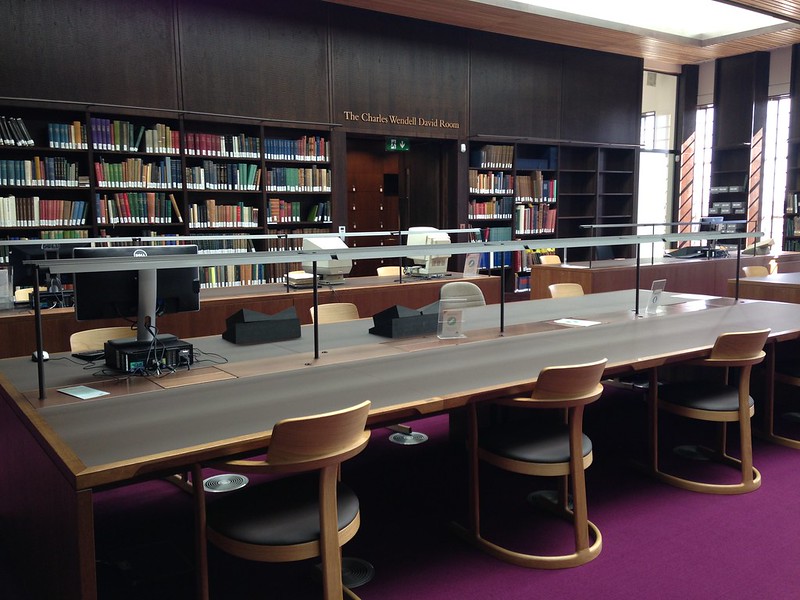
“The Weston Library, Oxford University. Opening Weekend tour (March, 2015)” by alisonjpope is licensed under CC BY 2.0.

I spent most of my visit in the Weston Library with the resources I had ordered. The ability to search through Disraeli’s papers and George Eliot’s notebook was thrilling. At first, I found Disraeli’s handwriting illegible – horizontal lines in brown ink with occasional bumps and tails. I had a sinking feeling that I wouldn’t be able to make out anything. But I tried comparing his handwriting to his novels on Project Gutenberg, and – slowly, very slowly – I began to be able to decipher his handwriting, and to note some changes between the manuscript and the finished novels.

George Eliot’s handwriting in her notebooks was meticulously neat, but she had written some pages in Latin, German, and Italian, so I copied down some passages with names and words I recognised to translate later on. I also spent some time in the Old Bodleian Library reading through Haight’s volumes of George Eliot’s letters.

I didn’t get through all of the material I ordered for my visit. Now that I know what is held there, I am planning my next trips with a more focused approach to specific materials – perhaps visiting for one day at a time,

I do, however, highly recommend staying overnight in college rooms. I booked into St. Stephen’s House, a theological college, about a twenty-minute walk from the centre of Oxford. The students were welcoming, and I had some very interesting conversations over breakfast. One of the students had a diamond pin on his lapel with the figures 1897. I asked him of the significance of the year, and he told me it was from the diamond jubilee of Queen Victoria and that he collects Victorian merchandise from the golden and diamond jubilees. I also spoke to a visitor who is an Egyptologist translating a ceremonial text held at the Ashmolean Museum.

I completed both my BA and my MA at the Open University, and I am passionate about the egalitarian principles the university is founded on, especially because of the opportunities it has afforded me. However, the chance to sit down and meet other students in a relaxed atmosphere, and to talk about interests beyond my own research, gave me a feel of what it might have been like had I attended university in my youth.

The benefits reaped during my visit went beyond the academic. I also experienced a boost to my mental health. I found it invaluable to clear space in my schedule to focus on my research, to be able to think a thought through without being interrupted by pressures of work or home life, and to be surrounded by such a wealth of learning and knowledge.

“Magdalen College, Oxford” by interbeat is licensed under CC BY 2.0.

One of my supervisors, who lives in Oxford, met me for a walk on two of the days. She gave me a tour of Magdalen College, including a walk around the deer park and through a field of snake’s head fritillaries. She also took me to her own alma mater, New College, where we heard the choristers practising.

I started my research in 2020 during lockdown, and I think I have inadvertently adopted sedentary habits – always a potential risk for bibliophiles. But it felt so good to be out and about, walking in the fresh air. It made me reflect on my use of time and to commit to getting outside each day, rain or shine, to clear my mind.

Antonia Saunders

Antonia Saunders studied for both her BA and MA at The Open University. Her primary interest is in the novel in all its forms with a particular concentration on the nineteenth and early twentieth century. She began her part-time PhD at the OU in October 2020. Her thesis, The construction of a Jewish Identity in histories and novels of the nineteenth century, considers the literary and historiographical contexts of representations of Jewish people and Jewish Identity.
George Eliot’s Piano

Dr Delia da Sousa Correa, Senior Lecturer in English

22nd November 2019 marks the 200th anniversary of the birth of novelist George Eliot, born Mary Ann Evans. Appropriately 22nd November is St Cecilia’s day, in honour of the patron saint of music. Music played a particularly vital role throughout Eliot’s life and this is reflected in the musical characters and pervasive references to music in her fiction. She was a keen piano pupil who continued to play in adulthood, and she loved attending concerts. Handel’s Oratorios featured large as they did for many of her contemporaries, and so did composers such as Beethoven, Schubert and Schumann, whose work she could also play at the piano. Eliot was one of the first champions of Wagner in Britain, although she was less enthused by his music than by his ideas on dramatic unity. The Romantic repertoire was where she was most at home. With her partner, the philosopher and scientist George Henry Lewes, Eliot enjoyed opportunities to hear music in London and abroad, meeting Liszt on their first visit to Weimar together in 1854. In London, they attended both public concerts, in fashionable venues such as St James’s Hall, and private concerts where leading musicians such as the violinist Joseph Joachim and singer (later conductor) George Henschel, performed for guests. Music making was also a significant part of their own social entertainments and domestic life.

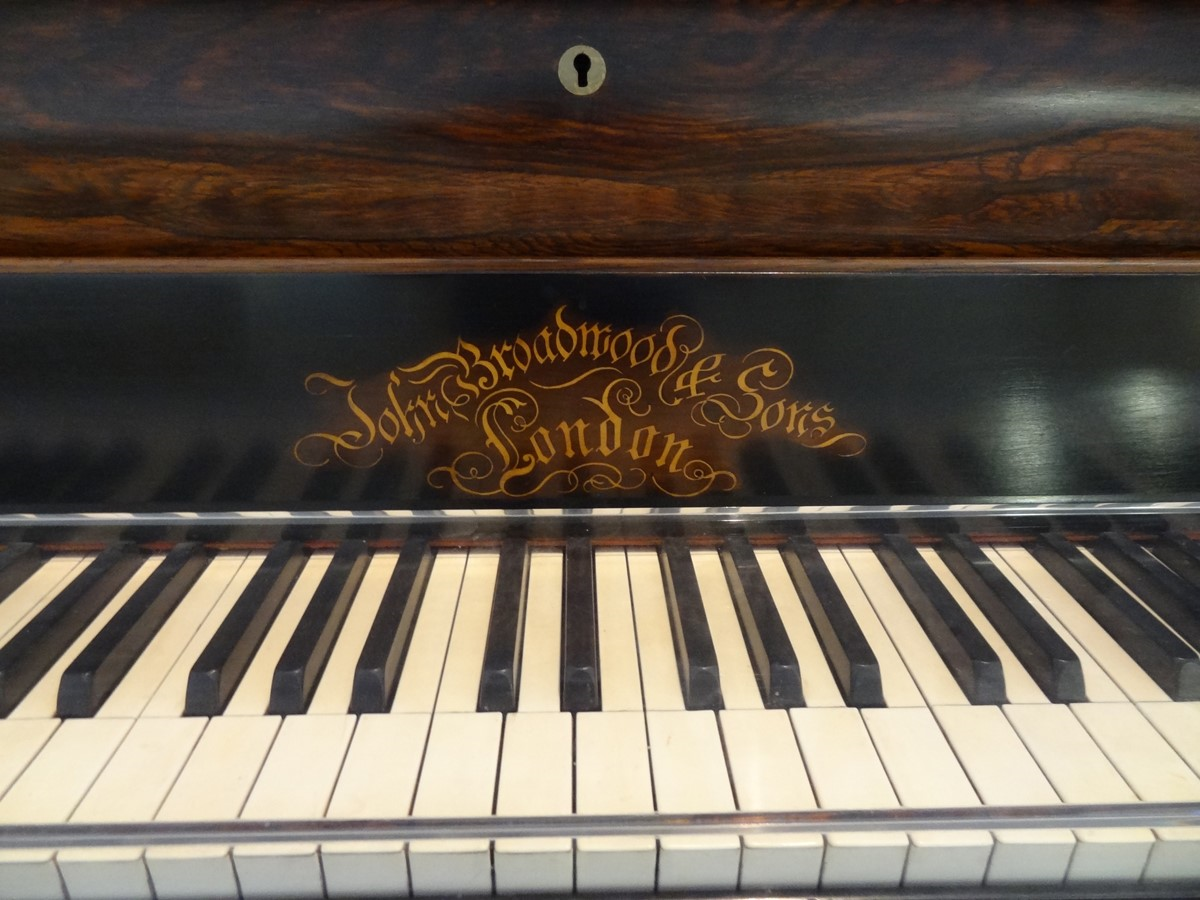
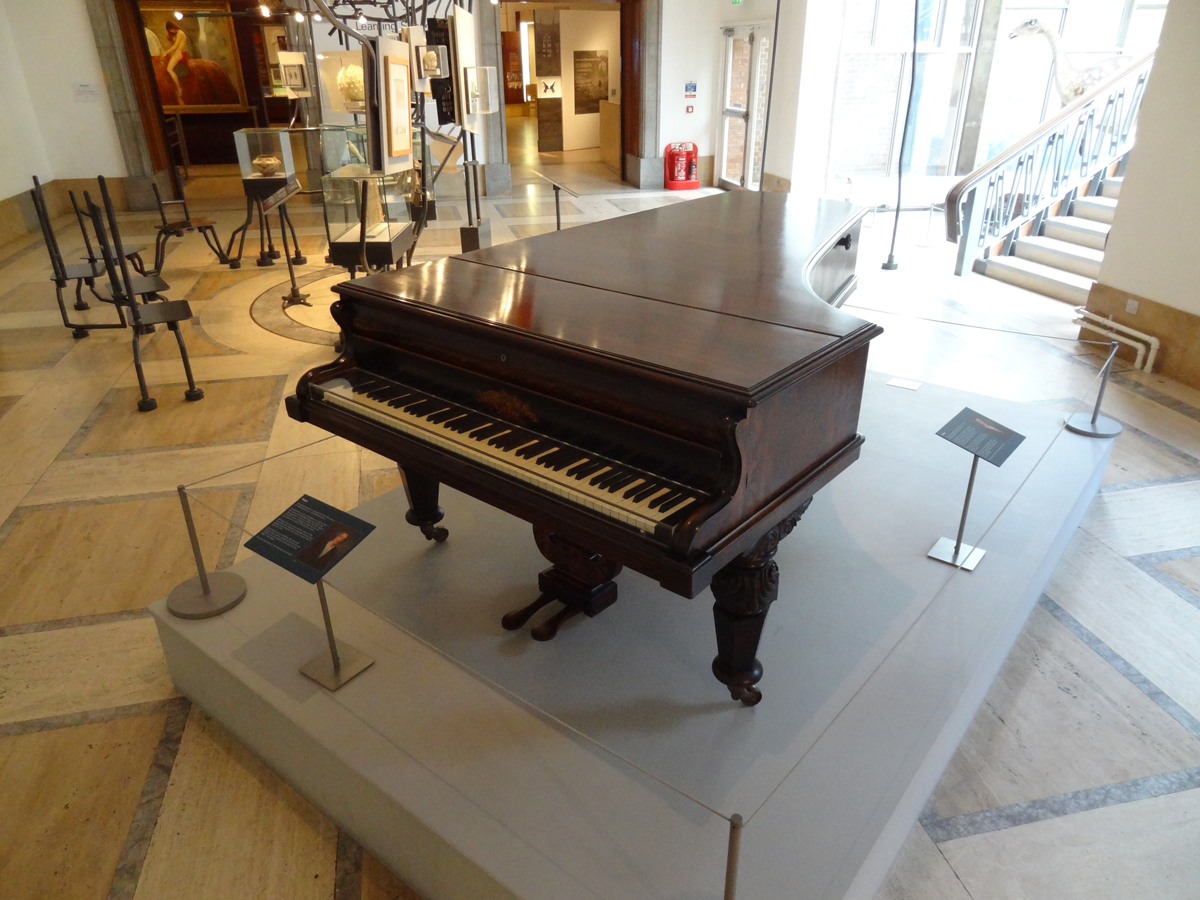
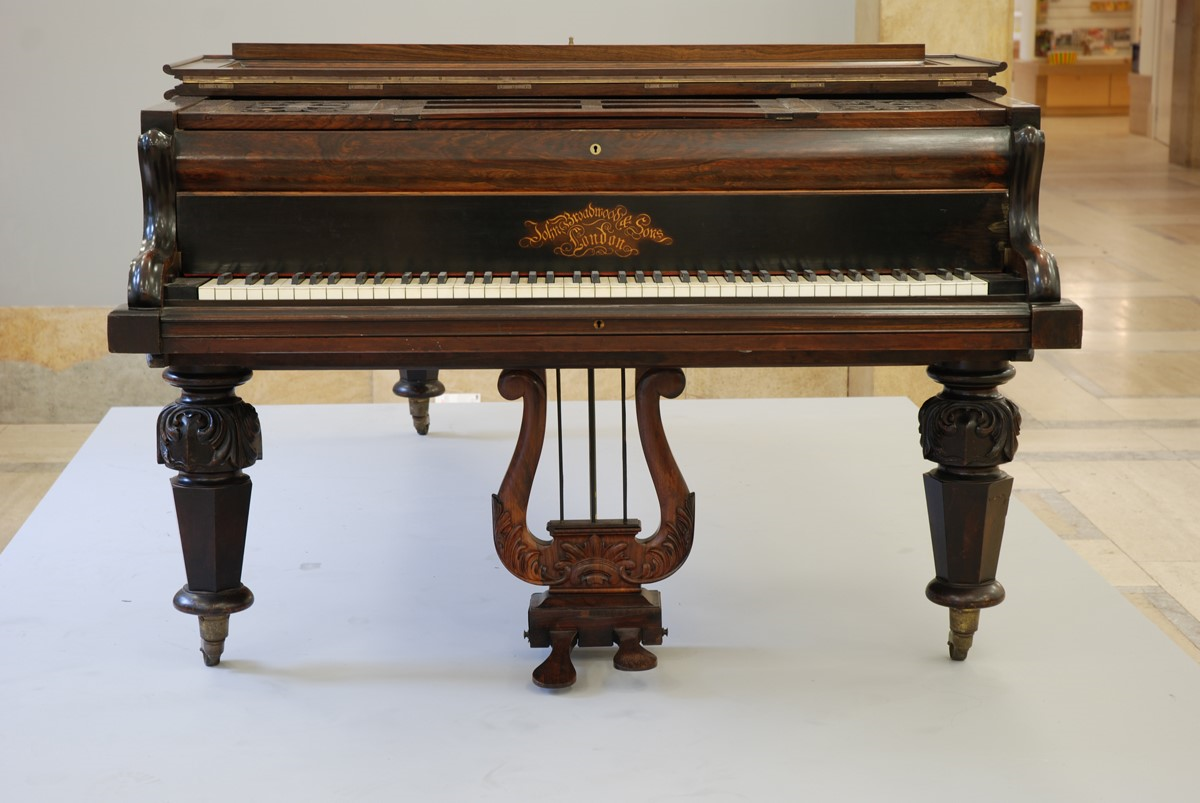
A material trace of Eliot’s passion for music remains in the form of a fine Broadwood piano, now housed at the Herbert Art Gallery & Museum, Coventry which was purchased by Lewes for Eliot’s 50th birthday. It thus became a presence in her life precisely 150 years ago on this 22nd November. Her anniversary provides a fitting opportunity for us to reflect on what this piano meant to her and what it adds to our understanding of her life and work. For us it’s also a question of what significance we invest in material relics of the past; what does Eliot’s piano, standing there in the museum, mean to us 150 years on?

On 22 November 1869, this piano was delivered to a grieving household. Lewes’s middle son, Thornfield, had returned from farming in Africa with a painful illness and had died, aged 25, just a month previously. Neither Eliot, who was writing Middlemarch, nor Lewes, were able to work. That the piano was purchased now, marks its significance. Not surprisingly, no flurry of references to the new piano fills Eliot’s correspondence at this date. Fittingly however, the piano is an implied source of solace a decade later when, on the first anniversary of Lewes’s own death, Eliot’s diary for 8 Sept 1879 reads simply: ‘Darwin. Schubert’ (Journals, 180). ‘Darwin’ may denote a visitor, or his books; Schubert she must have been playing at the piano. Eliot’s journal further records that she had ‘Touched the piano for the first time’ after Lewes’ death on 27th May (Journals, 175). However the piano, which survives in the Herbert Art Gallery and Museum, represents not just the personal importance of music for George Eliot but its significance for numerous areas of Victorian culture.

The purchase of this fine piano was possible because of Eliot’s success as a novelist, although the fact that it was acquired before the publication of Middlemarch, which made her wealthy, is a further indication of its priority. Nor was it the first Broadwood that Eliot had owned. The first, purchased in 1861, marked an early milestone in her successful career. The enthusiasm conveyed in Eliot’s letters communicates the central place a piano occupied in the Lewes’s domestic and social lives. ‘Today our new grand piano came – a great addition to our pleasures’ Eliot records in her journal for 1st October 1861 (Journals, 102). Later that month, she writes that a state of good health and spirits might be attributable to her ‘new grand piano, which tempts me to play more than I have done for years before’ (Letters, III:460). The next year she mentions being unhappy with the piano’s touch – no doubt among the reasons for subsequently replacing it (Letters, IV:30). Despite this reservation, Eliot makes repeated references over the following years to the benefits she derives from ardent and energetic practice (Letters, IV:120, 127). In 1862, the Lewes’s rearranged their entire drawing room to improve the piano’s position and sound (Letters IV:30). It became a centrepiece of social gatherings including the increasingly important Sunday salon held at The Priory, their house at 21 North Bank, Regents Park, purchased in 1863; from 1869 this will have been the place occupied by the new piano, when the Sunday salon resumed shortly after the death of Thornton Lewes for whom Eliot had frequently played during his illness. Their musical evenings were attended by an array of literary and scientific figures, including the poet Robert Browning and Herbert Spencer, founder of sociology, who would join in the singing.

The arrival of Eliot’s first Broadwood had been celebrated, on 5th October 1861, with a ‘Beethoven night’ the first of many musical evenings in which music of the Romantic period predominated (Letters, III:456). Eliot owned numerous Beethoven scores and when she acquired her first Broadwood, had been playing Beethoven duets ‘with increasing appetite every evening’ with her eldest step-son, Charles Lee Lewes (Letters, III:346). The liberal politician Frederick Lehmann (1826-1891), who visited The Priory to play Mozart and Beethoven sonatas for piano and violin with Eliot during 1866, described her as ‘a very fair pianist, not gifted, but enthusiastic, and extremely painstaking’; their audience was Lewes who would ‘groan with delight whenever we were rather successful in playing some beautiful passage’ (Letters, VIII: 385 n.7). In October 1868, Eliot wrote to Charles requesting him to buy ‘some music from your city man’; she asked Charles to choose ‘things by Schumann and Schubert, of the genre, for example, of Schumann’s Arabesque.’ (Letters, IV:478). Also I should like to have an arrangement of Verdi’s best operas for the Piano. Pater likes hearing those things’ (Letters, IV:478). Verdi was certainly not the only opera composer to be played, in piano reduction, on this new piano. In the late 1870s, when Lewes was already seriously ill, John Cross discovered him giving enthusiastic renderings of Rossini, singing ‘the great portion of the tenor part in the Barber of Seville – George Eliot playing his accompaniment, and both of them thoroughly enjoying the fun’ (Cross, III:334). The composers that Eliot played on this piano are frequently alluded to in her novels and Romantic composers in particular were a standard against which literary contemporaries were measured. In an 1856 review she wrote that ‘Turning from the ordinary literature of the day to such a writer as Browning, is like turning […] to the distinct individuality of Chopin’s Studies or Schubert’s Songs’ (Selected Essays, 350). While most details of their existence are lost to us, the wood and metal structures of this piano, that once sounded in response to Eliot’s touch, embody the meetings in music and conversation shared by the writer and her contemporaries.

Works Cited

George Eliot, The George Eliot Letters, ed. Gordon Haight, 9 vols., (Yale University Press, 1954-78). Cited as Letters.

The Journals of George Eliot., eds. Margaret Harris and Judith Johnston, (Cambridge University Press, 1998). Cited as Journals.

George Eliot’s Life: As Related in her Letters and Journals, ed. J.W. Cross, 3 vols., (Blackwood, 1885). Cited as Cross.

Selected Essays, Poems and Other Writings, ed. by A. S. Byatt and Nicholas Warren, (Penguin, 1990). Cited as Selected Essays.

Further Reading

Delia da Sousa Correa, George Eliot, Music and Victorian Culture, (Palgrave-Macmillan, 2003).

‘George Eliot, Schubert and the Cosmopolitan Music of Daniel Deronda’, The Edinburgh Companion to Literature and Music, ed. Delia da Sousa Correa, (Edinburgh University Press, 2020).

Photographs of George Eliot’s piano by kind permission of the Herbert Art Gallery & Museum, Coventry