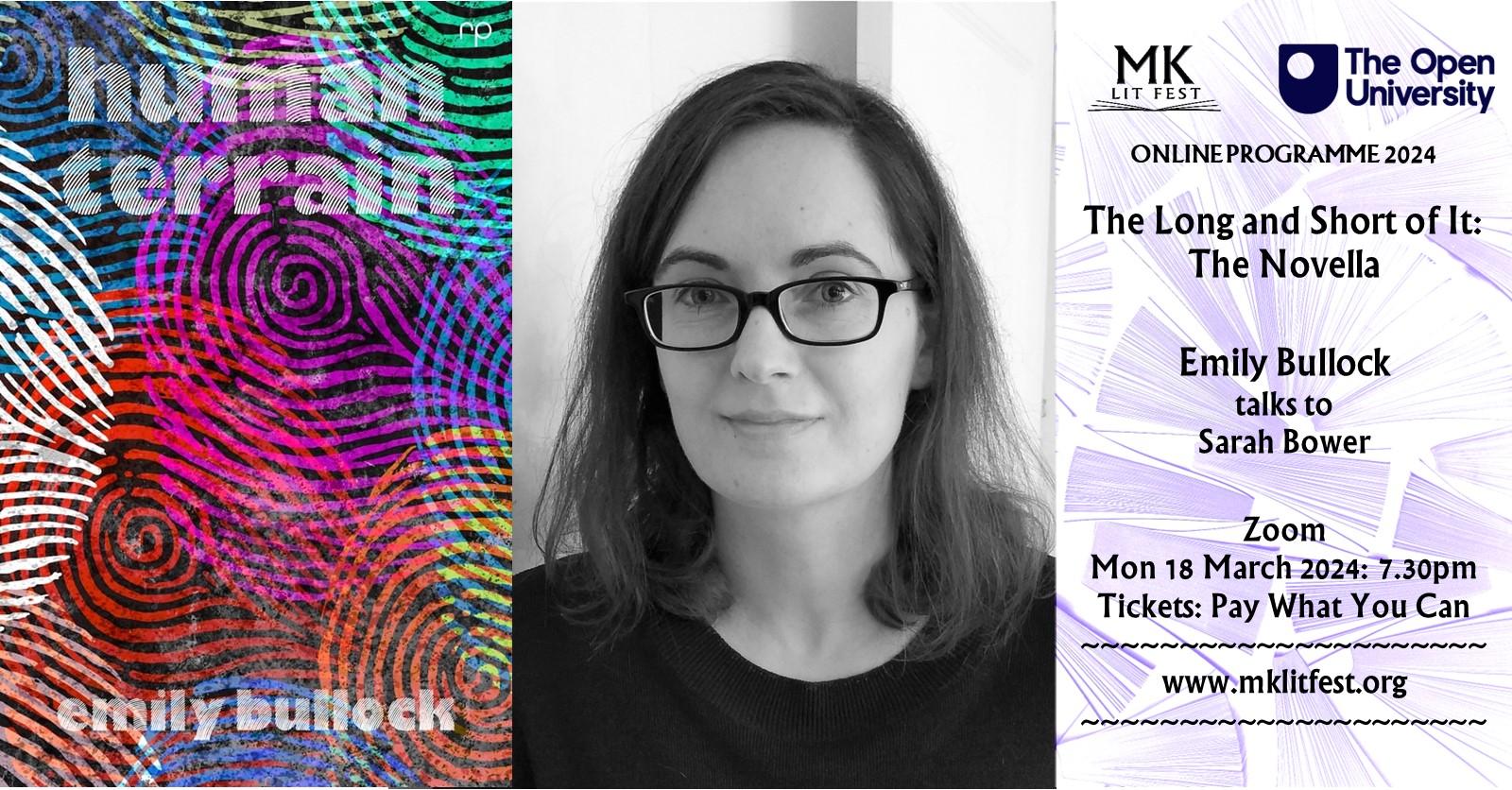
On Monday 18 March 2024, in the third instalment of the MK Lit Fest series The Long and Short of It, acclaimed writer Emily Bullock was in conversation with OU Associate Lecturer and PhD student Sarah Bower discussing the novella, sometimes dubbed literature’s ‘awkward middle child’.
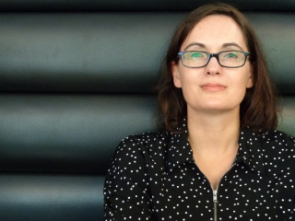
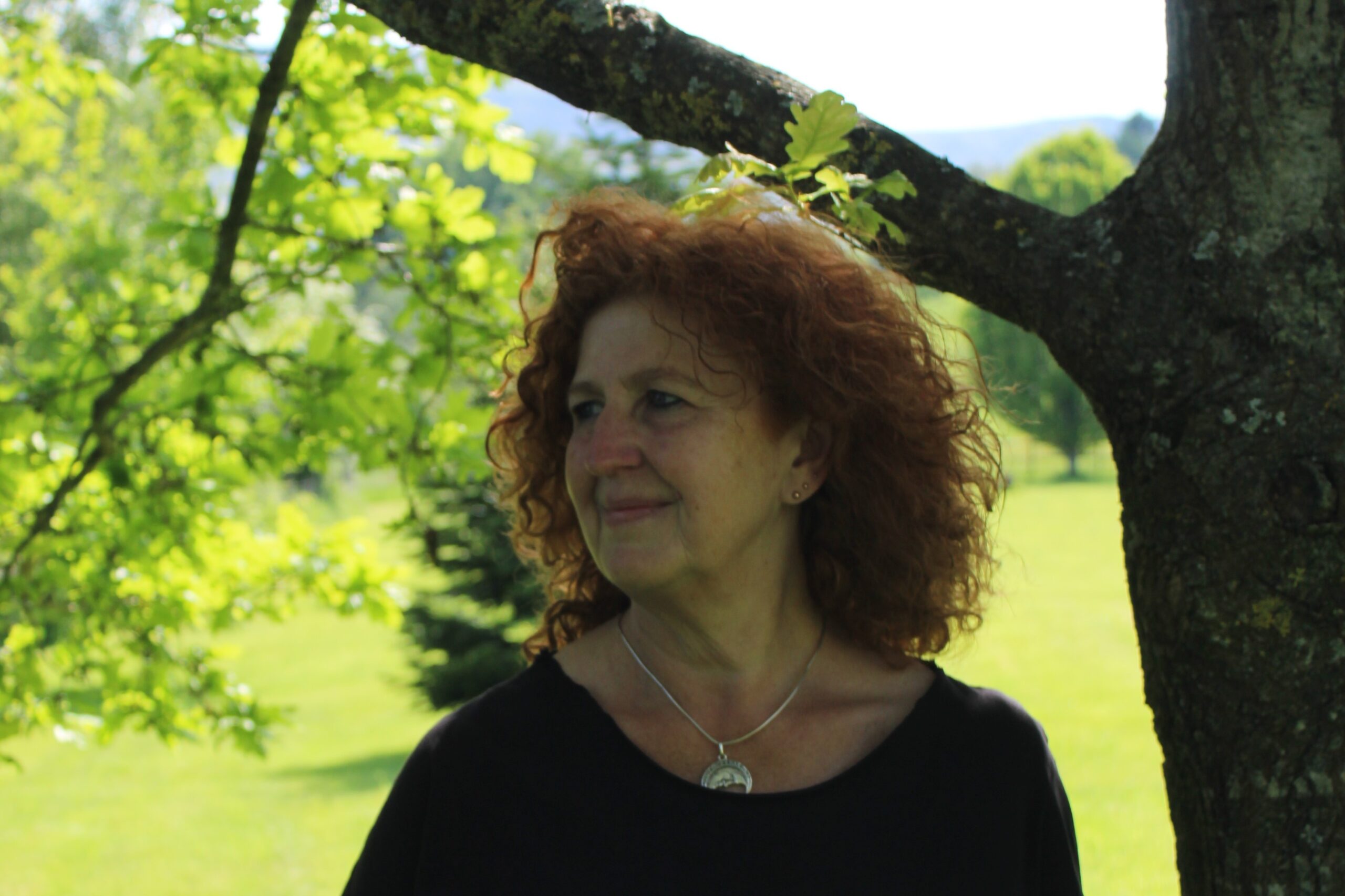
Emily BullockSarah Bower
The novella is for some a bit of a puzzle; too long to be a short story and too short to be a novel. For many mainstream publishers it is a headache to be avoided. For some readers the novella represents poor value for money, for others, it is the most perfect literary form. Although shorter than novel in terms of word count, a novella is not necessarily easier to write, and to write well requires the intense control and refinement perhaps more often associated with poetry.
Interviewing Emily Bullock about her forthcoming publication For Always Only and the form of the novella, Sarah Bower (herself the author of a novella) asked questions that got right to the heart of the matter.
For Always and Only is about the process of reading James Joyce’s Finnegan’s Wake, or at least it is partly about that because a novella is no one-trick pony and is never only about just one thing. There is a degree of irony, noted Bower, in using Joyce’s sprawling and notoriously difficult work as the organising principle for a short, tightly controlled novella. To explain how this works, Bullock gave an account of her own process of reading Joyce, not entirely for meaning, but as a kind of readerly ‘beach combing’, and how she makes Finnegan’s Wake her own by frequently interrupting Joyce with her own lines of thought. Roland Barthes also remarked on this aspect of reading in The Rustle of Language:
Has it never happened, as you were reading a book, that you kept stopping as you read, not because you weren’t interested, but because you were: because of a flow of ideas, stimuli, associations? In a word, haven’t you ever happened to read while looking up from your book? (1986, p29).
In the light of these descriptive accounts of reading and reading while looking up, the connection with Joyce begins to make perfect sense as the backbone of writing that is very much ‘about’ reading.
The process of writing this novella was notable for the amount of cutting Bullock found she was willing to do, such as cutting out her character’s backstory, cutting flashbacks, stripping back description, and ending chapters abruptly. All this cutting, she explained, leaves the remaining gaps to do more work and leaves space for the reader who must invest in the reading process. The reader needs to be particularly alert to what is not on the page. Writers often talk about the balance between showing and telling, but in the case of the novella, according to Bullock, what the writer is not showing and not telling become highly significant.
Bullock’s forthcoming novella is set in a claustrophobic bedsit in Bloomsbury, a location that gives a wry nod to Virginia Woolf’s ‘A Room of One’s Own’ and which is also perfectly sized to provide a counterpoint to Joyce’s Dublin. And yet, the setting offers a similar intensity to Dublin but, of course, achieved in far fewer words. In the reading Bullock gave, her use of lists of items economically created a whole world whilst leaving scope within the tight frame of narrative to express bigger ideas.
In answer to Bower’s question about how a writer might know that the novella is the literary form that would best serve the story they want to tell, Bullock explained that whilst a short story is very often the synthesis of two ideas, and a novel gives ample room for complexities of character chronology, and worldbuilding, stories that are of an experimental nature, stories with strong ideas and those requiring considerable reader engagement might find their ideal form in the pithy perfection of the novella.
In a lively Q&A session Bullock fielded questions on For Always Only (to be published later this year by Reflex Press) and on the form of novella more generally. Enthusiastic audience involvement would suggest that despite the lacklustre support from mainstream publishers, there is an enduring appetite for the intriguing form of novella, and many of the questions and comments raised could have kept us all talking long into the night.
The series will conclude with the novel form on Monday 25 March.
Gwyneth Jones
Gwyneth Jones is a writer of short and flash fictions under the pen name Jupiter Jones, and her work has been widely anthologised. She is currently a PhD candidate at the Open University researching (dis)connectivity in the literary hybrid form of the novella-in-flash. Her supervisors are Dr Jane Yeh and Dr Emma Claire Sweeney.
As creative writing academics, we constantly remind students about the importance of ‘reading as a writer’, and in my own reading I sometimes wonder to what extent this should be a conscious process, and to what extent something that I try to sublimate, reading as a reader, enjoying the book in a naïve way on first reading at least. In an ideal world, I would read everything twice, but as we know, this world is not ideal. Therefore, the way I consume books is a compromise, shifting between immersive engagement with the narrative and awareness of the techniques the author is using. As with the business of writing, novel reading is protracted, sometimes disrupted, sometimes seeming like a professional duty.
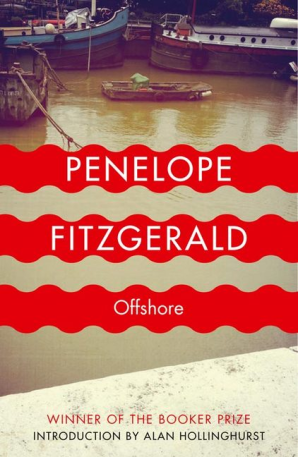
So looking back on my reading in 2018, what stands out? The novel which made the greatest impression on me was Penelope Fitzgerald’s Offshore, which won the Man Booker prize in 1979. The narrative focuses on a group of misfit Londoners, on the posh side of classless, who live in a row of semi-derelict boats on the Thames during the 1960s. None of them quite know what they are doing, or are entirely honest with themselves, and their compromises and misdemeanours drift with the ebb and flow of the river.
It’s hard to identify a protagonist, or a clear narrative through-line. But chaotic Nenna James comes closest to being its heroine, and her haphazard, wilfully disordered life presumably reflects that of Penelope Fitzgerald herself, who lived on a houseboat with her children after her first marriage collapsed. The point of view shifts among numerous characters including Maurice, a romantic and part-time rent boy, elderly marine painter Willis and Richard, an ex-naval man now working in insurance. All live half-way lives, at the edge of both land and water.
Nenna is incapable of doing anything practical, even a trip to Stoke Newington on public transport seems to faze her. Her visit ends in near disaster, shoeless in a rainstorm, pursued by a lecherous stranger. Yet at the same time, she is resilient and stoical, her expectations of life heroically low. In contrast, her young daughters Martha and Tilda are bizarrely precocious and competent, managing their bohemian lives with pragmatic ingenuity.
What I love about the book is its wry, strange humour, and Fitzgerald’s evocation of a lost London, not the place that we would associate with the Swinging Sixties, but more like the city that Dickens would have recognised. This metropolis is a post-war ruin not yet obliterated by developers, the river still a thoroughfare as it has been since Roman times. Fitzgerald evokes the inner lives of all these drifting, dreaming characters with intense precision as their stories unfold on the leaking vessels that the river will soon reclaim.
So what did I take from this book that will inform my writing? Initially, I was resistant to the way in which the point of view shifts are handled, with the narrative spinning around so much that I felt disorientated. But the effect builds over time, so that some scenes are focused intensely in the point of view of one character, and others achieve a choral effect. I also realised, by the time I finished the novel, that this kaleidoscopic perspective is consistent with the subject matter. The characters’ moods, desires and allegiances are in constant flux, just as the Thames is never still. Any piece of writing must similarly find its own shape, and the narrative mode should emerge organically from the material. And yet there is always the temptation to force a work of fiction into an already familiar format, to make it recognisable.
In addition, this book informs my knowledge of writing as an occupation, as this was a notoriously controversial Booker winner. The judges (Asa Briggs, Benny Green, Michael Ratcliffe, Hilary Spurling and Paul Theroux) failed to make a unanimous decision, unable to agree on whether William Golding should win with Darkness Visible or V.S Naipaul with A Bend in the River and so they gave the prize to Offshore which was ‘everyone’s second choice’, according to Spurling in a Guardian review of Fitzgerald’s collected letters. Spurling writes: ‘The presenter of the BBC’s book programme told her angrily that he’d been promised she would lose. Drunken reporters upbraided her for making them rewrite copy citing the favourite… according to her editor, the misery of this episode and its repercussions haunted her ever afterwards.’
What interests me here is the arbitrary nature of literary awards, and the way that they have increasingly become a measure of esteem and status. There is no reason to suppose that Offshore was inferior to the two books that caused the dispute between the judges, but Fitzgerald was made to feel that winning the Booker was a compromised achievement, that not being ‘the favourite’ meant that she was a writer of lesser quality.
Reading her novel today, it flashes with brilliance and strange insights. I’m inspired by her quiet eccentricity and her determination to pare her work down, creating something elliptical and magical in the midst of the chatter and turmoil of the book industry. The noise seems even louder now, so quiet eccentricity is even more important.
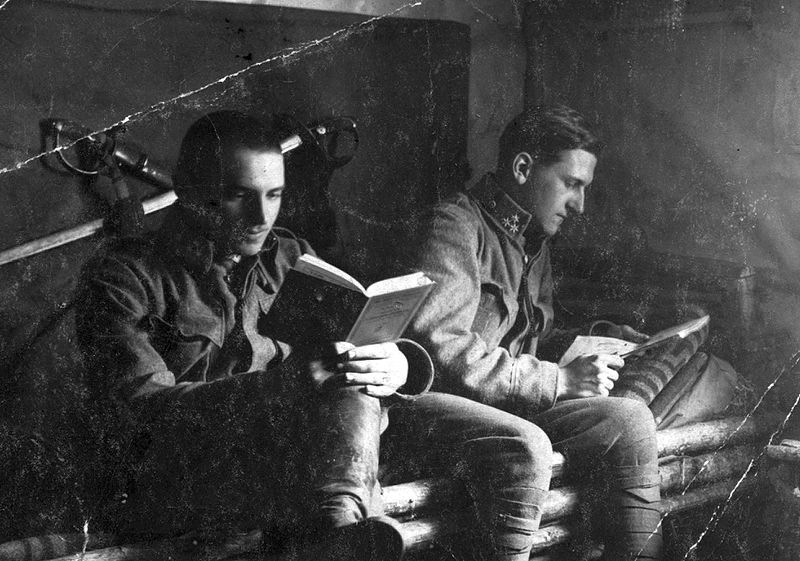
Soldiers reading during the First World War. Shared under the Creative Commons licence. Date:1917 Source http://www.fortepan.hu/_photo/download/fortepan_16325.jpg
We’ve been asking the first question in my title for this blog post for many years in our department. In modules such as A300 Twentieth-Century Literature: Texts and Debates our teaching materials have explored the relationships between art and politics, for example, and asked students to do the same. (My writing on Chekhov, the literary doctor, for A300 was perhaps an early sign of current interests.)
Recent research projects, though, have provided a new set of answers to both questions above, and reflecting on those answers for this post has proved a welcome activity.
Starting to read a thin and battered pamphlet in the spring of 2015 in Oxford’s Weston Library I had one of those ‘aha’ moments the researcher craves. I’d ordered it up because of a couple of key words in the title. Previous searches hadn’t unearthed it and I wasn’t sure until it was in front of me that it was going to be of much interest. But Helen Mary Gaskell’s account of the beginnings of her War Library in 1914 proved a wonderful find. Her epigraph, ‘Take choice of all my Library, and so beguile thy sorrow’ (from Titus Andronicus) had key words of its own, and what followed opened up the history, and challenged the scholarship, of reading during the First World War, particularly that of sick and wounded soldiers. It prompted me to find a name for one kind of organised charitable endeavour in war-time: ‘literary caregiving’ – a phrase I used in the key-note I was writing in 2015 and the article on Gaskell’s war library I’ve published since.
Gaskell’s idea for a library for sick and wounded soldiers, to be stocked in the main by donated books, was realised in the first weeks of the war. She had powerful and wealthy friends – one, Lady Battersea, had a mansion going spare in Marble Arch, which is where they stored the books. Aside from the speed with which the War Library was operational, the most striking aspect of the early weeks was the number of donations. One individual contributed a library of 35,000 books. Gaskell needed them all, and more too; supply rarely met demand. And yet records show that in the first half of 1917, for example, 1,125, 840 units were sent from the library’s London base to its depots around the world.
Gaskell also had a methodology – one related to her epigraph and to a democratised rather than hierarchical understanding of literature and its purpose. She prioritised what she called a ‘personal touch’, meaning that specific requests from wounded soldiers should be met if at all possible. Books, she felt, were a ‘flow of comfort’ that should not be interrupted by lack of effort. Over the course of the war, the War Library collected and distributed millions of books by writers such as O’Henry, Kipling, Marie Correlli, Dumas, Nat Gould – but if a soldier wanted a book on bee keeping, for example, every effort would be made to source that too.
This pamphlet was fascinating in its own terms. It also offered important answers to the question of what literature is for. And these answers, and the research directions they instigated have led to new networks and collaborations with colleagues departmentally, and externally too – a particularly positive outcome when we spend so much of our research time on solitary labours. Some of the results will be discussed in other posts here.
The tone and character of the book-related language used by soldiers and the volunteer librarians caring for them during the war will stay with me. Contemporary experience of a ‘book hunger’, of ‘the bitter cry for books’ led to the idea of books that might ‘heal’ – one that is explored in all kinds of ways in the papers those librarians left behind. The media, too, was fascinated by this work, which shifted the medical focus to include minds as well as bodies.
The Times, for example, told people ‘What to Read to the Wounded’ in 1915. It turns out, though, that both the wounded, and Gaskell and her colleagues, had other ideas. If one of the things that literature is for is healing, these caregivers noted, then feeling freely able to choose, and then being provided with, their own book was the best place for patients to start.