The new OU English and Creative Writing podcast is now live on Apple Podcasts, Spotify, Amazon, PocketCasts, and other major providers.
The podcast, called ‘re: reading – The OU Literature Podcast’ features OU English and Creative Writing academics discussing books, reading, and creative writing. It’s designed to be informative and accessible for the general listener, while retaining academic rigour and offering insights into some of the most exciting research coming out of the English and Creative Writing department.
Episode 1: Much ado about Wuthering Heights features Dr Jennifer Shepherd and Dr Anna Clarke discussing Emily Brontë’s Wuthering Heights, and Emerald Fennell’s recent adaptation, starring Margot Robbie and Jacob Elordi.
There are also several bonus episodes of the ‘5 Books’ series which ran successfully on OU News over the last couple of years. This series has suggestions from ECW academics of the best books to read on a whole range of topics, from bereavement to football. Available now on the podcast are episodes featuring
five classic novels about Italy
five books of apocalyptic fiction
five recommendations of Nordic noir fiction.
Listen for fascinating discussions about reading, creative writing, literary theory, book recommendations, and much more!
What initially motivated you to reconsider notions of realism, reality and the novel?
I was interested in exploring a number of potentially inter-related phenomena: the rise of auto/biography and memoir; the seeming rejection, on the part of some writers, of the novel – or at least current novelistic forms and expectations; and a sense on the part of some critics and writers that post-modernism had run its course, and that it was necessary to turn elsewhere for a literature fit for the 21st century.
I was also intrigued by comments made by Karl Ove Knausgaard and Rachel Cusk that seemed to echo a desire for an end to fakery and fabrication, which they associated, rightly or wrongly, with novelistic conventions (the need for plot, a narrative arc, a focus on ‘showing’ rather than ‘telling’). I wanted to investigate their desire to find forms of writing more attentive to the realities and complexities of experience. There did, in some senses, seem to be what writer David Shields terms a reality hunger (2010).
I have spent the best part of 30 years engaging with literature and particularly the novel. So Knausgaard’s dissatisfaction with invention and rejection of the kind of novel writing in which he had previously engaged, alongside Cusk’s experiments in a new kind of writing following the ‘creative death’ (The New Statesman, 2021) she felt she had undergone in the aftermath of her memoirs, prompted me to consider what was happening on the fiction/auto/biography/memoir front.
I wanted to understand the motivations of some successful writers who appeared to have turned their backs on fiction and were keen to stay closer to the outline, if not the substance, of their own lives. Rather than make things up, writers such as Knausgaard and Cusk felt the need to engage with the particulars of the world around them, seeing writing as a way of thinking through some of the big questions such as the impact of death and/or divorce on family life, what it means to be in love, the toll that having children can take on one’s ambitions to be a writer, and what it means to be a man or a woman at a particular life-stage in the 21st century.
Can you tell us a bit more about the terms ‘radical realism’ and ‘autofiction’?
The term ‘radical realism’ derives from prior usage in other disciplinary contexts (eg. politics, philosophy and art). I was particularly interested in its application by Caroline Levine (2000) to the work of John Ruskin; and to an article by Philip Tew (2001) on the work of B. S. Johnson. Bringing together ideas about predominantly literary realism/s with a focus on what might be seen as ‘radical’ in relation, for example, to Karl Ove Knausgaard’s My Struggle series was of course tricky, given the already wide-ranging literature on various realisms (eg. social realism, psychological realism, hyper-realism, to mention but a few). However, in helping to situate Knausgaard’s seemingly radical attention to detail and to the minutiae, some would say trivia, of everyday life alongside his concern to overthrow conventionalized ideas about the novel and its investment in storied fictions, the term helped make sense of what otherwise seems like a contradiction in terms: the notion of ‘a non-fictional novel’, Knausgaard’s own description of his work which he deploys to confront and interrogate fiction as the creation and maintenance of a sustained illusion, while seeking to get as close as possible to the realities of lived experience.
The term ‘autofictional narratives’ in the book title was a way of flagging up current interest in ‘autofiction’, another contentious and increasingly widely used term that goes beyond its initial application by Serge Doubrovsky, academic, literary theorist, critic and writer, to his self-designated autofictional novel, Fils. I begin by rehearsing the history of autofiction as a primarily French phenomenon before looking briefly at the way in which its usage as a neologism in English has increased exponentially in the last 5 years. So, for example, if you plug the term autofiction into the library search function, you’ll find 4,506 entries across the period 1976 to 2023, a 47-year span. Of these, 3,464 entries span the last 10 years, while 2,421 relate to the just last 5 years. These figures constitute evidence of a boom in (talk about) autofiction and the autofictional.
Your monograph engages in detail with the work of four writers – Rachel Cusk, Xiaolu Guo, Karl Ove Knausgaard, and Jeanette Winterson. What led you to focus on these particular writers?
My case studies centred on writers who have written both novels and works either classified as memoirs or autobiographies or works that appear to ‘document’, at some level, aspects of their own lives.
Knausgaard and Cusk provide an interesting pairing as they share a rejection of conventionalized novel forms, and have each set out to get closer to lived experience in their work. They also share an interest in contesting societal and culturally sanctioned views of ‘masculinity’ in Knausgaard’s case and ‘femininity’ in Cusk’s case. And they have both managed to antagonize members of their own families as well as many readers through their painfully honest accounts, as they would see it, of aspects of their lives.
In the case of Jeanette Winterson and Xiaolu Guo, I didn’t anticipate many parallels, given their very different cultural and linguistic backgrounds. However, insofar as they both hail originally from humble origins and have had to forge their own literary paths, sometimes in the face of fierce opposition, and have both been, from the off, unconventional novel writers who have produced, unsurprisingly perhaps, unconventional ‘memoirs’, they turned out to have quite a bit in common. Indeed, their work as a whole can be seen to reflect a number of self-projections or versions of self along a fact-fiction continuum and their so-called memoirs unsettle ideas of what a memoir might be.
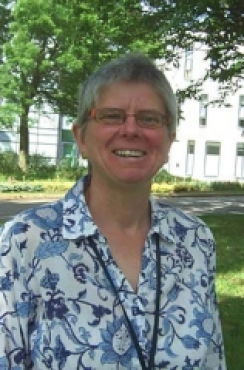
Fiona Doloughan
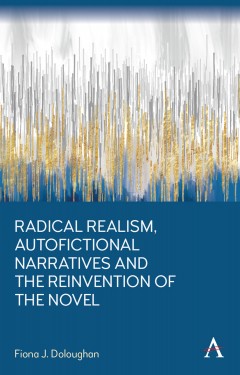
Fiona Doloughan’s research revolves around the development of the novel and on the forces (societal, cultural, technological, linguistic) shaping that development. She has published three monographs, the most recent of which is Radical Realism, Autofictional Narratives and the Reinvention of the Novel (Anthem Press, 2023).
On September 13, she’ll be delivering a lecture entitled Crisis? What crisis?: Rachel Cusk’s Reinvention of the Novel for the Twenty-first Century at Salve Regina University, Newport, Rhode Island.
On September 20, she’ll be at Agnes Scott College, Decatur, Georgia, giving a talk co-sponsored by the departments of English, French, and Spanish on what it means to be a female writer today.
In this bonus summer post, Jennifer Shepherd, Chair of the Faculty of Arts and Social Sciences team in Ireland, shares a behind-the-scenes glimpse into the Open University’s partnership with the John Hewitt Society’s annual Summer School.
What does summertime mean to you?
For me, it’s festival time.
Each summer, I find myself in the picturesque cathedral town of Armagh, Northern Ireland at the Marketplace Theatre, home to the annual John Hewitt International Summer School. Now in its 36th year, the festival is hosted by the John Hewitt Society, established to celebrate the legacy of local poet, art historian and social activist John Hewitt.
Hewitt’s legacy is everywhere in evidence here in Armagh in late July, as a diverse group of writers, visual artists, musicians, political commentators and social entrepreneurs gather to celebrate the power of story to explore some of the most pressing social issues we face today on the island of Ireland.
It’s warm and unpretentious and full of surprises.
One day the mainstage hosts eminent Irish playwright Frank McGuiness, sharing the wit and wisdom of a literary career spanning over 4 decades; another day finds bestselling crime writer Denise Mina discussing her take on hard-boiled crime fiction; still another, a round table of political commentators and journalists pitch ideas for engaging citizens meaningfully in the Northern Ireland political system.
Everywhere there’s story, whether it takes the form of images – such as Nigel Swann’s haunting photographs of the ‘Yellow Star’ houses of Budapest – or music, provided by award-winning folk artist Jack Warnock.
As an OU academic based in Northern Ireland, I have the pleasure of managing a partnership with the John Hewitt Society on the delivery of the Summer School. It’s a natural fit since the Open University has much to offer local conversations around politics, history, and creativity.
Collaborating with the John Hewitt Society for the last decade has allowed the Open University in Ireland to showcase the incredible quality of our teaching and research, particularly in the area of creative writing.
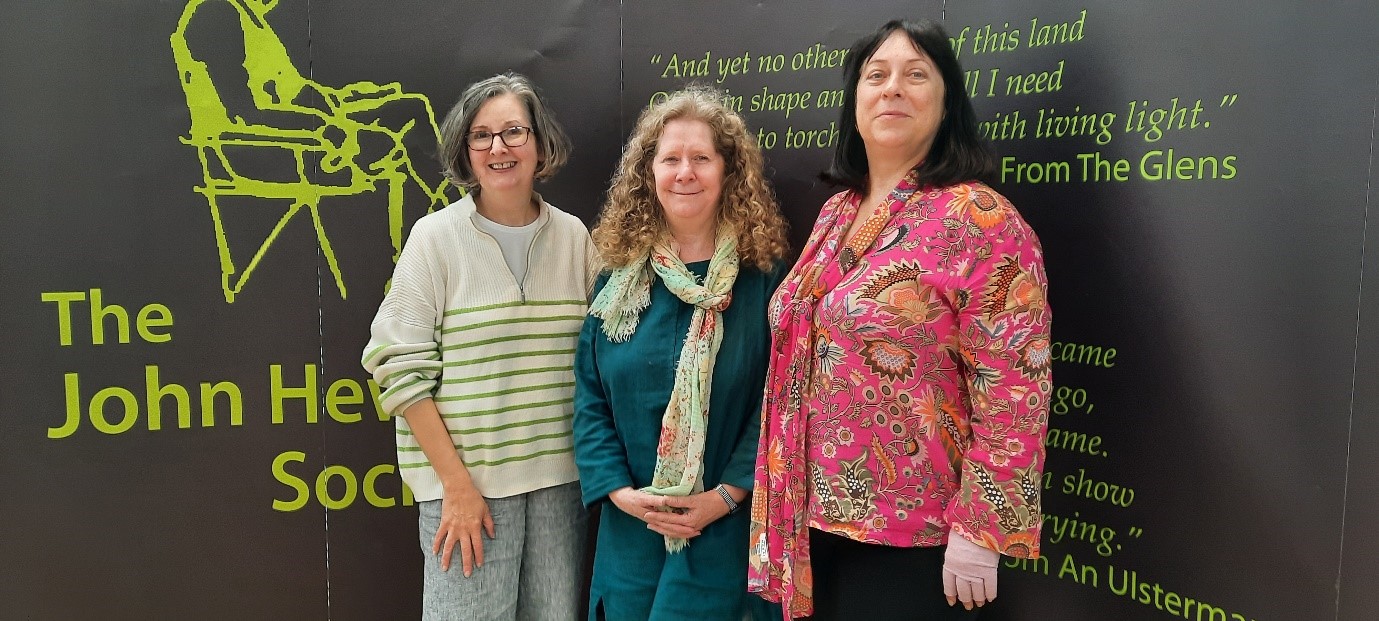
Heather Richardson, Nessa O’Mahony, and Siobhan Campbell
It’s a pleasure to meet festival-goers during the week who have signed up for workshops led by OU writers – this year, we were joined by novelist Heather Richardson, and poets Nessa O’Mahony and Siobhan Campbell. Festival-goers are full of praise for our teachers, noting that OU writers really ‘see’ each student and bring out the very best in them and their writing.
‘Oh, you’re with the OU,’ is how I’m often greeted when I introduce myself in the busy foyer between events—because if there’s a proverbial zero degrees of separation in Ireland, the same holds true here for the Open University.
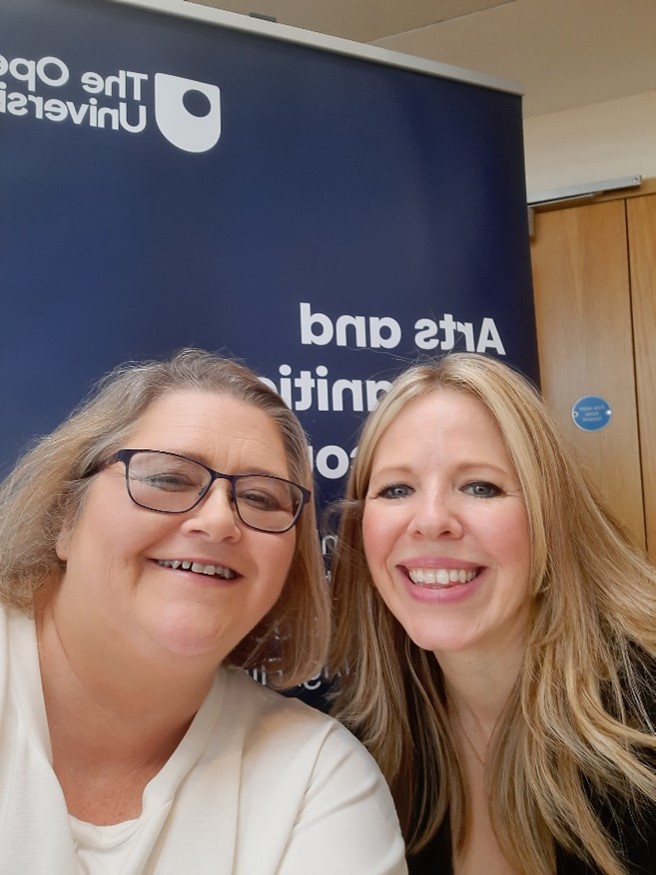
Jennifer Shepherd (right) with former OU student
At the local book vendor’s festival stall, a man tells me his friend is studying on the new English Lit MA and really enjoying it. I encounter a woman at the OU pop-up stand who confides that she’s already got a place reserved on an MA programme and wonders if she can get further details. Another man lingers over the OU leaflets on display and tells me a long story about a professional life that took many unplanned turns. He always wanted to study law but never got the chance – did I think it was too late for him? A former OU student of my own waves from across the crowded foyer and makes her way over for a catchup and selfie.
She reminisces fondly about her first OU module and grins at the memory of her debut at an Open University open mic night, the first of many engagements over the years as an accomplished poet and flash-fiction writer.
And maybe this is what I like most about my annual pilgrimage to Armagh each summer: to see the power of story at work in unexpected places. While speakers on the mainstage are inspiring us with tips for master storytelling or compelling new visions for a shared future in Ireland, I’m seeing something just as exciting at my Open University pop-up stand. People talk about their daily lives and, when they do, I get a glimpse of the way in which OU study allows people to write new futures for themselves and shape the story of their own lives in fresh and exciting ways.
Jennifer Shepherd
Originally from Canada, Jennifer Shepherd completed her PhD at the University of Alberta and post-doctoral fellowship at the University of Hull. She is a Senior Lecturer and Staff Tutor in the Department of English Literature and Creative Writing at the OU. As chair of the FASS team in Ireland, she is responsible for facilitating local knowledge exchange and engagement opportunities, as well as maintaining partnerships with Ireland-based organisations which include the John Hewitt Society, the Belfast Book Festival, and Dublin/Belfast Culture Nights.
We are proud to announce that this year’ s Peter Nicholls Prize has been awarded by the Science Fiction Foundation to Adam Baldwin. Adam is a fourth-year PhD student here with us at the Open University. He completed his BA and MA at the OU too, so has been with us now for almost 20 years – testament, he says, to the addictive nature of studying here.
Adam’s PhD focuses on the once popular but now little-known novelist George Griffith, and his role in the development of early science fiction. Adam’s prize-winning essay ‘Secularizing the Destruction of Gomorrah in George Griffith’s Hellville, USA’ will appear in the Science Fiction Foundation’s summer 2023 issue (no. 145).
Today, he shares with us how this fascination began, and where it has taken him.
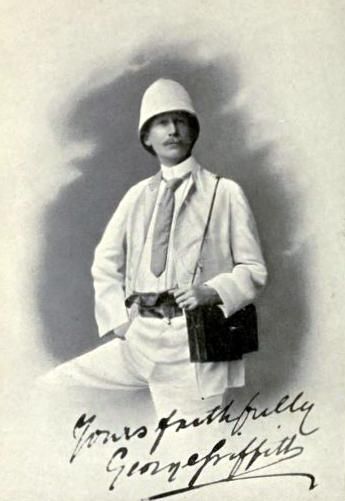
I have been working on a PhD thesis on George Griffith, a little-known science fiction and adventure writer, as well as journalist and globe-trotter, from the late-nineteenth century and into the first few years of the twentieth. Born the son of a country vicar in 1858, George Chetwynd Griffith-Jones (he changed his name by deed poll to George Chetwynd Griffith in 1894), was an immensely prolific author, writing around 44 novels across multiple genres between 1893 and his early death in 1906 at just 48, as well as a stream of innumerable short stories, poems and articles.
This image of George Griffith is in the public domain.
I came across his work around eight years ago when I picked up a modern reprint of his first novel The Angel of the Revolution (1893). I was fascinated by this story of an underground revolutionary group, led by the mysterious and mesmeric Natas, who, having exclusively obtained the knowledge of heavier-than-air flight (the novel is written some ten years before the Wright brothers finally succeeded at Kittyhawk), end a catastrophic world war and go on to impose a world-wide socialist utopia. The edition I read was edited by H. G. Wells specialist Steven McLean, and he ended his introduction with the words: ‘The Angel of the Revolution deserves to wing its way into modern critical consciousness’ (2012).
This comment was made only a couple of years before I read it, and I was interested enough in the novel to see if any work had been done on George Griffith’s work since then. The short answer appeared to be No. There is a handful of modern pieces on Griffith’s writing, but nothing substantial, and he certainly hadn’t winged his way into critical consciousness. I sought out reprints of his novels from small publishing houses and read what I could. McLean’s phrase stayed in my mind, and I decided I would take up his challenge. Luckily, the Open University agreed.
I have been drawn to Griffith’s work not because he is a great writer of extraordinary prose and delicately drawn characters, quite the opposite: Griffith writes thrilling novels, exciting page-turners, full of action, romances in the vein of H. Rider Haggard of King Solomon’s Mines (1885), She, (1886) and Allan Quatermain (1887) fame.
All this is set against a backdrop of what Sally Ledger and Roger Luckhurst called ‘an epoch of endings and beginnings…a time when British cultural politics were caught between two ages, the Victorian and the Modern; a time fraught with anxiety and with an exhilarating sense of possibility’ (2013).
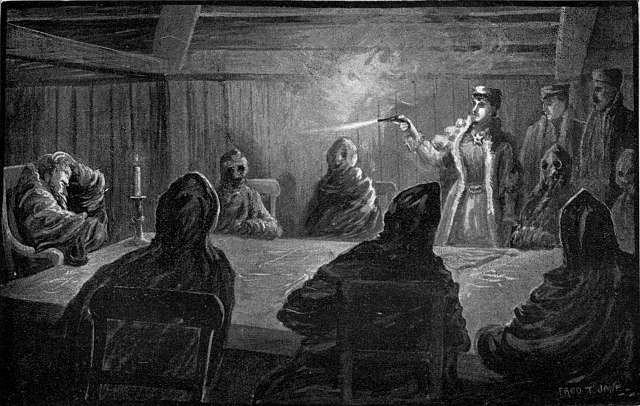
Within this new genre framework Griffith examines contemporary anxieties: the fear of invasion, the rise of socialism, the extension of suffrage, both male and female, evolution and degeneration, and the rise of the New Woman, a proto-feminist figure. Griffith’s portrayal of women is fascinating, if complex. Many of his women characters possess an unusual degree of personal agency over their lives and marriage choices for the time. In one extraordinary scene Natasha, the titular Angel of the Revolution, dispatches an unwanted suitor with a well-aimed gunshot to the head.
Natasha despatching her unwanted suitor, illustration by Fred T. Jane, 1893. (This image is in the public domain).
This is no spur of the moment action by a hysterical figure, but calm, controlled, if not quite cold-blooded. The remarkable part of this is that Natasha is permitted to do this, and she does not suffer punishment within the novel for her actions.
Reading further across Griffith’s novels, I frequently found similarly strong, independent female characters. An exploration of these, and how much freedom they actually have, is central to my thesis. Closer reading of the novels shows that women were still subject to patriarchal authority, they were just lucky enough to have father’s and/or erstwhile suitors who allowed these women unusual personal agency.
This may not seem like a great victory for women’s rights, but glance through the works of H. G. Wells, H. Rider Haggard, Arthur Conan Doyle or other adventure writers of the period, and you would be hard-pressed to find a female character who was not merely decorative, or a victim in need of rescuing – often both.
My mission is to rise to Steve McLean’s challenge, slightly modified, and help George Griffith wing his way into modern critical consciousness.
Adam Baldwin is a PhD Candidate at the Open University, studying the role of Victorian writer George Griffith in the development of science fiction. Adam has studied with the OU through his BA and MA since 2004. He is a recipient of the 2023 Peter Nicholls prize for early career researchers, awarded by the Science Fiction Foundation.