The new OU English and Creative Writing podcast is now live on Apple Podcasts, Spotify, Amazon, PocketCasts, and other major providers.
The podcast, called ‘re: reading – The OU Literature Podcast’ features OU English and Creative Writing academics discussing books, reading, and creative writing. It’s designed to be informative and accessible for the general listener, while retaining academic rigour and offering insights into some of the most exciting research coming out of the English and Creative Writing department.
Episode 1: Much ado about Wuthering Heights features Dr Jennifer Shepherd and Dr Anna Clarke discussing Emily Brontë’s Wuthering Heights, and Emerald Fennell’s recent adaptation, starring Margot Robbie and Jacob Elordi.
There are also several bonus episodes of the ‘5 Books’ series which ran successfully on OU News over the last couple of years. This series has suggestions from ECW academics of the best books to read on a whole range of topics, from bereavement to football. Available now on the podcast are episodes featuring
five classic novels about Italy
five books of apocalyptic fiction
five recommendations of Nordic noir fiction.
Listen for fascinating discussions about reading, creative writing, literary theory, book recommendations, and much more!
To whet your appetite, Gwyneth shares here why she likes to keep things small.
Flash fiction, which tells a complete story in just a few hundred words, takes brevity as its starting point and as permission to break rules. It holds in tension the practice of narration (the art of spinning out events in an engaging way) and techniques of concision (eliminating all but the most necessary) to imply much more than is actually on the page.
I began writing flash fiction about seven years ago, fascinated by the way it can use form as content and by the way the writer enfolds meaning for the reader to discover. Flash is neither easy nor quick to write, but it does offer great freedom to experiment.
Things that might be difficult to sustain or that would become exceedingly tedious in longer form fiction can be creatively explored within the sandbox of flash. Unusual points of view for instance, unusual tenses (future conditional, perhaps?), or alphabet games. Some inspiration for this comes from the Oulipo Group who impose strange external restrictions to gain writerly freedom – Oulipians are said to be ‘like rats building a labyrinth from which they plan to escape’. These are some of my labyrinths.
Unusual Point of View
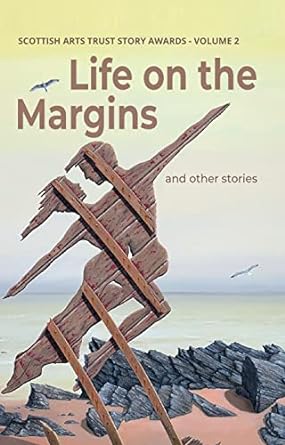
Life on the Margins: And other stories from the Scottish Arts Trust Story Awards (Volume 2)
Writing in second person can be slightly disconcerting for the reader who is asked to identify with the ‘you’ of the narrative. This is an excerpt from my flash fiction ‘Not Lost or Drowned’ published in Life on the Margins, about a woman escaping from a toxic relationship.
You’re staying alone in a caravan. You walk to pass the time. Sometimes you take the bus into town, cruising past trinket shops. You see missing posters, signs of desperation, fly-posted along the coast. She has, or had, the same name as you. Unsettling to see it there above a number to call, day or night. You memorise it, test yourself at the next poster, and the next, till you know it by heart.
Fibonacci Sequences
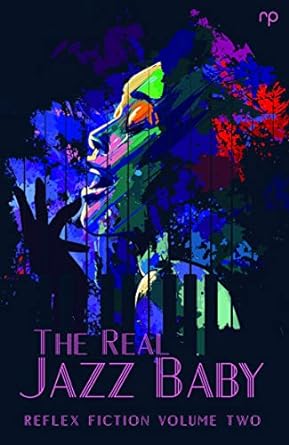
Book Cover: The Real Jazz Baby – Reflex Fiction Volume Two
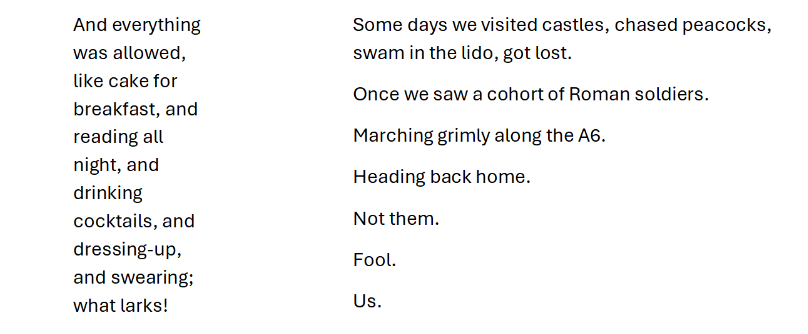
That is, writing in sentence lengths that correspond to the Fibonacci sequence where the last two numbers are added together to make the next (e.g. 1,1,2,3,5,8,13,21, etc). The rigidity of form compels the writer to add and/or subtract words with potentially unexpected results. I wrote ‘Aint no Cure for my Fibonacci Blues’ (published in The Real Jazz Baby) inspired by summer holidays with my slightly batty aunt. It opens with two one-word sentences and builds up to a fifty-five-word sentence and then back down. This is the ending:
Lipograms
The Oulipo group often devised lipograms – omitting one or more letters of the alphabet. The letter e, of course, is the hardest. I tried this in ‘No e in Pornography’ about a man whose ‘browsing history rats him out’ which was published online by Reflex Flash. I think the lack of e gives the writing a spikey brittle quality.
Not so sorry, thinks Nina, for abnormal cravings. Not sorry to bring havoc to Nina’s world. In outwardly lax administrations, such things flourish with abandon. Sonny looks long at icons of dissipation; nothing is off limits to a thin bald man with roving digits.
Breathless Paragraph
A form quite common in flash fiction is ‘the breathless paragraph’, that is, maybe three or four hundred words, written as one continuous sentence. This can result in a soaring arc of narrative or a relentless sense of inevitability. ‘Exegesis’ was published in the anthology In Defence of Pseudoscience
They’ll say she was asking for it, look at her, in her cheap skirt, scuffed heels, bitten nails and it’s obvious how she started out, a skinny, snot-nosed kid off the estate, no pony rides or chocolate eclairs for her, no, it was all ‘never mind your homework, mind your brothers,’ coz her mother was on tablets for her nerves, and what can you expect, absent father, feckless mother, things like that make a girl grow up fast, start using what she’s got to get where she wants, but as the saying goes, fruit doesn’t fall far …
Some other examples of experimental flash fiction from some brilliant writers:
Hermit Crab, taking a ‘readymade’ form such as a recipe, or lonely-hearts ad and telling the story within that form. Tim Craig’s ‘That’s All There Is, There Ain’t No More’ uses cribbage instructions.
Conceit or extended metaphor such as ‘Unbinding’ by Kathryn Aldridge-Morris which begins ‘My mother was a First Edition Pelican original’.
The experimentation and playfulness of flash fiction is a big part of its appeal for me. Sometimes the constraint of the experiment – ‘the labyrinth’ – will be evident in the finished work. At other times, it is nothing more than an escape hatch or a catalyst to spur creativity.
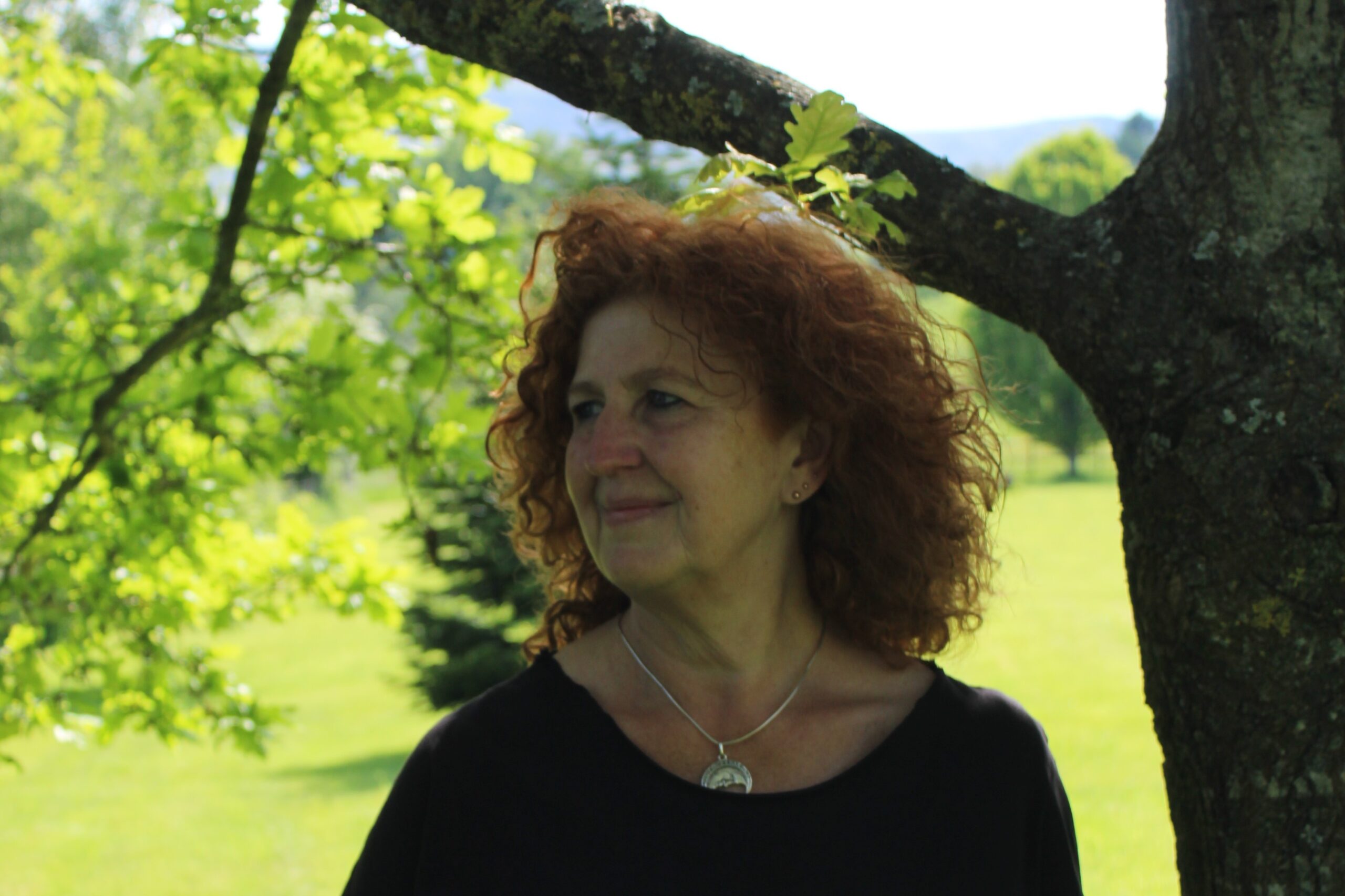
Gwyneth Jones, a writer of short stories and flash fictions
Gwyneth Jones is a writer of short and flash fictions under the pen name Jupiter Jones, and her work has been widely anthologised. She is also the author of three novellas-in-flash, the most recent, Gull Shit Alley and Other Roads to Hell was shortlisted for the Saboteur Award. She is currently a PhD candidate at the Open University researching (dis)connectivity in the novella-in-flash. Her supervisors are Dr Emma Claire Sweeney and Dr Jane Yeh.
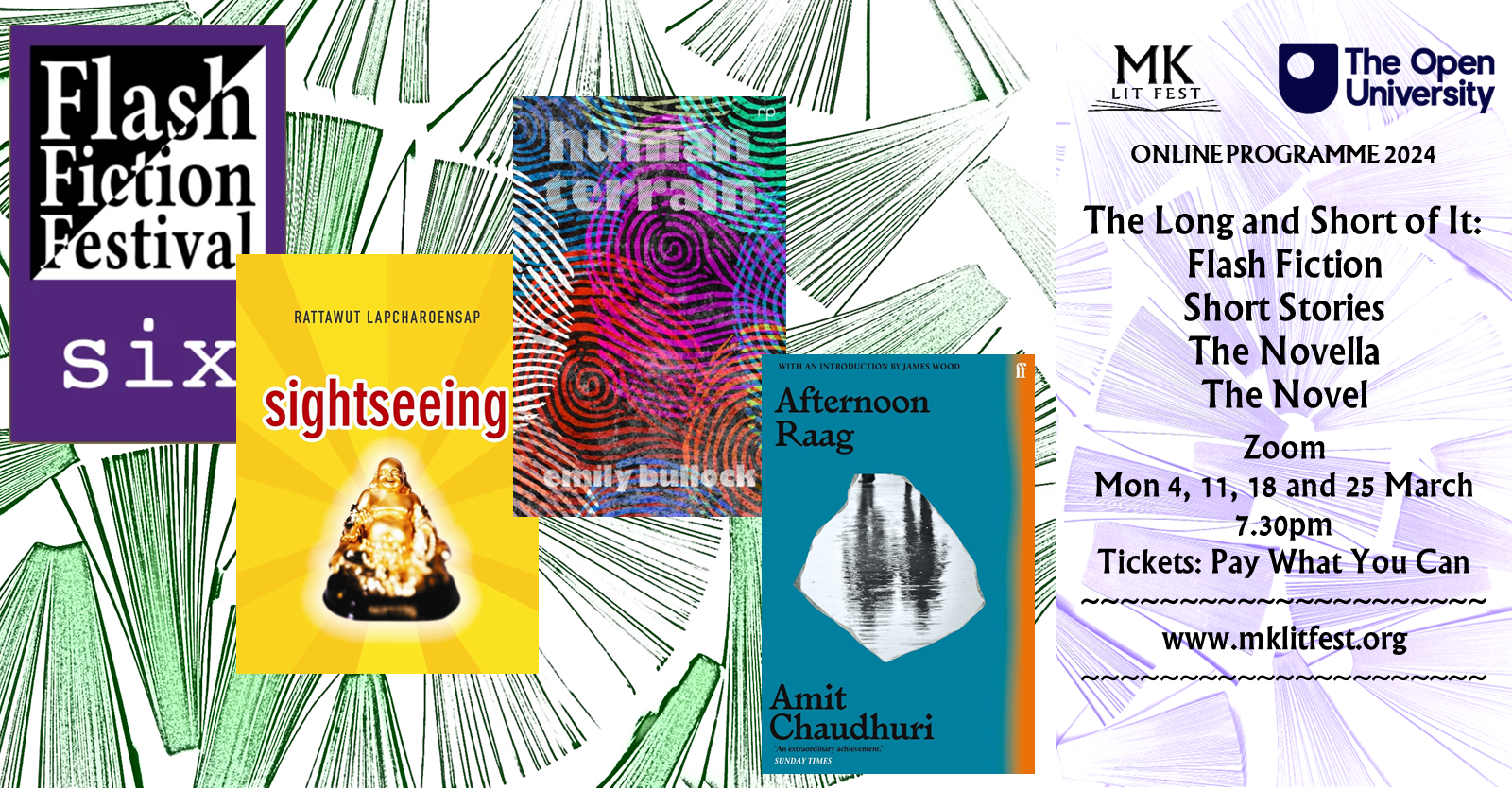
List of The Weekly Online Zoom Series from Monday 4th March – Monday 25th March at 7:30pm
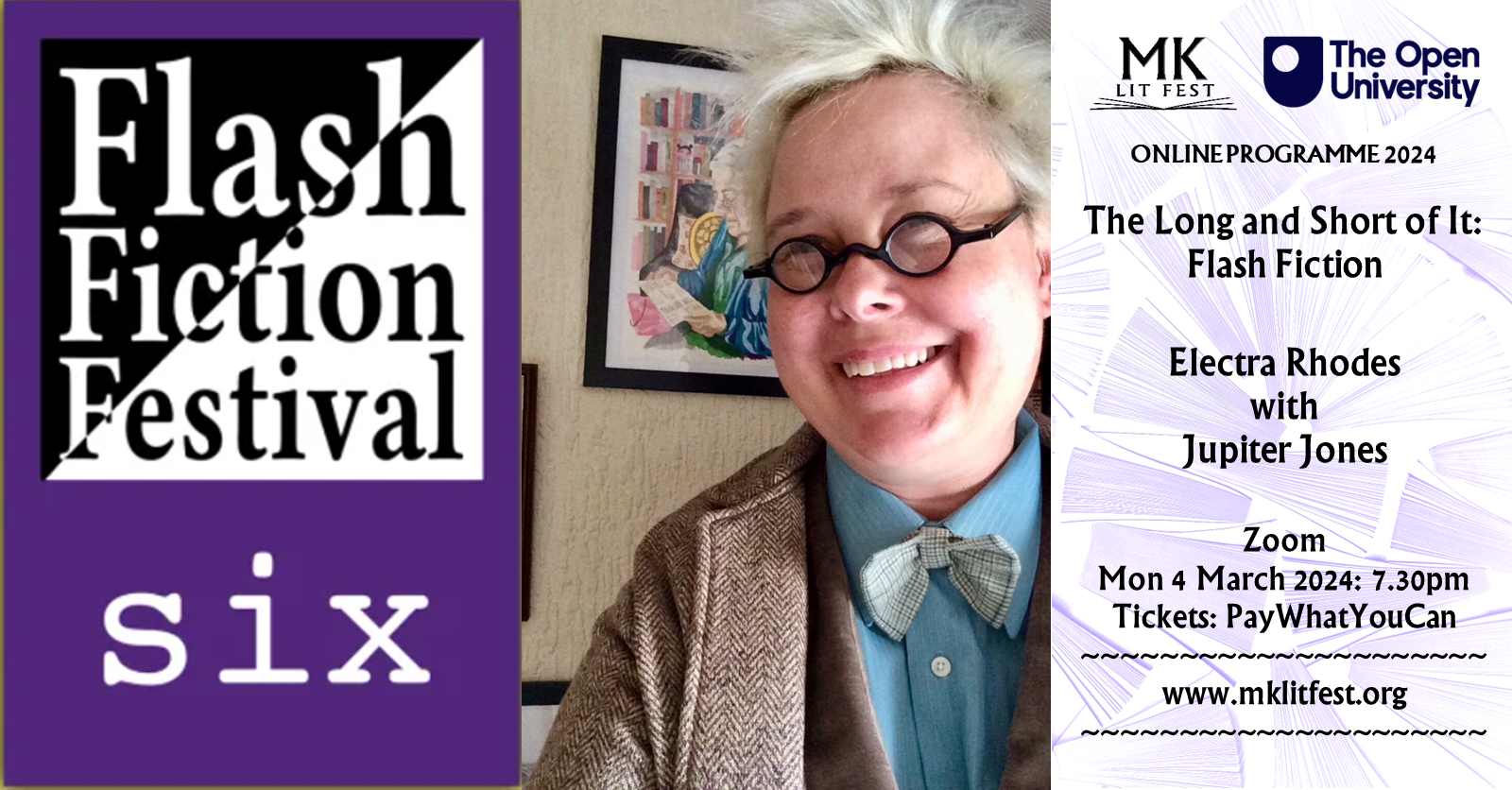
Go to MK Lit Fest’s website to book your free ticket for Gwyneth Jones’ online event with acclaimed flash fiction writer Electra Rhodes
The Open University’s Art’s Research Centre collaborated with Milton Keynes Literary Festival to train OU staff and MK Lit Fest volunteers to chair conversations with authors ahead of our joint events series, The Long and Short of It: From flash fiction to the doorstop novel.
Here, part-time PhD student, Antonia Saunders, who attended the training on campus, shares with us what she learnt.
The training was led by Julia Wheeler, a writer, journalist and interviewer who worked for the BBC for more than fifteen years. Julia chairs discussions at festivals across the UK as well as in the Middle East and North America. She has moderated events at The British Library, The Royal Geographical Society and onboard Cunard’s Queen Mary 2.
What’s the role of a moderator?
A great moderator is hardly noticed. You are offering a space for the author to shine. This includes asking relevant, interesting and concise questions. It’s your job to judge and manage the energy of both the audience and the author. A good sense of timing is crucial. Give the author the chance to respond engagingly to your conversation-starters, and leave time for questions from the floor. When an event is going well, you hardly notice the moderator.
How should a moderator prepare?
The weeks before: be the class swot. Become acquainted with the author’s latest work or the book they are promoting. A close reading will help you to form relevant questions related to central themes. It’s also beneficial to have some knowledge of the author’s backlist. Reading reviews can help to open up ideas from another perspective, and previous interviews can help you to avoid well-trodden ground and come up with some fresh and insightful questions. Follow the author on social media. Have they posted something recently that you can ask them about? Tailor your questions to the audience and event. Keep your questions focused on the guest as a writer. Remember, you aren’t revising for an exam, you are preparing for a fascinating conversation. What do you hope to discover about the author and their work?
One week before:be a safe pair of hands.
Contact the author to remind them of the event blurb, time and place. Include your own short bio so that they have a sense of who you are. Tell them how much you are enjoying the book and pull out something specific to praise.
Confirm whether the author is planning to read from their work, making clear that a reading should not last for more than two minutes. With a poet, you might weave a few short readings throughout the conversation, and you might end with a reading too. With prose, one short reading is sufficient.
Be upfront about certain themes you’ll need to cover to be true to the event description. Ask if there is anything the author would especially like you to ask – that dream question, perhaps, that no one has asked about before. Don’t close the conversation down by asking if there’s anything they do not want to cover. If the author happens to raise any no-go areas, though, be sure to respect them.
The hour before: You’re in charge!
Arrange the chairs so that you are angled towards one another while facing the audience. Bring a cookbook stand to position the book the author is promoting. Engage technical staff to check the audio equipment is working. Ensure the stage is clear of any trip hazards. Pour out the water before. Brief any volunteers who might be holding the roving mics. Ask them to keep hold of the mics where possible to prevent an audience member from hogging it, and to allow the volunteer to move quickly to the next question to avoid delays. Show the space to the author and advise them that you will enter the stage first and motion them to their place. Be confident and politely assertive.
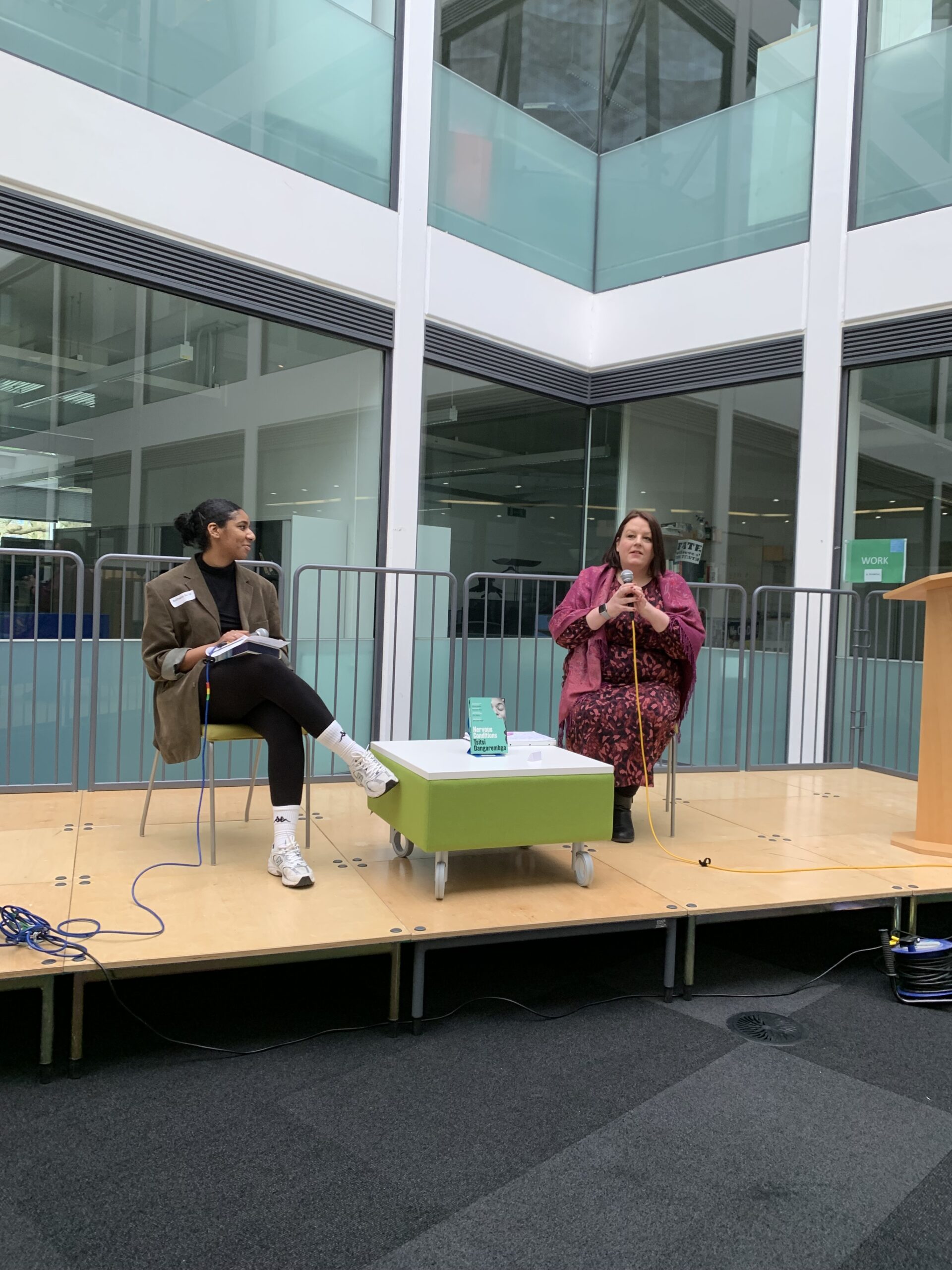
OU PhD student Antonia Saunders (right) is interviewed on stage by an MK Lit Fest volunteer.
How should a moderator handle the event itself?
Introductions: Short and punchy
Your introduction should include your name, the name of the event, and a brief description of the author and their work, ensure you mention their latest book. Three or four lines should do the trick. The audience is there to hear from the author so segue swiftly into your first question.
The conversation: Wear your research lightly
Distill your research into a one-page cheat sheet, which you can hide behind a copy of the author’s book! You should avoid referring to this too often, but it can offer a crutch to remind you of important quotations, or to jog your memory with a question to keep a conversation on track. But it’s important to listen to your guest and respond to their answers appropriately, rather than stick to a pre-formulated list of questions. It should be a conversation not an interrogation! By briefly summarising the author’s answer you can segue into a deeper exploration of that topic, or you can close it off and move onto another area of interest. Don’t necessarily ask your best question first, rather give the author the chance to warm up. Ask open questions (what, why, how, tell us about, to what extent) to encourage the author to open up. Be prepared to keep the conversation going if the author is a little timid or to anchor the conversation if the author is very talkative. Have a phrase to bring things back if things go wrong. Responses like ‘people always ask that’ or ‘That’s wrong’ can be disconcerting, so have a very open question up your sleeve. ‘What would you like readers to take from the book?’ or ‘What inspired you to write about…?’ Try to maintain eye contact and ensure your body language conveys that you are engaged by what the author has to say.
Handling a panel: Create a dinner party vibe
You’ll need knowledge of one or two texts by each author. Keep in touch with all guests on an email chain. Set up the chairs in a curve, with you at one end and the author you expect to be easiest to work with at the other end. Ensure you give each panellist equal opportunity to speak, regardless of status. A question like ‘how does that resonate with you?’ can be a good way of acknowledging one response before moving onto the next author. Allow the conversation to flow, and don’t be afraid of a little controversy. Set some hares running!
Online events: The same but different?
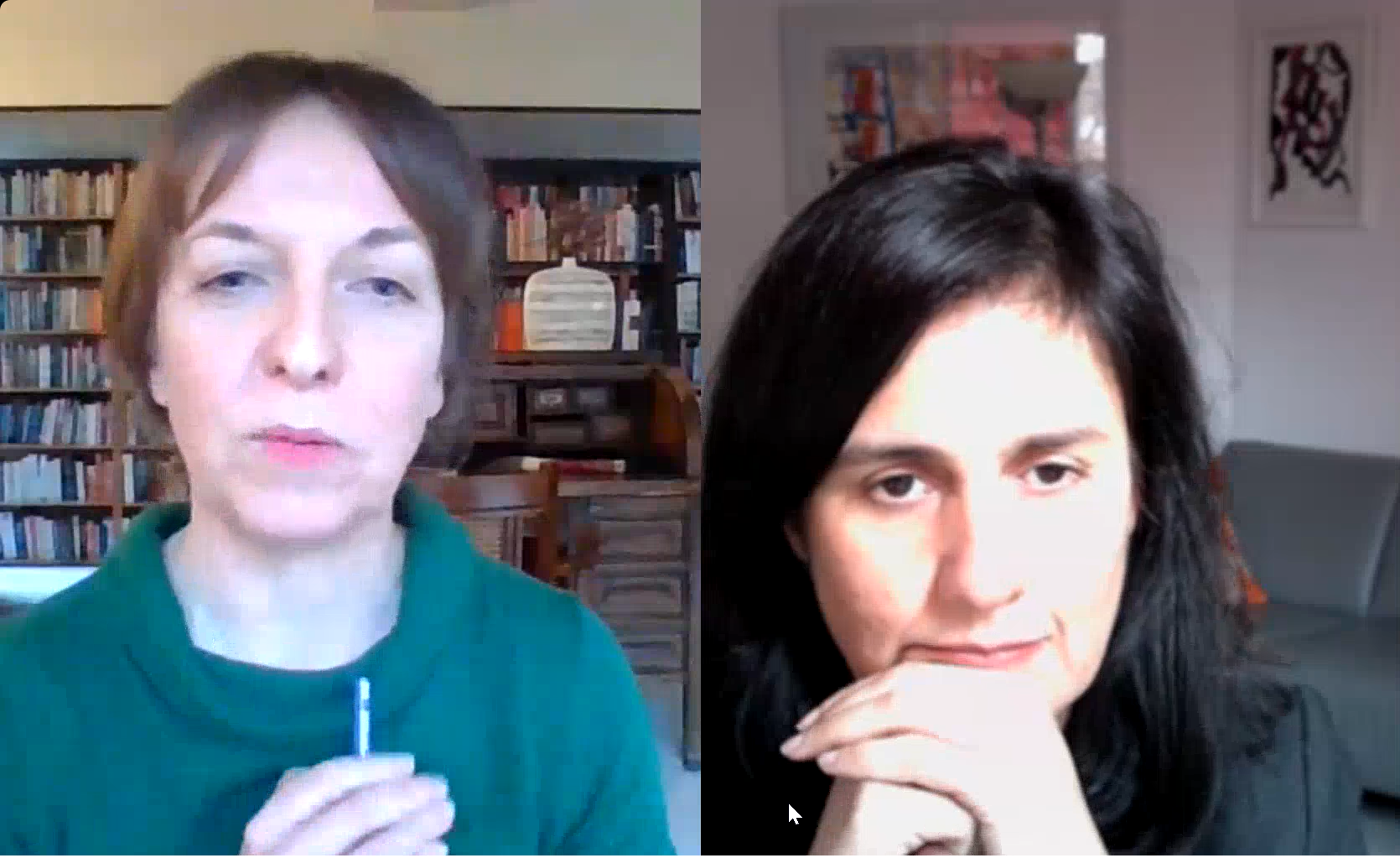
Kamila Shamsie (right) in conversation with Emma Claire Sweeney. Spot the deliberate mistake?…They are not similar distances from the screen!
Check your download speed to ensure your WiFi is working at sufficient speed, and switch off any alerts. Think about the aesthetics of the screen. Lighting should be in front of you, and the author’s book visible behind you. Log in with the author ahead of time to position yourselves a similar distance from the screen. Wear bold un-patterned clothing. Give yourself enough time right before the event to ensure everything is working. Mute and turn off audience cameras during the main discussion. If an event is hybrid, direct one of your first questions to the author dialling in to ensure their voice enters the room early on.
You will need to make extra effort to inject energy into an online conversation to keep it lively and engaging. It’s a good idea to pull questions out of the chat as you go along, rather than saving them all for the Q&A. Remember to nod and smile as the author is talking to show your engagement.
The Q&A: The question in that is…
Establish boundaries at the beginning of the session. Ask the audience, for the sake of time, to keep questions short and punchy. If the audience member gives a comment rather than a question, try to rephrase it as a question. If a question is particularly long, then announce your intention by saying ‘I’m just going to interrupt you there’. This takes the heat out of the interaction. Avoid saying that you have time for one more question in case that question is a dud! And have a supplementary question ready in case the discussion dries up.
Closing: End on a high
Keep to time. Audience members might have other places to be, and event organisers often have a swift turnaround between events. Put as much thought into your closing word as your opening ones. Thank the audience for coming. Give clear directions about where the book is on sale. Thank the author too, of course.
Afterwards: Be kind to yourself
There are almost always things you might have done differently in hindsight. But if you’ve kept your own ego in check, and helped the author take centre stage, then it will have been a job well done.
Antonia Saunders
Antonia Saunders studied for both her BA and MA at The Open University. Her part-time PhD looks at the construction of a Jewish Identity in histories and novels of the nineteenth century, and considers the literary and historiographical contexts of representations of Jewish people and Jewish Identity. She is co-convenor of the GOTH (Gender and Otherness in the Humanities) Postgraduate Forum, and she’s chaired discussions on the trope of the ‘Madwoman in the Attic’, gender fluidity in the arts and humanities, the non-human as other, and most recently, feminist readings of fairytales. Her supervisors are Prof. Delia Da Sousa Correa and Prof. Suman Gupta.
What initially motivated you to reconsider notions of realism, reality and the novel?
I was interested in exploring a number of potentially inter-related phenomena: the rise of auto/biography and memoir; the seeming rejection, on the part of some writers, of the novel – or at least current novelistic forms and expectations; and a sense on the part of some critics and writers that post-modernism had run its course, and that it was necessary to turn elsewhere for a literature fit for the 21st century.
I was also intrigued by comments made by Karl Ove Knausgaard and Rachel Cusk that seemed to echo a desire for an end to fakery and fabrication, which they associated, rightly or wrongly, with novelistic conventions (the need for plot, a narrative arc, a focus on ‘showing’ rather than ‘telling’). I wanted to investigate their desire to find forms of writing more attentive to the realities and complexities of experience. There did, in some senses, seem to be what writer David Shields terms a reality hunger (2010).
I have spent the best part of 30 years engaging with literature and particularly the novel. So Knausgaard’s dissatisfaction with invention and rejection of the kind of novel writing in which he had previously engaged, alongside Cusk’s experiments in a new kind of writing following the ‘creative death’ (The New Statesman, 2021) she felt she had undergone in the aftermath of her memoirs, prompted me to consider what was happening on the fiction/auto/biography/memoir front.
I wanted to understand the motivations of some successful writers who appeared to have turned their backs on fiction and were keen to stay closer to the outline, if not the substance, of their own lives. Rather than make things up, writers such as Knausgaard and Cusk felt the need to engage with the particulars of the world around them, seeing writing as a way of thinking through some of the big questions such as the impact of death and/or divorce on family life, what it means to be in love, the toll that having children can take on one’s ambitions to be a writer, and what it means to be a man or a woman at a particular life-stage in the 21st century.
Can you tell us a bit more about the terms ‘radical realism’ and ‘autofiction’?
The term ‘radical realism’ derives from prior usage in other disciplinary contexts (eg. politics, philosophy and art). I was particularly interested in its application by Caroline Levine (2000) to the work of John Ruskin; and to an article by Philip Tew (2001) on the work of B. S. Johnson. Bringing together ideas about predominantly literary realism/s with a focus on what might be seen as ‘radical’ in relation, for example, to Karl Ove Knausgaard’s My Struggle series was of course tricky, given the already wide-ranging literature on various realisms (eg. social realism, psychological realism, hyper-realism, to mention but a few). However, in helping to situate Knausgaard’s seemingly radical attention to detail and to the minutiae, some would say trivia, of everyday life alongside his concern to overthrow conventionalized ideas about the novel and its investment in storied fictions, the term helped make sense of what otherwise seems like a contradiction in terms: the notion of ‘a non-fictional novel’, Knausgaard’s own description of his work which he deploys to confront and interrogate fiction as the creation and maintenance of a sustained illusion, while seeking to get as close as possible to the realities of lived experience.
The term ‘autofictional narratives’ in the book title was a way of flagging up current interest in ‘autofiction’, another contentious and increasingly widely used term that goes beyond its initial application by Serge Doubrovsky, academic, literary theorist, critic and writer, to his self-designated autofictional novel, Fils. I begin by rehearsing the history of autofiction as a primarily French phenomenon before looking briefly at the way in which its usage as a neologism in English has increased exponentially in the last 5 years. So, for example, if you plug the term autofiction into the library search function, you’ll find 4,506 entries across the period 1976 to 2023, a 47-year span. Of these, 3,464 entries span the last 10 years, while 2,421 relate to the just last 5 years. These figures constitute evidence of a boom in (talk about) autofiction and the autofictional.
Your monograph engages in detail with the work of four writers – Rachel Cusk, Xiaolu Guo, Karl Ove Knausgaard, and Jeanette Winterson. What led you to focus on these particular writers?
My case studies centred on writers who have written both novels and works either classified as memoirs or autobiographies or works that appear to ‘document’, at some level, aspects of their own lives.
Knausgaard and Cusk provide an interesting pairing as they share a rejection of conventionalized novel forms, and have each set out to get closer to lived experience in their work. They also share an interest in contesting societal and culturally sanctioned views of ‘masculinity’ in Knausgaard’s case and ‘femininity’ in Cusk’s case. And they have both managed to antagonize members of their own families as well as many readers through their painfully honest accounts, as they would see it, of aspects of their lives.
In the case of Jeanette Winterson and Xiaolu Guo, I didn’t anticipate many parallels, given their very different cultural and linguistic backgrounds. However, insofar as they both hail originally from humble origins and have had to forge their own literary paths, sometimes in the face of fierce opposition, and have both been, from the off, unconventional novel writers who have produced, unsurprisingly perhaps, unconventional ‘memoirs’, they turned out to have quite a bit in common. Indeed, their work as a whole can be seen to reflect a number of self-projections or versions of self along a fact-fiction continuum and their so-called memoirs unsettle ideas of what a memoir might be.
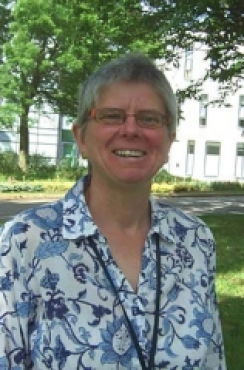
Fiona Doloughan
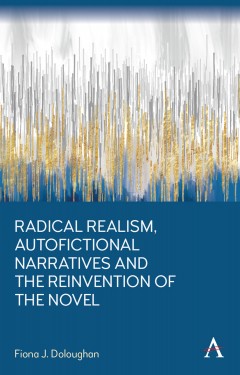
Fiona Doloughan’s research revolves around the development of the novel and on the forces (societal, cultural, technological, linguistic) shaping that development. She has published three monographs, the most recent of which is Radical Realism, Autofictional Narratives and the Reinvention of the Novel (Anthem Press, 2023).
On September 13, she’ll be delivering a lecture entitled Crisis? What crisis?: Rachel Cusk’s Reinvention of the Novel for the Twenty-first Century at Salve Regina University, Newport, Rhode Island.
On September 20, she’ll be at Agnes Scott College, Decatur, Georgia, giving a talk co-sponsored by the departments of English, French, and Spanish on what it means to be a female writer today.
In recent months, several members of our Creative Writing team have been collaborating with our local bookish friends at Milton Keynes Literary Festival.
On Saturday 15th April, lecturer Lania Knight interviewed fellow novelist and life writer Kit de Waal about the extraordinary journey she has made since first voluntarily reading a novel at the age of 22.
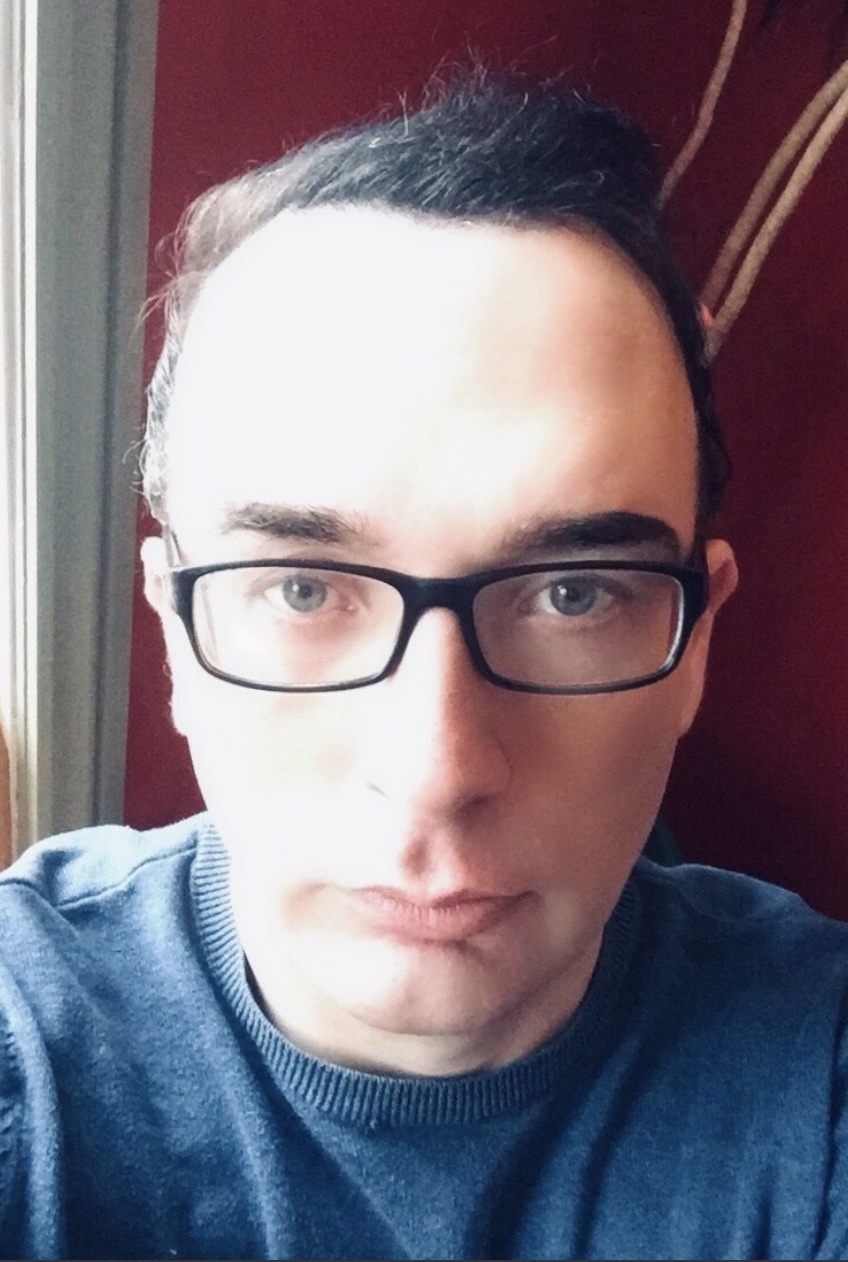
Saturday was also be a big day for those writers who have been shortlisted for MKLitFest’s MinK2023 Writing Competition. In the leadup to tomorrow’s announcement of the winners, we caught up with Open University PhD graduand, Patrick Wright, who acted as a judge for the poetry categories.
Tell us a little about your first encounters with poetry and your journey to becoming a poet.
My mother used to recite quite a bit of poetry around the house when I was growing up — poems such as ‘Night Mail’ by W.H. Auden and William Wordsworth’s ‘Daffodils’. This was my first introduction to rhythm and rhyme. We also had a few anthologies lying around that I’d dip into. I recall studying poems by Norman Nicholson at school and I was especially taken by ‘Windscale’.
My interest was only really piqued though by my discovery as a teenager of Sylvia Plath. I saw then what poetry could do in terms of confessionalism and free verse. I began to experiment with writing my own poems at this time — without a clue about what I was doing. It wasn’t until I studied for an MA in Creative Writing, at the Centre for New Writing, University of Manchester, that I truly started to learn the craft and see myself as a poet.
How has winning awards and having poems selected for anthologies affected your writing life?
It’s given me encouragement. Poetry can be a solitary activity and there are times when I wonder if it’s worth the investment. Is it too rarefied or self-indulgent? However, moments of praise and recognition always make the sacrifice worthwhile. There can also be a tinge of glamour at times. Though I’ve learnt to not feel too intensely about the ups and the downs. I can’t rely on the fruits at the end of the process: writing must be enjoyed for its own sake; and yet there’s certainly a kick that comes with having work accepted by a magazine or anthology, and that feeling can be quite addictive. I’m now more confident too and willing to take additional risks: with form for example or having the courage to break the rules I was taught. With the success that’s come my way, I’m also persuaded that my poems can sit alongside the poets I admire.
You are an award-winning poet yourself, and now you have judged MK Litfest’s flash fiction competitions. From your experience on both sides of the process, what would you say makes for a prize-winning poem?
I suppose it must tick several boxes at once. Technical elements should be considered; but there’s also the theme, the way a poem strikes at the heart of something in the zeitgeist, or how it leaves an impression. There’s also the inevitable subjective aspect, and what I think works best at a given moment. It’s often fine margins — and I have no doubts that my thoughts as a judge might have changed if I’d read the same poems again another time or in a different mood. Taste and a complex set of characteristics that the reader values (some of which are hard to pin down) will often shape the final verdict. So, my message to poets is: Don’t be discouraged and keep writing. There’s every chance that next time you will have your work chosen.
Tell us a bit about some of the poems you shortlisted for MK Litfest.
In the 14-19 group I enjoyed ‘My Roots’, ‘To all you ash-grey men’, and ‘The Aftermath’. I thought that ‘My Roots’ was particularly impressive with the poet’s clear adherence to the theme (Milton Keynes and green spaces), awareness of form, organised stanzas, and memorable images.
In the 20-plus group, I liked ‘The Green’, ‘The Other One’, and ‘Covid Spring’. Each of these had a distinctive voice and demonstrated a striking or unusual use of language. ‘The Green’ stood out for me with its neat couplets and appreciation of sound.
How has your work and research at the OU shaped you as a poet?
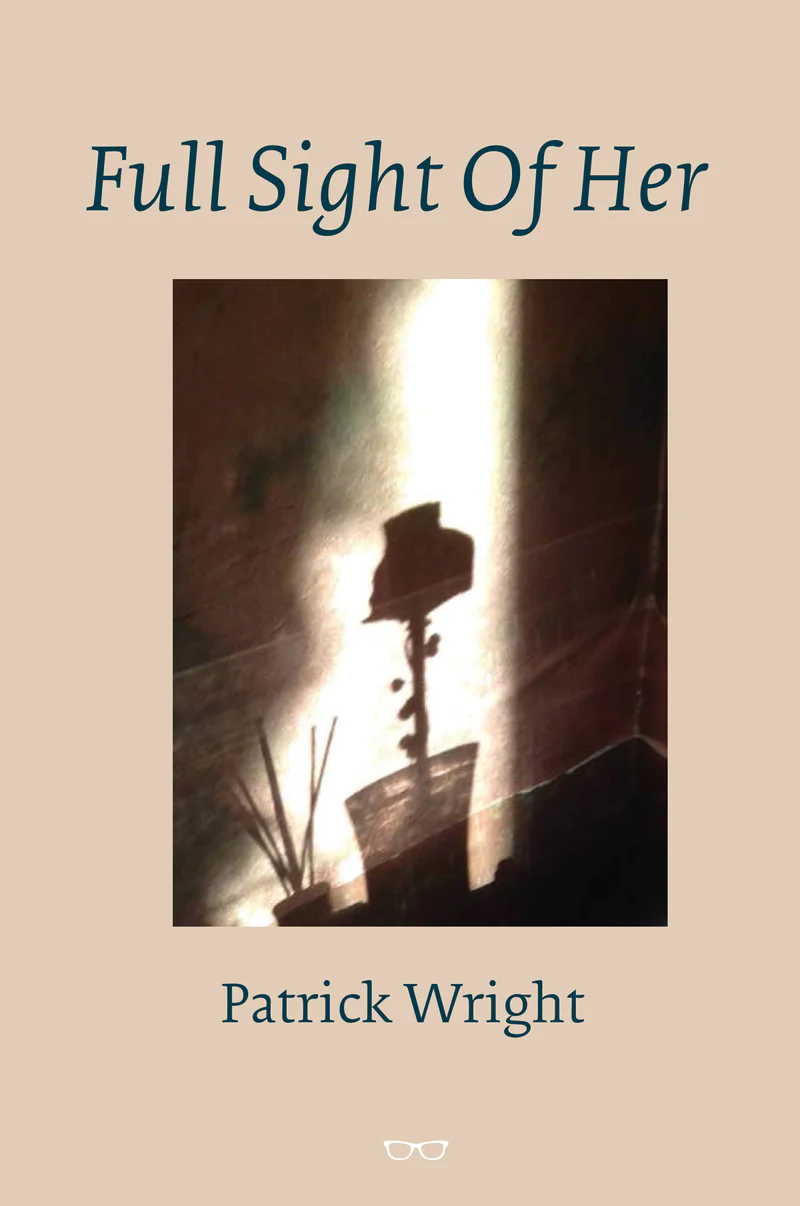
Looking back, my PhD in Creative Writing (Exit Strategy: Ekphrasis through the lens of the abstract and the formless) was a way of going in another direction from my first collection (Full Sight of Her). I was clear from the start that I wanted to be open to new forms, constraints, and feedback — always in the hope of allowing me to find a new voice and not sound like myself. This striving to get away from what I’d done before is one reason the collection is called Exit Strategy. It was about having a book of poems that could be expressive of a new identity, and I achieved that. The critical part helped me become more aware of other poets and where my writing fits in the present landscape.
Aside from new ways of making a poem in response to modern art (the focus of my thesis), I’m particularly interested in aligning myself with the current trend of exploring hybrid forms, such as the prose poem or the lyric essay. My current project follows in this vein: a memoir that includes prose poems.
Patrick Wright has a poetry collection, Full Sight of Her, published by Eyewear and nominated for the John Pollard Prize. He has been twice shortlisted for the Bridport Prize and teaches English Literature and Creative Writing at the Open University. He has just completed a PhD in Creative Writing on the ekphrasis of modern and contemporary art, supervised by Jane Yeh and Siobhan Campbell.