Step into the enchanting world of Amit Chaudhuri, a literary luminary known for his exploration of diverse creative forms and their connection to the human experience. Join us as we uncover the secrets of Chaudhuri’s work, from his love for Indian Classical Music to his thought-provoking insights on storytelling. Prepare to be inspired and captivated by the brilliance of Chaudhuri’s literary legacy.
One of the most intriguing things about literary giant Amit Chaudhuri’s work, is his interest in the way different creative forms speak to human experience.
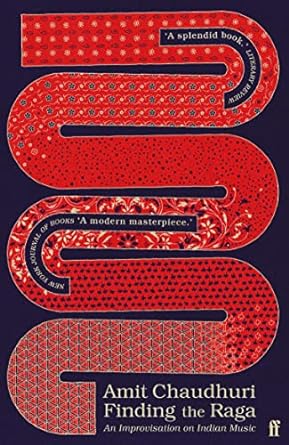 Chaudhuri’s work has always reflected his interest in Indian Classical Music and in the non-fiction work, Finding the Raga, he writes about the difference between experiencing the world as language where the word ‘morning’ is only arbitrarily connected to what we understand the word to mean, and experiencing the world through the representational act of telling stories. He sees the first as akin to poetry and the second akin to narrative forms like the novel.
For Chaudhuri, a Western musical tradition is wrapped up in a linear exploration of the human at the centre of things and the Indian tradition decenters human action and refocuses attention on experiences that slip out of standard narrative interpretation and linger in the present.
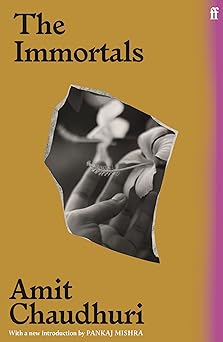 When I read novels like Afternoon Raag or The Immortals it is this ability to discard some of the strictures of beginning, middle and end, and to focus instead on those moments in which time seems to stand still, in which nothing dramatic happens and yet the sense of what it is to be a conscious, breathing human is elegantly brought to life, that makes Chaudhuri’s work so engaging and exciting. This is poetry working within the novel and as a reader I find my way into his work through this intense love of those moments, or moods of being.
This is of particular interest to me as a writer in my third year of a creative writing PhD at the OU, writing my novel, All The Hollow Places, that centres around the last day in the life of Gertrude Bell, the archaeologist, traveller, linguist and political officer who helped to draw the lines around modern day Iraq.
I’ve spent the last few years thinking hard about the ways in which we interpret the world through the many filters of our familial, social, educational and cultural backgrounds. I’ve wondered about how I can reimagine Bell for a modern audience in a way that not only brings her to life on the page, but encourages a reader to question her interpretation of the world and, by extension, their own.
Some of this needs to be done through interrogating that representational, linear act, and just like Chaudhuri, thinking about how to embrace moments out of time that collapse the linear spatiotemporal structures we generally use to situate ourselves. In this way, we can understand what it is like to wake early to the call of the muezzin because we have all had moments of being that seem, in the words of Annie Ernaux in The Years, to ‘float on top of each other’. Annie Ernaux names the feeling of such moments ‘the palimpsest sensation’ and like her, I feel this sensation could be an alternative ‘instrument of knowledge’, one which the novel, that expansive, potentially circumlocutory form, has the ability to wield to startling effect. One which Amit Chaudhuri wields beautifully himself.
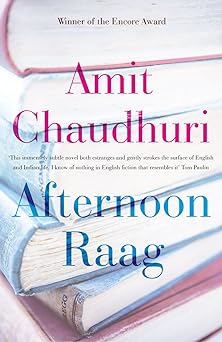 One of my favourite passages of Afternoon Raag describes the protagonist imagining his mother making and drinking her early morning cup of tea. This is something she does every morning and, just like this repeated act, we imagine that tea twice. We start with her boiling the kettle to a ‘solipsistic bubbling’ (p24), divert to other things she does throughout the day, other observations about her hair and character, and then we return to the tea: ‘there (on the veranda) she stands with the teacup balanced in one hand, pausing now and then in her thoughts (for she is always thinking) to sip her weak tea politely, watching the lane’ (p26). We are not sure how often the protagonist has actually watched this moment, and understand this rendition of her morning to be one collated over a series of specific moments that together form more of a generalised sensation of his mother moving about the house before dawn, waiting to drink tea as the sun lifts over the horizon. Her habits are the stuff of life, the background comforts of home that offer quiet solace to her son in a cold, damp Oxford, far from his parents’ Bombay flat.
The memory reveals the value in the everyday, the meditative, undramatic moment that weaves through our lives and holds a sense of our identity unshackled by strict chronology and the events that we tend to use to shape our histories (births, marriages, deaths). This is the kind of mood and sensation Chaudhuri evokes with such gentle poetry.
Being asked to interview Amit Chaudhuri for the MK Literary Festival is a dream come true. As he writes in Finding the Raga, ‘a creative work is engendered, almost always at a crossroads’ (p52) and I hope, in our conversation, to tease out the multiple creative impulses that generate his literary and non-literary work, and to find inspiration for my own work as I try to marry past and present, form and content in my novel.
My creative practice PhD combines a novel and critical thesis centred around the life of Gertrude Bell (1868-1926). As a distant relative of Bell, my novel uses multiple perspectives – including a personal one – to explore the controversies of Bell’s life, from her hand in establishing modern day Iraq, to whether her overdose was really suicide. Both novel and thesis examine the ways in which we tell and use stories of the past, searching for new approaches to collective and individual storytelling that might help us think and act differently in the present.
Rebekah Lattin-Rawstrone has a Masters in Creative Writing from Birkbeck, University of London, a Masters in ‘Issues in Modern Culture’ from University College London, and a degree in English from Cambridge University. Her fiction has received Arts Council funding and her PhD is funded by the OOCDTP.

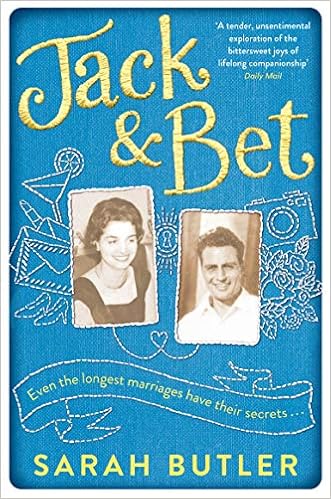 So, I changed the direction of my research, exploring the relationship between the novel form and home. I thought about the impact of the loss of home (particularly through urban gentrification) and nostalgia, and how nostalgia can be a driver of narrative. I thought about the verbs to leave, to stay, to return and to settle in relation to home in my own work and in two novels by