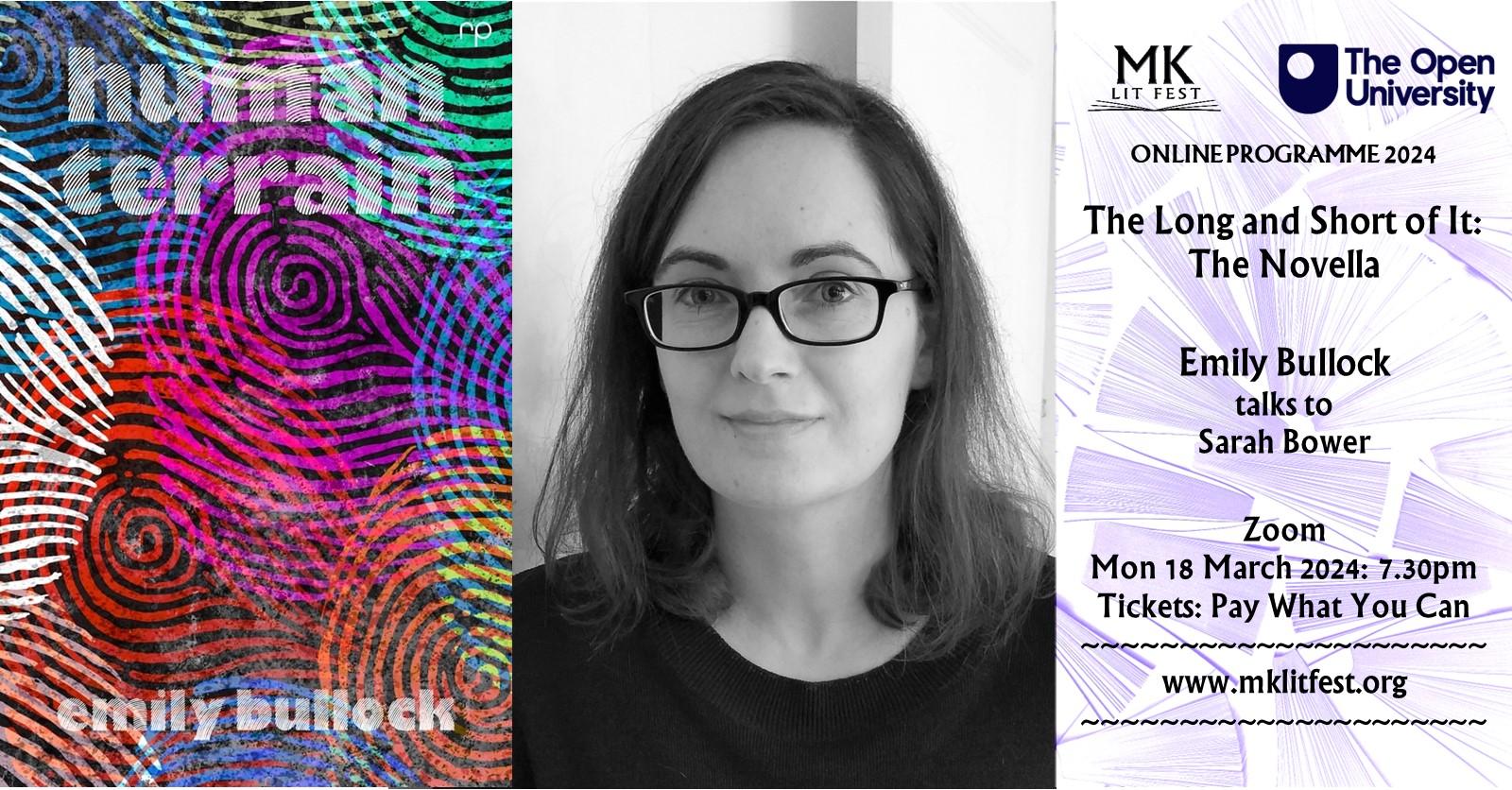
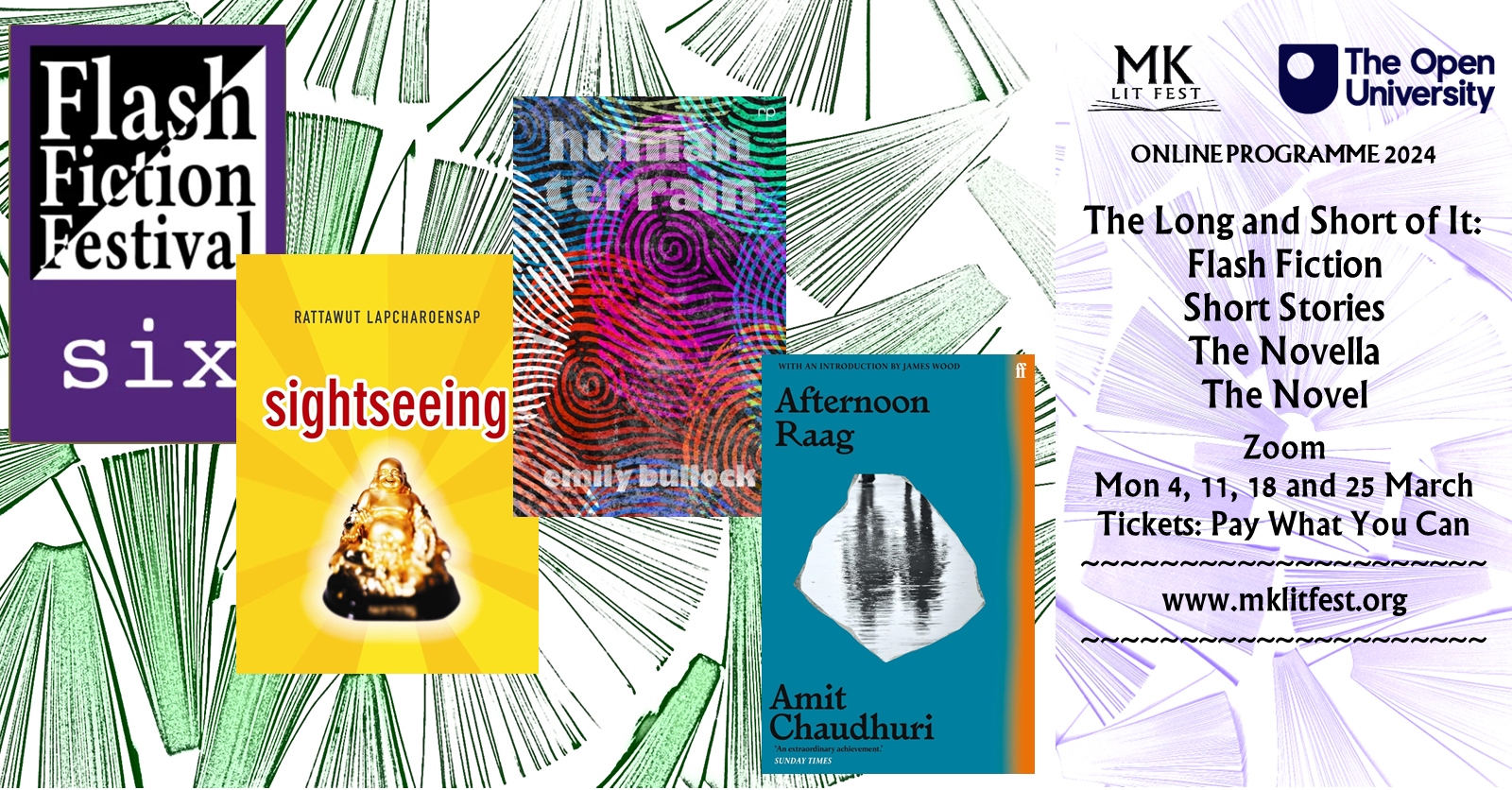
On Monday 18 March 2024, in the third instalment of the MK Lit Fest series The Long and Short of It, acclaimed writer Emily Bullock was in conversation with OU Associate Lecturer and PhD student Sarah Bower discussing the novella, sometimes dubbed literature’s ‘awkward middle child’.
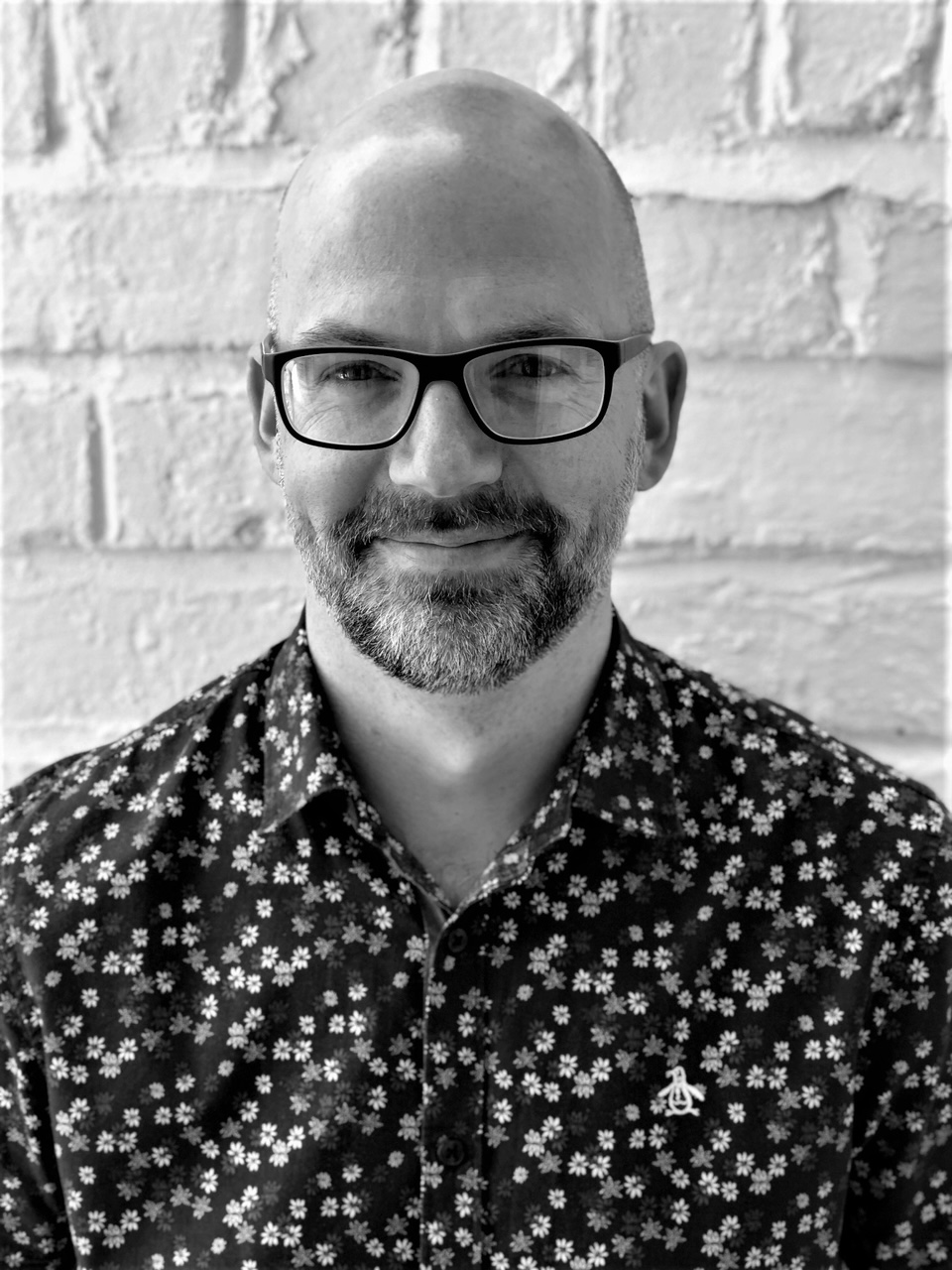
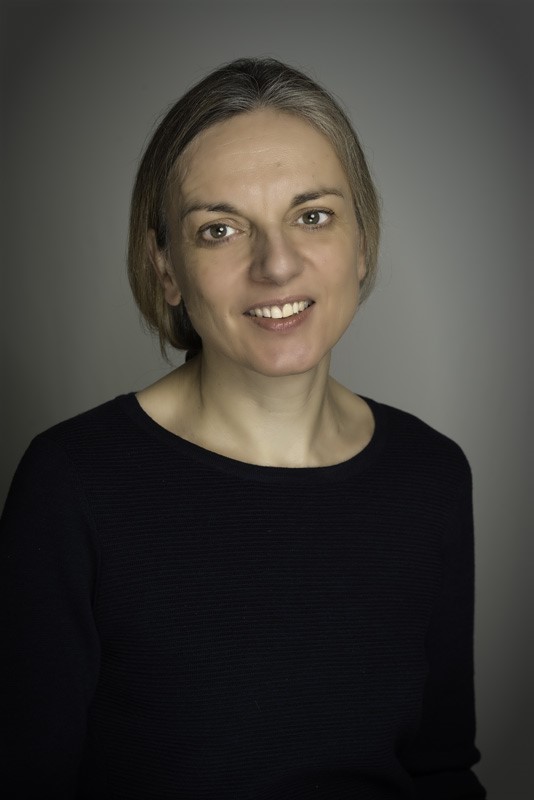
Emily BullockSarah Bower
The novella is for some a bit of a puzzle; too long to be a short story and too short to be a novel. For many mainstream publishers it is a headache to be avoided. For some readers the novella represents poor value for money, for others, it is the most perfect literary form. Although shorter than novel in terms of word count, a novella is not necessarily easier to write, and to write well requires the intense control and refinement perhaps more often associated with poetry.
Interviewing Emily Bullock about her forthcoming publication For Always Only and the form of the novella, Sarah Bower (herself the author of a novella) asked questions that got right to the heart of the matter.
For Always and Only is about the process of reading James Joyce’s Finnegan’s Wake, or at least it is partly about that because a novella is no one-trick pony and is never only about just one thing. There is a degree of irony, noted Bower, in using Joyce’s sprawling and notoriously difficult work as the organising principle for a short, tightly controlled novella. To explain how this works, Bullock gave an account of her own process of reading Joyce, not entirely for meaning, but as a kind of readerly ‘beach combing’, and how she makes Finnegan’s Wake her own by frequently interrupting Joyce with her own lines of thought. Roland Barthes also remarked on this aspect of reading in The Rustle of Language:
Has it never happened, as you were reading a book, that you kept stopping as you read, not because you weren’t interested, but because you were: because of a flow of ideas, stimuli, associations? In a word, haven’t you ever happened to read while looking up from your book? (1986, p29).
In the light of these descriptive accounts of reading and reading while looking up, the connection with Joyce begins to make perfect sense as the backbone of writing that is very much ‘about’ reading.
The process of writing this novella was notable for the amount of cutting Bullock found she was willing to do, such as cutting out her character’s backstory, cutting flashbacks, stripping back description, and ending chapters abruptly. All this cutting, she explained, leaves the remaining gaps to do more work and leaves space for the reader who must invest in the reading process. The reader needs to be particularly alert to what is not on the page. Writers often talk about the balance between showing and telling, but in the case of the novella, according to Bullock, what the writer is not showing and not telling become highly significant.
Bullock’s forthcoming novella is set in a claustrophobic bedsit in Bloomsbury, a location that gives a wry nod to Virginia Woolf’s ‘A Room of One’s Own’ and which is also perfectly sized to provide a counterpoint to Joyce’s Dublin. And yet, the setting offers a similar intensity to Dublin but, of course, achieved in far fewer words. In the reading Bullock gave, her use of lists of items economically created a whole world whilst leaving scope within the tight frame of narrative to express bigger ideas.
In answer to Bower’s question about how a writer might know that the novella is the literary form that would best serve the story they want to tell, Bullock explained that whilst a short story is very often the synthesis of two ideas, and a novel gives ample room for complexities of character chronology, and worldbuilding, stories that are of an experimental nature, stories with strong ideas and those requiring considerable reader engagement might find their ideal form in the pithy perfection of the novella.
In a lively Q&A session Bullock fielded questions on For Always Only (to be published later this year by Reflex Press) and on the form of novella more generally. Enthusiastic audience involvement would suggest that despite the lacklustre support from mainstream publishers, there is an enduring appetite for the intriguing form of novella, and many of the questions and comments raised could have kept us all talking long into the night.
The series will conclude with the novel form on Monday 25 March.
Gwyneth Jones
Gwyneth Jones is a writer of short and flash fictions under the pen name Jupiter Jones, and her work has been widely anthologised. She is currently a PhD candidate at the Open University researching (dis)connectivity in the literary hybrid form of the novella-in-flash. Her supervisors are Dr Jane Yeh and Dr Emma Claire Sweeney.
On Monday 12 March 2024, we had the privilege to hear the writer RattawutLapcharoensap in conversation with OU Associate Lecturer Dr. Alistair Daniel. In this second instalment of the MK Lit Fest series The Long and Short of It, they explored the unique challenges and pleasures, and possibly also pains, of short story writing.
PhD student, Anne Wetherilt, offers here a summary of the event for those of you who couldn’t make it.
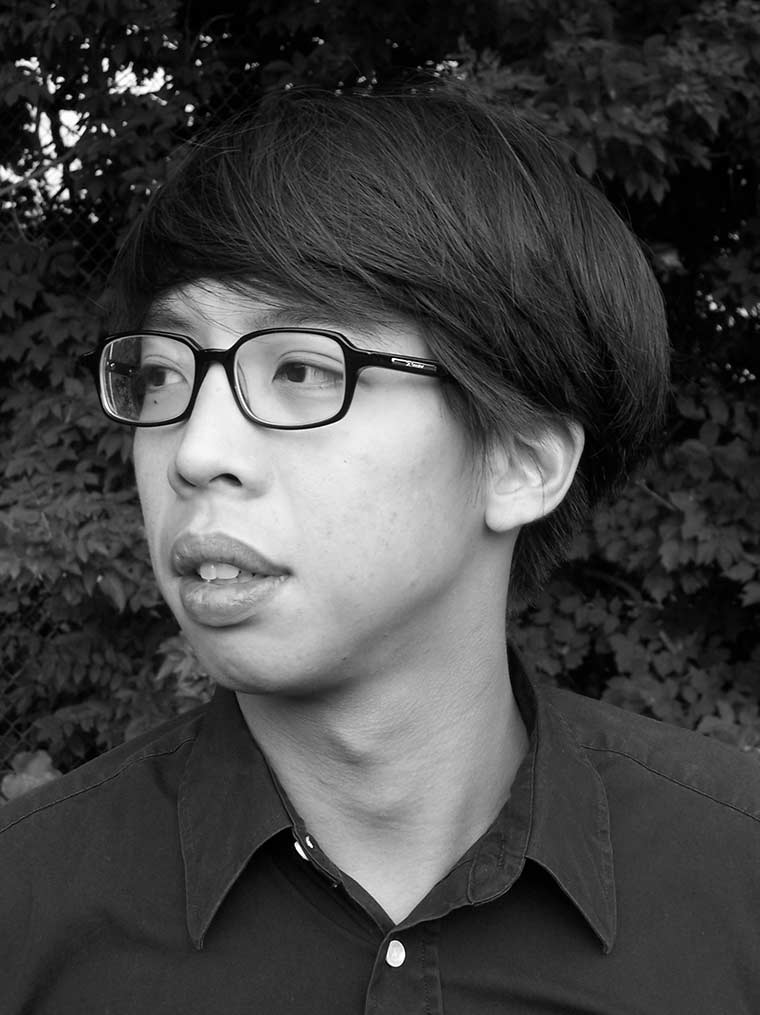
Alistair DanielRattawut Lapcharoensap
Rattawut Lapcharoensap, Alastair Daniel wrote earlier this month burst onto the literary scene in 2005 with his debut story collection, Sightseeing. It won the Asian American Literary Award and was a finalist for the Guardian First Book Award.
Short stories, Edgar Allan Poe famously wrote, need to be read in one setting. But this, Lapcharoensap argues, short-sells the short story. An avid reader of the form – he quotes James Joyce, Frank O’Connor, Sherwood Anderson, Flannery O’Connor, Alice Munro, Katherine Anne Porter and Junot Diaz amongst others – Lapcharoensap is drawn to the short story because of its ability to capture the individual and the collective experience, and its intense awareness of human loneliness.
His short stories have a strong sense of place. ‘I want to write the truth about the communities I felt part of’, he tells us. Indeed, in Sightseeing, he gives us a richly detailed picture of Bangkok in the 1980s and 1990s. The stories are rooted in experiences he witnessed as a young person and carried with him as an adult. And whilst they touch on topical political issues, his main aim is always to tell the truth about his characters’ lives.
When Sightseeing came out, William Sutcliffe, writing in The Guardian praised its ‘novelistic richness’. Lapcharoensap aims to achieve this richness through his characters. Even though a short story gives the reader only a glimpse of the character’s life, you can present the whole person: where they came from; what they have done earlier in their life; how they have lived their life. You can write beautifully and with great emotional clarity, he asserts, a short story need not be short in terms of descriptive power.
In Sightseeing, these stories typically narrate the experiences of young boys or adolescent men. But they are brought to us by older first-person narrators, who calmly observe and report their own earlier encounters with life. This older first-person narrator, Lapcharoensap reflects, brings an interesting perspective to the story. They may have greater articulacy, but often continue to be bewildered.
Given the centrality of place and character in his stories, it is perhaps no surprise to learn that Lapcharoensap usually starts the writing process with a scene or a character. Asking ‘who is speaking’, he expands on a notion, a feeling, a telling detail or bird’s eye view. The story line may emerge later – although sometimes it doesn’t. This early composition is like playing in the dark, he explains, and proceeds without a plan. But planning comes in when he starts revising and here we get a glimpse of the personal discipline Lapcharoensap applies to his writing. Revision is about looking for opportunities to exercise the imagination, he believes. The creative act is not just the initial inspiration – the artist struck by the imagination in his study. Rather, such moments occur in the sequence of drafts, when ‘something beautiful emerges from the lumps of despair’.
For all their promise, short stories can be prone to clichés and pitfalls. Lapcharoensap is particularly wary of the emphasis on epiphany. The Joycean epiphany can be beautiful, he argues, but as a narrative habit it can also be limiting. Not every character needs to act, stumble and learn from their mistakes. Weak epiphanies or false epiphanies abound in short stories, and as a genre requirement, it can limit a young writer in their development and imagination. Another pitfall, he admits, is to create characters like yourself, which you don’t allow to fail or behave foolishly. Invariably, this reduces the richness of the story, and the fictional narration becomes wishful fulfilment.
Part of the joy of being a short story writer, Lapcharoensap notes, is in seeing them published as part of a collection. Each story is written on its own and should stand on its own feet. But they are enriched by their neighbours, as the writer organises them in a particular way to achieve formal and thematic dignity.
Sightseeing closes with ‘Cockfighter’, which at 90 pages is closer to a novella.This particular one did not end, Lapcharoensap explains. ‘It just wouldn’t stop and I continued to be interested in it’. As a reader, he loves the novella – it has the expansiveness of the novel yet requires the rigour and economy of the short story. To this reader of Sightseeing, Lapcharoensap moves effortlessly across the two forms, offering us ‘novelistic richness’, as well as sheer reading pleasure.
The series will delve into the novella form on Monday 18 March and conclude with the novel on Monday 25 March.
Anne Wetherilt
Anne Wetherilt is a part-time PhD student in the Department of English, funded by the Open Oxford Cambridge (OOC) Doctoral Training Partnership. Her thesis – ‘Decolonisation and the Female Middlebrow: Politics, Economics and the Novel’ – studies the work of women writers, who witnessed the end of the British empire. Her supervisors are Prof. Alex Tickell and Prof. David Johnson.
Co-directors Professor David Johnson and Dr Philip Seargeant founded the new research group to give oxygen to interdisciplinary research conversations and initiatives, and they see it as an exciting opportunity for new and interesting synergies to emerge.
The group launched with an online literary event featuring author Jim Crace, who read from his Booker-shortlisted novel, Harvest, and spoke to OU Lecturer in Creative Writing and fellow novelist, Dr Emma Claire Sweeney, about the interrelationship between politics and language in his own work.
A conversation between Jim Crace and Emma Claire Sweeney
This year, LLP will kick off with a series of public talks that take inspiration from Raymond Williams’s hugely influential ‘Keywords’ book to examine the terms and concepts that act as touchstones for today’s society.
Williams describes a keyword as one for which ‘the problems of its meanings seem inextricably bound up with the problems it’s being used to discuss.’ So the act of defining the word is part of the process of exploring and arguing for the values that the concept represents.
An animated video essay about Raymond Williams’s ‘Keywords’, and the relevance of the idea for today’s society.
With speakers spanning disciplines from philosophy to political science and lexicography to literature, the series will look at how Williams’s project is still highly valid today, and at what words – and the arguments around them – define society and culture in 2022.