Writing in Lockdown

Jo Barnden, AL on A215 and A363

For those first, intense weeks of lockdown, I seemed to be out of step with the rest of the world. Everyone was telling Twitter how much time they had to walk through nature and take up knitting, to make TikTok videos and bake bread (if they could track down yeast). Frankly it sounded wonderful but it was not my experience. Quite the contrary, I was chained to my desk trying to write a novel in four weeks – the most intense working challenge of my life.

It started when my agent rang me out of the blue to say that my publisher had ‘had an idea’ and thought I might be the writer to bring it to fruition. Piatkus publish my historical novels as Joanna Courtney. These are works set in 1066 and earlier that take at least a year to research and write, but what they wanted from me now was a contemporary novel, a lockdown love story. Needless to say, we had to move fast.

I was perhaps not as bizarre choice as that makes it sound. Two years ago I’d started writing contemporary fiction as Anna Stuart for another publisher, Trapeze. Both books (Bonnie and Stan and Four Minutes to Save a Life) had done well so hopefully that was some quality assurance for them. More importantly they knew that I’m quite efficient when it comes to writing – though none of us were sure if ‘efficient’ would add up to a 70,000-word novel in four weeks.

This, I was told, was an ‘IP (Intellectual Property) Project’ in which the core idea for the novel had been invented by the publisher – to be precise a lovely editor called Hannah – and I was the ‘hired pen’ to bring it to life. It’s not like ghost writing as I was simply given a handful of characters and a plot outline with the rest very much mine to bring to life. However, because it was her idea the editor was very bought in and very, very helpful in how we put it together. That was to be invaluable in the intense weeks that followed.

I loved the basic concept and the characters seemed to come to life for me instantly so I fleshed out Hannah’s core plans and within a week we had signed a deal. It was hard to credit. Having spent years and years trying to land a novel contract, I felt as if I was suddenly being handed one on a plate – now all I had to do was write it. Simples! Except that my normally empty house was now filled with a husband working from home, two kids who should have been doing GCSEs and A-levels, and a 23-year-old stepson who’d had to flee his lovely job in the ski-bars of Whistler. It was a worry. I like a quiet house to write in and I certainly wasn’t going to get that.

As it turns out, however, the young folk quickly went nocturnal, leaving things pretty quiet until at least midday and with my husband working with China we were both at our desks by 7am – my most productive time anyway. Plus, to be fair to the kids, they stepped up and took on both the cooking (enthusiastically) and the cleaning (less so!), so all I had to do was shut myself in my little office and write. To be honest, I loved it.

The novel is called Just the Two of Us and is about a middle-aged couple whose kids have left home and who are on the brink of divorce when they find themselves locked down together. All that enforced time in the house pushes them to explore the things that have messed up what was once a wonderful marriage and to see if, perhaps, there’s a way back to happiness. It cuts between the current story and flashbacks to their long, shared past and was fun to write, if a little tricky in terms of timelines.

That, however, is where my editor came in. I provided the first 28,000 words in a week (it was a hell of a week!) and she was back to me two days later – that’s almost unprecedented in the publishing world! It was the same again once the first draft was done three weeks later. We chatted on the phone and over email and tinkered with second and third drafts and, miraculously, six weeks after I signed the contract, we sent Just the Two of Us to copy edit at 80,000 words. It was a whirlwind but fantastic fun and, most importantly, early reviews from NetGalley readers suggest that people are really enjoying it.

How did we do it? I’ve no idea! I’m a planner. I always have a full chapter-by-chapter synopsis of my novels, historical or contemporary, before I start so that I can hit the ground running and I think that helped here. I have no idea how people manage to just start writing without knowing where the novel is going, but everyone has to write the way that suits them best. It seems that for me that is in a manic, concentrated run.

Lessons learned? The biggie is that traditional publishing houses can be more mobile and responsive than they usually let on and I think that’s the way they’re going to have to go with digital-first publishers producing books so nimbly these days. For myself, it confirmed that I like working under pressure – and that I really like not doing housework!!

My agent did scare me the other day by saying ‘I know how fast you can write books now, so I expect at least three next year.’ In this, she will be disappointed. Just the Two of Us was a one-off, driven by the strange coronavirus circumstances we all found ourselves in. I may not have learned to knit, or made TikTok videos (to my kids’ relief) but I did write a lockdown love story.

Jo Wilde is on twitter and facebook as @jowildeauthor
Cold Dark Matter: Writing a poetry collection during lockdown

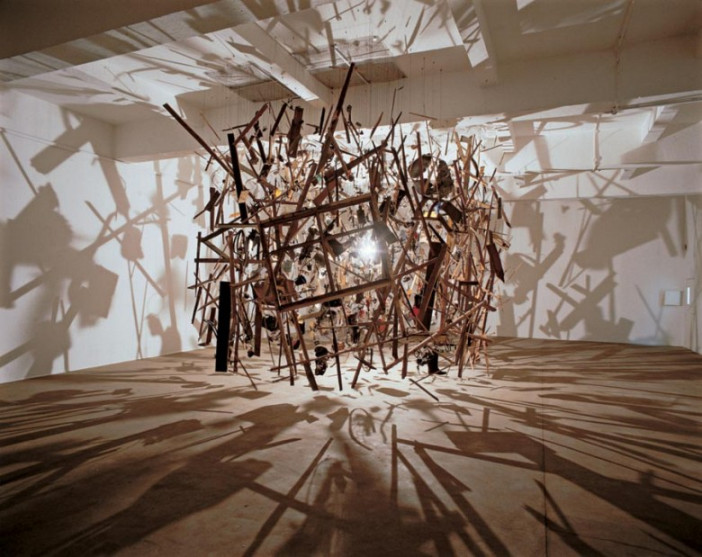
Image shared under Creative Commons licence: ‘Anti-Mass’, de Young Museum, San Francisco, US, https://www.famsf.org/blog/framework-anti-mass-cornelia-parker Source/photographer “Anti-Mass,” Cornelia Parker (de Young Museum)

By Patrick Wright, PhD Student, Creative Writing

As an introvert, and usually working from home, the lockdown has allowed much of my practice to go on unabated. Some aspects have intensified: developing an active imagination and reflection are two examples that come to mind. While in some ways productive, there’s always the lingering threat of such faculties lapsing into torpor, lethargy, or morbid daydreaming. As immersive as my own bookshelves have been, the tranquillity of my back yard, and embrace of digital technologies, underlying my new methods is a quiet despondency.

Still immersed in a grief process, after losing my partner, and left alone in a flat, surrounded by our combined possessions, is a dangerous recipe – especially as a poet, where life is often fraught with precariousness and introspection.

From my first experience of a PhD, I know it can be isolating at the best of times; the ideas just too rarefied for friends, family, or pub conversation. Now, though, the restrictions on movement and socialising have greatly exacerbated this reality. I miss having a workplace, with those familiar water cooler moments; and I feel at some remove from my colleagues, living as I do in the North-West. Though I am clear in my purpose and grateful for my vocation. This, for now, is a Creative Writing PhD with the working title Cold Dark Matter: The Ekphrasis of Modern and Contemporary Art, supervised by Siobhan Campbell and Jane Yeh.

As a means of survival, I imposed for myself a structure and discipline. I replaced my familiar café environment with a picnic table. I’ve written many of my poems in cafés: maybe it’s something to do with finding an optimum decibel level for my creative flow, or I feel reconnected with human presence.

Image shared under Creative Commons Licence: “let me show you” by kygp is licensed under CC BY-NC-ND 2.0

I also had to replace my excursions to galleries and museums with the use of art history books, exhibition catalogues, and virtual museum tours (e.g., Kettle’s Yard). My home library has revealed overlooked marvels, as I’ve lived out a similar narrative to the one in Xavier de Maistre’s A Journey Around My Room.

My practice research focuses on the ekphrasis of modern and contemporary art; and thus far I’ve enjoyed writing in situ: in front of a painting for instance, or spending time in the holdings, having arranged a private viewing. On such occasions, I’ve sketched first drafts that incorporated, in some way, the details on the surface of the artwork, the texture, the detritus, and so on; details that may not been seen in a reproduction. There’s also the smell of the gallery, the sounds around me – the chatter of tourists, the screams of children – and the paratextual features: the blurb, the frame, or other images in juxtaposition, curated alongside.

Inspiration has, no doubt, been affected. I have been less productive during lockdown. It’s likely that we’re not wired to flourish while detained and enduring a monotonous routine. It might also be the case that – at this stage in writing what will be my second poetry collection – I’m less eager to just write another poem, especially if it’s similar to something I’ve written before. The reflective part of my thesis has aided my awareness of such repetition, while I’ve become more conscious in general of my decision-making and poetics; though this is a challenge, as I’m still habituated into an M.O. that’s often instinctive. I’ve also found that analysing the complexity of my inner dialogue can be overwhelming; or lead to the realisation that my mind is, on some level, preoccupied with nerdy considerations, such as obsessing over whether to use parataxis in the third line of a ghazal.

My recent confinement has also been, like many kinds of limitation, enabling. I’ve begun, over the past few weeks, a series of poems that respond in some way to the pandemic. One recent example is my poem ‘An Exploded View’, which takes its title from an installation by Cornelia Parker (‘Cold Dark Matter – An Exploded View’):

Without being able to see Parker’s artwork first-hand, my poem begins with recalling it to mind. I visualised her installation (an exploded shed, frozen in time), then visualised how my poem could look, set out on the page with a shape analogous to the artwork. (For now, at least, my words are ‘exploded’ in fragments around the page.) During my research, I consulted Google Images, which provided a series of intriguing viewpoints under different lighting conditions; and yet I was aware the re-mediated artwork was no substitute for standing in the gallery. So many angles are elusive; my distance from the work is accentuated; and the device through which I look (an iPhone) makes the jpegs obscure and subject to unwanted reflections in the mid-afternoon sun. In this poem, and others, the technology – with all its filters and frustrations – becomes part of what I write about, along with peripheral aspects of my often incongruous lived milieu (‘a sky-dance of swallows’).

Despite ongoing struggles in seeing art through such screens, I’ve been drawn to André Malraux’s notion of the ‘Imaginary Museum’: how, in a culture of reproduction, art is now potentially more accessible and democratic. Likewise, I’ve applied the idea of the ‘death of the author’: rejoicing in my own interpretations or misperceptions.

For now, I’m content to borrow at least half of Parker’s title for my collection. A title, I’ve found, can have the power to drive a collection forward, to give it an identity or coherence. Many of my poems – like ‘An Exploded View’ – look to clash disparate lexicons together: in this case, art and cosmology; and I like how ‘cold dark matter’, rather than a phrase coined by Parker, is also a term that refers to around 85% of the universe, which remains invisible. In addition to suggesting how my ekphrastic collection is tethered to this and other artworks, the title is apt for another reason: my poems make use of scientific vocabulary to explore the metaphysical questions that arise in the space of bereavement.