Skip to content

English and Creative Writing

Research and teaching news from English and Creative Writing at the Open University

  • Home
  • About
  • More blogs!
  • Accessibility statement

Tag: The long and short of it: From flash fiction to the doorstop novel

Posted on 26th February 202423rd January 2025

Flash Fiction and the Paradox of Constraint

This spring our Contemporary Cultures of Writing research group is collaborating with Milton Keynes Literary Festival to run The long and short of it: From flash fiction to the doorstop novel – a series of online and in-person conversations between OU creative writing scholars and acclaimed authors. We’re kicking off the series at 7pm Monday 4 March with an online event with flash writer Electra Rhodes, who’ll be in discussion with Open University PhD student Gwyneth Jones.

To whet your appetite, Gwyneth shares here why she likes to keep things small.
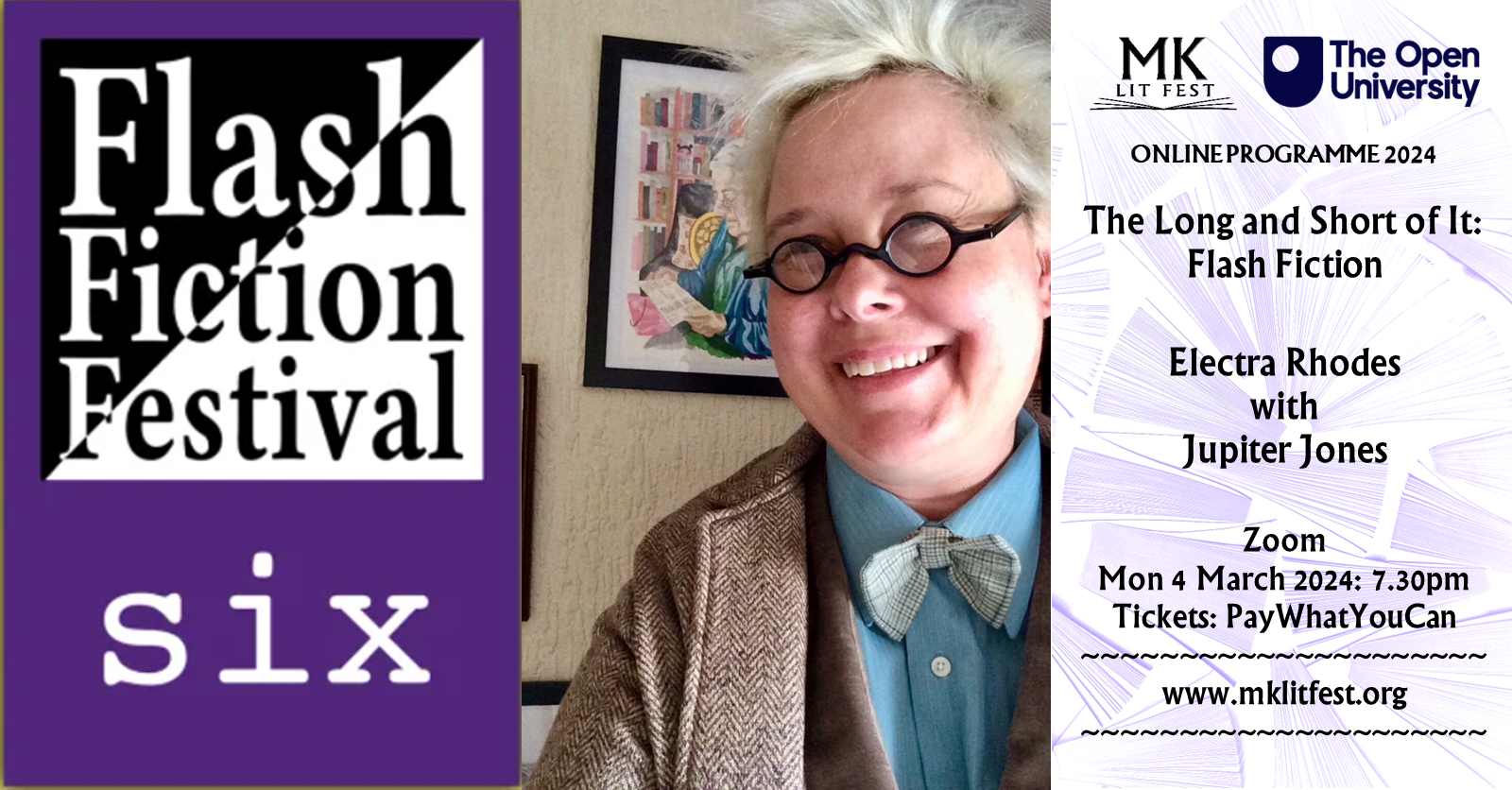
 

A banner promoting an online event on Flash Fiction with author Electra Rhodes in conversation with OU PhD student Gwyneth Jones on Monday 4 March at 7pm. The image features a headshot of Electra Rhodes, a Caucasian woman with short platinum blond hair, wearing a blue shirt, a dicky bow and small circular glasses.

Flash fiction, which tells a complete story in just a few hundred words, takes brevity as its starting point and as permission to break rules. It holds in tension the practice of narration (the art of spinning out events in an engaging way) and techniques of concision (eliminating all but the most necessary) to imply much more than is actually on the page.

I began writing flash fiction about seven years ago, fascinated by the way it can use form as content and by the way the writer enfolds meaning for the reader to discover. Flash is neither easy nor quick to write, but it does offer great freedom to experiment.
A miniature maze created with wooden pegs.Things that might be difficult to sustain or that would become exceedingly tedious in longer form fiction can be creatively explored within the sandbox of flash. Unusual points of view for instance, unusual tenses (future conditional, perhaps?), or alphabet games. Some inspiration for this comes from the Oulipo Group who impose strange external restrictions to gain writerly freedom – Oulipians are said to be ‘like rats building a labyrinth from which they plan to escape’. These are some of my labyrinths.


Unusual Point of View
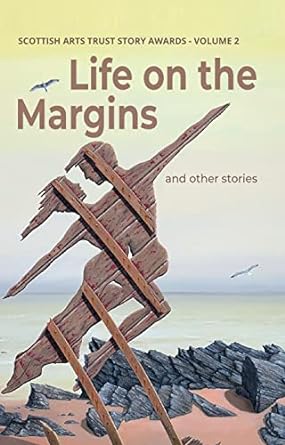
Life on the Margins and other stories book cover. The book cover features the background of a rocky beach and a wooden cut out of a couple dancing.
Life on the Margins: And other stories from the Scottish Arts Trust Story Awards (Volume 2)

Writing in second person can be slightly disconcerting for the reader who is asked to identify with the ‘you’ of the narrative. This is an excerpt from my flash fiction ‘Not Lost or Drowned’ published in Life on the Margins, about a woman escaping from a toxic relationship.

You’re staying alone in a caravan. You walk to pass the time. Sometimes you take the bus into town, cruising past trinket shops. You see missing posters, signs of desperation, fly-posted along the coast. She has, or had, the same name as you. Unsettling to see it there above a number to call, day or night. You memorise it, test yourself at the next poster, and the next, till you know it by heart.

Fibonacci Sequences
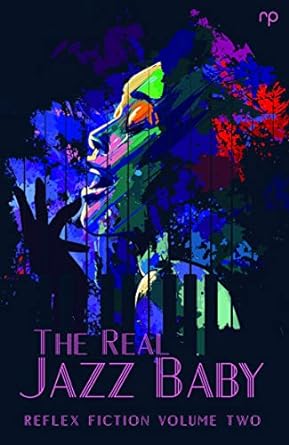
The Real Jazz Baby: Reflex Fiction Volume Two Book Cover. Featuring a vintage style illustration of a woman singing. Vibrant colours, with hues of black, blue, red, purple and green.
Book Cover: The Real Jazz Baby – Reflex Fiction Volume Two

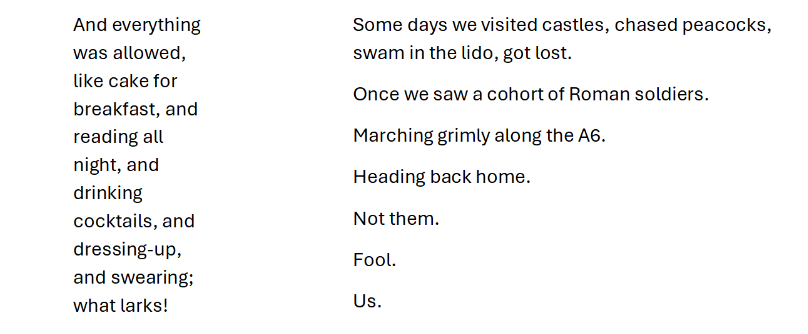
That is, writing in sentence lengths that correspond to the Fibonacci sequence where the last two numbers are added together to make the next (e.g. 1,1,2,3,5,8,13,21, etc). The rigidity of form compels the writer to add and/or subtract words with potentially unexpected results. I wrote ‘Aint no Cure for my Fibonacci Blues’ (published in The Real Jazz Baby)  inspired by summer holidays with my slightly batty aunt. It opens with two one-word sentences and builds up to a fifty-five-word sentence and then back down. This is the ending:


Lipograms

The Oulipo group often devised lipograms – omitting one or more letters of the alphabet. The letter e, of course, is the hardest. I tried this in ‘No e in Pornography’ about a man whose ‘browsing history rats him out’ which was published online by Reflex Flash. I think the lack of e gives the writing a spikey brittle quality.

Not so sorry, thinks Nina, for abnormal cravings. Not sorry to bring havoc to Nina’s world. In outwardly lax administrations, such things flourish with abandon. Sonny looks long at icons of dissipation; nothing is off limits to a thin bald man with roving digits.


Breathless Paragraph

A form quite common in flash fiction is ‘the breathless paragraph’, that is, maybe three or four hundred words, written as one continuous sentence. This can result in a soaring arc of narrative or a relentless sense of inevitability. ‘Exegesis’ was published in the anthology In Defence of Pseudoscience

They’ll say she was asking for it, look at her, in her cheap skirt, scuffed heels, bitten nails and it’s obvious how she started out, a skinny, snot-nosed kid off the estate, no pony rides or chocolate eclairs for her, no, it was all ‘never mind your homework, mind your brothers,’ coz her mother was on tablets for her nerves, and what can you expect, absent father, feckless mother, things like that make a girl grow up fast, start using what she’s got to get where she wants,  but as the saying goes, fruit doesn’t fall far …

Some other examples of experimental flash fiction from some brilliant writers:

  • Hermit Crab, taking a ‘readymade’ form such as a recipe, or lonely-hearts ad and telling the story within that form. Tim Craig’s ‘That’s All There Is, There Ain’t No More’ uses cribbage instructions.
  • Conceit or extended metaphor such as ‘Unbinding’ by Kathryn Aldridge-Morris which begins ‘My mother was a First Edition Pelican original’.
  • Inventory, using a list to tell the story such as ‘LifeColour Indoor Latex Paints – Whites and Reds’ by Kristen Ploetz.

The experimentation and playfulness of flash fiction is a big part of its appeal for me. Sometimes the constraint of the experiment –  ‘the labyrinth’ – will be evident in the finished work. At other times, it is nothing more than an escape hatch or a catalyst to spur creativity.
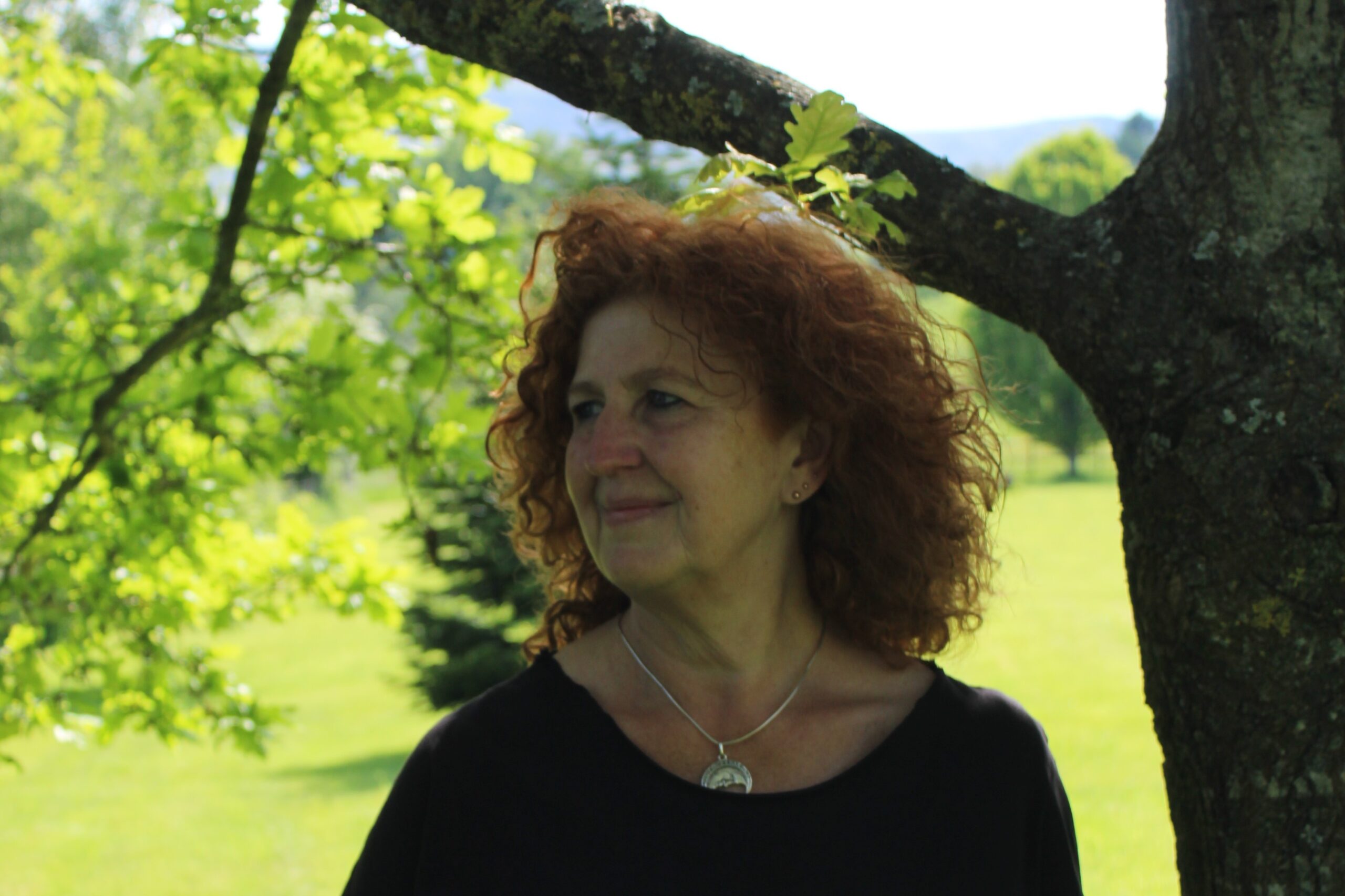
A headshot of Gwyneth Jones, a Caucasian woman with curly ginger hair, wearing a round neck black blouse and a silver necklace with a silver pendant.
Gwyneth Jones, a writer of short stories and flash fictions

Gwyneth Jones is a writer of short and flash fictions under the pen name Jupiter Jones, and her work has been widely anthologised. She is also the author of three novellas-in-flash, the most recent, Gull Shit Alley and Other Roads to Hell was shortlisted for the Saboteur Award. She is currently a PhD candidate at the Open University researching (dis)connectivity in the novella-in-flash. Her supervisors are Dr Emma Claire Sweeney and Dr Jane Yeh.
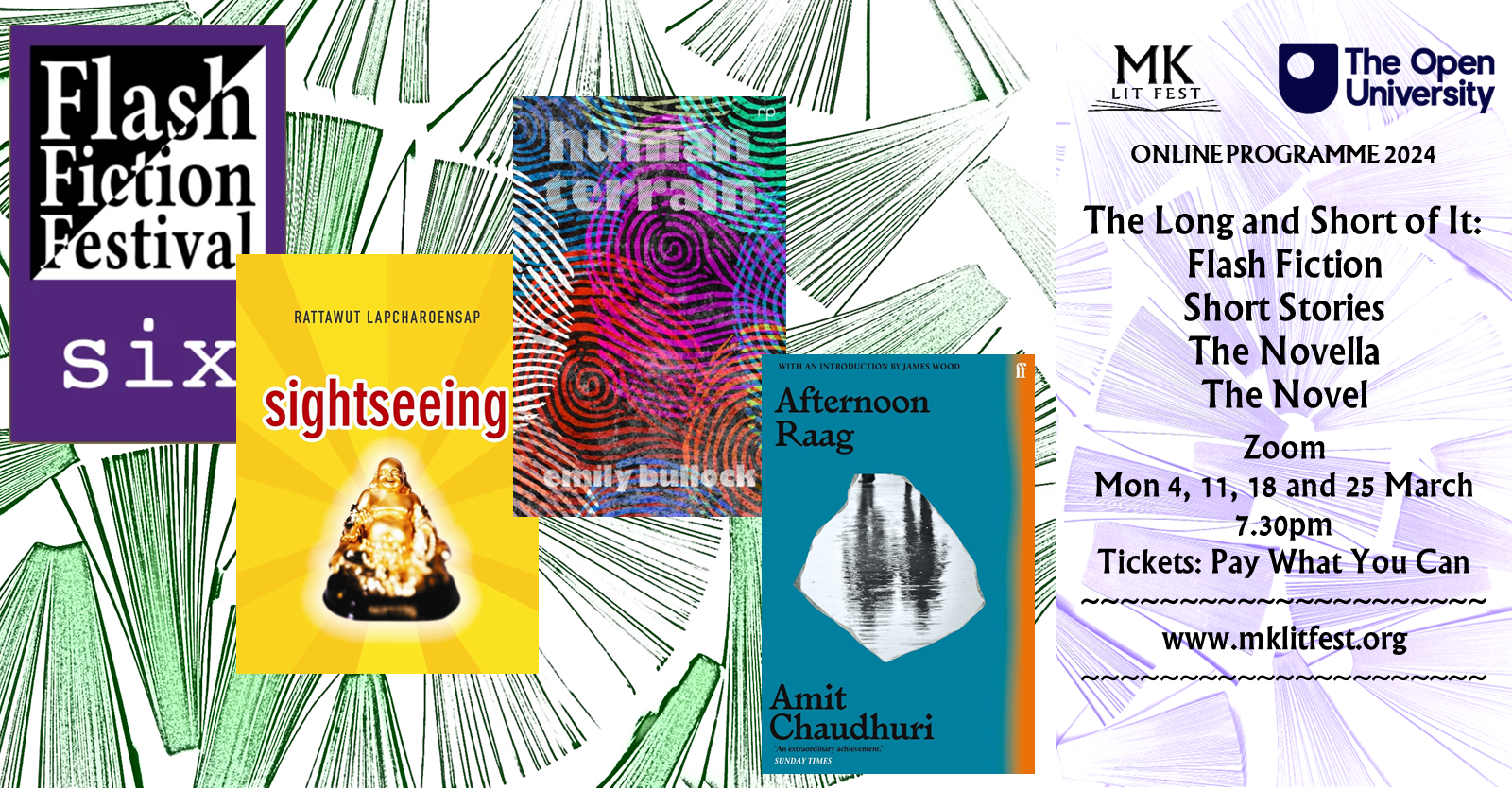
 

A poster showcasing the four zoom online events covering flash fiction, short stories, the novella and the the novel. Featuring Emily Bullock, Amit Chaudhuri, Rattawut Lapcharoensap, Electra Rhodes and Jupiter Jones. Taking place on Monday 4th, 11th, 18th and 25th March at 7:30pm.
List of The Weekly Online Zoom Series from Monday 4th March – Monday 25th March at 7:30pm

Go to MK Lit Fest’s website to book your free ticket for Gwyneth Jones’ online event with acclaimed flash fiction writer Electra Rhodes


Posted on 23rd February 202423rd January 2025

It’s not about you! Top tips for chairing literary events

The Open University’s Art’s Research Centre collaborated with Milton Keynes Literary Festival to train OU staff and MK Lit Fest volunteers to chair conversations with authors ahead of our joint events series, The Long and Short of It: From flash fiction to the doorstop novel.

Here, part-time PhD student, Antonia Saunders, who attended the training on campus, shares with us what she learnt.

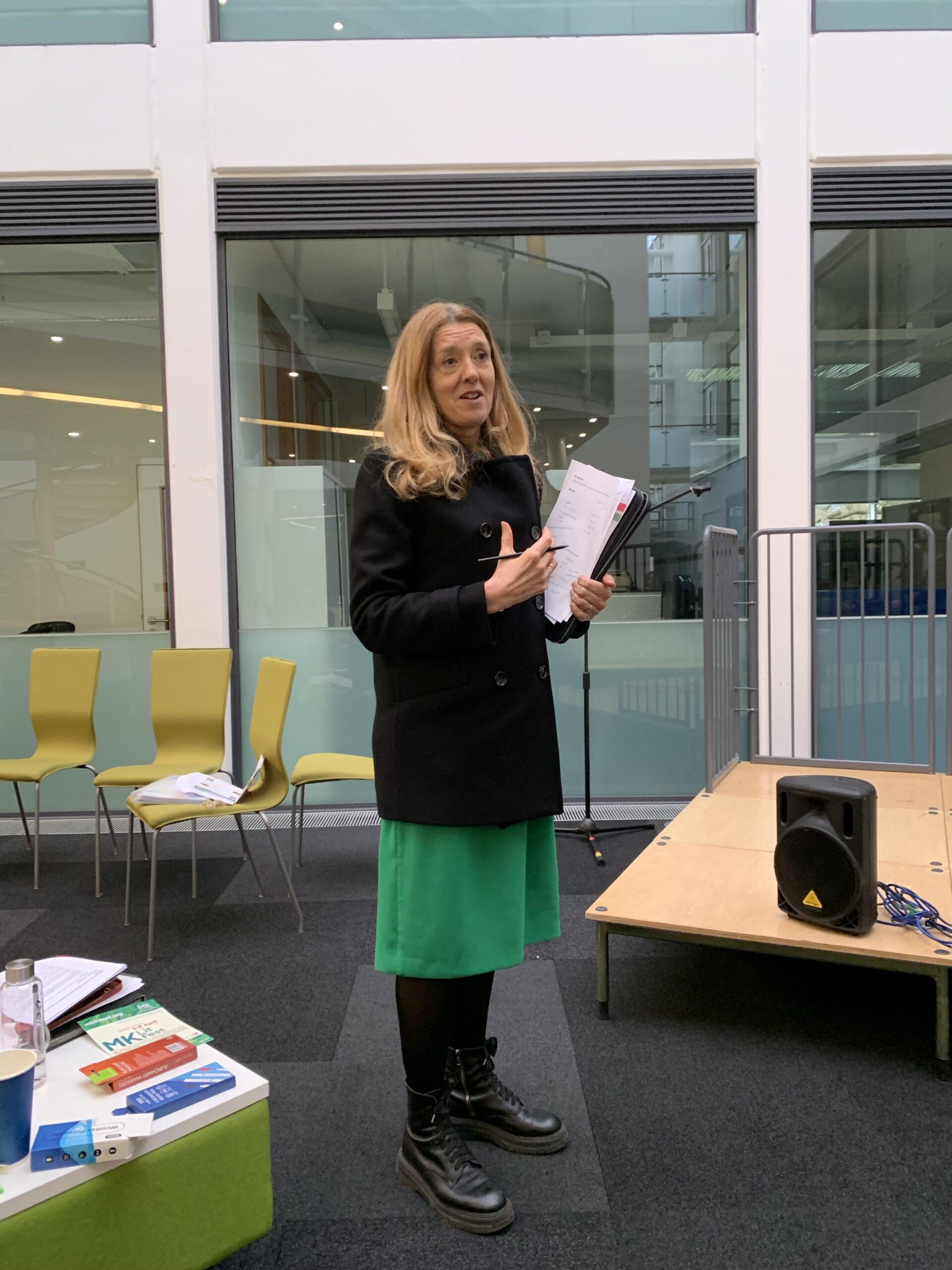
A middle-aged white woman with long blond hair, wearing a green dress. She is standing up and talking.
The training was led by Julia Wheeler, a writer, journalist and interviewer who worked for the BBC for more than fifteen years. Julia chairs discussions at festivals across the UK as well as in the Middle East and North America. She has moderated events at The British Library, The Royal Geographical Society and onboard Cunard’s Queen Mary 2.

What’s the role of a moderator?

A great moderator is hardly noticed. You are offering a space for the author to shine. This includes asking relevant, interesting and concise questions. It’s your job to judge and manage the energy of both the audience and the author. A good sense of timing is crucial. Give the author the chance to respond engagingly to your conversation-starters, and leave time for questions from the floor. When an event is going well, you hardly notice the moderator.

How should a moderator prepare?

The weeks before: be the class swot. Become acquainted with the author’s latest work or the book they are promoting. A close reading will help you to form relevant questions related to central themes. It’s also beneficial to have some knowledge of the author’s backlist. Reading reviews can help to open up ideas from another perspective, and previous interviews can help you to avoid well-trodden ground and come up with some fresh and insightful questions. Follow the author on social media. Have they posted something recently that you can ask them about? Tailor your questions to the audience and event. Keep your questions focused on the guest as a writer. Remember, you aren’t revising for an exam, you are preparing for a fascinating conversation. What do you hope to discover about the author and their work?

One week before: be a safe pair of hands.

Contact the author to remind them of the event blurb, time and place. Include your own short bio so that they have a sense of who you are. Tell them how much you are enjoying the book and pull out something specific to praise.

Confirm whether the author is planning to read from their work, making clear that a reading should not last for more than two minutes. With a poet, you might weave a few short readings throughout the conversation, and you might end with a reading too. With prose, one short reading is sufficient.

Be upfront about certain themes you’ll need to cover to be true to the event description. Ask if there is anything the author would especially like you to ask – that dream question, perhaps, that no one has asked about before. Don’t close the conversation down by asking if there’s anything they do not want to cover. If the author happens to raise any no-go areas, though, be sure to respect them.

The hour before: You’re in charge!

Arrange the chairs so that you are angled towards one another while facing the audience. Bring a cookbook stand to position the book the author is promoting. Engage technical staff to check the audio equipment is working. Ensure the stage is clear of any trip hazards. Pour out the water before. Brief any volunteers who might be holding the roving mics. Ask them to keep hold of the mics where possible to prevent an audience member from hogging it, and to allow the volunteer to move quickly to the next question to avoid delays. Show the space to the author and advise them that you will enter the stage first and motion them to their place. Be confident and politely assertive.

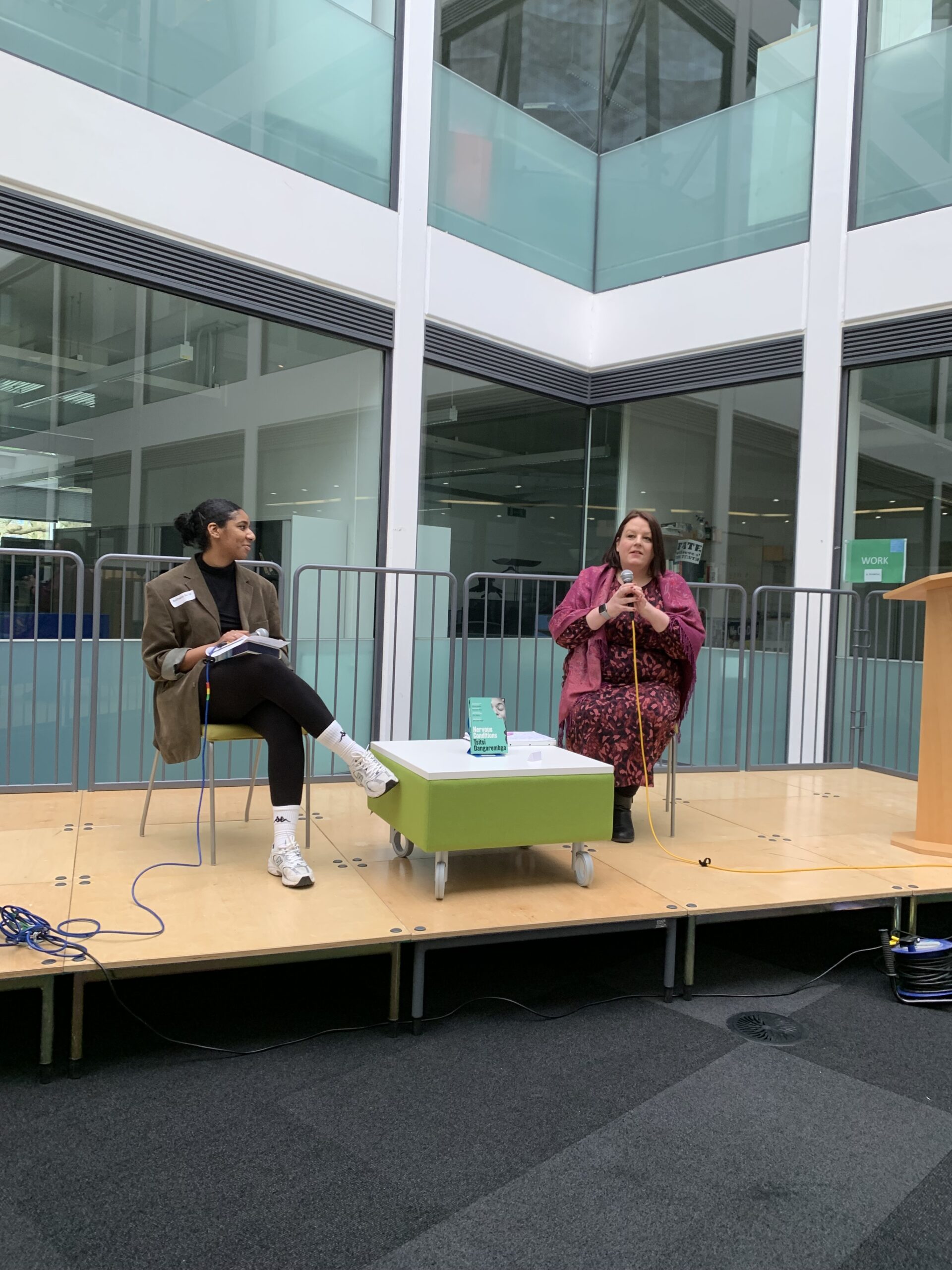
A middle-aged white woman is interviewed on stage by a young black woman.
OU PhD student Antonia Saunders (right) is interviewed on stage by an MK Lit Fest volunteer.

How should a moderator handle the event itself?

Introductions: Short and punchy

Your introduction should include your name, the name of the event, and a brief description of the author and their work, ensure you mention their latest book. Three or four lines should do the trick. The audience is there to hear from the author so segue swiftly into your first question.

The conversation: Wear your research lightly

Distill your research into a one-page cheat sheet, which you can hide behind a copy of the author’s book! You should avoid referring to this too often, but it can offer a crutch to remind you of important quotations, or to jog your memory with a question to keep a conversation on track.  But it’s important to listen to your guest and respond to their answers appropriately, rather than stick to a pre-formulated list of questions. It should be a conversation not an interrogation!  By briefly summarising the author’s answer you can segue into a deeper exploration of that topic, or you can close it off and move onto another area of interest. Don’t necessarily ask your best question first, rather give the author the chance to warm up. Ask open questions (what, why, how, tell us about, to what extent) to encourage the author to open up. Be prepared to keep the conversation going if the author is a little timid or to anchor the conversation if the author is very talkative. Have a phrase to bring things back if things go wrong. Responses like ‘people always ask that’ or ‘That’s wrong’ can be disconcerting, so have a very open question up your sleeve. ‘What would you like readers to take from the book?’ or ‘What inspired you to write about…?’ Try to maintain eye contact and ensure your body language conveys that you are engaged by what the author has to say.

Handling a panel: Create a dinner party vibe

You’ll need knowledge of one or two texts by each author. Keep in touch with all guests on an email chain. Set up the chairs in a curve, with you at one end and the author you expect to be easiest to work with at the other end. Ensure you give each panellist equal opportunity to speak, regardless of status. A question like ‘how does that resonate with you?’ can be a good way of acknowledging one response before moving onto the next author. Allow the conversation to flow, and don’t be afraid of a little controversy.  Set some hares running!

Online events: The same but different?

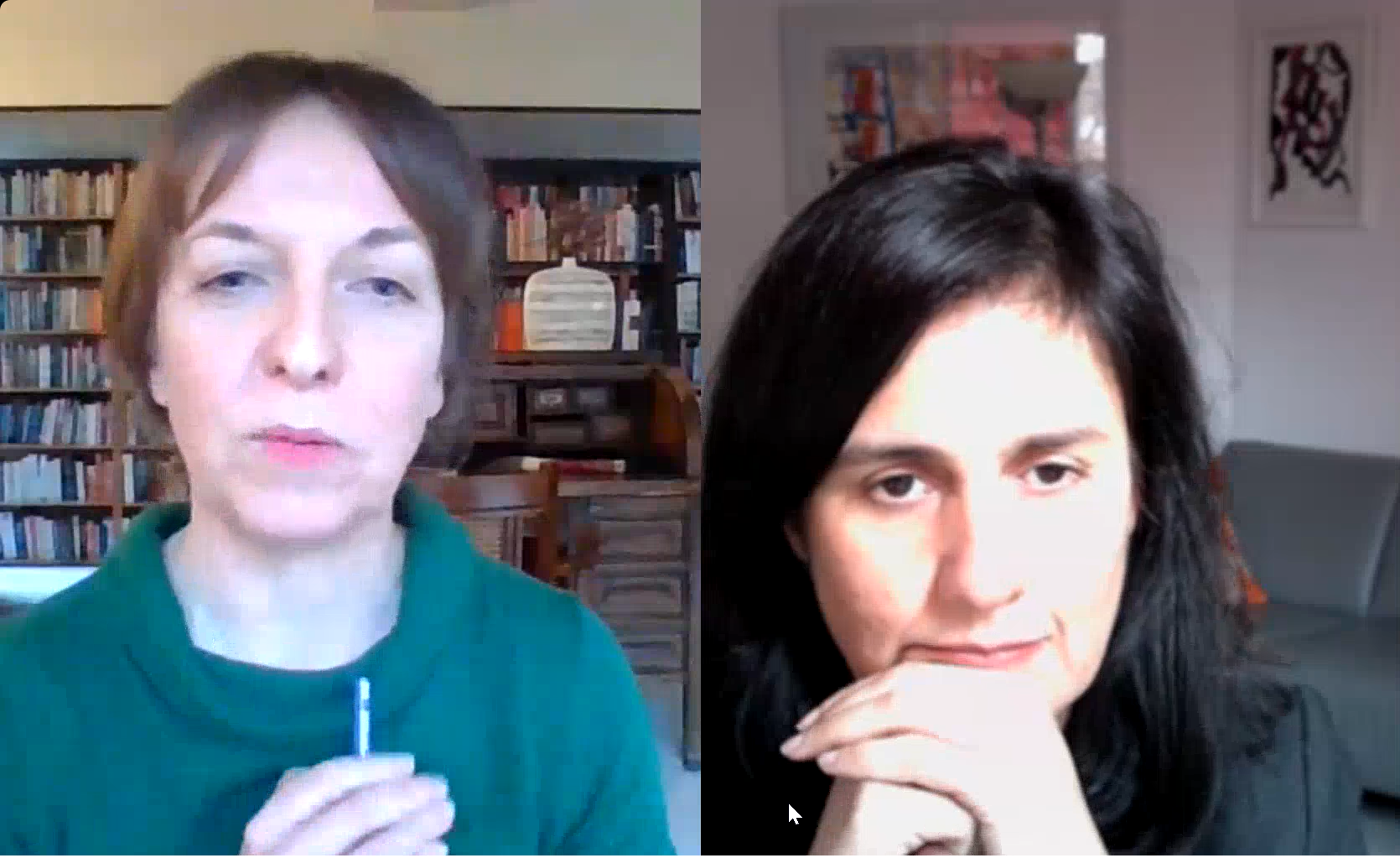
A middle-aged caucasian woman in a green rollneck top sits in front of bookcases. She's talking on a Zoom call to a middle-aged Asian woman, who is sitting closer to the screen.
Kamila Shamsie (right) in conversation with Emma Claire Sweeney. Spot the deliberate mistake?…They are not similar distances from the screen!

Check your download speed to ensure your WiFi is working at sufficient speed, and switch off any alerts. Think about the aesthetics of the screen. Lighting should be in front of you, and the author’s book visible behind you. Log in with the author ahead of time to position yourselves a similar distance from the screen. Wear bold un-patterned clothing. Give yourself enough time right before the event to ensure everything is working. Mute and turn off audience cameras during the main discussion. If an event is hybrid, direct one of your first questions to the author dialling in to ensure their voice enters the room early on.

You will need to make extra effort to inject energy into an online conversation to keep it lively and engaging. It’s a good idea to pull questions out of the chat as you go along, rather than saving them all for the Q&A. Remember to nod and smile as the author is talking to show your engagement.

The Q&A: The question in that is…

Establish boundaries at the beginning of the session. Ask the audience, for the sake of time, to keep questions short and punchy. If the audience member gives a comment rather than a question, try to rephrase it as a question. If a question is particularly long, then announce your intention by saying ‘I’m just going to interrupt you there’. This takes the heat out of the interaction. Avoid saying that you have time for one more question in case that question is a dud! And have a supplementary question ready in case the discussion dries up.

Closing: End on a high

Keep to time. Audience members might have other places to be, and event organisers often have a swift turnaround between events. Put as much thought into your closing word as your opening ones. Thank the audience for coming. Give clear directions about where the book is on sale. Thank the author too, of course.

Afterwards: Be kind to yourself

There are almost always things you might have done differently in hindsight. But if you’ve kept your own ego in check, and helped the author take centre stage, then it will have been a job well done.

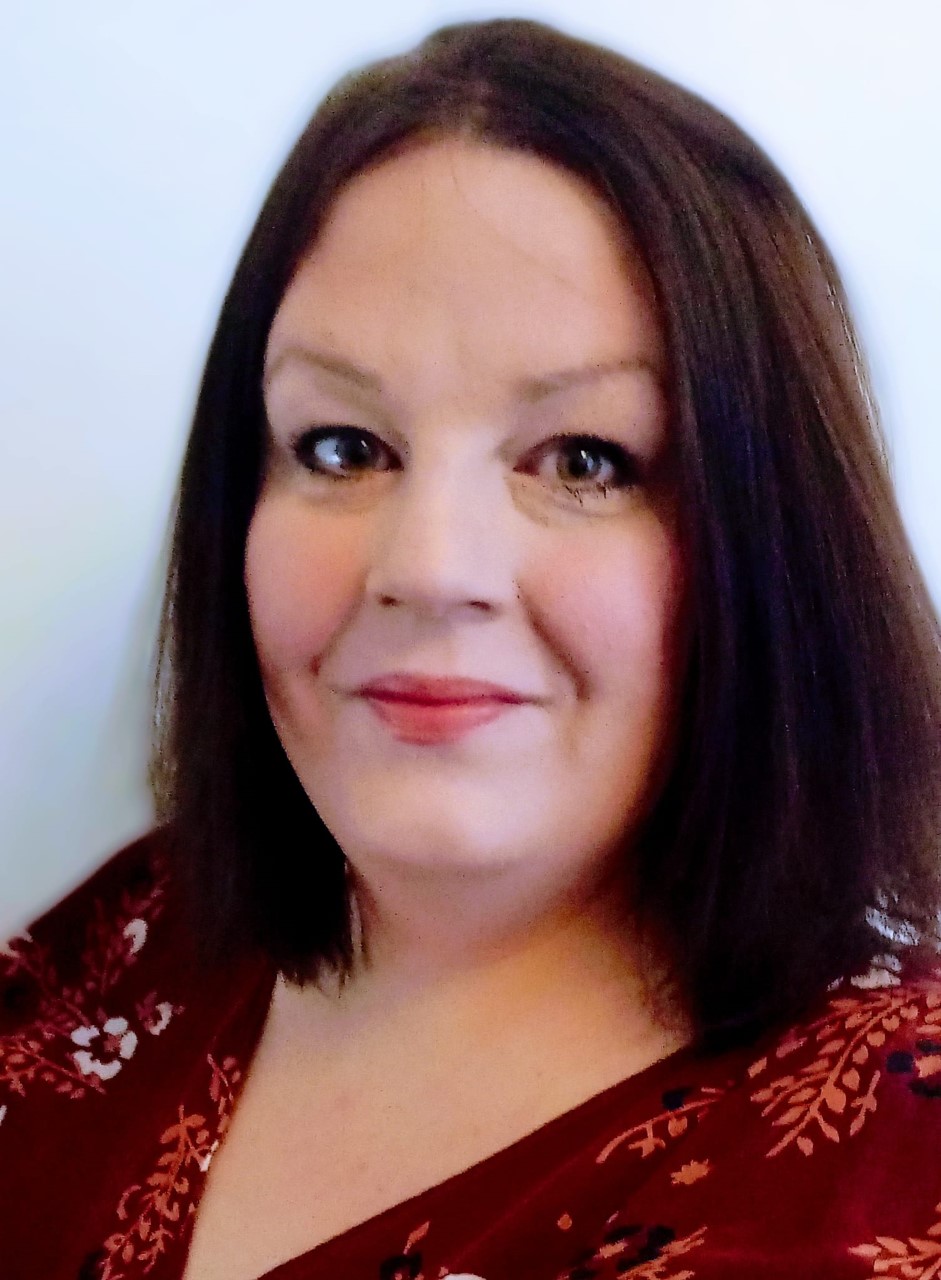
A headshot of a middle-aged Caucasian woman with a brunette bobbed hairstyle, wearing a maroon floral-patterned dress.
Antonia Saunders

Antonia Saunders studied for both her BA and MA at The Open University. Her part-time PhD looks at the construction of a Jewish Identity in histories and novels of the nineteenth century, and considers the literary and historiographical contexts of representations of Jewish people and Jewish Identity. She is co-convenor of the GOTH (Gender and Otherness in the Humanities) Postgraduate Forum, and she’s chaired discussions on the trope of the ‘Madwoman in the Attic’, gender fluidity in the arts and humanities, the non-human as other, and most recently, feminist readings of fairytales. Her supervisors are Prof. Delia Da Sousa Correa and Prof. Suman Gupta.


  • Bluesky
  • Instagram
  • Spotify
  • YouTube
  • Bluesky
  • Instagram
  • Spotify
  • YouTube

News

    About Proudly powered by WordPress