AwDUra: Increasing the representation of Global Majority communities in Welsh children’s literature.

This post is the English translation of a Welsh-medium article by Dr Gwenllian Lansdown Davies and Angharad Morgan written for a special edition of the Primary First journal, edited by the Open University’s Early Childhood team ( Journal – NAPE )

Mudiad Meithrin (originally Mudiad Ysgolion Meithrin) was established in 1971 to nurture and support a landscape of Welsh-medium play and learning experiences for children from birth to school age throughout Wales. Our vision is that every child in Wales should have the opportunity to play, learn and grow through the Welsh language. We are passionate about giving the Welsh language to the children of Wales, and believe that children benefit from being bilingual and multilingual. As an organisation, our aim is to develop, support, provide and facilitate childcare and Welsh-medium education in Cylchoedd Meithrin (playgroups) and registered day nurseries. Why then did we step into the field of publishing children’s literature?

Why children’s literature?

Like many other individuals and organizations across the world, the murder of George Floyd in Minneapolis back in 2020 was the trigger for us to look objectively at our work, and we are now at the start of the journey to be an anti-racist movement.

Simply put, there are three main strategic drives to our work in this regard. Firstly, the curriculum for non-maintained funded nursery settings in Wales (namely Cylchoedd Meithrin and day nurseries) states the need to “ensure that every child has a strong sense of belonging, that they feel valued and represented in our setting”. Secondly, the Welsh Government’s commitment to developing Wales as an anti-racist nation by 2030 is an important target. Thirdly, it is the morallycorrect thing to do considering that the Welsh language belongs to everyone.

The concept of ‘cynefin’ – which is translated in English as ‘the place where we feel we belong’ – is a fundamental element of our curriculum. A wide range of research indicates the importance of ‘seeing myself’ in books and across various media for children and adults as a way of fostering a sense of belonging to a community.

In order to achieve these visions, our education and childcare systems need to expand the understanding and knowledge of children, young people and staff of the various cultures that are part of our past and present here in Wales. We must ensure that the ‘cynefin’ we present as part of our provision is inclusive.

The Welsh language has a rich history of telling stories, in print and orally. Nevertheless, one of the many challenges for our traditional institutions is to ensure that our Black, Asian and Ethnic Minority or Global Majority communities are seen as part of Welsh and Welsh-speaking life and culture.

Mudiad Meithrin has a history of publishing books for children since its establishment in the early 70s and the series of reports ‘Respecting Realities’ published by the Centre for Literacy in Primary Education since 2017 strengthens the argument to intervene in the market to ensure the presence of minority cultures in mainstream Welsh medium literature for children.

Our intention was therefore to support and stimulate work by Black, Asian and ethnic minority authors (or global majority) to produce work for children in Welsh. It was important for us to ensure that Black, Asian and ethnic minority individuals were part of the planning work and we had the support of several individuals including members of our Board of Directors.

From ‘Authors’/‘AwDUron’ …

Following the initial phase of planning, it was necessary to identify and seek various sources of funding to finance such a plan. We were fortunate to receive grants from the Welsh Government, a grant from a philanthropic fund, and crowdfunding to develop our vision. The funding is essential to ensure that the mentors and prospective authors receive payment for their commitment to the scheme.

The initial scheme ‘AwDUron’ was launched by specialist translation company ‘Lily Translates’ and Mudiad in 2022, with a call for authors from a global majority background to work together with us to translate books they had already published in English into Welsh.

The aim of the ‘AwDUron’ scheme was to give a voice and a platform to Black, Asian and ethnic minority communities to write, create and publish stories for children in Welsh so that children see themselves and the diversity of our country in books.

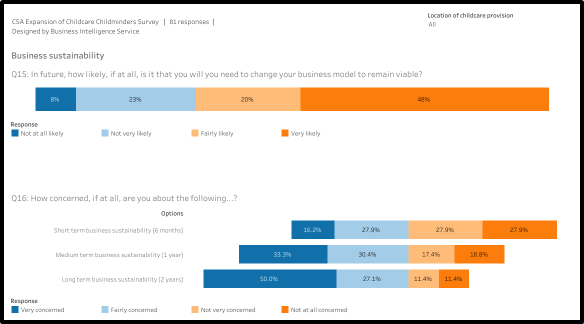
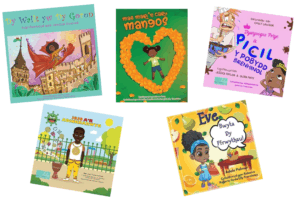
The ‘AwDUron’ scheme has led to the publication of 5 new books in Welsh:

  • Jojo a’r Adinkrarwyr (Jojo and the Adinkrars) by Jodi Twum-Barima;
  • Eve, Bwyta dy Ffrwythau (Eve, Eat Your Fruit) by Adele Palmer;
  • Y Dywysoges Priye & Picil y Pobydd Brenhinol (Princess Priye & Pickle the Royal Baker) by Jessica Taylor and Olivia Priye;
  • Mae Mari’n Caru Mangos (Mari loves mangoes) by Marva Carty;
  • Dy Wallt yw Dy Goron (Your Hair is Your Crown) by Jessica Dunrod.

… to ‘Author’/’AwDUra’

What then is the difference between the ‘AwDUron’ scheme and the ‘AwDUra’ scheme? The two names are actually a play on words: ‘awdur’ (the Welsh word for author) and ‘awdura’ (the verb for ‘to author’)… and both contain the Welsh word ‘DU’ (Black). The emphasis of the ‘AwDUron’ scheme was to translate work that already existed in another language. The aim of ‘AwDUra’ on the other hand is to support authors to develop original work in the Welsh language. As explained above, the ‘AwDUra’ scheme was introduced in partnership with ‘Lily Translates’ (and the author Jessica Dunrod), the first translation company in the UK that specializes in translating children’s literature.

In order to do this, we have to overcome the challenges that come with encouraging new writers to write in a minority language  – which may actually be their 2nd or 3rd language – and which they may not engage with outside of a formal, academic environment.

From the applications to ‘AwDUra’, ten candidates were selected to be part of a mentoring and support process by Manon Steffan Ros (prolific author and Carnegie medal winner) and Jessica Dunrod (author and founder of ‘Lily Translates’). The process included workshops, one to one meetings and opportunities to listen to other published authors such as Marva Carty and Dr Ishani Kar-Purkayastha.

All authors received support and feedback from internationally renowned authors and industry mentors, encouraging them to continue to create quality children’s literature even after the project ended.

Ultimately, 4 works were chosen to be published based on their content, their storytelling skills and their relevance to ‘Cynefin’ and the Curriculum for Wales – books by Chantelle Moore, Theresa Mgadzah Jones and Mili Williams together with a cartoon by Sarah Younan published in the magazine ‘Wcw’ (in partnership with Cylchgronau Golwg Cyf.). Here are the details of the books:

  • Y Brenin, Y Bachgen a’r Afon (The King, The Boy and the River) by Mili Williams
  • Mamgu, Mali a Mbuya (Grannie, Mali and Mbuya) by Theresa Mgadzah Jones
  • Granchie a’r Dderwen Fawr (Granchie and the Great Oak) by Chantelle Moore

A few other participants – Natalie Jones and Nia Morais – continued to develop their creative work with other publishers and also produced important resources for us (a resource on John Ystumllyn and a poem). The AwDUra scheme has shown that, by working together with authors, publishers, and critical friends, positive and constructive steps can be taken to improve the representation of Global Majority communities in original Welsh literature.

Books on the Web

Following a successful application to the Windrush Cymru fund in 2024, we set about developing a digital, visual version of Chantelle Moore’s book, Granchie a’r Dderwen Fawr. The video has been published on our YouTube Channel for children  – Dewin a Doti Channel. Here you can also see the presenter Seren Jones reading the book ‘Mam-gu, Mali a Mbuya’. These are invaluable resources that are freely available to everyone.

Where Next?

Mudiad Meithrin is still learning. But the scheme has also borne fruit more widely… as the authors go to present their books in schools, libraries and bookshops across Wales. In addition, we see anti-racism conferences referring to the importance of the anti-racist Welsh bookshelf, blogs about the history and development of ‘AwDUra’ being published on our website, collaboration with the National Library in Aberystwyth, and seeing increasing pressure on other bodies to reflect on their contribution to this crucial field.  Mudiad publishes countless resources that are anti-racist in nature: from resources about nursery rhymes in various languages, to ‘Cymru Ni’ (resources about Black Wales) to a ‘Cylch for all’ inclusiveness pack, a ‘Come and Celebrate’ religion pack and strategic and practical collaborations with DARPL providing anti-racist professional learning opportunities, creating useful guidelines for the childcare sector and producing resources on understanding anti-racism in its historical and political context.

We have now bought the book rights to ‘Dy Wallt yw Dy Goron’ and have republished it under the name of Mudiad Meithrin.

We continue to look for funding that will enable us to develop the scheme further. Our hope is to be able to fund the ‘AwDUra 2’ scheme to respond to the need to develop creative and educational resources to support learning and teaching which is in line with the Curriculum for Wales and which builds on the foundations laid by the original ‘AwDUra’ programme. This will contribute towards ensuring that all Welsh children see themselves reflected in their resources and contribute constructively to creating an anti-racist atmosphere in the Cylch Meithrin, the nursery and the classroom.

Above all, we are passionate that we want to continue to encourage authors from a Global Majority background to write for children and to write in Welsh; to create a sense of belonging; to celebrate an inclusive environment; and to celebrate the diversity of Wales in the visual and literary representations of our children.


Posted in Uncategorised | Leave a comment

Is he happy? Summary of an investigation to discover the influences on the happiness of young children while at school.

This post is the English translation of a Welsh-medium article by Dr. Carys Jennings written for a special edition of the Primary First journal, edited by the Open University’s Early Childhood team ( Journal – NAPE )

One of the three questions that parents often ask during a meeting with their child’s teacher is, does he listen? Does he have friends? And the favourite – is he happy at school?

Happiness at school is important for parents, teachers and pupils because it can contribute to fostering a positive learning environment, which can also possibly help improve academic performance and the individual’s personal growth (Musgrave, 2017). I know from my  own experience as a class teacher and researcher, that when pupils feel happy they are more motivated, they are better engaged and are ready to participate in activities and lessons, leading to better learning outcomes.

For parents, a happy school experience supports their child’s emotional well-being and helps them develop confidence. And when the pupils are happy, teachers can benefit from a comfortable classroom climate which often leads to better behaviour, easier relationships and effective teaching. Usually children spend a significant period of their lives at school therefore understanding what influences their happiness is a matter that should be considered seriously (Jennings, 2025). Overall, happiness promotes a sense of belonging and encourages enjoyment of learning.

What? Child wellbeing in the context of education in Wales

There has never been a time in Wales when such priority was given to the importance of children’s well-being and to children’s voices, significantly within the context of education. This can be seen clearly in the latest education reform documentation Curriculum for Wales (CfW) (2022), which has been implemented as a rolling programme across Welsh schools since 2022. Although the health and well-being of children has been the foundation of the Welsh education system for several decades, there is little research that shows that the system includes and responds to considerations related to children’s emotions by including their voices as influential factors.

Well-being or happiness?

Musgrave (2017) and Layard (2018) argue that investing in the well-being of young children is a valuable investment for the individual and for society, emphasizing that all adults share the responsibility of supporting the health and well-being of our youngest citizens. They also note that, like happiness, the concept of well-being is challenging to define and explain (Musgrave, 2017). With so many different definitions of well-being, there is a danger that its importance will be underestimated due to the lack of consensus on its meaning (Sharman, 2019; Manning-Morton, 2014). However, Sharman (2019) claims that, although an accurate or precise definition is difficult, there is broad agreement within research literature that well-being, in essence, includes positive emotions such as happiness and joy, which help to overcome negative feelings such as depression and sadness.

Ensuring children’s wellbeing has always, and continues to be, a shared responsibility between professionals (including teachers) and parents. Some methods of measuring well-being, such as testing specific growth and developmental stages from birth and tracking progress in areas such as response, hearing and weight, have continued over time (Bedford et al., 2013). However, recently there has been an increasing focus on children’s emotional well-being, both in the media and within domestic policies in Wales.

This change has been driven by reports such as The World Happiness Report (2025), The Good Childhood Report (2024) and Welsh Government research, ‘Well-being Wales, 2022: The well-being of children and young people’ which highlights the importance of children’s well-being and happiness. The Well-being of Future Generations (Wales) Act (2015) outlines recommendations for the well-being of communities, and the document Our Nation’s Mission (2017) acts as a foundation for current educational reforms to ensure the well-being of children within the curriculum. In CfWs documents (2022), Health and Wellbeing is recognized as a key area of ​​learning and experience, reflecting how well-being is now central to children’s education in Wales.

Why happiness as a research focus?

The reasons for focusing on children’s happiness rather than their well-being stemmed from the belief that happiness is a key part of a wider general well-being. It was one of the themes that constantly resurfaced within my practices as a teacher and researcher. The well-being and voice of the child are core considerations when developing pedagogies as a teacher, to ensure effective and appropriate provision. Happiness is a central and essential aspect of a child’s emotional state, and when it is nurtured within the educational space, positive outcomes are more likely to occur. By prioritising happiness, we lay the foundation for emotional well-being, which in turn can lead to better learning, stronger relationships, and a more positive school environment.

Researchers in the field of Psychology and Sociology state that happiness is a subject of worldwide importance (Seligman, 2000; Haan, 2002). Happiness is considered an integral part of an individual’s well-being and which contributes significantly to the quality of life (Layard, 2020). Layard adds that the attention given to happiness in the media has doubled since 2010, and incidents involving mental health have increased over five times more frequently (Layard, 2020). This is also seen within published research with only small numbers existing in 2000 to around two thousand per year within educational, economic and psychological texts in 2020 (Seligman, 2011) but they rarely include the voices of young children. This leads us to the conclusion that happiness is a developing field, and could be considered a culture in itself.

Where? The importance of the learning enviroment

Any discussion about a child’s happiness will eventually turn to the world the child lives in; and any solution to education must address the adults who create the conditions in which learning takes place (Harrison and Hutton, 2013). It is widely believed that focusing on children’s happiness at school is essential because it plays a core role in their overall well-being and development, but it is often overlooked in favour of wider wellbeing, academic performance or a means of controlling behaviour.

Happiness in the school environment can significantly improve a child’s emotional and psychological growth, fostering resilience, creativity and the desire to learn. As someone who is very interested in this aspect, I believe that when children feel truly happy and supported at school, they are more likely to thrive socially, emotionally and academically. This is not only important for the children themselves, but also for parents and teachers, who benefit from seeing the children develop a positive relationship with the school. When a child’s happiness is prioritised, it lays the foundation for a lifelong appreciation of learning, as well as a healthier, more balanced approach to education. It is therefore believed that by highlighting the emotional side of education, we can create a more holistic, compassionate environment that supports the well-being of all.

How: The investigation

A qualitative study was carried out as part of my Educational Doctorate to investigate the influences on the happiness of young children at school, and to find out if this information, when shared with the children’s teachers, could further improve their understanding of their pupils and be a factor that contributes to the children’s emotional well-being. The participating sample was drawn from across three counties in Wales and from different schools in terms of size, language and geography. Although a small sample of nine children and six teachers were included within the data, the results were sufficient to demonstrate themes and relevance to classes across Wales (Bassey, 1981).


The procedure below was followed in terms of getting to know the participants and collecting the data with a second visit to ensure a correct analysis of what was collected in order to present it correctly.

Visit1- With teachers, explain the purpose of the research

Visit 2- speak with the children and gather the various data

Visit 3- share feedback from visit 2 and collect initial data from the teachers (current practice)

Visit 4- re-visit with the teachers to see if their practice had changed


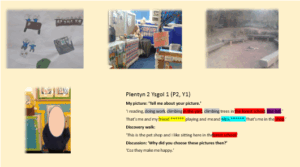
Braun and Clarke’s (2022) thematic analysis method was the vehicle for identifying themes within the data and the children’s responses were shared by collating works (below) that brought together their drawings, paintings, transcripts of the conversations and photographs of what made them happy at school.

The decisions made by the researcher about how the research is handled include accountability and taking responsibility for those decisions (Clark, 2017), this was in line with my personal values ​​of securing children’s voices as a necessary source within research that relates to their worlds.

Conclusions were drawn and implications were discussed to further support educators as they plan provisions and to inform legislative makers of the power to listen to children’s voices for their happiness.

So: The findings

In conversation with the young participants it became clear that they understood the concept of happiness and they were able to explain their experience of it. They offered examples of their happiness when at school. One expressed that happiness was…’when playing in the outside area with friends’ and another felt happy when…’received a golden ticket from Miss’.

Schools have now established various ways of checking children’s feelings at the start of the day or a learning session by recording in various ways on a chart or digital app. This investigation was different as it’s purpose was to find out what in schoolenvironments influenced the children’s happiness. This offered new insight to the teachers in terms of their planning and provisions and enabled them to enrich what was offered.

The children’s conversations showed that there were positive influences on their emotions while at school and this brought them enjoyment. Among these influences were, indoor and outdoor spaces, activities in and beyond the classroom, people, and opportunities to choose which activity to do for themselves. This was one of the unexpected findings, namely that they not only they express a preference for doing certain things with their peers or teachers, but the fact that they also enjoy doing an activity independently. This was evident from all of the participants regardless of their age. There are implications here for educators to consider offering opportunities for children to engage independently as well as being involved in pair, group or whole class activity.

As for the teachers, their inclusion within the investigation offered them space and time to think about their practices, and to evaluate and refine their current pedagogies. By participating and discussing the data capture methods new ways of identifying the children’s preferences, understanding and experiences of their happiness at school were introduced and opportunities for incorporating these within their normal routines became evident. Their participation was also to secure opportunities for young children to maintain their participatory rights as Welsh citizens via multi-modal communication methods. Following the investigation, the teachers recognized that this process helped them to foster a deeper understanding of their pupils’ emotional intelligence, laying the foundation for more meaningful and inclusive interaction in the classroom.

Investigating children’s happiness at school through multi-methods, such as combining, interviews, paintings, photographs and participatory activities, allows a more nuanced understanding of their emotions and experiences. By embracing multiple perspectives, educators and researchers can create more responsive strategies that truly address the factors that shape children’s happiness and well-being in schools and offer a broader and richer way of understanding and knowing the individual. This could also inform policy makers of the importance of ensuring consistent and suitable ways for children to be able to voice their opinions and experiences and for us as educators to be able to respond confidently to parents… this is what makes them happy at school.


Posted in Uncategorised | Leave a comment

Childhood Poverty: Then and Now

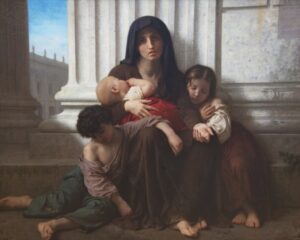
Tracy Mason-Fayle is a level 2 Early Childhood Student; here she shares her reflections on a painting depicting a family living in poverty and how this might relate to current concerns.

Image credit: Birmingham Museums Trust

Charity | Art UK

The painting ‘Charity’ is by an artist called William Adolphe Bouguereau. It was painted in 1865 and depicts a desperate scene of times gone by. The image represents poverty, homelessness, and suffering; it depicts inequalities and deprivation. Although painted in 1865, it is a poignant image of despair and hopelessness and how that impacts wellbeing. Yet, it only takes a glance at today’s news to understand that homelessness is not an issue buried in history. Rather, it is very much a current concern. For example, an online article by Big Issue, a social enterprise group set up in 1991 to ‘help millions of people in the UK affected by poverty to earn, learn and thrive’ found that:

  • Homelessness affects hundreds of thousands of people in the UK even though we have the world’s sixth biggest economy with one in every 200 households impacted by this issue.
  • Numbers of people who are homeless are consistently increasing.
  • Nearly 160, 000 children live in temporary accommodation having no place to call a real home in England alone.

Shelter (2024) has recorded the impact of the ‘right to buy scheme,’ which sold off social housing (1980 Social Housing Act) leaving fewer available social houses, allowing private landlords to demand higher rents. This created uncertainties and the threat of homelessness for families. Tenants feel less secure, a ‘constant threat’ of moving causing disruption to children’s well-being and schooling.  Jules Birch speaks emotively of the ‘huge human cost’ to children who live in temporary accommodation as he reflects on the latest figures released at the end of last year. This current economic and political issue is caused by low or no income and impacts on children and young people’s wellbeing leaving them feeling ‘unsettled and insecure’. Citizen’s advice (2024) advises that social services ‘might’ be able to help with finding accommodation for someone who cares for a child although their criteria state:

If you’re homeless and you have children, social services only have to find somewhere for your children to live if they decide they’re in need. But they should try to house you with your children if possible. Your child is in need if:

    • they’re disabled
    • their health or development wouldn’t reach a reasonable level or would be damaged without help from social services

This begs the question – when wouldn’t a child’s health or development be impacted by being without a home?

Bouguereau’s picture was painted nearly 200 years ago, how poignant that the scene he depicts reminds us of present-day concerns. We may not see children begging on the street in the UK but certainly they can be seen in other European cities. However, this is not to congratulate the UK at all,  given the high number of invisible children in this context, not necessarily begging on the streets but certainly living in poverty without a place to call home.


Posted in Uncategorised | Leave a comment

Getting active to get school-ready

Every year there is lots of debate about school readiness, but one important aspect is often overlooked. In this post Jane Dorrian highlights the role of that physical activity plays in successful transitions.

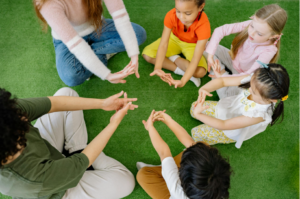
Royalty free image: https://www.pexels.com/photo/preschool-children-doing-hand-exercise-with-teachers-8613366/

A group of young children are sitting outside on the ground stretching their hands out in front of them.

Recent reports that one in four children are still in nappies when they start school  and the news that one Welsh county will call parents into school to change nappies if their child is not toilet trained have triggered debate about what children should be able to do when they enter nursery or Reception, but the key role that physical activity plays in toilet training and other areas of school-readiness has been overlooked in the discussion. Parents are bombarded with information and advice about the specific skills they should ensure their children have to ensure a successful start to school, things like being able to put their shoes on, sit still and follow instructions, but all these depend on the child having effective physical skills.

Active children develop the body awareness needed for bowel and bladder control. To be able to sit still a child needs to have good core stability, balance, and control and these can only be achieved by engaging in in lots of different types of movement and activity. Manoeuvring a pencil is dependent on being able to control big movements connected to skills like crawling and climbing. Children who are physically confident to explore new activities and situations are more likely to share their experiences with others, discussing and trialling ideas and making new friends. These examples show how physical activity and development is connected to all the other areas of a child’s development. Many of the ‘essentials’ of school-readiness that are highlighted to parents as important relate to speaking and listening, cognition and social and emotional skills, and whilst all of these need to be supported for a child to be able to make a successful transition into school life the role of physical activity in developing them is not often highlighted.

Lots of the equipment that is used with young children is designed to ‘hold’ them and keep in one place. ‘Containers’ like pushchairs and car seats stop children wriggling and stretching, reducing the strength of the muscles supporting the shoulders, hips and spine which are essential for crawling and walking. Often these ‘containers’ face the child away from the adult, reducing opportunities for the child to get a response to their facial expressions or their movements and build their interaction skills. These examples show how physical inactivity can impact on the skills needed for school readiness, limiting children’s ability to get involved in activities and interactions.

There are plenty of debates about what ‘school-readiness’ is, but supporting children to be physically active from birth promotes social, emotional, cognitive and language skills so whatever people think the most important aspects of being ‘school ready’ are, physically active children will have them. Supporting parents and early childhood practitioners to get children active will help to ensure children make the best start to school that they can.

If you would like to find out more about promoting and supporting young children’s physical activity this book has lots of helpful information and practical ideas:

Musgrave, J., Dorrian, J., Josephidou, J., Langdown, B. and Rodriguez Leon, L. (2024), Promoting Physical Development and Activity in Early Childhood, Routledge. https://www.taylorfrancis.com/books/edit/10.4324/9781003386728/promoting-physical-development-activity-early-childhood-jackie-musgrave-jane-dorrian-joanne-josephidou-ben-langdown-lucy-rodriguez-leon

Posted in Uncategorised | Leave a comment

Student reflection on being part of a research project

In this post, Jo Hilliarda second year Early Childhood student, shares her experiences of participating in the Praxis project ‘The Journey of the Early Childhood Student’ with Jo Josephidou.

I decided to join the research project simply because I valued the opportunity to share my thoughts. Like many people who work in early childhood already, I often feel that my opinion isn’t considered by those who make the decisions, and I felt that I couldn’t justify complaining about this, if I didn’t find the time to share my thoughts when someone did ask. I knew that I had lots to say about what the Open University does well, as well as a few little grumbles (because nothing in life is ever perfect!) but I also wanted to be a part of any potential changes that may come about in the future. I felt that as the OU was prepared to take the time to listen to their students’ voices, then I should find the time to share my mine. After all, the more students who were able to help, the clearer the picture would be for the researchers and therefore the wider the impact of the research overall. I felt that could only be a positive thing for my studies going forward.


The biggest benefit of the project for me has been the sense of belonging I have gained from meeting with my fellow students who are also taking part. I didn’t expect to connect with them as much as I have but it has been a real pleasure to meet with them online a few times a year to share our thoughts, celebrate our successes and generally just cheer each other on when the work/uni/life balance has been a struggle. Sharing meetings and email exchanges with Jo, the project lead, has been an equally positive experience as the way that she acknowledges and values our contributions makes me feel like I matter to the university as both a student and as a real person. Open University study can feel a little bit too distant sometimes, so the project has been a welcome thread of connection for me during my student journey.


I am excited to start my second year on the research project and to be a part of something that I feel has real potential to be a positive force for students now and in the future. My hope is that my contributions will be able to help the researchers identify ways that they can continue to support students like me to achieve the dreams that have set them on the path of an Early Childhood Degree. Helping to shape the experiences of students who will take this journey in years to come, is a real privilege.


Thank you, Jo, for sharing your thoughts so honestly with us. I am sure other students will find this post inspiring. If anyone would like to read the first report from the project, you can download here. we look forward to sharing further updates with you

Posted in Uncategorised | Leave a comment

If I’d known you were coming I’d have baked a cake; thinking creatively about our work

In this post Jo Josephidou reflects on the under-explored link between academic research and making cakes- there’s more of a connection than you might think!!


Every year the Graduate School at The Open University hold a highly creative competition where postgraduate students have the opportunity to ‘bake’ their research in the form of a cake. You might be wondering what the point of such an activity is; is it just a bit of light relief from all that difficult postgraduate reading and writing? When we think about studying, at whatever level, we can focus on the reading and writing stuff and forget that the thinking stuff is perhaps the most important bit. The thinking stuff doesn’t have to be done at a desk or in a library, it can be done on a walk, in the swimming pool or indeed in the kitchen baking a cake!

An added bonus of thinking about your work in a different and more creative way can help you make links, see omissions or make observations you have not considered before. For example, sometimes academics will write a poem about their research, or they will try to draw it in a picture. I have found both these approaches really helpful – not to share with anyone but just to help me develop my own ideas. Professor Pat Thomson discusses the importance of creativity in research in her blog post ‘Research as Creative Practice’ that you might like to read. She notes how ‘unseen social relations are embedded in and frame everyday events, conversations, processes and relations’, everyday events such as baking a cake perhaps. Reflecting on our ongoing project ‘The Journey of the Early Childhood Student’, I thought about what it might look like in cake form – especially from someone who has no particular talents in the kitchen. We have shared previously on this blog that we have been considering the concept of ‘Mattering’ in this project and that made me think about what ingredients matter in a cake, and in what quantity. For example, if I am trying to make a healthier cake, does it matter if I reduce the amount of sugar or replace the butter with another ingredient. In the same way, what ‘ingredients’ are important for our students if we want them to feel that they matter.

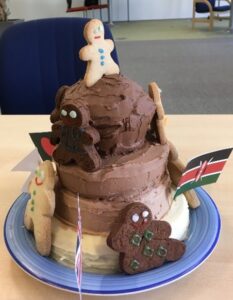
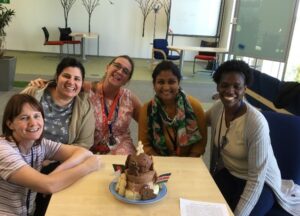
At this point, you may be thinking, yes, I get it but I’m not sure what my cake would like in practice. Lucy took part in the competition when she was a postgraduate student, and she shares how she approached the competition with her fellow students to bake the cake above:

My fellow students and I were all doing research with children, so we made the ‘Bronfenbake’; this cake represents Bronfenbrenner’s ecological systems theory. This theory explains how a child’s development is influenced by a series of interconnected environmental systems, such as their family, communities and wider society. We were all studying different aspects of children’s lives in different cultural contexts, yet all our research highlighted that, to understand children’s lives and experiences, we also need to understand the contexts in which they live.

So what about you? Why don’t you have a go at ‘baking’ your next assignment – and don’t forget to share a photo with us!

Posted in Uncategorised | Leave a comment

Picturing Childhoods

Some of the OU Early Childhood team are currently undertaking a longitudinal PRAXIS project which is just entering the second year (Phase 2) where we are considering the concept of ‘mattering’ and what that means to our Early Childhood students. We are used to the ideas of provocations in early childhood pedagogy and to give us inspiration for this phase of the project we decided to take a mini road trip to Chatsworth to attend the ‘Picturing Childhoods’ exhibition, using this as a creative provocation to our thinking about writing up the report of Phase 1 and moving forward with Phase 2. It turned out to be a marvellous provocation and before we left to travel back to the various corners of the UK, we got together over a coffee to discuss some of our thoughts and reflections, and this blog captures these.

Julie’s Reflection

This was my first visit to Chatsworth House and I wondered how it would go.  We met briefly as a group of 4 academics in the days before we went and discussed how we should approach the visit and what we would do, deliberating themes we could view the exhibition through.  Being time poor, I had been unable to give sufficient time to reading and reflecting before our discussion.  I felt like some of our degree students going to their first tutorial.  Unprepared and unsettled.  After our chat I felt motivated, a little excited and was looking forward to our visit.  This aligned with Prilleltensky’s (2020) view of mattering as innate and Elliot’s (2009) expansion of ‘mattering’ as overlapping with ‘belonging’.  I felt as if I fitted into the group and belonged and more than that; in a social sense, I mattered to this group of colleagues and from this I developed interest and confidence.   I took time that night to read and reflect on the purpose of the visit.  I wonder now about the skill needed by an Associate Lecturer to make a student facing time and confidence challenges feel as if they matter and belong in order to develop motivation and enthusiasm rather than less confident and a little lost.

On arrival at Chatsworth the scale and beauty was imposing but there seemed to be a calmness emanating from the surroundings and my colleagues.  We had decided to arrive together but to experience the exhibition alone in order to reflect on our perceptions.  We entered the house and then moved through the first room individually.  I noticed some grasses arranged in a cross on a chair and found them interesting and puzzling.  Why were they there?  Why were they crossed?  I wondered if they were illustrating a historical interest or feature, maybe a child’s plaything, after all we were in a childhood exhibition.  I enjoyed this wondering as a young child might and allowed myself to reflect on it as we walked through the rooms.


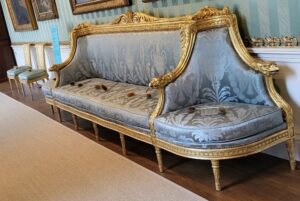
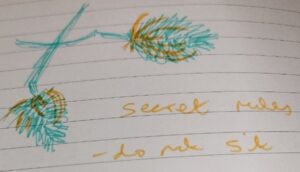
After a couple more rooms I noticed that a lot of the chairs held these grasses or ‘tweezles’, as a colleague later named them, and realised that they indicated a chair which must not be sat on.  This unwritten rule was not obvious to me at first and it was only through drawing on my cultural tools and knowledge of these grasses being spiky and hard that I realised the symbolism and the hidden rule.  Young children face unwritten rules, but what interested me was how new to Higher Education students know how to interact with new course materials, new peers, or tutors.  Do we include unwritten rules?  How will a student feel when they ‘realise’ the rule, perhaps having made a mistake or even worse missed some vital aspect of study.

Jo’s reflection

Everything was so big and grand, it made me feel very small and insignificant. The lack of light and general gloominess added to this feeling of being diminished. I think I noted several times ‘I feel so small’. This isn’t necessarily a negative affective response – there is something about feeling safe, small, enclosed, not standing out, not noticed, that is calming. The miniature objects in the dolls’ house displays reminded me of this and how being small and detailed is a positive thing. It is like the feeling when you look at the horizon or the sky etc. It was interesting when I used the mirror to look at the ceiling in the Great Hall; this made me feel still small but part of the scenery as if I was swimming in it.  Others talked about ideas that made me think of not belonging, of ‘spatial transgression’- I don’t think I felt like that, but I did feel quite removed from it all, as if I was standing back and wondering objectively about the secrets – who was missing, what was being concealed. I don’t think I also worried about where I was allowed to go but I did feel a little disorientated because of the grandeur and the gloom.

The room which had the greatest impact was the chapel with the Damian Hirst sculpture. I think this was because of the shock of the unexpected. As I walked in, I kind of felt that it was just another gloomy albeit grand room, with a shiny statue. I loved the shock as I approached the statue and realised what it was. I was unaware of this story but was intrigued by it. The notes said to look for the secret door to the right of the statue, but I was unable to find this and found it another irritating example of keeping secrets and withholding information. I absolutely loved the sculpture because it seemed so transgressive and shocking. I also appreciated the pain of all humanity across the saint’s face. I don’t know a lot about Damian Hirst, apart from recognising his more famous pieces of work, but I loved the creativity, the humour almost in the saint having his skin draped over his arm – humour in the grotesque. I don’t appreciate the constraints of religion – thinking about my own childhood, so to have this disruption in the middle of the pomposity of an ornate chapel appealed to my sense of resistance and pushing back. I also appreciated the lovely symmetry of ideas of the skin as clothing with the upstairs exhibition and the draping of fabric; in fact, symmetry was an idea I seemed to focus on in many of the spaces.
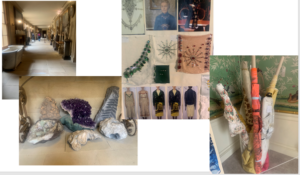
Colleagues talked about the ‘sewing rooms’ which also really resonated with me but made me feel both sad, thinking about childhood memories and also nervous because of the sound track; it took me a while to work out where the sounds were coming from and what they were supposed to be (cutting scissors and a sewing machine); I think I got the sense of spatial transgression here that others talked about elsewhere, even though I found these rooms captivating. The long corridor with the crystals didn’t hold my attention at all apart from the marble bath; we talked about how these crystals were more open-ended provocations but from my perspective I am not sure they are; I didn’t like the ideas they reminded me of. We are all bringing our own perspectives as academics and are as diverse as our students.

Eleonora’s Reflection

I have had several visits to Chatsworth House in the past so I approached the ‘Picturing Childhood’ Exhibition with some sense of familiarity coupled with a sense of uncertainty of how I might feel about engaging with it in my professional role. The exhibition offered ‘representations’, ‘experiences’ and ‘memories’ of childhood as the curators re-focused their collection to keep ‘childhood’ in the centre and in this way, inviting new layers of interpretation of the treasures of the House.

To me, portraiture as aesthetic representations of children and childhood have endless possibilities and I was wondering how I might perceive the many nuanced layers. Portraits could also suggest a political undertone in that they represent who is heard, whose voices are silenced, who is visible and who is not. So, I was curious to see how children appeared in the exhibition artifacts and how they were reflected or represented. As a subjective being, I could not help but engage with the exhibition influenced by my own ‘image of the child’ and my Anglo-Eastern European cultural and social capital.

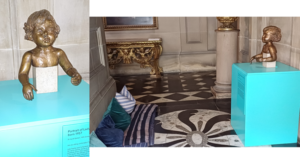
Many of the somewhat ostentatious rooms and spaces in the House were awe-inspiring due to their scale and the wealth they exuded.  They were certainly designed to impress, and I could not help but feel very small, which made me wonder how children might feel in these spaces. I was also struck by the multi-sensory richness of the exhibition and was drawn to the sounds and textures that were sometimes soothing and comforting, and at other times intriguing or even spooky. The positioning of exhibits and the spaces created around them made me wonder about the curators’ ‘image of the child and childhood’, their intensions and also the hidden tensions and power at play in the entire exhibition. For example, the sculpture of Lady Sophia Cavendish as a child was placed under the main stairs in the Great Hall, with cushions on the floor, the tiles of which appeared like waves licking children’s toes as they sat. The sculpture was amazingly animated, her outreached hand inviting the observer to touch her, and the explanatory text addressed children directly. Then, as I sat down on the cushions and disappeared from view, I began to wonder: am I hidden to be out of sight to maintain the order in the richly decorated elegant environment or hidden to be in a secretly private space that children often seek out? Whose agenda drove the creation of this space? What assumptions have been made?

Jane’s Reflection

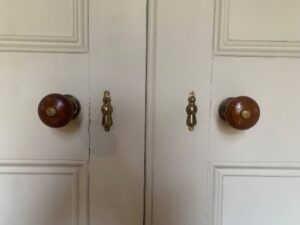
When I reflect back on my visit my immediate thoughts are about invisible boundaries. As I went around the house I took photos from a child’s-eye perspective, trying to see the contents and experience the spaces from their viewpoint. This meant that I had pictures of key holes, door stops, table legs and other random items. Towards the end of the visit a security guard approached me to ask if I had been taking pictures of door handles, what my photographs might be used for and generally finding out what I was doing. During the conversation I realised that actually, there could be a malevolent reason for taking these pictures, and I also realised that the staff in each room and corridor had been watching and raising concerns with the security team. When it became apparent that I wasn’t up to no good we had a great chat about the exhibition, the work that the Chatsworth education team do and I went on my way. But when I looked back at my photographs the incident coloured my recollections, I found myself thinking ‘should I have been looking at that’? Was I supposed to be in that space? Was I doing things ‘right’?
 

As an adult in this situation, we know some of the unwritten rules, not to touch the exhibits and to stay in the roped off areas but in some places the rules were not so clear. Were you able to go up a particular staircase, or was that only for people to come down? Can I push that door or not? These feelings link to the feelings of being small and overwhelmed by the unfamiliar and inherent power of the place that have been mentioned elsewhere, and this led me back to thinking about children and then onto students. Young children learn the unwritten rules by crashing into invisible boundaries all the time, reaching out to touch things they shouldn’t, running into places where they shouldn’t be and then being told the rule by someone with more knowledge or power. This process is a ‘normal’ part of learning but when this happens as an adult, we feel wrongfooted and guilty, as if we should already know these things and we have done something wrong. Students will meet invisible boundaries related to the hidden curriculum throughout their studies, highlighting this as a normal part of learning and trying to reduce feelings of having ‘done it wrong’ is something we could do more.

I hadn’t expected my visit to Chatsworth to lead to a reflection on how to support students and this conversation was one of many things that I could have written about, the whole experience has a catalyst for lots of ideas, thoughts, and inspiration many of which echo the responses of my colleagues.

Final thoughts

The exhibition certainly made us reflect on the construct of childhood. We were four diverse academics from different locations in Europe and so we all brought our unique perspective, however, as we shared ideas we found common interests, triggers, and questions. It made us think about our childhoods and how we might have behaved as children at the exhibition. We were quite playful in how we captured our ideas as we moved around the rooms, making sketches, jotting down ideas, and taking photographs, not of the usual exhibits but more of the tiny features or the hidden details. We were reminded of childhood hobbies, of how you had to behave as a child, the things that had remained with you and things you had lost on the way. We compared our own childhoods, the childhoods of the children in portraits we engaged with and the childhoods of children today. We had all recognised how power manifested itself in different ways through the house, we had all felt small and we all had emotional responses to objects and to spaces where we did and did not feel we belonged or mattered. The visit certainly helped us to develop our perspectives of ‘Picturing Childhood’ and to expose and refine concepts that are already influencing the PRAXIS project.


Posted in Uncategorised | Leave a comment

Dancing Babies

In this post Dr Jo Josephidou shares her reflections on her recent reading and thinking about how babies are considered by society.

Dr Karen Horsley has previously posted on this blog about her experiences of working with New Zealand colleagues and the learning opportunity this was for her (Waitangi Day- learning in collaboration with kaiako (educators), tamariki (children) and places in two Early Childhood Education (ECE) centres in New Zealand. | Early Childhood Blog (open.ac.uk). One of the ways we continue to develop our professional relationships with colleagues in New Zealand is by engaging with their professional journals. Whilst reading the latest copy of The New Zealand Journal of Infant and Toddler Education (The First Years Ngā Tau Tuatahi), I came across an obituary of Pennie Brownlee, an important thinker, writer, trainer and above all advocate for babies in the context of New Zealand. I was intrigued to read about her work, having a research interest myself in what happens to babies in our society. I decided to find out more and read one of her books ‘Dance with me in the heart’ (2008). This lovely book, written both very simply but very powerfully, focuses on the role of the adult in supporting the very young child in what she terms ‘the dance of learning’.  Its content resonated with me as I thought about recent election promises  around ‘fixing childcare’ and baby manifestos; it  also made me think of the recent work that Dr Jools Page has been carrying out in her area of professional love and more specifically on the Dance of Reciprocity.

Brownlee (2016) acknowledges the work of Emmi Pikler (1902 – 1984) as one who has informed her own ideas about the respectful ‘infant-adult’ relationship that comes about through carefully ‘choreographed tender care moments’.  As she considers the role of the adult, Brownlee imagines the baby and adult as dance partners. It is an ‘elegant dance’ that begins in the womb, accompanied by the rhythm of the beating heart. Neither partner leads but each takes their turn to convey which way they want to go and what the next move should be. A stressed dancer will convey this stress to their partner so that it is important that they are relaxed and at ease. As Brownlee continues to ponder on the role of the adult, she reflects on the importance that one in such a role would view their partner as competent, able and one who can be successful at the dance.

Her writing reminded me of Trevarthen’s (1931 – 24), a fellow New Zealander whose research explored babies’ musicality and how ‘to be’, as adults, with very young children. Trevarthen et al. (2018) write of the shame that can become part of the young child’s life as they are met with expectations and demands that, rather than celebrate them, find them wanting. In much the same way, Brownlee quotes Gerba as saying “How must it affect infants when what they can do is not appreciated, and what they cannot do is expected?”  The recent Manifesto for Babies, published in June (2024) by the First 1001 days movement was a call to advocate for these very young children and in particular to:

  • Support babies’ healthy development
  • Invest more in prevention
  • Tackle health inequalities
  • Support those who care for them

Being introduced to this book by Brownlee has helped me develop thinking around the consideration that is given to babies in our society. Looking after babies is complex, so those who look after them, parents and practitioners, should also be given greater consideration. The metaphor of dance is helpful in understanding how we can be supportive partners and dance alongside babies in their learning and development.

Posted in Uncategorised | Leave a comment

Mattering and belonging: offering learning spaces where Early Childhood students can flourish

Here at the OU we are privileged to work with our validated partner institutions across the UK, supporting the design and delivery of high-quality early childhood programmes that ensure the workforce of future is equipped to deliver the best possible outcomes for babies and young children. An important aspect of these partnerships is the opportunity to share our research and scholarship and discuss the issues and questions that are currently high on our agenda. One way in which we do this is by holding collaborative events and this year’s took place on Thursday 11th July.

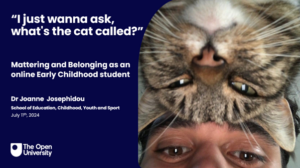
The theme of the event was ‘Mattering and belonging: offering learning spaces where Early Childhood students can flourish’ and Jo Josephidou started proceedings by introducing the PRAXIS scholarship project that she is leading on with other EC@OU colleagues, titled ‘I just wanna ask, what’s the cat called? Mattering and belonging as an online Early Childhood student’.

The title came from an incidental comment made by a student during an online focus group session, where another student’s cat walked across the screen prompting the question ‘I just wanna ask, what’s the cat called?’. This seemingly general and unimportant comment actually became a point for reflection, prompting Jo to think about how our distance, online students can make the connections and find points of commonality that are essential in developing their student identity and creating a feeling of mattering and belonging. The project is a longitudinal study using group interviews and monthly reflective email questions to try and capture the journey of the early childhood student and identify what is important to them. Early findings indicate that they feel they have an identity as a higher education student and that this is something they have achieved for themselves and feel proud of, and they can see the impact their studies are having on their roles as parents, carers and practitioners. The project is ongoing and we look forward to finding out what happens next.


The next session was led by Louise Hannan, an Early Childhood Lecturer and PhD student at University Centre Somerset, and Caren Egan, the Nursery Manager at Bridgwater and Taunton College Childcare Centre who presented ‘Self-care strategies to promote staff wellbeing in an Early Years setting: A praxeological study.’

 This thought-provoking study considered how the pressures associated with consumerist and capitalist societies can impact negatively on the early years workforce who are already in a vulnerable situation because their work is stressful and requires a large amount of emotional engagement and skill. To counteract these pressures the study looked at ways to empower the nursery practitioners to find ways of valuing themselves for themselves rather than being influenced about what to value by external factors like the media or advertising. The study used photo elicitation to explore practitioners’ ideas of wellbeing generally and their own wellbeing in particular, and  a free drawing task that asked them to draw wellbeing ‘radiators and drains’, the things that contributed to their wellness and those that take away from it. The practitioners then engaged in a range of self-care sessions, including breathwork, connecting with nature, yoga, and meditation. Reflecting on the sessions practitioners identified that they felt calmer, more able to give time to situations and to consider their interactions with children and each other. Not every session ‘worked’ for every practitioner but everyone was able to connect to something and see a benefit, and these findings really resonated with the attendees at the event who had lots of questions for Sarah and Caren.


After the questions Sarah Guscott, a HE Practice Tutor and Lecturer in Early Childhood Studies & Primary Education at University Centre Peterborough gave the final presentation, ‘Exploring educators understanding of Sensory Processing and its developmental impact for children’.

Sensory processing relates to the reception, organisation, and interpretation of sensory information by the nervous system which is crucial for various aspects of child development, and which goes beyond the ‘traditional’ five senses to include the vestibular, proprioceptive and interoceptive senses too. Children who have sensory processing difficulties can find it challenging to cope with environments and situations which can affect their behaviour and learning, but there is currently little support for practitioners to identify and support these children. Sarah’s study used qualitative and quantitative questionnaires to gather insights into participants’ experiences and interpretations of sensory processing in young children. The findings indicated that practitioners face significant obstacles due to a lack of training and resources in sensory processing, leading to difficulties in recognising and addressing children’s sensory needs effectively. There was recognition that modifying the environment to reduce sensory overload and implementing individualised interventions resulted in a significant improvement in children’s sensory experiences, but there was need for more professional development in the area to help raise awareness and improve practice.

As the descriptions of the presentations show, the range and quality of research and scholarship being done in the field of Early Childhood is diverse and exciting and it was a pleasure to have the opportunity to hear, learn and discuss this great work.

Posted in Uncategorised | Leave a comment

Empowering everyone in early childhood to work in harmony

On June 26th 2024 Dr Natalie Canning presented her Empowerment Framework at a breakfast event held in the British Library in London. The organisations who attended the event neatly illustrated how ‘early childhood’ is an umbrella term, with representatives that work with babies, pregnant mothers, early childhood and care settings, and childminders as well as early childhood researchers, practitioners, policy influencers and members of the EC@OU team. The work being done by these groups reaches across the UK nations and beyond.


Grant Gordon from the Ethos Foundation captured this breadth in his introduction to the event as he outlined the context within which the Foundation was established and by highlighting the lack of real change in this context since its creation. Natalie then presented the Empowerment Framework, focussing on the potential it has to amplify children’s voices and how that can be a force for change. The presentations provided a catalyst for some lively discussions which showed the passion and expertise of everyone in the room, and which again drew attention to the diversity of issues that ‘early childhood’ represents. Questions were asked about school readiness, diversity and representation, curriculum design and workforce morale, whilst all the time looking at how to put the child at the centre of all the work that is done.

Listening to the presentations, questions and conversations I became aware of how everyone in the room was passionate about early childhood and had a particular issue, theme, situation or aspect that really motivated them. Everyone wanted to give voice to that passion but we were mindful that we needed  to focus on a unifying theme. It was like an orchestra tuning up, each instrument is important and essential to creating the finished work but at that point each one is focussed on perfecting their own piece and this creates a discordant noise that distracts and rather than a tune that engages and appeals. It needs a conductor and clear direction to bring all the sounds together into one clear and organised melody that resonates with the audience, connecting to them and getting their attention.

The work being done with our youngest children and their families covers education, care, social justice, professional identities, inclusion, representation, wellbeing, welfare, and more. The importance of each of these is undeniable, if we want the best future outcomes for all children then all these areas must be acknowledged and valued and there needs to be a clear agenda that the work in all these arenas can agree on and work towards together. To continue the orchestra metaphor we need the sheet music that shows us the music, the part  each us is playing, where we work together and where our solo opportunities are. The breadth and flexibility of the Empowerment Framework and its potential to support every child could provide the perfect opening bars for us all to play our part together.


You can find out more about the Empowerment Framework here:

TACTYC OCC-Paper-14-N-Canning.pdf (open.ac.uk)


Posted in Uncategorised | Leave a comment