Reflective learning Strategic study techniques
Being aware of your habits as you study is vital to the success of your learning. Bad habits can hold you back and, unless you analyse what you are doing, you might remain unaware of better ways of doing things. At the OU we call this analysis 'reflective learning'.
Like many other aspects of studying, reflective learning is highly individual. There's no guidebook on how or when to do it. Rather than thinking of reflection as yet another task to be added to the 'to do' list or squeezed into a busy study schedule, view it as something to practise at any stage. The emphasis is on being a reflective learner rather than doing reflective learning.
An experience that is repeated without reflection is just a repetition, which does not help you to learn.
Reflection has an important role to play in learning and self-development. Reflection could be described as:
- thinking with a purpose
- being critical, but not negative
- analysing how effective your learning is
- questioning and probing
- making judgements and drawing conclusions.
Get used to reflecting on your experiences as part of your everyday learning. In this way, each experience - whether positive or negative - will contribute to your development and personal growth. Record your reflections in a learning journal or on audio.
- See reflection as complementary to your study
- Use it to clarify your thoughts and focus on your development
- Record your thoughts on any difficulties or challenges you are facing
- Think about any strategies that might help you deal with difficult tasks or assignments
- Use it to help you think about how the topics relate to other areas of your experience
I've come a long way since doing my first TMA - I suppose I'm starting to develop some reflective skills in that I'm looking at how my study sessions have gone and identifying strategies that work well for me.
It is easy to become stuck in a study routine that is not effective for the task in hand. Reflecting on what works well helps you to develop your skills, as you try out different approaches.
Benefits of reflection
Reflective learning can help you to get more out of your studies in several ways.
Planning and prioritising
You may find yourself overwhelmed by the sheer range and number of activities you're expected to tackle while studying. Figuring out how to plan your time and prioritise study tasks, and how to juggle all your other commitments (such as work, family, friends and hobbies), can prove quite challenging. It's worth thinking ahead to organise your time and reflect on why, what, how and when to prioritise.
Setting and achieving goals
Your motivation for studying can be improved if you reflect on your study goals and relate them to the broader goals in your life, both personal and professional. Reflection can help you to define immediate goals and then devise strategies to achieve them.
Dealing with procrastination and anxiety
Procrastination, the art of putting things off until they absolutely have to be done, is both a cause and a symptom of anxiety. It can lead you to miss deadlines or fall behind with your study schedule and can severely affect your confidence. Reflecting on how, when, where and why you procrastinate can help you to recognise and challenge your routines and habits.
Recognising and overcoming obstacles
How often do you make negative assumptions about your ability to study? These beliefs can undermine your confidence and motivation but by reflecting on the assumptions you can make positive changes.
Regardless of whether or what you've studied before, chances are that you've gained expertise and insights from your vocational or personal experience. Be aware of the useful skills that you bring with you to your study. However, also be aware of when you might need to let go of preconceived ideas of what is required from your studies.
Each subject requires the development of particular cognitive processing skills (for example, the ability to construct an objective argument in a social sciences assignment). In the following video, listen to Gill and Maggie discuss how prior understanding might become 'prior misunderstanding' in a new discipline.
Your prior learning

Gill (Learning Consultant)
You learn maybe to think in a certain subject area in a certain way. You move over and you use those skills. I mean my personal example would be spending a lot of years working in the Social Sciences and then going to take a Business course and finding that my first assignment in a business course gave me one of the lowest grades I'd ever had. And it made me realise that I was transferring skills that were no longer as appropriate and I had to learn to think like a Business Studies' student and not like a Sociologist.
And it can be a bit of a shock 'cos you're not aware at first that you need these new skills, 'cos you're coasting on your acquired previous learning skills and they're doing you very well, until somebody else comes in to give you some feedback and then they're saying, "Well, it's just OK, but actually it's not great because you haven't learnt the new skills."
Maggie (Learning Consultant)
Yes, and my advice to students certainly would be, you know, almost be prepared for this and if you're not sure what you need to do to actually get back to your normal grade or enhance it then whoever is there to support your learning, whoever is there to mark your assignments and give you the feedback, go and talk to them. Don't just sit and brood or get cross or disappointed. Most of all don't give up, because there are ways of helping students make that transfer across the actual disciplines.
Gill
And it's the same, isn't it, transferring skills that you've learnt, say for the workplace, because you may have to read certain documents in the work that you do, write reports in a certain way for your employer. You come into the OU and they're good skills to have, they give you a starting point, but you probably need to read differently and write differently because you've started a course in history or economics.
Maggie
I think this is particularly so when you're looking at the difference between sort of cognitive processing skills, i.e. a body of knowledge that you are analysing or evaluating by reflection and examination of the ideas, as opposed to more practical or professional skills which you may not even be aware you've got, and suddenly you have to start analysing and reflecting and developing those.
Prior learning is a huge advantage to adult students. We need to be really aware of the immense amount of learning we've had. The need to articulate it, to adapt it, to use it, and then to demonstrate it, is very challenging. All adults have lessons from life, have experiences, have expertise, have knowledge in all sorts of areas that might not immediately seem sort of connected or relevant, and actually sometimes to sit back and think, well I managed to do that, in that setting, I can move some of those skills and approaches across. And it's confidence enhancing.
Making effective use of available support
Your tutor may have suggested that you get in touch to discuss any problems you have while studying, and you've probably received information about the range of other support services available to OU students. But sometimes it's not so easy to ask for help. Reflecting on how you are coping with your studies can make it easier to request and respond to available support.
Tools for reflection
You may need to try a few different tools and methods of reflection to find which is most beneficial to you. Common tools for reflection are:
- learning journals, diaries - jotting notes down in written prose
- tables, mind maps, lists and bullet points - your notes summarised in note form
- recordings: use your smart phone or a digital recorder to document voice recordings
- creative representations - icons, mind maps and diagrams.
Support for studying

Maggie (Learning Consultant): One of the characteristics of the Open University from day one was that you may be isolated and a distance from other people, but you're not on your own. I think people will need to look carefully at what help it is they need. If they have a tutor for their course, or a learning advisor, to go to those people, but to actually be sure they persevere 'till they find what they need.
I'm very impressed by the range of study support, generic study support, that's available electronically.Gill (Learning Consultant): We now talk about we're a community, and we really are a 24 hour, 7 day a week, 52 weeks a year community. There are people who will be online at 2 o'clock this morning talking to another student in another place in the world. You may choose not to be very involved online but, if you want to be, there are so many forums and online conversations, usually in your course, but also in general in the OUSA area, that you should see all of this as available resources to support and help you.
Keeping a reflective learning journal
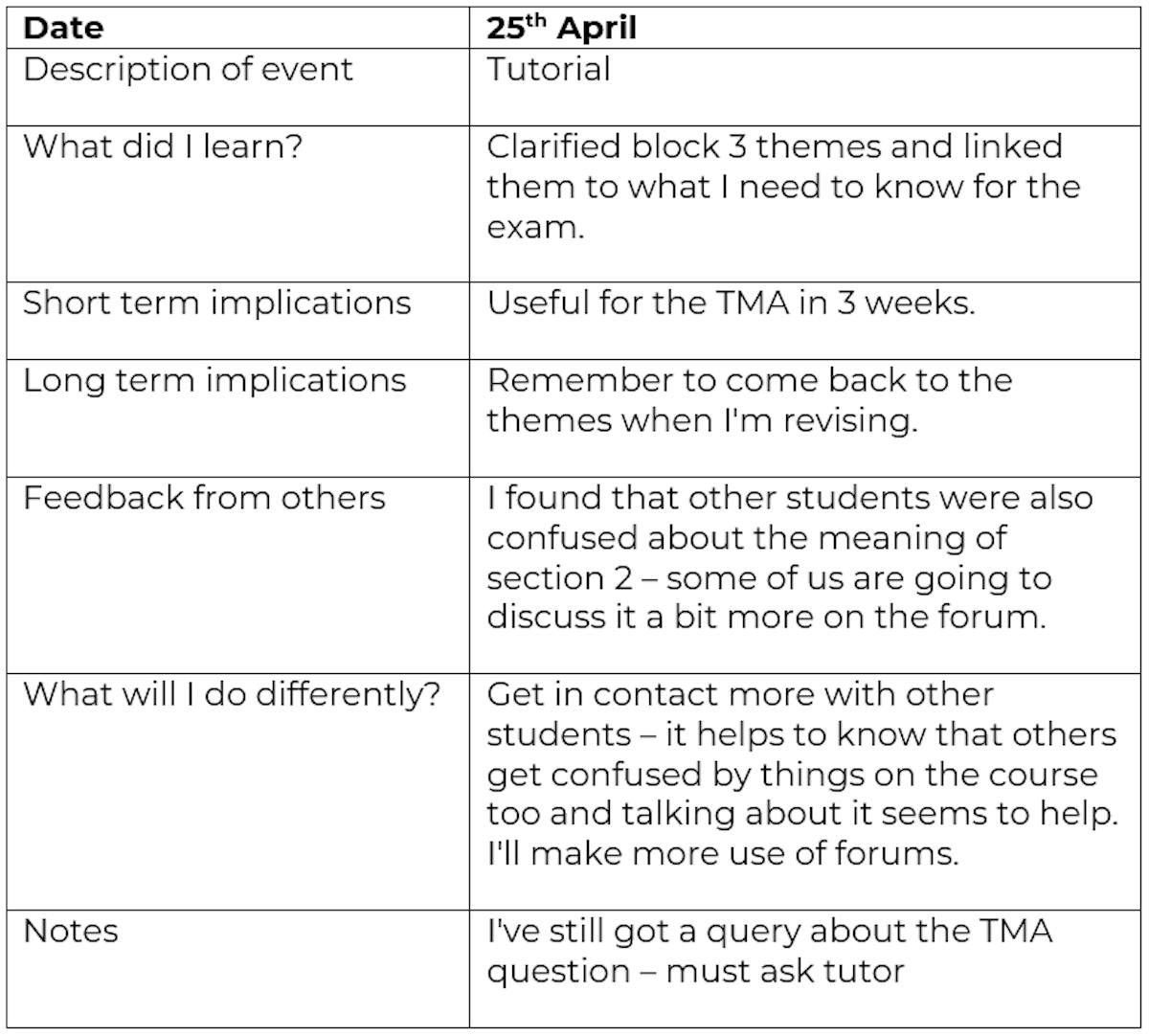
The use of a reflective learning journal is a common and valuable approach. You can adopt a structure for each journal entry, which could include the setting and date, what you did, and key critical notes on your reflections about the activity and what you think you learned. You could use a diary with a day to a page for your journal, or try your own creation - a note book in which you've stuck your study timetable at the front, and your favourite postcards here and there to inspire you.
Here are some tips when using a journal.
- Write in your journal regularly, even if individual entries are sometimes short.
- Focus on a specific event or issue for an individual entry - think about how you could address or resolve the issue, or what you'd like to improve.
- Use questions or prompts to help you focus on the task.
- Avoid descriptive writing - take an analytical approach.
- Use techniques such as mind mapping, diagrams, sketches or cartoons. Use colour to make these more engaging and memorable.
- Review the entries you've written to see if you can find themes and recognise the longer-term action you might need to take (e.g. to improve a particular study skill).
- Remember that writing itself can be used as a learning tool: you can use writing to explore ideas as a way of understanding them.
But whatever you choose to write, do let go of judgements - remember that there are no right or wrong answers. And be honest, open and direct - reflection is most effective when you can be yourself.