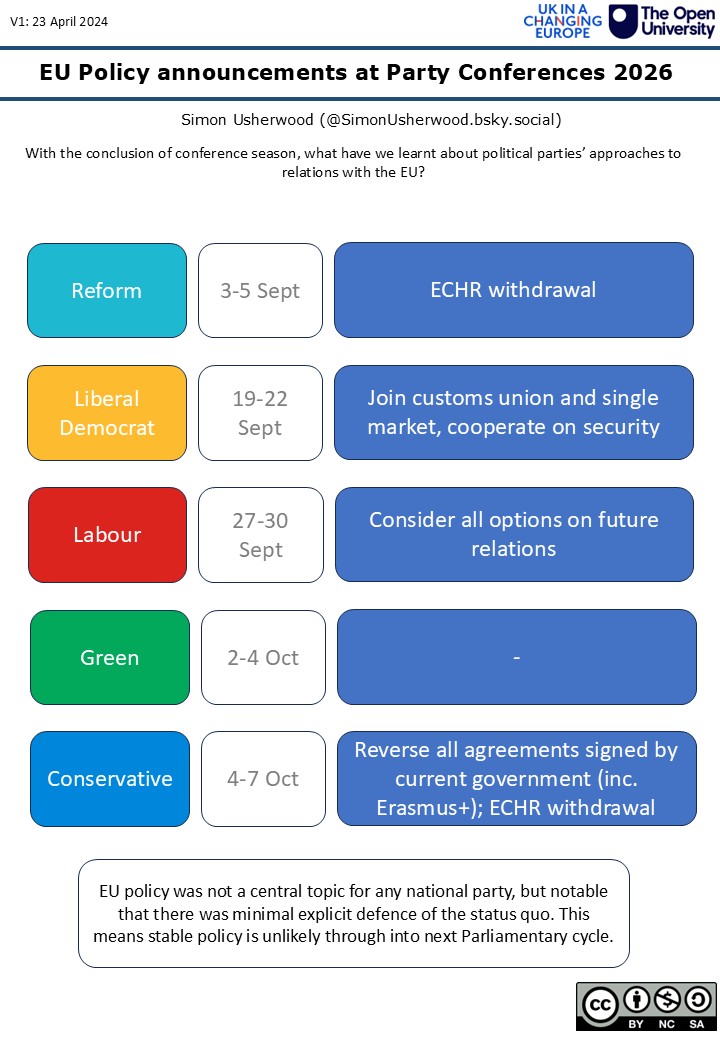
A short post this week, partly because I’ve got other things on, more because my cunning plan to summarise where parties are on ‘Europe’ came a bit unstuck.
Either they’ve kept quiet on the matter or they’ve offered much talk. Probably only the LibDems of the national parties have both adopted a new policy objective and talked explicitly about how it fits with their wider plans. Sadly for them, that got rather overtaken by Burnham’s commitment to look at the ‘different options‘, which everyone seems to be taking as a pathway to a re-accession commitment in the next manifesto.
While Burnham’s move is the big one from the season, it shouldn’t obscure the other developments we’ve seen.
ECHR withdrawal has become a mundane part of both Reform and Conservative policy, grounded solely within the frame of controlling borders and immigration. Neither party seemed to make much of the effects of withdrawal generally, let alone its impact on UK-EU relations. As a reminder, the Trade & Cooperation Agreement provides for extensive retaliatory measures and suspensions of provisions should one party leave the Convention; a provision including in large part for just this kind of scenario.
This incidental collapsing of much of the architecture of relations is part of a wider piece by these parties to move beyond Brexit, which they now singularly fail to defend as a success. Indeed, it was telling that Kemi Badenoch’s only mention of Europe in her speech yesterday was to argue that re-opening things was a waste of time:
“Can you imagine having to go through that again? So much time lost. Arguing with ourselves, arguing with the EU, going round and round in circles, businesses not knowing whether they should invest. He [Burnham] wants to do it all again. I think that is a terrible idea.”
The absence of substantive thoughts on either process or direction of policy should Burnham actually get moving on all this does not suggest that the Conservatives will find it as easy as they might have thought beforehand.
As a final observation, the absence of anyone arguing that the status quo is working points to medium-term instability in policy. Those on the left seem to want to explore well beyond the current red lines, while the right affects to be unconcerned about causing a major argument with the EU.
What the EU itself wants does not appear to be a major concern at this stage, but the volatility that British politics continues to display is likely to reinforce more cautious voices across the Channel that worry about making any kind of deal that might come unstuck very quickly.