A short one this week, partly because I can’t manage my time well and partly because there’s not much to say, even with all the UK government briefing about the fabulous deals coming later this month (that means you, travelling ferret owners).
Rather than try to second-guess where the Youth Mobility talks end up, I want to focus instead on the big open question of future relations, namely: how does the UK decide what it wants?
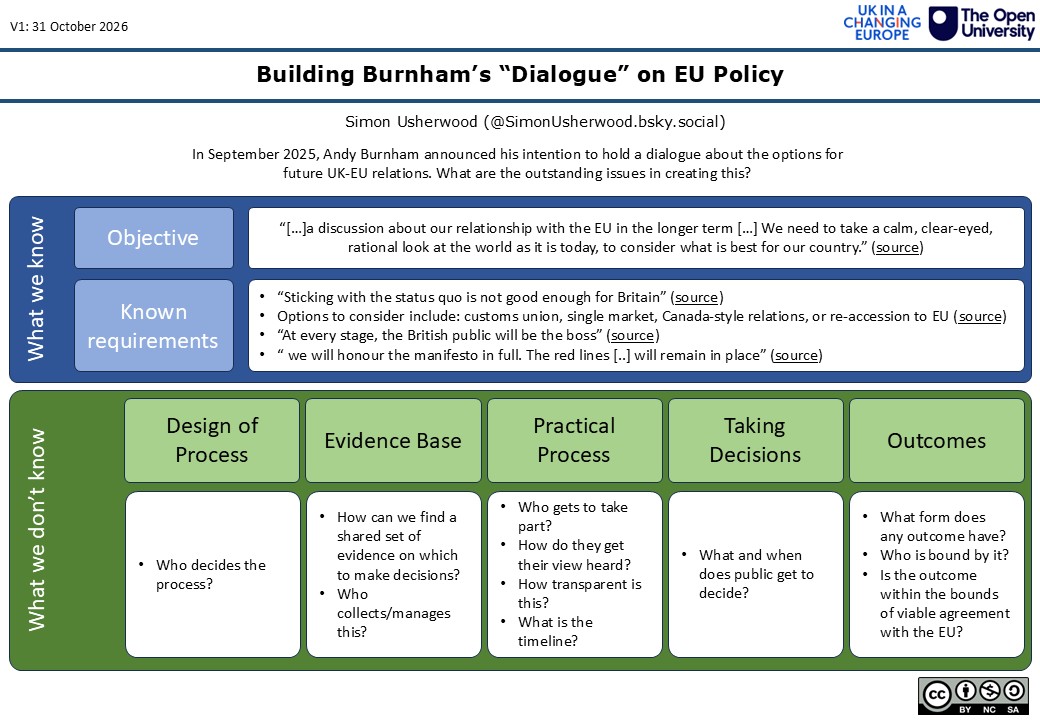
For all Burnham’s talk of a dialogue, there’s been essentially nothing about the mechanics of having that dialogue, or even who might be involved in it. It’s all a bit underpant gnomes.
The graphic below sets out the most immediate questions we might ask of Number 10, but beyond some kind of tentpole speech around the time of the summit on 20 November there’s no definite pathway.
If we assume that the goal is a new policy to stick in the next Labour manifesto, then there’s not actually a need to do anything more than internal party mechanisms to find a consensus position among members and getting it approved by conference.
But the impression is clearly one of something broader, across party lines.
So maybe we’re looking for a policy statement or a resolution to be voted on in Parliament to signal the breadth of the consensus Burnham talks of building.
If MPs/parties are the focus, then it’s logically some kind of working group or conference to hammer out ideas and common positions, more or less open to outsiders to watch.
But Burnham also seems to want the general public involved too: we might assume this goes beyond just voting in elections.
This is where is becomes much more complex.
Maybe it’s some kind of consultation exercise, or even a consultative referendum (although, really?). Maybe it’s a citizens’ assembly, but still with the question of how to translate that from the specific citizens to the wider population. And all these take a lot more time to do properly, which might be tricky if you want to have it conclude in good time for a general election.
And all this before we get into the questions of whether Burnham really does want to not pre-judge the outcome (despite some clear preferences) and of how to determine what might be the least objectional way of weighing evidence.
And evidence will be weighed here.
While you might get a broad consensus view from economists on impacts on GDP for various models of relations, you won’t get the same from political scientists on political consequences. Even when people do agree on what matters, they can easily differ on what that points to (just cast your mind back to 2016’s debate).
Add in that most people either don’t confidently understand the issues or don’t care too much about finding out more and you have a recipe for a difficult process. Which might be why we’ve yet to hear what it looks like.
But it will matter, because procedural aspects will be part of building the kind of resilient consensus that Burnham is seeking and that the EU will look for when deciding whether it wants to indulge whatever new British line emerges.
Working on this might be the more important activity for the government in the next two weeks.