Interested in doing an MA with us? To watch a short introductory video, click here.
To find out more about applying, visit our postgrad pages.
Interested in doing an MA with us? To watch a short introductory video, click here.
To find out more about applying, visit our postgrad pages.
by Emma Bridges
A common thread running through the research and teaching of many of us who work in the department of Classical Studies at the OU is the study of classical reception – that is to say that we think about the ways in which, and the reasons why, ancient Greek and Roman ideas, texts and material culture have been revisited and refigured by later cultures and societies.
One of the most challenging aspects of thinking about classical reception is also, for me, one of the most exciting. In order to develop an understanding of the ways in which themes and ideas have been adopted and adapted in new contexts, a researcher must frequently step outside her own comfort zone, looking beyond the texts with which she is most familiar and exploring a range of genres, historical periods and geographical settings. Following the journey of a theme across time and space can yield fascinating and sometimes unexpected results, and the researcher who does so often needs to become familiar with areas of study of which she had little prior knowledge.
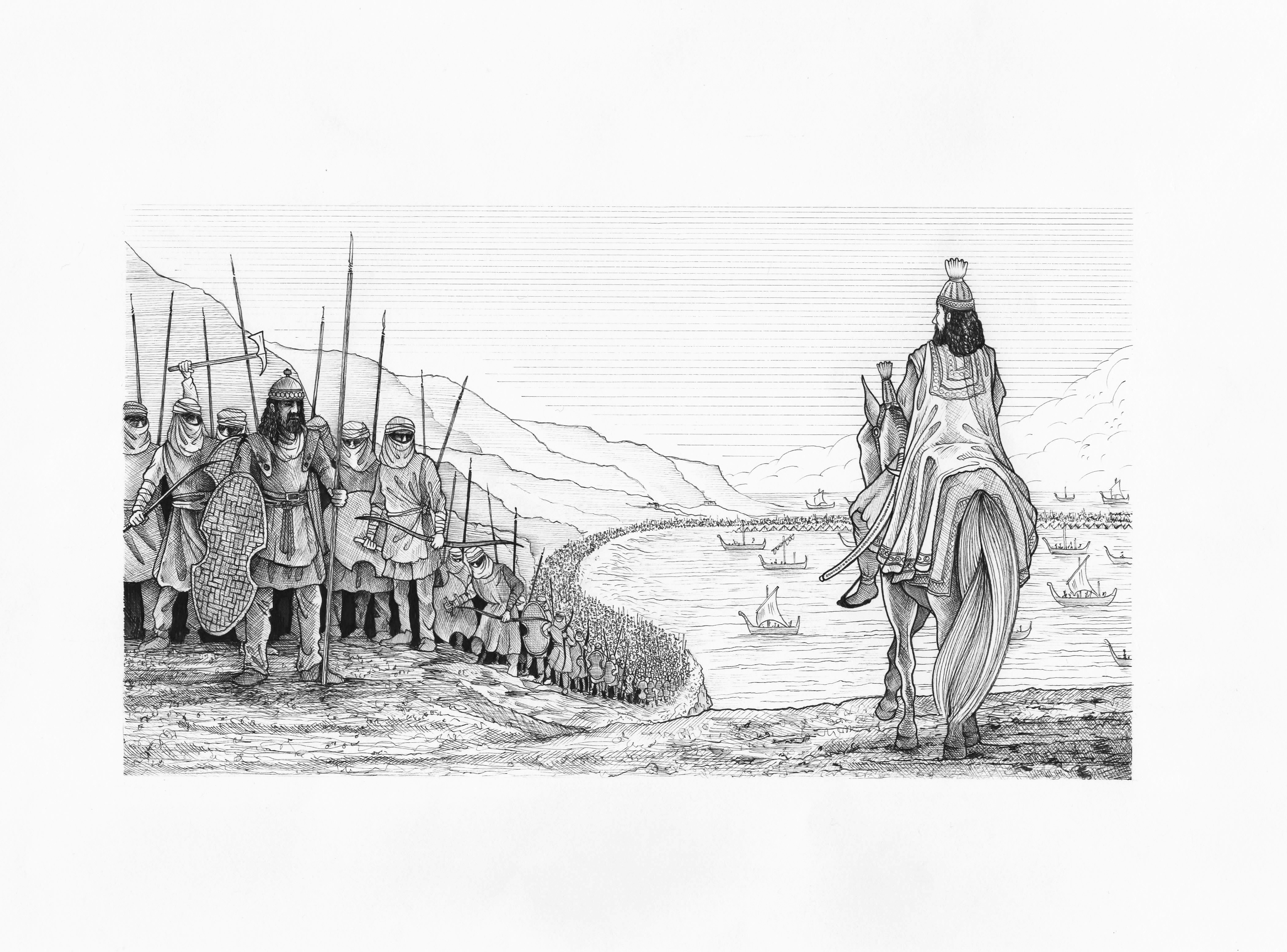
My recent book, Imagining Xerxes, took me on one such journey; in tracing the ancient cultural responses to the figure of the Persian king whose invasion of Greece was famously defeated against seemingly overwhelming odds, I found myself examining ancient sources which spanned a period of around 700 years, with a geographical spread incorporating Greece, the Roman empire and ancient Persia itself, and in a vast – and sometimes daunting – array of diverse literary genres.
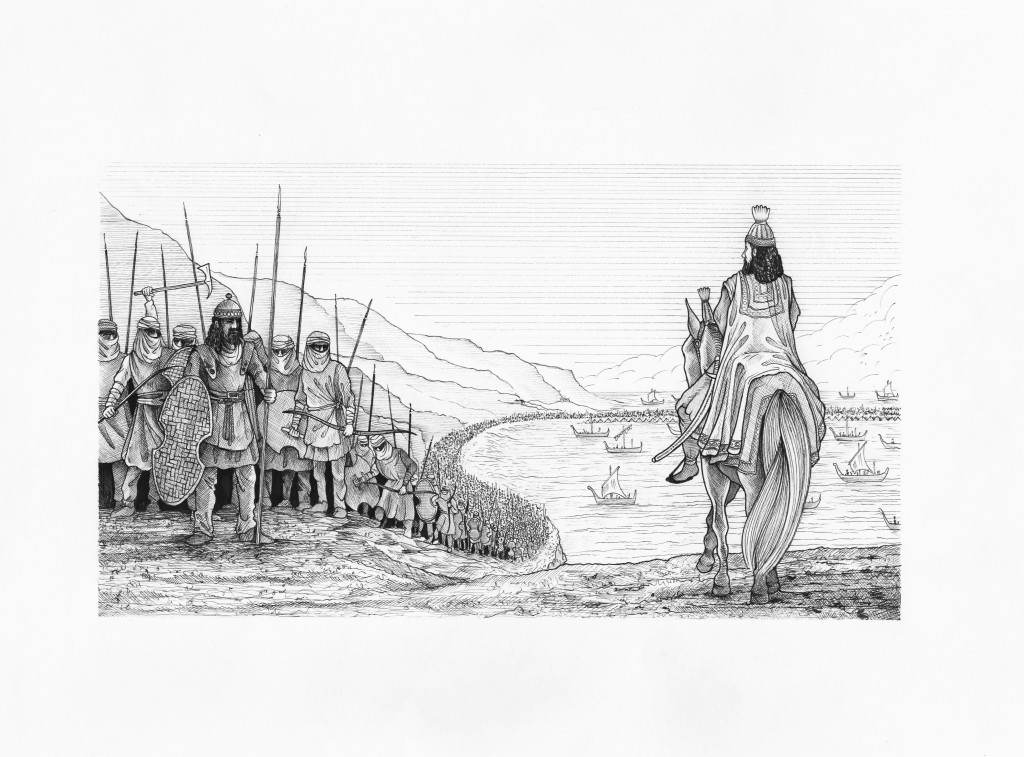
Xerxes crosses the Hellespont.
Original illustration from Imagining Xerxes (2014). Image copyright Asa Taulbut. Reproduced by permission of the artist.
As a scholar, I have always felt most at home with the Greek texts which were written in the fifth century BC – thus, when I started out, I knew a fair bit about Aeschylus’ Persians, in which a defeated Xerxes appeared on the Athenian tragic stage, and about Herodotus’ historiographical account of the course of the Persian Wars. In the course of my research, however, I also needed to tackle sources ranging from the inscriptions and relief sculptures of the royal palace complex at Persepolis, to biblical texts (Xerxes appears – named as Ahasuerus – as a key figure in the Book of Esther), to Roman and rhetoric and satirical poetry. Along the way I would discover that the historical figure of Xerxes was reimagined and reshaped in astonishingly diverse cultural settings, and that portrayals of his character – shaped by the historical circumstances in which they were produced as well as by the literary agendas of the authors who wrote of him – ranged from images of him as the archetypal and destructive enslaving aggressor, to a figure synonymous with the luxury and exoticism of the Persian court, or as an example of the vacillations of human fortune.
The joy of this kind of work is that there is always more to discover; every text or artefact encountered, every ‘reception’ of an ancient work or idea, has a context – literary, artistic, intellectual, historical – which needs to be investigated and explained if we are to understand why themes from the ancient world recur where and when they do. That’s good news for people like me, who love the challenge of getting to grips with something new!
by Jessica Hughes
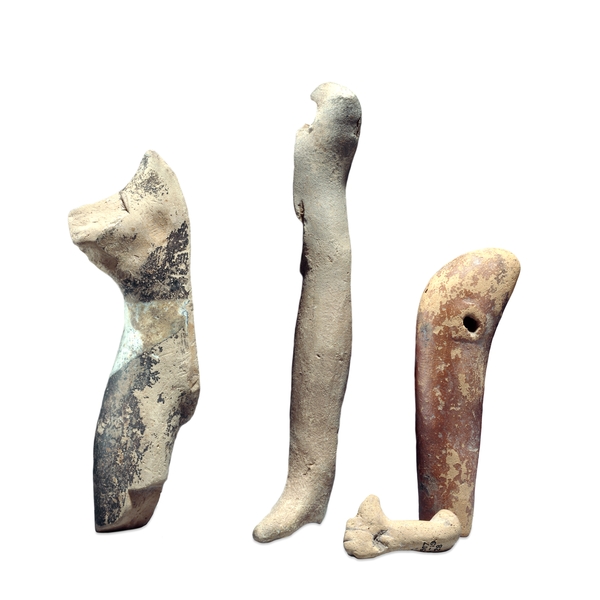
I’m at the annual College Art Association conference, which this year is being held in New York. The CAA is a huge conference taking place over four days; it’s packed with hundreds of papers, panel discussions, and an array of networking events. I arrived two days ago and gave my paper yesterday, in a session called ‘The Tiny and the Fragmented: Miniature, Broken and Otherwise Incomplete Objects in the Ancient World’. I’d been invited to speak about my research on anatomical votive offerings, which are always ‘fragmented’ and occasionally ‘tiny’ (see image: these are miniature offerings from a peak sanctuary on Crete, now in the collections of the British Museum).
The whole session was really interesting, with five papers addressing different but complementary aspects of ‘incompleteness’ in the ancient world. Highlights included Verity Platt’s exploration of the unfinished paintings recorded in ancient literary texts, and Douglass Bailey’s paper on ‘holes in the landscape’ from the Neolithic to Contemporary Art. The session chairs Becky Martin and Stephanie Langin-Hooper did a great job of tying everything together in their introductory and concluding comments, which underlined the need for new theoretical approaches to the ‘archaeology of the incomplete’.
Now the session is over, it’s time to relax a bit and enjoy the rest of the conference, and of course to explore some of the city’s museums. It’s 5.30 am on Friday (thanks, jetlag!) and I’m putting together my itinerary for the day ahead. To begin, there’s an early morning paper on ‘Spolia and Souvenirs’, which looks very relevant to my new research project on modern-day souvenirs from classical sites; then I’ll go off to the Metropolitan Museum to do some fieldwork for that same project in their gift shop (trying very hard not to buy too many fridge magnets!). Then it’ll be back to the conference for our ‘sister’ session on ancient art, followed by a browse around the book fair to discover the latest trends in Art History. Finally, I’m having a dinner this evening on the Upper West side with some new US friends who also work on material religion – we’ll discuss our shared interests and maybe come up with some new collaborative projects.
Coming to a big overseas conference like this one does involve a lot of time, money and effort – and I should mention here that I’m extremely grateful to Kress Foundation and the OU for help with subsidising the trip. But the effort is more than worth it, because I’ll be returning to the UK with new contacts, ideas and inspiration for my research, and will hopefully reap the benefits of this trip for many months to come!
You can follow the conference on Twitter at #CAA2015
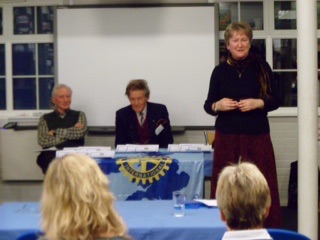
Illustration: Summing up at the Youth Speaks public speaking competition
by Helen King
I don’t come from a family of academics – I was the first in my family to go to university – and I’m not married to an academic. So my nearest and dearest think I am weird, in a number of ways. Over the last month their focus has been on the amount of supposedly free time I’ve been spending giving talks. OK, I’ll admit it has been excessive in the last month – as well as two short conference presentations, which don’t bother the family that much except that they involved a Saturday, I’ve done two talks for Friends of Classics, one for a branch of the Historical Association, one for a branch of the Classical Association, and another for an Italian Association. And I judged a Youth Speaks event for local schools. And then there was the Day Job… There was a slight diary error in there, which meant there were two more talks than I had thought I was giving when I did an overview of my diary at the start of the year. Oops.
These talks are to groups in the 20-100 range (in terms of audience size) and in the 50-85 range (in terms of age group), although sometimes a schoolteacher brings along a group of their students, which shifts the dynamic in interesting ways. These events certainly don’t get the huge numbers of a radio or TV programme or a major online site. None of them will make your fortune – typically they just pay your travel, usually but not always a meal, and maybe – or maybe not – present you with a (much appreciated!) book token. I am told that there are speakers out there who charge a fee, but I have a full-time job so why would I do that? So it’s not the money and it’s certainly not the glamour (I am writing this on a delayed train at 23:00).
So, why? Most importantly for me, because it still feels great to share my enthusiasms; to introduce my favourite parts of the ancient world to those who’ve never encountered them before. There is something about the live, face to face contact that is exhilarating – I don’t speak from notes, but tend to have a PowerPoint with some key images and words, so I am thinking on my feet. But in this process, as a speaker, I invariably learn something that’s new to me. Audiences ask questions that make me rethink my ideas, or take them in new directions. As I think out loud, I make unexpected connections. I hope those in my audiences who teach will take something of what I’ve shared back to their students, and those who don’t will go away with their eyes opened and their minds stretched. And very often there will be current OU students, or people with OU degrees, in the audience who’ll share their experiences with me.
Yes, this last month it has all been a Bit Too Much, but it has also been great fun!
by Helen King
As the current head of department, it’s great to welcome you to our blog. Whatever brings you here – whether you are a current or prospective student, or just someone interested in all things classical – I hope you enjoy hearing more about what we’re doing and that it inspires you to find out even more about the classical world!
At the Open University we cover a wide range of aspects of the classical world, from texts to images to material culture. Many of us also think about the reception of the classical past, from the ancient world itself – Romans thinking about the Greek world – to the present. So there should be something here to interest pretty well everyone.
I’m spending part of today speaking to a Classical Association branch in Southampton. Maybe some readers of this blog will be there…?