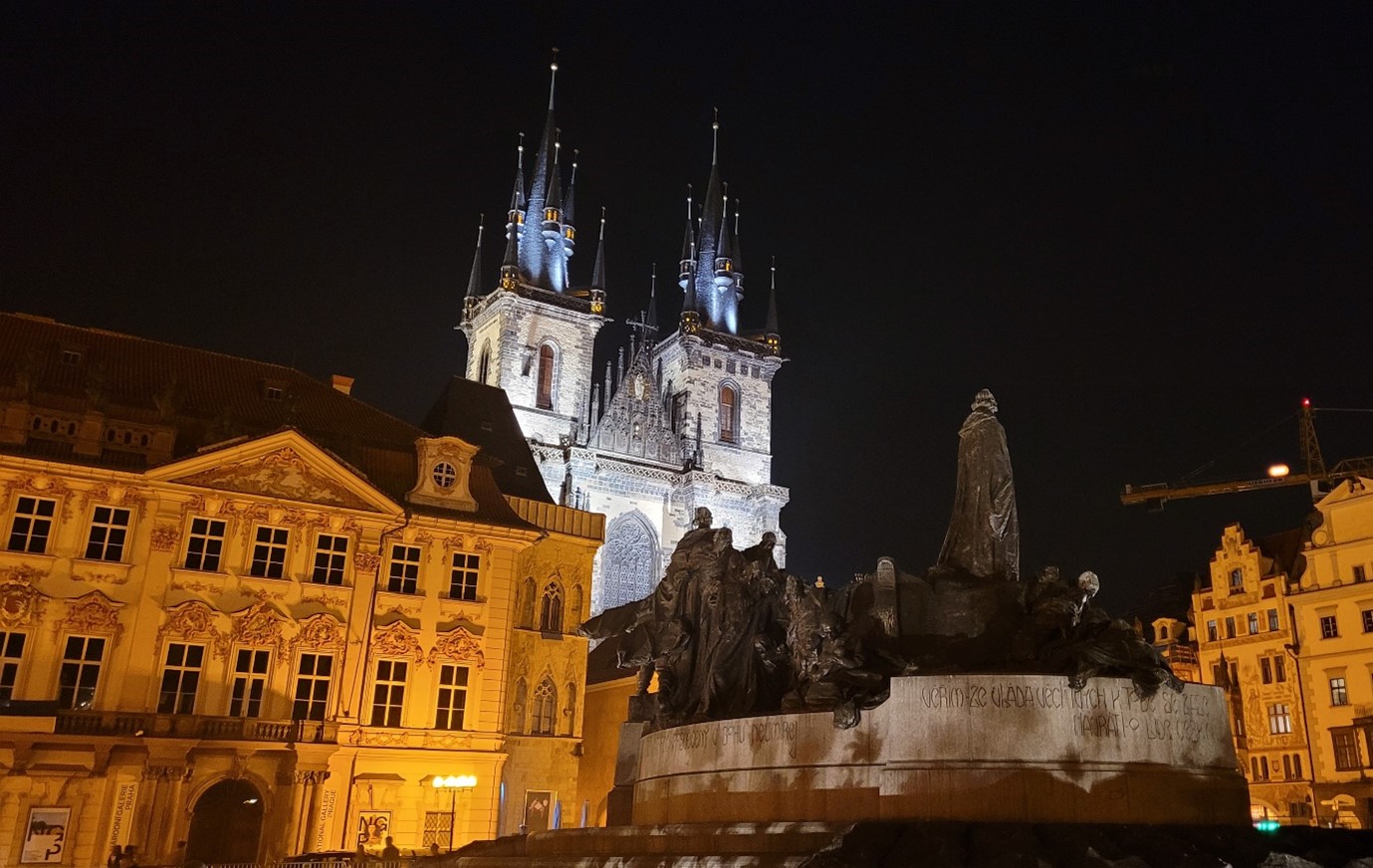
Staff Tutor and Associate Lecturer, Jennie Owen, travelled to Prague to present at a conference on the theme of Global Horror. The conference was run by Progressive Connexions, an organisation that supports sustainable global interdisciplinary research, and promotes collegiate exchange of ideas, experiences, and points of view.
Prague
This emphasis on curiosity, open-mindedness, and collaboration is also at the heart of our Contemporary Cultures of Writing conference on 20th April, which Jennie is organising. You can book here for tickets to this London-based one-day conference: Writing place: what haunts the landscape of modern Britain?
At the Darkness at the Edges conference, delegates spoke on varied topics, from the gothic and dystopic in Indigenous fictions to fairy tale motives in German post-war literature.
I’ve long had an interest in horror, as well as the gothic and dystopian. My particular fascination with cursed paintings began as a distraction from the more challenging sociological aspects of my PhD research into traumascapes in the northwest of England.
The notion of the modern-day curse is often propagated through social media, and I was fascinated by how these urban legends become fragmented as they are retold online on websites and community forums.
But the idea of the curse is not a new one. We can trace its path through ancient history: it’s discussed in the Bible, linked inextricably to our perceptions of ancient Egypt, and a common inciting incident in the fairy-tale narrative. In common folklore, a portrait that falls to the ground may foretell the death of a loved one; whilst anyone who was a fan of the cartoon Scooby Doo will be aware of the risk of the eyes in a portrait following you around the room.
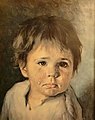
The Crying Boy by Giovanni Bragolin. This image is in the public domain.
One of the most famous cursed paintings in the UK is The Crying Boy by Giovanni Bragolin (1911-1981) – an image of a smudge-faced toddler looking sadly out at the viewer, tears running down his face.
In 1985, the Sun issued a warning that around 50 houses in Yorkshire had burned to the ground, leaving only this painting intact. This created a mild panic, reflected in a series of subsequent articles with headlines such as ‘Crying Flame’ and ‘Crying boy curse strikes again’. Such was the panic that on Halloween the Sun burned dozens of these paintings, which had been sent to their offices, and quoted a fire officer who stated: ‘I think there will be many people who can breathe a little easier now’.
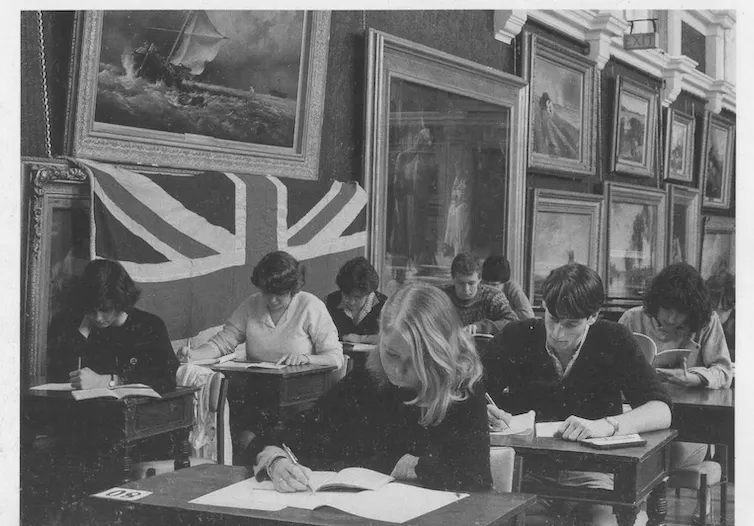
There is a rich vein of allegedly cursed artworks. Man Proposes, God Disposes by Sir Edwin Landseer (1802-1873), which hangs in Royal Holloway University, has to be covered with a Union Jack during exam season to allay students’ fears that they might fail or lose their minds if they spend too long staring at the painting. Indeed, its subject matter is rather gruesome: two polar bears fighting over the remains of the 1845 Franklin expedition. This infamous expedition was designed to locate the northwest passage in the Artic, and resulted in the loss of two ships and all men aboard (and rumours of cannibalism).
There are dozens of mysterious contemporary pieces too: having once seen it, for instance, who can forget the Momo Whatsapp curse, which featured a distorted wide-eyed sculpture by Japanese artist Keisuke Aiso?
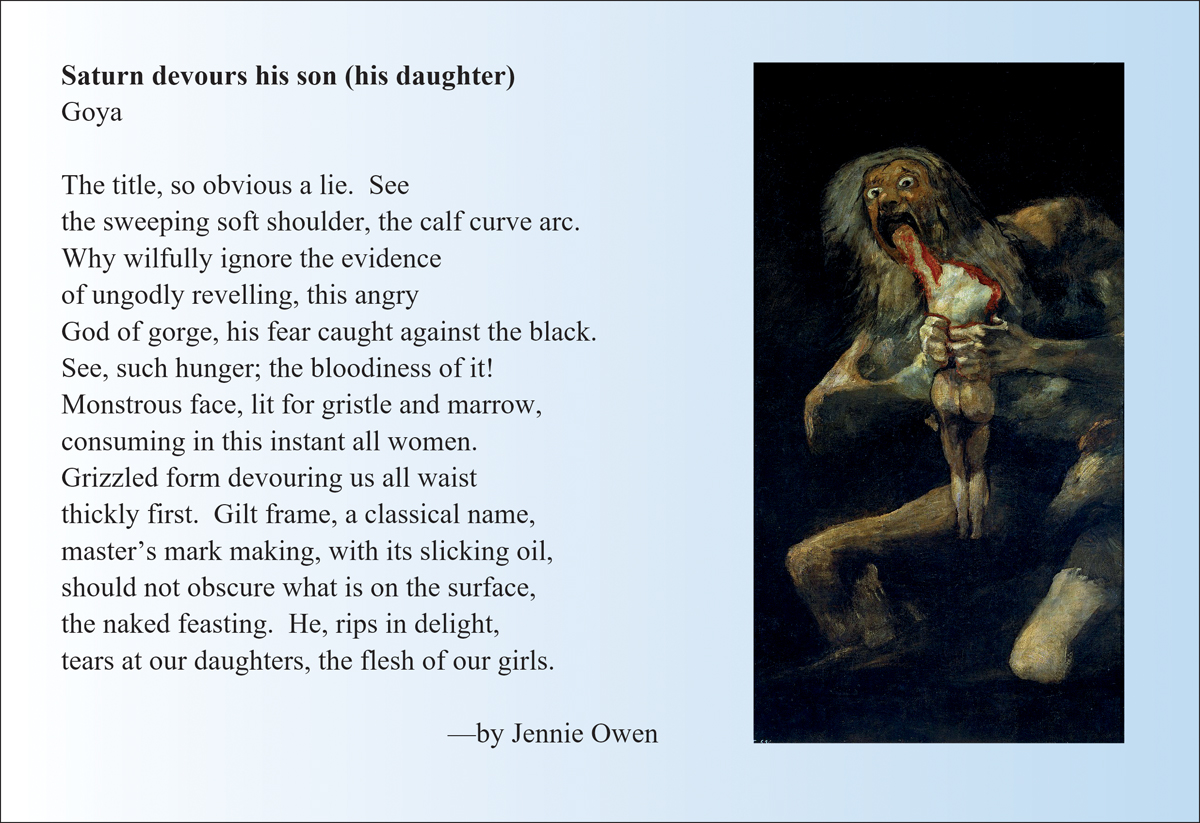
Using close examination of supposedly cursed art in the public domain, I used an ekphrastic methodology to create a series of poems.
The Poetry Foundation defines an ekphrastic poem as ‘a vivid description of a scene or, more commonly, a work of art. Through the imaginative act of narrating and reflecting on the “action” of a painting or sculpture, the poet may amplify and expand its meaning.’ It is hardly a new form of poetry – just think of Percy Bysshe Shelley’s ‘On the Medusa of Leonardo Da Vinci in the Florentine Gallery’ or ‘Ode on a Grecian Urn’, by John Keats. But ekphrastic poetry does appear currently to be celebrating a kind of renaissance in popularity.
With international colleagues from a wide variety of disciplines, I shared my practice-based research by discussing my own creative process of using art as a means of inspiration for poetry. I explored how this approach has had an impact on both the form and content of my writing, as well as how the writing of these pieces both celebrates and challenges the concept of cursed art.
My presentation was received, I hope, without any undue residue of curses.
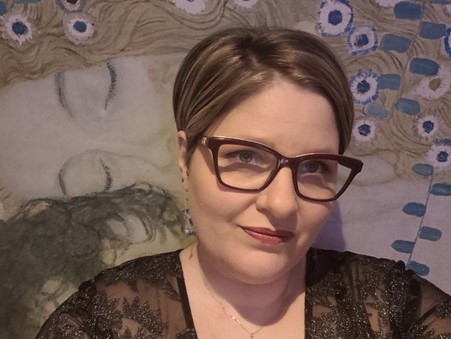
Jennie Owen
Jennie E. Owen’s cursed poems will be featuring in an anthology pamphlet published by Nine Pens Press later in 2023. Jennie has worked as an Associate Lecturer here at the OU for nearly 20 years. She is now also a Staff Tutor in Creative Writing, and lead Cluster Manager for A363, our level three undergraduate creative writing module. Jennie is working towards her PhD with Manchester Metropolitan University. She is a Forward– and Pushcart-prize nominated poet and writer of short stories, whose work has been widely published in anthologies, journals and magazines.
Dean de la Motte’s name will be familiar to anyone who attended our February 2019 Contemporary Cultures of Writing event, ‘The lives of others: research and writing’. The panel’s chair, OU Senior Lecturer Fiona Doloughan, suggested that both Dean and his fellow speaker might be breaking out of their comfort zones by applying their intellectual and emotional energy to new genres. Fiona Sampson was turning from poetry to biography, while Dean was moving from literary criticism to the writing of fiction.
Now that Dean’s novel Oblivion: The Lost Diaries of Branwell Brontë has been published by Valley Press, Fiona D. catches up with him again to discuss why he made the transition from authoring academic to creative works, and what he has learnt in the process.
Fiona: Congratulations on the publication of your novel. Tell us about your long-standing interest in the Brontës, and how you came to be particularly interested in the sisters’ lesser known brother, Branwell.
Dean: I read the Brontës in school, though I confess that I was not any more interested in them than I was in Dickens or Eliot, and arguably less so than in Hardy, whom I still love. In the mid-1990s I was designing a course called ‘Writing the Nineteenth Century’, where I paired works of fiction with works of history, including Charlotte Brontë’s Shirley and a book on the Luddite rebellion. I read Juliet Barker’s magisterial The Brontës and learned for the first time the full story of the family, including how Branwell fit into the family dynamic.
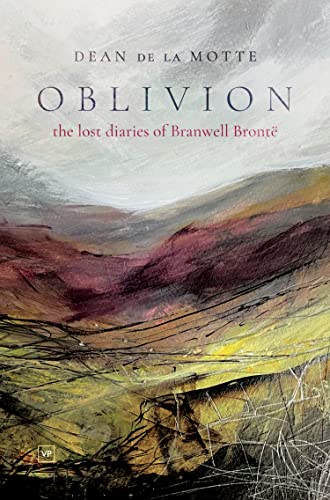
Oblivion: The Lost Diaries of Branwell Brontë published by Valley Press
I was utterly fascinated with him, perhaps because I could (at least in remembering my 20-something self) relate to him, if not to his actions at least to his character traits and flaws.
I conceived the idea of a novel called Oblivion, inspired by a) the oblivion into which he and his works have fallen; b) his own attempts to drink (and perhaps drug) himself into oblivion; c) the recurrent theme of a desire for oblivion (the word appears often in his poetry) or escape from the sorrows of existence, and d) his famous portrait of his sisters, where he painted himself out, or ‘into oblivion’. I wanted the book to be something of a tribute to the style, structure and themes of his sisters’ works, though I didn’t yet know that the book would take the form of a first-person diary.
Fiona: As an academic who specialized in 19th-century literature in France and England, in some ways your interest in the Brontës is consistent with your research expertise. But why did you decide to write a novel, rather than, say, a more conventional academic monograph?
Dean: I must confess that like Branwell, I once had a burning desire to be known primarily as an author of creative works. Unlike the Brontë siblings, however, I had available the more ‘practical’ path of an academic career. I often think all of the Brontës, including Branwell, might well have become professors had they lived a century or more later! In addition, I really am a scholar of nineteenth-century France, though I have written one article on teaching Emily Brontë’s Wuthering Heights.
Oblivion arose from a never thoroughly defeated desire to write a novel, my fascination with Branwell (including his similarities of character to me, which allowed me a ‘safe’ sort of confessional or therapy space), and my love of the language and historical period of the Brontës.
I went into academic administration for nearly 15 years and shelved the project, but never stopped thinking about it or reading works by and about the Brontës. When I moved back to full-time teaching in 2014, I at last had the time (a sabbatical plus subsequent summers) to write the historically detailed (and long) novel you now have before you.
Fiona: One of the original impetuses behind the development of Creative Writing in the US had to do with sharpening and sensitising the critical faculties of academics and giving them the opportunity to understand ‘from the inside’ what goes into the making of a piece of literature. Did writing a novel allow you to put aside your critical faculties and venture into more creative terrain in a way that writing a monograph might not?
Dean: The process has given me enormous empathy for all those who attempt to write and publish creative works. It is hard and emotionally exhausting work, especially if, as was my case, you are drawing on your own psychic life (which I think writers nearly always do, by the way).
I have, since finishing the book, been able to use my insights and discoveries in my teaching, notably to address the construction of characters and narratives generally, and the works of the Brontë sisters in particular. I don’t think writing a biography or study of Branwell’s poetry would have provided the level of awareness I have gained from writing Oblivion.
In addition, I’m not terribly interested in or impressed by Branwell’s body of work; rather, it was his life juxtaposed with the lives and works of his sisters, and the period in which they lived, that fascinated me.
Fiona: Publishing and promoting your book this year was the culmination of years of writing, drafting, reworking and editing. Can you say more about how you succeeded in obtaining a publisher? And what did it feel felt like to engage directly with readers ?
Dean: I was fortunate to find a small independent publisher, Valley Press, located in Scarborough, a stone’s throw from where Anne and Branwell worked, and where Anne died and is buried. They do beautiful work and allowed me to publish the book – which, at 250,000 words, is admittedly very long – as I had envisioned it. I’m not convinced one of the large multinational corporations would have permitted it. In many cases, readers are great fans of the Brontës, so I am already among kindred spirits. The feedback I’ve gotten from people who’ve read the novel has been enormously gratifying, because I seem to have accomplished what I set out to do.
Fiona: Do you have plans to write another novel? If so, would it be rooted in 19th-century British culture or might you turn to a different part of the world? I know you’ve been working on Victor Hugo of late.
Dean: I don’t yet know, but I’ve got several ideas. One involves a Frenchman who sails to my native California in the 19th century, only returning to France at the end of the century. I continue to be fascinated by the enormous upheavals and transformations in France during the period 1830-1870 , as well as the ‘long 19th century’ of 1789-1914.
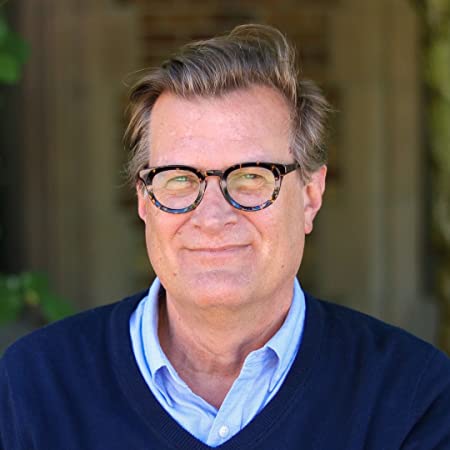
Dean de la Motte
Dean de la Motte was born and raised in California’s San Joaquin Valley, and studied English, French, and comparative literature at UC Santa Barbara, UNC Chapel Hill, and the University of Poitiers. He has published articles and books on 19th-century French literature and culture, as well as numerous essays on the teaching of literature, including Emily Brontë’s Wuthering Heights. The father of two grown children, de la Motte lives in Newport, Rhode Island, and spends most summers in France. Oblivion: The Lost Diaries of Branwell Brontë (Valley Press, 2022) is his first novel.
Fiona Doloughan
Fiona Doloughan is a Senior Lecturer in English (Literature and Creative Writing) and Qualifications’ Lead for English at the OU. She has a dual background in Comparative Literature (University of North Carolina at Chapel Hill) and Applied Linguistics (University of Reading). While her research focusses on contemporary narrative forms in literature, she is also interested in translation and creativity. She has published two monographs (Continuum, 2011; Bloomsbury, 2016) with a third, entitled Radical Realism, Autofictional Narratives and the Reinvention of the Novel, due to be published by Anthem Press in February 2023.
Sally O’Reilly is a novelist and Senior Lecturer here at the Open University’s Department of English and Creative Writing, where her role as Media Lead has included editing this blog. Before Sally’s appointment as a Central Academic in 2014, she’d already worked here for many years as an Associate Lecturer. But Sally’s long relationship with the OU is about to evolve as she is now making the leap to fulltime writing. Ahead of her departure, Sally’s successor as Media Lead, Emma Claire Sweeney, has seized the opportunity to ask Sally about her recent research into climate change and creativity – an area where Sally hopes to continue collaborating with OU colleagues.
Emma: How do you think creative writing might play a role in addressing the societal challenges posed by climate change?
Sally: Like so many people, I am increasingly alarmed by the climate crisis and I also feel unsure what I can do to help. It’s hard to see a way in which any one person can make a difference, and there are two default settings – thinking about something else, or assuming a position of nihilistic fatalism. But what I’ve realised is that it’s not about any one person, it’s about the power of collective action and social change, and while one person is powerless alone, if you can start communicating with like-minded people, astonishing changes can be made.
And while, at first, I thought that trying to address these issues was something I must do outside my work and writing time, I saw eventually that writing creatively is directly related to the climate crisis, because writers can (perhaps) encapsulate what this means in human terms, and be part of a movement to reimagine the world.
I’ve talked about this in three videos recorded for the Faculty of Arts and Social Sciences:
Imaginative writing can seem like an adjunct, a ‘nice to have’, rather than being essential to society like (say) physics. But if you look at the way people turned to books, film and TV during the lockdown, you see how vital narrative is to everyone. So writing can both help people process what is going on, and help communicate the situation – but without pushing an overt ‘message’ because there we have another pitfall, becoming polemical or seeming to preach.
Emma: Can you name a few contemporary writers who you feel have navigated this territory particularly well?
I really like the way that a fiction writers like Jenny Offill can play on our sense of unease by weaving alarming statistics about climate, preppers and the coming apocalypse into a contemporary realist narrative. It is the very ordinariness of the story that makes it terrifying.
Right now, I’m in the middle of a fascinating book called Being a Human by Charles Foster, which isn’t overtly about climate change, but about the way in which humans lived for many thousands of years, as Palaeolithic hunter gatherers. They lived long, healthy lives, their carbon footprint was zero and they produced visual art of stunning sophistication. Our view of modernity as being part of a post-Enlightenment process of constant improvement does not stand much scrutiny if you take the long view, and the despoliation of the planet is part of that. What’s particularly interesting about Foster, who is an extraordinary writer, a sort of modern William Blake, is that he bends genre in this book. Ostensibly, it’s creative nonfiction, but he brings in the ghost figures of a character named X and his son, spirits from the Palaeolithic age. His writing reminds me of both Ted Hughes and Alan Garner, the sense of the numinous in nature, the mystery in being. And Foster also embodies the meeting of scientific, empirical knowledge and creativity – he has studied veterinary medicine, he is barrister, and he has a wild imagination.
Sally: I invited poets, fiction writers, scientists and activists to talk about how distilling observations about the natural world and telling stories relates to the present moment and our choices about the climate. I’m aware of my own ignorance here. My writing has not focussed on climate previously, and so it is as steep a learning curve for me as it is for anyone. But in the research I have done so far, I can see how this issue connects with so many other issues – racism, social justice, education, equality.
Emma: So your own research interests are changing in the light of these connections?
After I leave the OU, I will be working on a series of essays about the contemporary world and climate, working tranche title Eco Worrier. And my current novel explores Victorian attitudes to nature and the way in which the ancient, shamanic understanding of the natural world had its last gasp at that time. It’s a book that has led me down a lot of surprising, twisty pathways, like walking through an ancient forest. Or so I tell myself when my energies are flagging.
Emma: Another area of your research relates to diverse voices in historical fiction. Could you tell us a bit more about that? Are there links between this and your interest in creativity and climate change?
Sally: I’m in the process of putting together a collection of essays about difference in historical fiction, and the way that previously marginalised voices are now being heard in this genre. Two years ago, I would have said this was separate from my interest in climate, but now I see a close connection. If you read about the British Empire and the ruthless way in which the British colonised and exploited people and resources, you can see how the foundations of climate injustice were laid. The Industrial Revolution paved the way for global expansion, which traditional British histories have said made the UK the ‘workshop of the world’, but we did this at the expense of disenfranchised groups in Britain – women, children, the working class – as well as in the global South. And the roots of Empire go back to Tudor England, to those glamorous swashbucklers Drake and Raleigh, that period of history that now seems so brightly coloured and picturesque.
Emma: Now that you are leaving your current post at the OU to write full time, how do you hope your new relationship with the OU might develop?
I’d like to find a new way of working, writing books that have academic rigour in collaboration with academics, perhaps in other disciplines, and also writing novels that reflect the new way that I see the modern world. One of the poets at the first seminar, Kristian Evans, talked about the way in which writing makes us more present to reality, and helps us experience life with more intensity, more directness. I’d like to channel that, into reading, thinking and writing. And collaborating. Because as I was saying earlier, this has to be about collective action. Novelists are good at sitting on their own tapping out sole-authored books, and writing novels is still my priority, but I’ll be looking for creative collaborations with OU colleagues whose interests relate to mine. I’d like to follow Foster’s example and work at the interface between fiction and nonfiction, a way of writing that seems particularly resonant at this time, when the facts are so extraordinary that processing them is an imaginative challenge.