A little literary tourism: in search of Hilary Mantel

Shafquat Towheed, Senior Lecturer in English

Hilary Mantel has been lauded for reviving the fortunes of the historical novel in English, for being the first woman writer to have won the Booker Prize twice (2009, 2012), and for selling over five million copies of her books – but where did it all start? Where did Mantel become a writer, hone her craft, and enter the public domain as a published novelist? What were the social and environmental circumstances that facilitated her arrival as an author? 
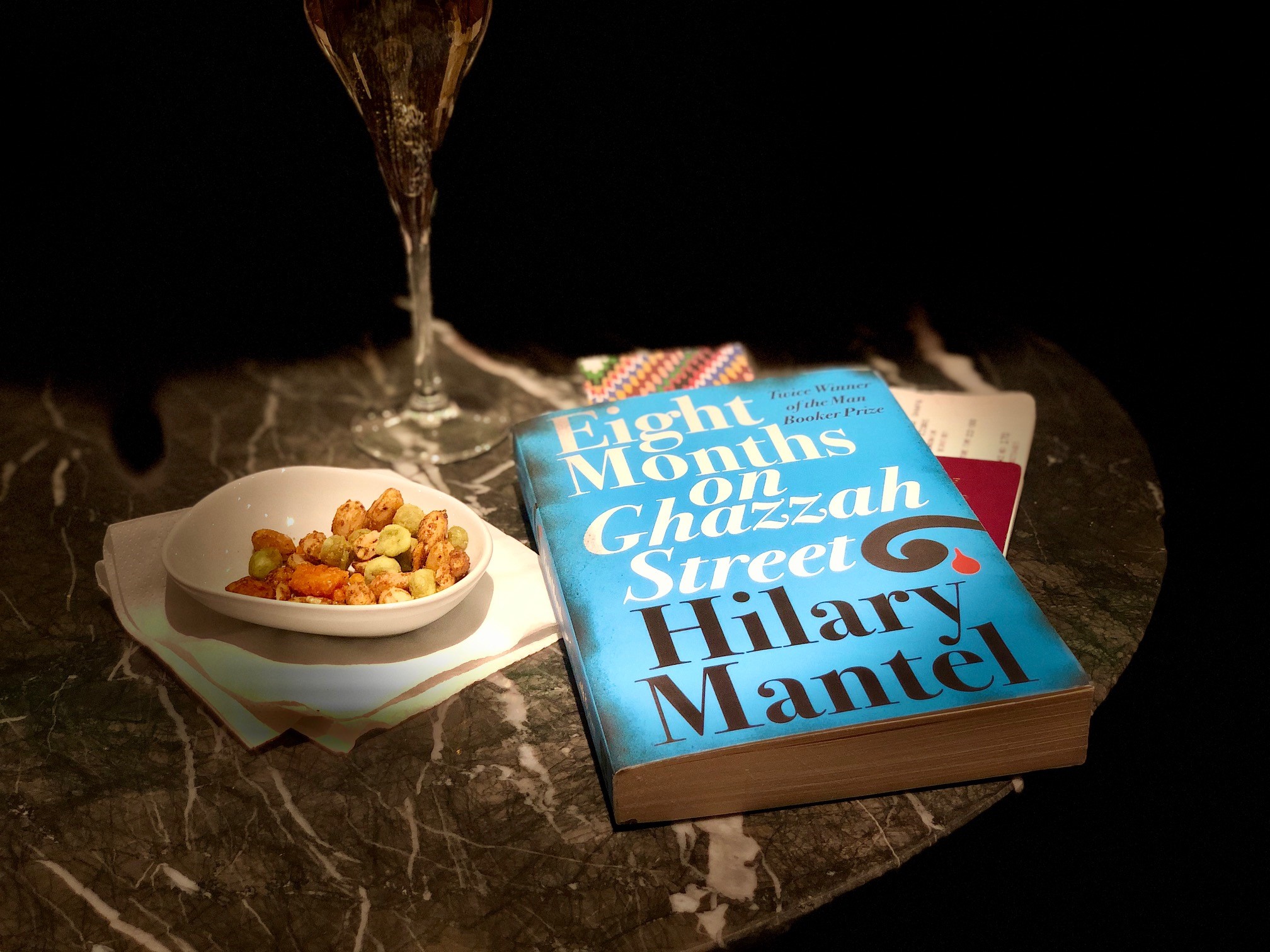
 I had recently been reading Mantel’s third novel, Eight Months on Ghazzah Street (London: Viking, 1988), which is set in Jeddah, Saudi Arabia, in 1984-85, and tells the story of Frances Shore, the unhappily married cartographer wife of a civil engineer on an expatriate work contract in the Kingdom. The novel is perhaps the best evocation of 1980s Saudi Arabia written by a woman in English, and carefully reconstructs the oppressive, punitive environment that she encounters. A mapmaker stranded in a city without signs, Frances Shore observes that pavements in Jeddah exist to stop cars crashing into buildings, and not for the benefit of pedestrians. Her large apartment on Ghazzah Street has windows with views of blank compound walls, and she can only glimpse a view of the sea by climbing to the roof. Denied the opportunity to work or drive, Frances Shore reads her way through all the detective novels she can find, while keeping a diary of her claustrophobic life and trying to reconstruct the lives of others around her. It is a compellingly atmospheric novel. 

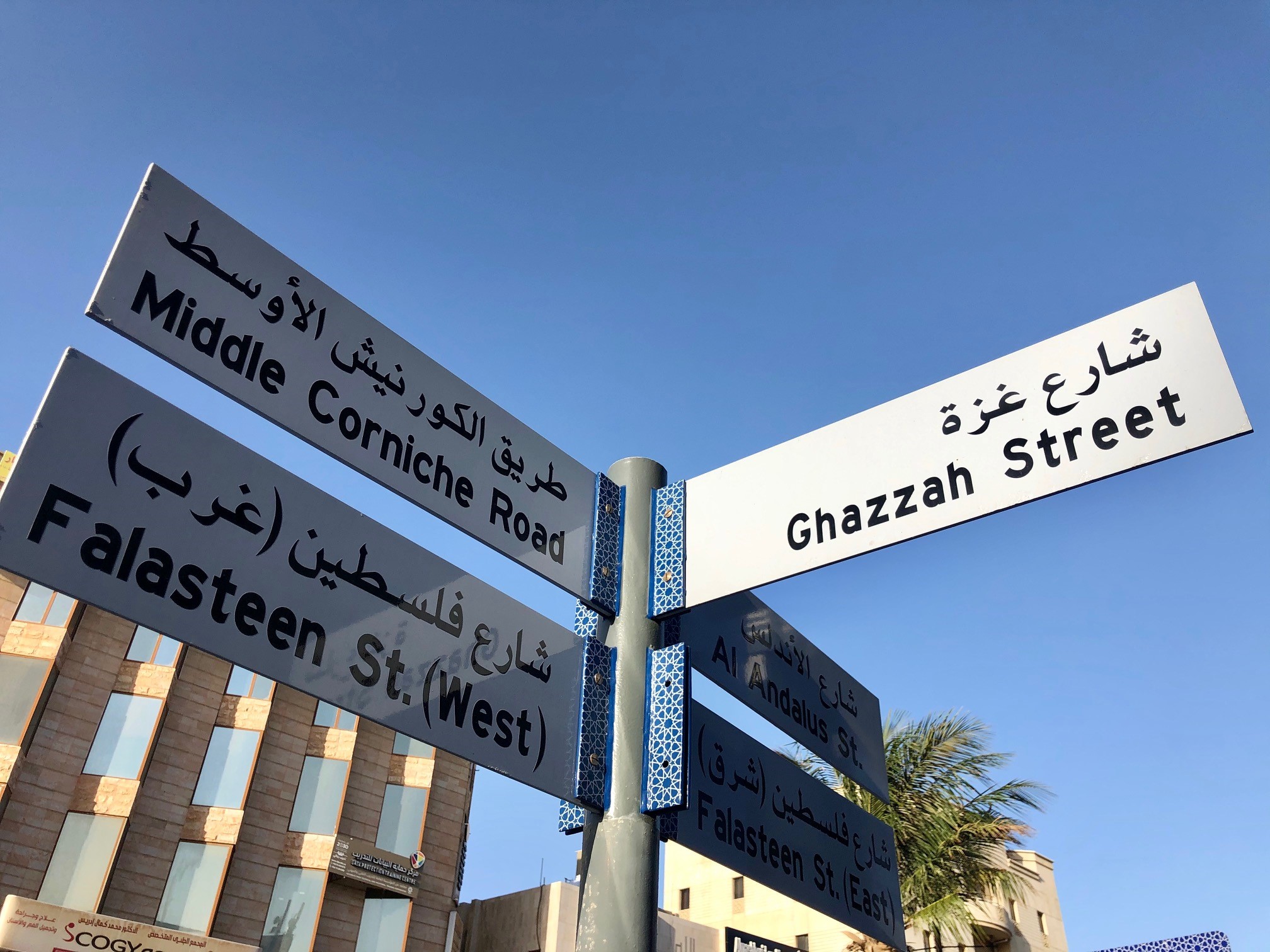
When I recently went to Saudi Arabia for a short visit, I had to go and find Ghazzah Street, and see the place that Mantel had reimagined in her fiction for myself. Within 72 hours of setting foot in the Kingdom, I was there, and a spot of surreptitious literary detective work (and pilgrimage) had begun.  
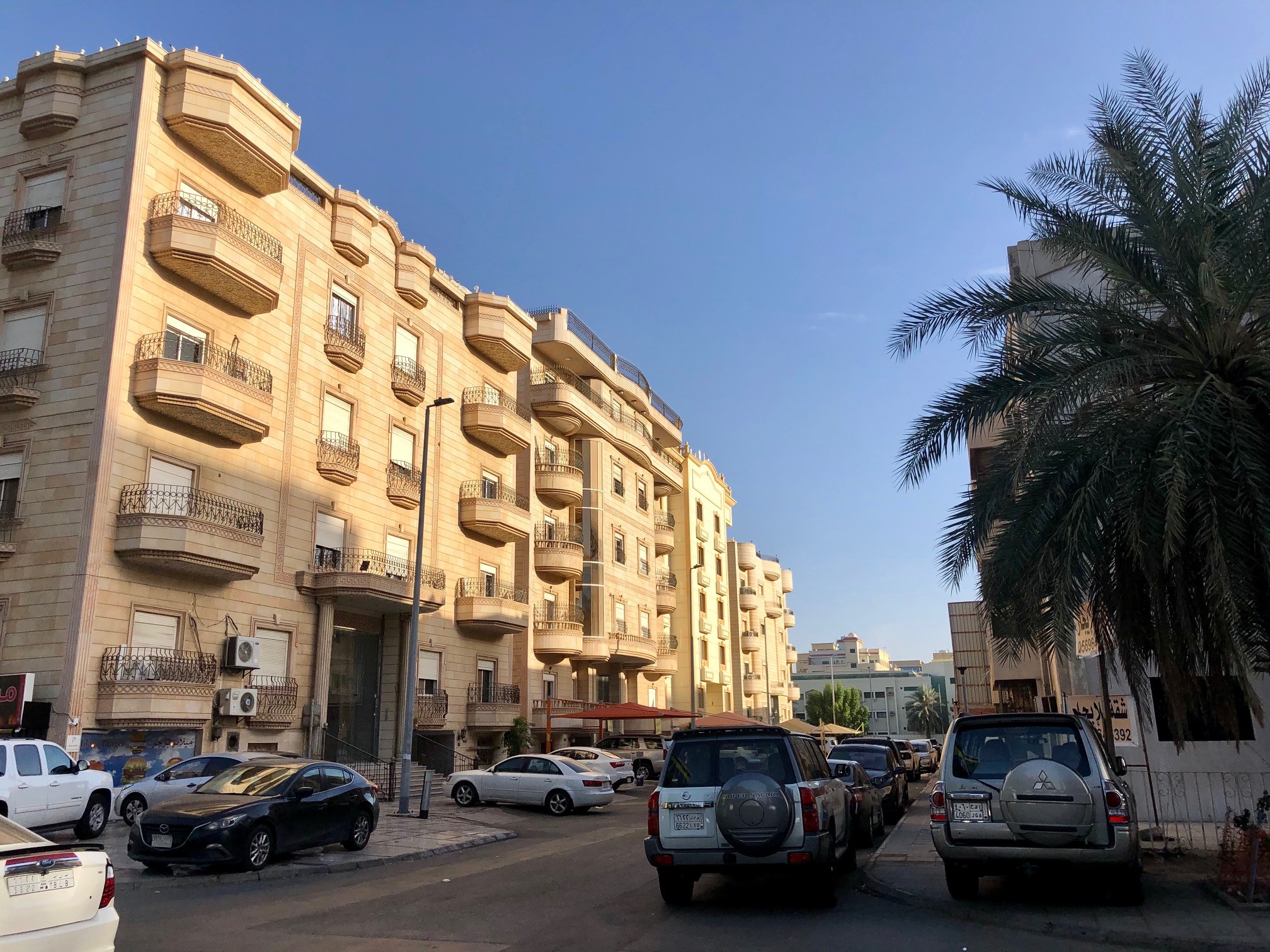
 So here is Ghazzah Street, 9 blocks in from the sea, in Hamrah in Jeddah’s downtown, just off Shari’eh Falasteen (Palestine Street). Several of the buildings look plausible as the likely home of Frances Shore in the novel -which thinly fictionalised the first apartment Mantel actually lived in. Much has changed – Ghazzah Street now has a swanky business hotel, Palestine Street is beautifully pedestrianised, and women are allowed to drive – but parts of the built environment dating from the 1970s and 1980s are exactly as Mantel would have encountered and thinly fictionalised in the novel. In fact, Mantel spent not eight months in Jeddah, but stuck it out for four years, in three different addresses in Jeddah and one outside of the city, accompanying her geologist husband. 
Mantel hated her time in Saudi Arabia and to the best of my knowledge, has never been back. And yet, it was those four years, living in the most gender repressive society on earth, that was the crucible that forged her as a writer. She had time to write, as denied the ability to work or drive, she could do little else. Like her fictional character Frances Shore, Mantel read her way through the British Council Library’s collection of detective fiction, and similarly, kept a diary of her day to day life. She arrived as a housewife and left as a professional writer, with two novels under her belt, and the material – her Jeddah diaries – for her third, Eight Months on Ghazzah Street, ready to go. She worked through her material and wrote the novel back home in England during the winter of 1986, in a world that ‘always seemed to be dark’. Even before the novel was published, Mantel’s Jeddah material was winning awards: her first literary prize was as the first ever recipient of the Shiva Naipaul Memorial Prize for Travel Writing (1987) for a piece on Jeddah. 

 So, if you are thinking of the place that turned Hilary Mantel from a geologist’s wife into an awardwinning novelist, look to Jeddah, and not just for the inspiration for Eight Months on Ghazzah Street. Surely, there could have been no better preparation for writing about absolute male patriarchy and the divine right of kings in Tudor England than having lived in the Kingdom of Saudi Arabia? Perhaps even more ironically, Mantel now has a readership within the Kingdom: Wolf Hall and Bring up the Bodies are both openly sold and read there, as my own visit to Jarir Books, Jeddah’s largest physical and online book retailer, located just a few kilometres away from Ghazzah Street, proved. 
Voices from the Past: Peterloo and New Historical Fiction

It’s exciting to hear that Hilary Mantel’s novel The Mirror and the Light will be published in March 2020. Like many thousands of historical fiction fans, I am impatient to see how she concludes her epic trilogy about the life of Thomas Cromwell. However, I’m also keen to see historical fiction focus on the lives of those who have been given only a footnote in the historical record.  Earlier this month I organised a conference in Manchester with my Creative Writing colleagues Heather Richardson and Joanne Reardon, commemorating the anniversary of the Peterloo Massacre and considering the role of historical fiction in celebrating marginal voices from the past.

Held at the People’s History Museum, the conference brought together a number of speakers including writers and academics from different disciplines. The keynote was Jacqueline Riding, historical consultant to Mike Leigh for the film Peterloo.

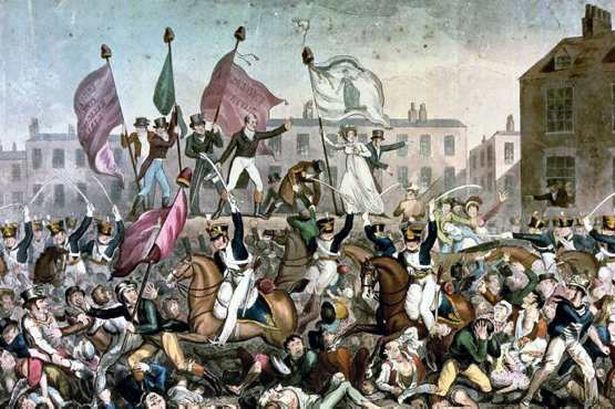
Jacqueline briefly summarised the events that took place on 16 August 1819. On that day at St. Peter’s Field, a combined force of local yeomanry cavalry and British-army regulars  tore through a pro-democracy meeting of 60,000 people. Many of the local yeomanry were drunk.  At least 15 people were killed or died later from their injuries, including an infant and two women, and over 650 were beaten and maimed. This terrible event is the focus of increasing interest, with a number of books published recently including Jacqueline’s Peterloo: the Story of the Manchester Massacre.

The first panel discussion looked at the way in which historical fiction writers interact with historical fact, and why they tell the stories they do. Novelist Emma Darwin suggested that often readers go to historical fiction looking for stories that aren’t covered by history, sometimes focused on whole sections of the community, sometimes on individual voices that have not been heard, citing the example of Joseph O’Connor’s Ghost Light which tells the story of Maire O’Neill, partner and muse of Irish playwright J. M. Synge who became a successful Hollywood actress.

Michael Green talked about his novel The Ghosting of Anne Armstrong, and his research process. It is based on the story of a 14 year old girl who went before a justice in Northumberland  in 1673, accusing her neighbours of witchcraft. Michael came across the story on a plaque in his local pub, and became engrossed in the research journey, which eventually led him to the National Archives at Kew where he found Anne’s depositions. Her unlikely story caught his imagination: ‘A voice gets me and won’t go away.’

The panel ‘Touching history – tactile historical fiction’ focussed on the importance of tactile objects when connecting with the past. Vivienne Richmond presented on her work on the clothing of the working class and talked about her book Clothing the Poor in Nineteenth Century England. It is hard for us to understand the way that clothing was coded in the past, and historical fiction set in the Victorian period – such as The Crimson Petal and the White by Michel Faber – can help decipher such codes, because writers producing work for 21st century readers make information explicit which would have been implicit in the work of Victorian writers.

Vivienne also suggested that as the scraps of fabric that mothers left with their babies when leaving them at the Foundling Hospital in London are often vibrantly patterned, we can assume that they wore dresses made from such fabrics. The concept that we generally have of ‘the poor’ wearing clothes that were shabby and drab would only apply to the most deprived.

Heather Richardson talked about her research process in her novels Magdeburg and Doubting Thomas, and her recent project ‘A Dress for Kathleen’, in which she commemorates the life and death of her aunt Kathleen during a blackout in World War II by making a dress using a contemporary dress pattern and creating an artefact that blends the verbal and the tactile.

The conference also encompassed new ways to present historical fact. Graphic novel Peterloo: Witnesses to a Massacre, a collaboration between cartoonist Paul Fitzgerald ‘Polyp’, artist and activist Eva Schlunke and academic Robert Poole, demonstrates that it is possible to distil detailed academic knowledge into the succinct visual form of graphic art.

The final panel event was a ‘Big Book Group’ discussion in which Emma Darwin talked about her book The Mathematics of Love, which encompasses the Peterloo Massacre, and her latest publication: This is Not a Book about Charles Darwin. Emma described how The Mathematics of Love began as a response to a writing exercise where the prompt was ‘watch’. Immediately the image came into her mind of a red-coated English soldier watching a girl bathe in a Spanish river – and so her main character was born.

Throughout the conference there was a sense of connections being made and links being forged, and of possibilities for future collaborations. One conclusion is that this is a vibrant, multifaceted form that offers continually evolving interpretations of past realities. There is a full report of this conference on the Contemporary Cultures of Writing site.