By Chris Cotter
In May 2016, I took a short flight from Edinburgh to Belfast to sing in a farewell concert for my secondary school’s retiring Head of Music. It was quite an emotionally charged evening and, fittingly, the final piece on the programme was an arrangement of “Anthem” from the musical Chess. The final lines of the song run as follows:
“Let man’s petty nations tear themselves apart
My land’s only borders lie around my heart “
(Rice, Andersson, and Ulvaeus 1986: 64)
Before we sang, my former teacher suggested—perhaps joking, perhaps not—that this should really be “our” national anthem (whatever “our” might mean in a Northern Irish context), rather than the rather uninspiring God Save the Queen (now “King”). In a place as politically and culturally layered as Northern Ireland, that comment carried weight. It also stuck with me.
In this post – which is a blogified version of Cotter (2017) – I’ll attempt to unpack that moment and reflect upon the notion of identity: how we construct it, perform it, and shift it depending on context. I’ll return to Anthem (the final eight words of which I now have tattooed on my forearm) after I have offered some reflections on my memories of growing up Northern Irish, living in Scotland, and learning—slowly—that identity is never quite as fixed as we might think.
History and Memory
I don’t remember really learning much, if any, Northern Irish history at school. I could tell you about the Great Famine, and I could say a bit about the First World War, but beyond that, my formal education feels oddly silent. Given Northern Ireland’s complex and often painful past, that silence feels significant. I now suspect that this wasn’t accidental. Teaching recent, politically sensitive history is difficult, especially in a divided society. And maybe my parents were keen to keep sectarianism at arm’s length and didn’t go out of their way to fill in those gaps at home either. However, this remembered absence is worth reflecting on, especially when I think about just how present sectarian divisions were in my everyday life.
I grew up in the 1990s in what I’d describe now as a middle-class Protestant (Church of Ireland) household. And like many Northern Irish people of my age, I was aware of “the Troubles,” even if I didn’t fully understand them. I knew about the violence. The murders, the bombs, the annual tensions around marching season. I remember the visual markers such as flags and painted kerbstones which marked different territories. And I remembering being puzzled that so many of my primary school classmates supported Glasgow Rangers (the ‘Protestant’ team) when I didn’t think Scottish football was that good (sorry!), and being teased for supporting the supposedly ‘Catholic’ Manchester United.
More positively, the cul-de-sac we moved to in the mid-90s was roughly half Catholic, half Protestant, and I don’t remember this fact causing any issues. Far from it. However, importantly, this information was still known, even if not really mentioned, and we also learned to be careful with using certain friends’ ‘Irish’ names when we crossed the bridge to go to the shop in the nearby ‘loyalist’ estate.
Looking back, I have to acknowledge that these memories aren’t neutral snapshots of the past. They’re shaped by who I am now: someone who likes to think he’s a bit more “above” sectarian divisions; someone who has gone on to specialize in Religious Studies and even authored some materials on Northern Ireland for OU’s new module – DA332: Religion and Global Challenges in the Past and Present– which has just finished its first presentation.
Did school actually avoid Northern Irish history, or have I just forgotten it? Were my classmates consciously expressing (their parents’) religious or political identities through football, or am I projecting that on to them? What I can say is that identity mattered, even when I didn’t fully grasp why, and I had my own tactics for navigating it.
Two Flags, One Photo
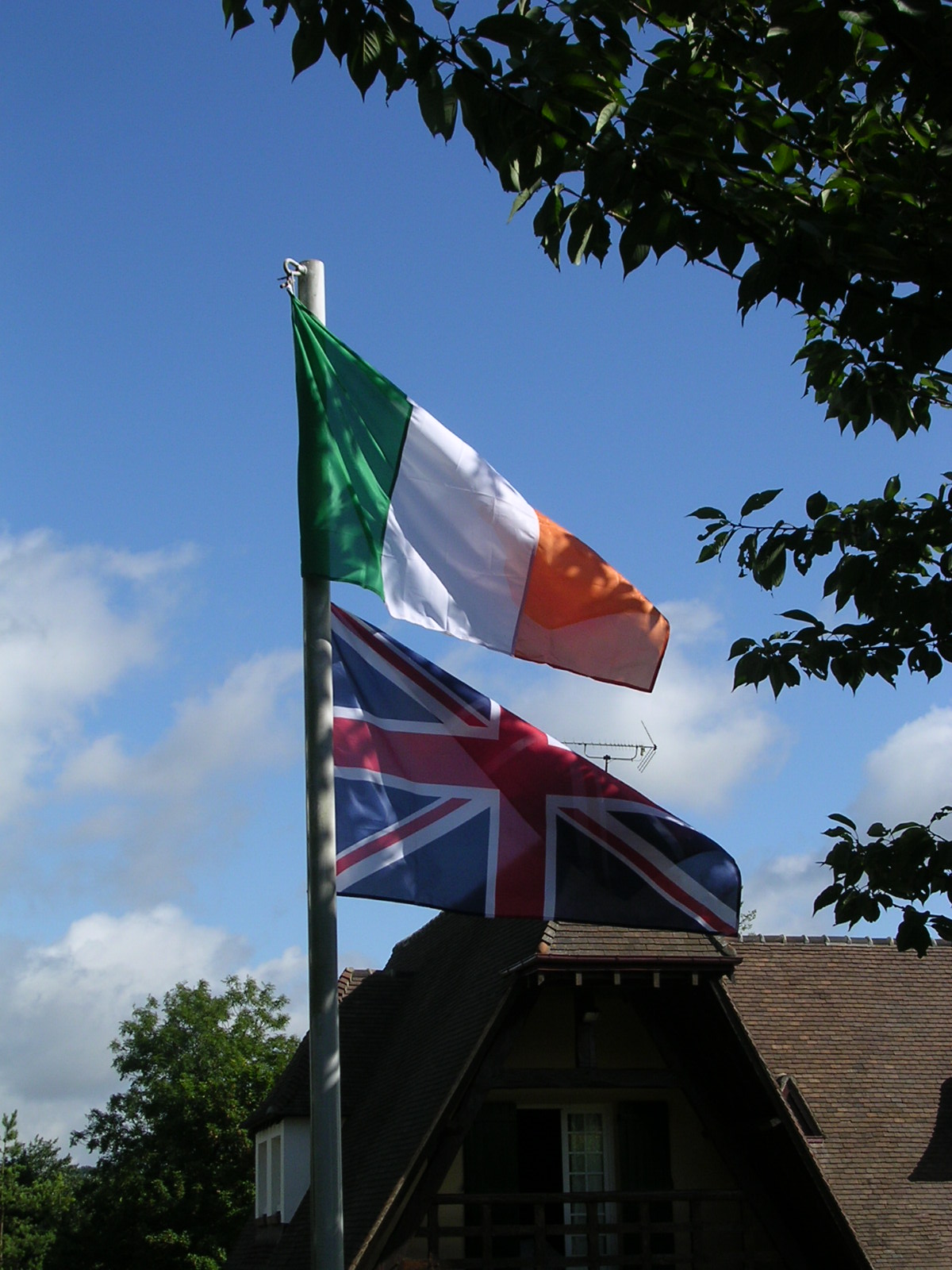
A wonderful illustration of this comes from another memory of a 2003 family holiday in Normandy. The owner of the holiday home we were staying in had a quirky habit where she would fly the national flag of whoever was staying in the cottage from a flagpole in the garden. Misunderstanding our “Northern Irish” identity, she first raised the Republic of Ireland flag and then, upon realising her ‘mistake’, she added the Union flag below it on the same pole.
For what might have been the first time in my life, I saw those two flags – each of which I associated with violence, bigotry and claims to territory – flying together. So, I took a photo. And, as many teenagers did at the time, I immediately set this quirky image as my MSN Messenger profile picture when we returned home.
Not everyone appreciated the symbolism as much as I did, and I can remember a ‘friend’ almost instantly berating me for displaying it, stating that she would rather die than see the Union flag flying beneath the “tricolour”. I asked why this bothered her so much, and she said that this display was offensive to her “religion”, which was “Protestant,” as she put it. I pushed back, questioning what she meant, especially when she admitted she didn’t attend church. In my mind, I had “won” the argument. Much like I had decided that my classmates didn’t “really” support Rangers, I decided that she wasn’t a “real” Protestant but was just someone using the label as an alternative to “loyalist”.
Looking back now with my Religious Studies hat on, I can see that I fell right into the trap of what Aaron Hughes calls the rhetoric of authenticity (Hughes 2015: xv). This rhetoric dominates in much public discourse about religion, where “the operative assumption seems to be that ‘religion’ or a ‘religious tradition’ must be essentially good and just, and, a priori, anything that is bad or unjust must therefore be an aberration of religion” (Martin 2010: 3). I thought I knew what Protestantism “really” meant. I thought I was above the politics. But, of course, I now know I was playing the same game, but from a different standpoint. As my doctoral supervisor, Kim Knott (2005: 125), has argued, ‘there is no “bird’s eye view”’ from which ‘we’ can study religion (or, indeed, many other social categories).