tl;dr – The UK’s Command Paper on the Northern Ireland Protocol

The publication on 21 July of the UK government’s Command Paper came just before the end of the Parliamentary session. Flagged for several weeks, it was presented as the culmination of a long push to secure changes to the Northern Ireland Protocol.

Undoubtedly, the Paper does cap the numerous public statements of Lord Frost, Brandon Lewis, Boris Johnson and others in government, not least in saying that a root-and-branch reformulation of the entire text is needed, rather than some tweaking at the edges.

But it is another aspect of culmination that is more striking: the lack of credibility behind the proposals advanced.

Put briefly, the UK’s position appears to be one of “we didn’t mean to sign the Protocol, so let’s change it”, an approach that has no grounds in either international law or basic political common sense.

The international law aspect is something I’ve covered already, but to recap the basics: if you freely sign a treaty, you’re bound to stick to it, unless there’s some very fundamental change of circumstances. And no, disliking it isn’t enough.

The political angle is one that’s not too complex to unpack either.

In any potential negotiation, you need to know what your best alternative to a negotiated agreement (or BATNA, for acronym fans) is. As long as you can get a better outcome by negotiating than by not negotiating, then you should negotiate and agree.

Note that this is purely relative: the negotiated outcome might be poor, but it just needs to be less poor than not agreeing. And so it is for Brexit.

The EU might not like the Protocol much, but it was better than any other option on the table, or walking away from the table altogether.

As such, the UK’s proposal to renegotiate the Protocol needs to be a clear improvement on the status quo.

And yet, the Command Paper barely deals with the EU’s needs (beyond Single Market integrity), which means the case has not been made to even start on this, so the Commission’s rejection of renegotiation is less than surprising.

Since the UK knows all this, the question has to be why bother pursuing a route that isn’t going to lead anywhere good? Playing with invocations of Article 16 (which isn’t what the UK government thinks it is, but that’s a different point) can only result in numerous legal and trade retaliations from the EU, and a big telling-off by the US, only to leave the UK with the original problem still in place, so it’s not really going to work.

As with so much of the Brexit process, this isn’t really about the external aspect, but the internal one. The deep allergy of Number 10 to signing up to anything that gives a formal role to the EU in UK affairs is driven by the pressures of backbenchers, regardless of the views of public opinion, businesses or anyone else.

Indeed, the most telling sentence in the entire Command Paper is from para 14:

Nevertheless, the revised Protocol delivered the fundamental requirement of enabling the UK as a whole to leave the EU in a genuine and meaningful way

British policy is thus about what mustn’t happen, rather than what must; a strategy that has failed repeatedly since 2016.

The hope is still, clearly, that someone will come up with a cunning wheeze to square the numerous circles, so all that’s needed – and fortunately all that’s possible – is to keep things from settling into any kind of regularity, so that no one gets too comfortable.

I’ve set out some further thoughts on the Command Paper in this thread, but the key is that this isn’t any kind of unblocking process, but rather a holding pattern:

https://twitter.com/Usherwood/status/1417826694216495109?s=20

As a bit of a side-note, I’ll also mention that the DUP made various positive noises about the proposals in the Command Paper, largely because they talk to the same people.

The DUP’s seven tests from last week did highlight the problems of the current Protocol, but also of all the other options out there. Those that do meet the DUP’s requirements don’t work for either the EU or Number 10.

This suggests that we are still a very long way from any kind of stable equilibrium on Northern Ireland.

Posted in Uncategorised | Tagged , , | Leave a comment

Financial Settlement News

Perhaps the most striking thing about the breaking of the story about the unexpectedly large size of the UK’s financial liabilities under the Withdrawal Agreement last week was that it generated so little attention.

The consolidated EU accounts for 2020 were published on 9 July, but it took a ‘tip-off‘ to RTE to get them checking the text. Number 10 said it ‘didn’t recognise the figure’, but then that was it.

So little for something that had been flagged in 2016 as one of the hardest issues to crack in the then-upcoming negotiations.

In practice, finances were dealt with relatively early and relatively simply: the WA set out (Arts.135-148) the rules for deciding what was and wasn’t included, plus a schedule for payments.

But no figures. Precisely to avoid getting anyone’s backs up. And because until the money’s spent, no-one actually knew how much it would be.

Which didn’t stop the UK trying to work out the bill.

The graphic below sets out those estimates, as well as highlighting the huge potential for misjudging totals. The Commons Library briefing on all this is excellent as a guide.

The short answer to the mismatch between the UK estimates and the Commission’s first calculation (which is unlikely to move much) is that both the basic calculations on contributions and RAL were shifted by Covid and the associated economic slump, which also affected valuations of other assets and liabilities.

Number 10 might not have recognised the total, but they also haven’t gone hard on rebutting it, which suggests this is one fight that they are not going to push on.

UPDATE: The UK government’s report on the 2020 budget reiterates the March OBR estimate, but doesn’t challenge the more recent Commission valuation.

Posted in Uncategorised | Tagged , , , | Leave a comment

Meetings and the TCA/WA

One aspect of the WA/TCA pairing that will generally never get much attention is the meeting roster.

Both treaties provide not only for a coordinating body – the Joint Committee (WA) and the Partnership Council (TCA) – but also a raft of more specialised bodies, roughly one for each section of each treaty.

These bodies are intended to provide a space for discussion between the parties, and a ratification of jointly-agreed decisions. The specialised bodies deal with their particular reams, then it goes up to the central body for approval.

In most part, the work of all of these is dull. If there are no major issues, then they essentially operate to provide regular confirmations of this; if there are major issues, then the more senior officials and politicians get stuck in and try to find solutions in an ad-hoc manner.

But this doesn’t mean they’re not important. On the contrary, their documentation provides as good a public paper trail as is available to most interested parties, while the simple rhythm of their meeting tells you something about their value.

In the two graphics below, you can already some of this.

The WA committees have had longer to bed in, but the centrality of the Northern Ireland Protocol is clear, with Citizens’ Rights rather less behind than might have been evident: with the end of the UK’s window for registering for Settled Status, that Specialised Committee is likely to gain further in prominence.

By contrast, the TCA bodies have been much slower to get moving, in part because of the delay to full ratification until May, in part because the urgent issues have been with the WA and in part because everyone’s still working through a lot of what the TCA actually means in practice. Note that one of the WA committees didn’t first meet until 9 months into that treaty’s entry into force.

I’ll be updating these graphics regularly, with PDF versions that let you click through to Commission reports on each meeting uploaded to the bit.ly links below.

PDF: https://bit.ly/UshGraphic85

Posted in Uncategorised | Tagged , , , , , | Leave a comment

Further grace periods

The past week has seen two important grace periods extended.

These periods have been used in both the TCA and WA to allow the UK and EU enough time to make necessary preparations for full implementation, or that is at least the EU’s line.

The less-remarked of the two has been the granting of data adequacy to the UK’s rules for a four-year period to 28 June 2025, meaning that data can continue to move freely across the border. However, this has come with an unprecedented sunset clause and explicit powers to revoke it should the UK change those rules, which currently remain much as they were during membership.

As such, the discussion about reforming the UK’s regime might well end up bringing adequacy back to the table sooner rather than later.

The more-remarked was yesterday’s confirmation of a three-month extension to the chilled meat products exemption for Northern Ireland (UK declaration and EU response). This is problematic in different ways from data, in that the issue has been a failure by the UK to make conspicuous movement towards full implementation and the concern that this extension might be a prelude to an effort to get a semi-permanent delay to that occurring.

As a result, the EU’s comments on conditions and expectations are worth noting.

In a sense, both cases highlight the difficult road that this relationship is following. The degrading of trust during and following negotiations leads the EU to be very attentive to compliance, even as it makes efforts to avoid looking too inflexible. In that regard, the bundling of the chilled meats extension with other work on flexibility on the Protocol is as important, even if still most promissory.

For the UK, the almost permanently aggravating behaviour of the fist half of 2021 has soften a bit. The decision to ask for the chilled meat extension, rather than just announcing one, counts as a win here. Likewise, the signing of a bilateral agreement with Germany on security points to other paths for showing good faith is possible.

However, this path will be a very long one. There are clear issues with all the remaining grace periods, plus the negotiations and reviews, in the coming six months, not least the operationalising of the new format for fisheries quotas to be completed by New Year.

And that’s not even getting into the end of the application period for EU nationals to acquire Settled Status in the UK and the scope for removals.

One swallow doesn’t make a summer, as they say.


Posted in Uncategorised | Tagged , , , , , , | Leave a comment

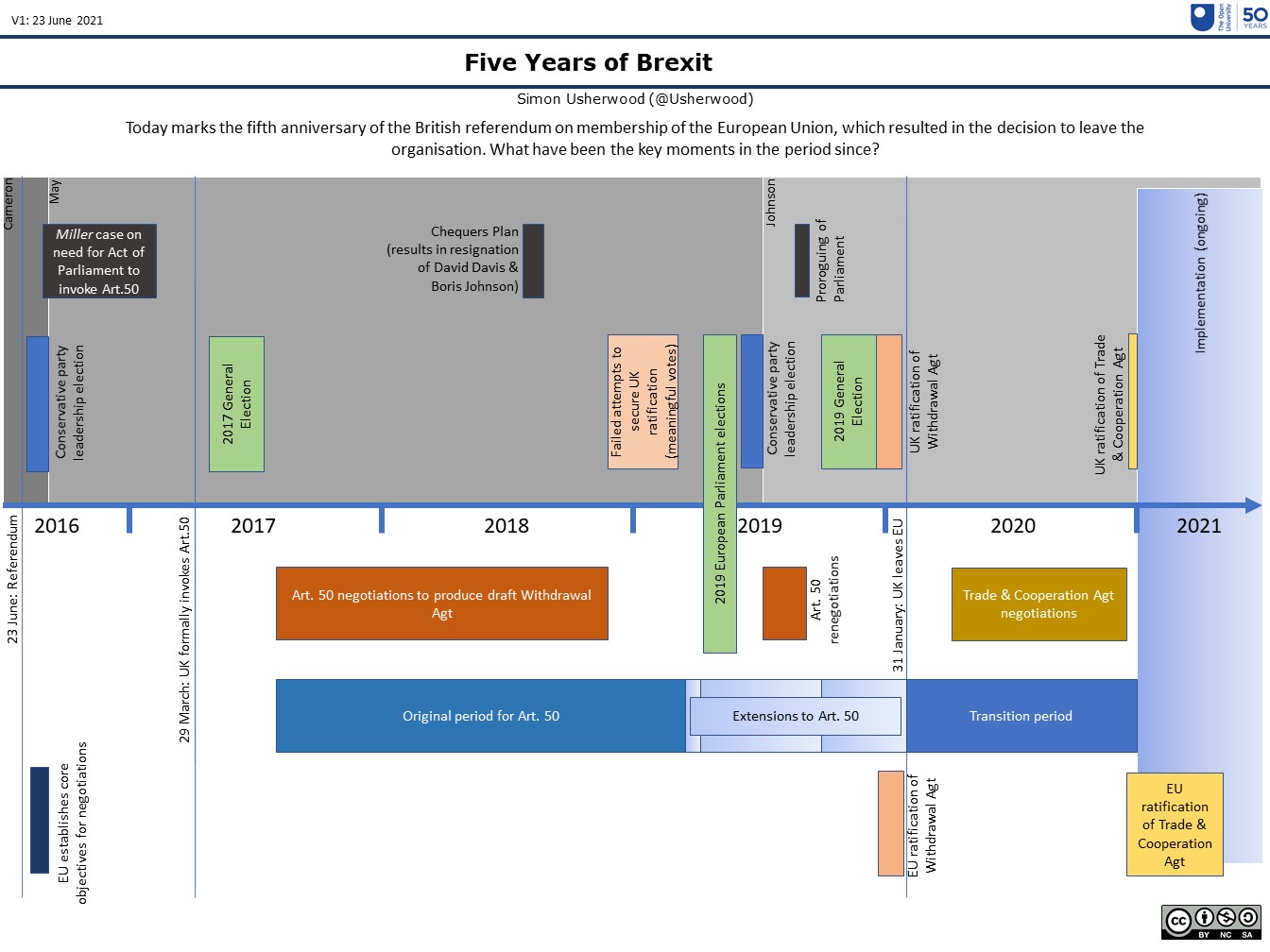
Five years of (some of) Brexit

For me, it was the morning after that I remember most vividly.

An early train to London left me wandering into Parliament Square at too-early-o’clock to hunt down the Radio5Live tent on College Green, to sit with Adrian Chiles for a few hours while he interviewed some of the many passing politicians about the result of the referendum.

I remember it a bit because Adrian was very generous in sharing his biscuits, but much more because of what I saw unfolding around me.

Almost to a person, everyone looked as if there had been an explosion and they were now staggering through the dust, trying to work out what had happened. Leavers as much as Remainers carried a look of those who weren’t entirely sure what whether this was real or not, a figment of their fevered imaginations.

And more than this.

There was a vague sense in the air that if this was so, then what else might be possible? For a while, everything seemed uncertain, nothing was fixed. As a good Gen Xer, I was put in mind of Ice Magic: the hard shell of our political institutions being lifted off to reveal a rapidly-melting polity.

No, I hadn’t slept much.

Throughout the 24th, I kept coming back to this strange place, simultaneously fearing that no-one else knew what came next and hoping that no-one did, that they might come up with something calamitous.

But no one did. Just a trail of resignations, of sheepish press conferences, of hours, then days, of drift. Very soon it became clear that no one had really, truly, properly prepared for this.

And this has been the leitmotif of the past five years: an aftermath, a picking up of the pieces, with no sense of whether to whip out the superglue or to stick the mess in the bin.

Ultimately, the referendum was a decision without a rationale or a reason. That’s not wrong – unlike some, I’m not hear to call out the quality of the debate beforehand – but it is problematic.

Whatever relationship the UK wants with the EU, it will not be secured in the way that it has been pursued since 2016. The British approach has been driven by what is not wanted, rather than by any coherent sense of what should be, and why it should be so.

My hope in 2013 had been that Cameron’s offer of an in-out referendum might trigger a careful national discussion about such things, although I’ll profess to being dubious it would happen until that offer came good.

My hope in 2015, after the general election, was that now would be the time.

My hope in 2016, after the referendum, was that this was now essential, ahead of any negotiations.

And my hope now, after all my previous hopes have been dashed, is that one positive consequence of the tortured process we’ve undergone is that the case of trying to build an inclusive project for the UK is now easier to make.

Maybe I’m too optimistic on that front, but I do know that I’ll keep on trying to help people make sense of the issues and the options, so that we can work towards a new, stable and resilient relationship with the EU.

Posted in Uncategorised | Tagged , , | Leave a comment

Citizens’ rights under the Withdrawal Agreement

Citizens’ rights has been a rather strange part of the Brexit process, in that it has never occupied a very prominent place in the negotiations or discussions, even though it contains huge potential for disruption and problems.

Whereas the financial obligations was seen as a big haggle, and the Irish dimension as complex, citizens’ rights was treated in large part as a matter of recognising the situation of the other parties’ nationals on your territory and leaving it pretty much at that.

Of course, there was more to it than that, not least in the past year when travel restrictions left many living somewhere other than their normal residence, causing complication to the various schemes used by different states.

This matters as we are closing in fast on the first set of deadlines for people to confirm their status: the Withdrawal Agreement provides for people to remain where they were pre-UK withdrawal, but in many states (including the UK) there has to be an active process of acquiring confirmation that it applies.

As the graphic below shows, this stems from a choice open to all signatories as to how they wanted to go about this. The constitutive approach needs that active process, while declaratory model is more flexible (although in some cases deadlines still apply).

These deadlines matter because the lists they produce will be a baseline for accessing the rights contained within the Withdrawal Agreement. As has been seen in both the UK and the EU, the lack of need to hold such official registrations beforehand has led to very significant undercounting by preliminary estimates, with the risk that tens of thousands of individuals might find themselves without a legal residence status.

This summary captures the key points for the UK scheme. Important to note is the issues that arise for anyone not meeting the deadline (even if you ultimately secure settled status) and extent to which Home Office officials will have discretion on cases.

As someone who’s had to help guide a close family member through the British process, I can attest to it being less than simple for anyone not currently in regular employment, so if you know anyone still to do it, then make sure they get going on it now: the link is here.

Even with the best will, there will be many pieces of litigation around this topic, especially should any state start to remove nationals because of non-compliance with these registration schemes. I strongly recommend following Steve Peers on this, for his excellent analysis (gateway page here). The UK in a Changing Europe also have just issued this new report/guide that’s well worth your time.

Posted in Uncategorised | Tagged , , | Leave a comment

Pathways for the Northern Ireland Protocol

With the first meeting of the TCA’s Partnership Council finally done, alongside the WA’s Joint Committee, it’s perhaps a good time to reflect a bit on the Northern Ireland Protocol.

While this sits within the Withdrawal Agreement, it’s worth noting that sanctions for non-compliance can extend to any other agreement between the EU and UK, so the TCA’s remit of trading relations is still in the mix.

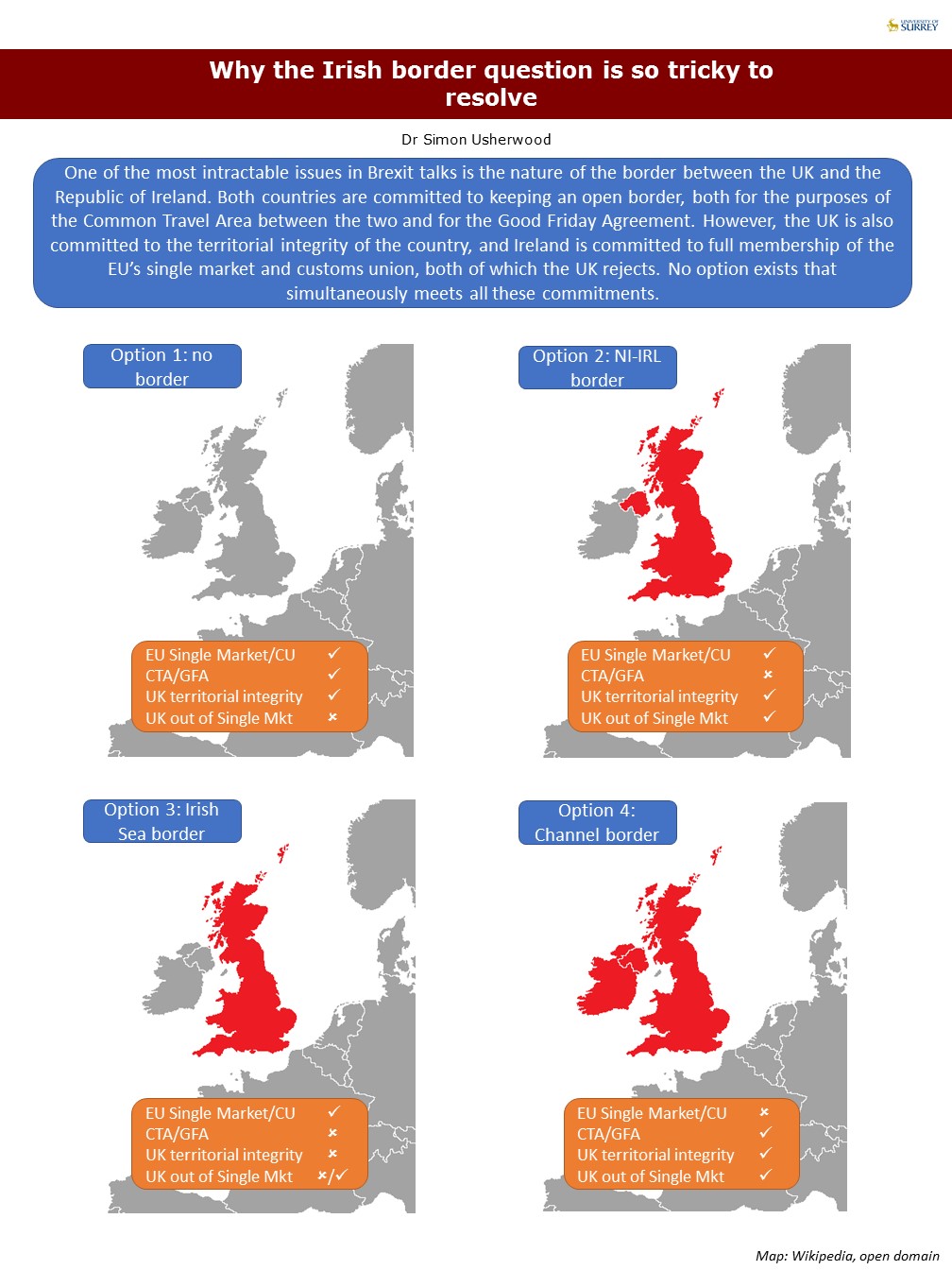
It’s undeniable that the Protocol has been the locus of many of the difficulties between the two sides, and that it represents a problematic compromise for them both. The question is therefore what to do about it?

In the most generic sense, there is a clear range of options, depending on whether you want to work within the Protocol or want to escape it.

If the EU has leant towards the ‘leaning in’ options, then the UK has gone the other way, as evidenced by its failure to demonstrably work towards making the Protocol operational (most recently with chilled meats and the Great Sausage War of the morning of 7 June 2021 [sic]).

The issue for the UK is that any path it follows it problematic at some level (and usually several levels), so much hangs on how Number 10 views the relative importance of each aspect, especially given that inaction is likely to become ever less viable as a way out.

I’ve covered dispute settlement elsewhere, but there is an additional level of addressing issues within the Protcol, the infamous Art.16. This provides for temporary measures to deal with serious difficulties, albeit in a way that doesn’t seem to have been properly internalised by either side just yet.

And if you’d like another take on the basic tensions in resolving Northern Ireland’s situation, I refer you back to one of my earliest graphics, from June 2017:

Posted in Uncategorised | Tagged , , , , , | Leave a comment

A bit of trade and not much cooperation: The hard Brexit deal

Source: Consilium

This is a draft version of a piece published in Political Insight. Please refer to that version for any citations.

Even before Covid, it was evident that 2020 was going to be a difficult one for British politics. The December 2019 general election might have given Boris Johnson the majority he needed to push through the Withdrawal Agreement that had bedevilled the past three years, but that merely opened the door to the next phase of Brexit – working out what a new relationship with the European Union might look like.

The Withdrawal Agreement was focused on ending the old relationships: finding arrangements to tie up the financial liabilities, securing commitments on citizens’ rights and the Irish border. But it was never meant to be the be-all and end-all of the process. Alongside it, a Political Declaration announced the intention of both sides to pursue a new set of negotiations on an “ambitious, broad, deep and flexible partnership” that would reflect the proximity and importance of each to the other.

The obvious fly in the ointment was that the repeated extensions of the Article 50 process to produce the Withdrawal Agreement had not been matched by extensions of the planned period in which to conclude this new partnership. The date of 31 December 2020 for the new treaty’s operation had been set in the version that Theresa May failed to get through Parliament for the original March 2019 deadline. Despite having to push that back ten months, neither side seemed keen to flex. For the EU, a delay would have both pushed into a new financial planning period and dragged out a process that was dragging attention away from the other, more pressing items on the to-do list. For Number 10 under Johnson, asking for more time after making so much of the previous delays was simply not an option, especially given the belief that some time pressure could help make the Commission more flexible.

The upshot was that the early spring of 2020 found the two sides preparing to conclude another agreement with each other, of a scale and nature that more usually might take several years of negotiation, a situation that became even more daunting as those talks formally started in March, just as the scale of the Covid pandemic was becoming all too clear.

With this in mind, it is still rather easy to overlook that the conclusion at all of the Trade and Cooperation Agreement (TCA) on Christmas Eve, just nine months later, is a significant achievement that has no real parallels elsewhere. The reasons for that successful conclusion are worth examining, because they also help to explain the contents of the TCA.

Most obviously, and distinctively, this was a negotiation about divergence, rather than convergence. Almost all trade deals have concerned themselves with reducing barriers between the parties; an often-difficult process of trying to agree on joint standards or processes, or which side’s version might be acceptable to both. By contrast, the UK and EU had shared a vast array of common laws, regulations and procedures and so it was a matter of what they might want to stop doing in alignment with each other, at least in formal terms.

Secondly, the UK made very clear from the start of this phase that it intended things to be kept to a very limited scope. Notwithstanding the rhetoric of the Political Declaration, the formal opening position that was presented in March 2020 indicated that this was to be a modest Free Trade Agreement, with minimal diversions into other areas. Less on the table meant less to be got through.

Lastly, the consequences of not agreeing a deal hung all too clearly over both sides’ heads. While the experience of the Article 50 process had been a difficult one, it did underline the importance of having some functional relationship for both. The prospect of entering 2021 with a collapse of all prior arrangements – with all the attendant uncertainty and disruption – was one that did not ever really seem to be acceptable, even to those in the UK that talked of ‘prospering mightily’ in such a situation. The huge disruptive effects of Covid lockdowns only furthered the arguments of those who said that a second level of disturbance was not desirable.

And yet, for all this, the process ended up being a lot more finely-balanced that could have been.

Central to this was the issue that had made the entire process heretofore so difficult: the UK seemed unable to identify clearly what it wanted to achieve. As with Article 50, much of the official position was about ending particular aspects of cooperation and avoiding others, rather than about articulating a more constructive model of what it hoped for and how it fitted with its wider plans. Thus a key issue throughout was the removal of any role for the EU’s Court of Justice after many decades of support by the UK while a member state for the need for an independent arbiter in disputes. Likewise the unwillingness to maintain any future alignment on regulations, even in areas where the UK has consistently had more stringent requirements than the EU.

Likewise, the segmentation of the process by the EU also meant that it had already secured its fundamental red lines in the Withdrawal Agreement, and so seemed more willing to let the UK chose to walk away. This was certainly grounded in an analysis that the latter stood to lose very much more than the EU did by having a no-deal, and by an understanding that in trade talks the larger party usually gets what they want, but that still assumed a degree of coherent strategizing from the UK side that was not always apparent.

Exhibit number 1 in this was the decision to introduce the Internal Market Bill in the autumn, which including provisions to specifying disapply parts of the Withdrawal Agreement in order to facilitate intra-UK trade. Not only did this endanger the parallel process of implementing the Northern Irish Protocol, but it also called into question the entire architecture of international treaty-making, something that is existential to the EU’s being. While gradually walked back by the UK, with no obvious concession by the EU, it did highlight the dangers for the latter of making further commitments that might be disregarded in short order.

All of which brings us to the Agreement itself.

In content, the TCA is a relatively modest free trade agreement, with some relationship-specific elements added in. Certainly if benchmarked against membership, it represents a severe weakening of the EU-UK relationship, even as it does some eye-catching aspects.

Most noted at the point of its rapid signature and entry into provisional force was the ‘zero-zero’ aspect of trade in goods: no tariffs and no quotas between the two. Most free trade agreements fail to hit this, as specific sectors lobby hard to retain protection from competition: in this case, the status quo ante was one of no such barriers.

However, this does not mean that trade in goods has not been constrained. Both sides now have to impose checks for health and sanitary standards, as well as requiring paperwork to prove goods have sufficient local content to meet rule of origin requirements. This multiplication of steps for importers and exporters not only contributed to short-run disruption in the first weeks of the TCA’s operation, but will continue to add cost to cross-border trade, which should be expected to lessen as a result.

But goods are only a part of economic activity and it is in services that effects will be more evident. The UK pulled back from trying to keep the (somewhat patchy) provision for selling services: this includes recognition of professional qualifications or guarantees about British financial providers being able to supply within the EU, potentially of major consequence for the City. In addition, there seems to be little prospect of developing this area, despite it being one that modern free trade agreements more generally are recognising as important for securing economic gains.

Aside from this trade package, it has been fisheries that have taken much of the limelight, as the EU sought to keep its historic access to UK waters, while the UK tried to escape the failures of the Common Fisheries Policy. Both sides ended up putting a lot of symbolic weight on this topic, far out of proportion to its economic value, mainly because it had much potential for demonstrating the success of each side’s negotiating. The result was, perhaps as a result of this, something of a fudge. While the EU quota does get cut back during an adjustment period of five and a half years, and the UK becomes an ‘independent costal state’ at that time, the TCA does allow the EU to impose tariffs on the UK if its quota gets cut any further. Put differently, the nominal independence does come with some effective strings attached.

Elsewhere, it is the absences that have been more striking. Cooperation on security was largely put on hold, as the UK falls out of most of the police and judicial cooperation systems and intelligence sharing. While work-arounds can be found for things like arrest warrants, these will be both slower and more cumbersome than what came before.

Similarly, the continuation of participation in EU research programmes was more than out-shadowed by the decision to stop being part of the Erasmus+ exchange scheme. As critics rightly pointed out, this has been a key means of introducing young, skilled people to the UK and so making that more difficult will have a negative impact on the kind of economic migration the government says it wants to encourage, while also weakening the soft power that the UK carries in the world. A hurried announcement of a replacement ‘Turing scheme’ by the government merely emphasised the cost and confusion of replacing things that had already been demonstrated to work, while exposing the lack of comprehensive preparation undertaken.

And this will be the leitmotif of the next years: a deal agreed at speed, and with minimal discussion with economic and social actors, is likely to run through more extensive ‘teething difficulties’ than needed to be the case. That phrase, uttered by ministers in the first weeks of the TCA, is likely to seem less and less credible as an explanation as time goes by. As much as hauliers and firms will get to grips with the new border processes, and the regulatory gaps get closed over time, this will not be able to distract from the wider impacts that are going to be felt through the economy and society.

To use the language of what might now be termed ‘early Brexit’, this deal represents the ‘hard’ end of the spectrum. Certainly, it stands well beyond the vision of future cooperation painted by the Leave campaign during the 2016 referendum, where participation in the single market and customs union were portrayed as a good balance of being out, but still close.

The dynamics of the subsequent years has been for an ever-harder, ever-purer form of Brexit; as if any institutionalised cooperation is necessarily and fundamentally suspect. As noted already, the shape of debate has been about escaping the clutches of the EU, a position made easier by appeals back to the ‘will of the people’ to leave: would that not be betrayed by trying to keep by other means those links that were rejected back then?

But to what end? This is now, as it has always been, the central question of Brexit: what is it for? Even now, after two treaties and seemingly endless discussion, it is impossible to pin down what vision the UK has for itself as a society or as a member of the international community. It is just as hard to see a concrete project emerging from Number 10 or the government more generally.

“Get Brexit done” was an effective slogan in 2019 because so many people were tired of hearing about the subject. While the TCA does provide a first step towards achieving that, the public is likely to discover that there’s still a long way to go and many difficult choices to be made: taking back control requires control to now be exercised.

Posted in Uncategorised | Tagged , , | Leave a comment

Making the WA/TCA work, institutionally

As I noted in an earlier post, if the first priority in establishing the Withdrawal Agreement and the Trade & Cooperation Agreement was the legal text, then the second has been their implementation.

Part – a very visible part – of that has been the politics of getting that done, from domestic arrangements and infrastructure to supporting affecting individuals and organisations. Indeed, even before the signing and ratification of either Agreement, there has been plenty to consider on both sides.

But there is also a more prosaic element of operationalising an institutionalised relationship. Both Agreements set up a framework of bodies for the EU and UK to meet and discuss.

PDF version: https://bit.ly/UshGraphic71

If the graphic looks a bit daunting, then be encouraged by the realisation that all either system (and they are separate) is simply a main body, plus sub-committees dealing with each section of the relevant treaty. The TCA’s Trade Partnership Committee breaks down that work into sub-sections, again mapping onto the legal text.

The ambition of the TCA framework is clearly bigger than that of the WA’s: the latter is a closed arrangement for the limited purposes of the winding-up of liabilities from membership, while the former seeks to create a space in which future discussions and negotiations can occur, up to and including treaty revisions. It’s a similar approach to the one that the EU has been trying to get the Swiss to agree to for some years (not very successfully).

The logic is a simple one: a standing institutional framework can be re-used, rather than having to reinvent the wheel each time, plus it helps embed that framework more firmly if it has a general purpose. Which is part of why the UK was rather resistant to it at the start.

The TCA framework also provides for inputs from parliamentarians and civil society, again underlining the ambition.

But ambition isn’t facts on the ground.

While it’s possible to map the meetings of the WA bodies since March 2020 (below), we still have yet to have any meetings of any TCA bodies. The delay in EU ratification to the end of April this year offers some explanation, but given the pressing nature of many of the implementation issues that have arisen since New Year, there has been a distinct lack of urgency on either side.

PDF version with clickable links: https://bit.ly/UshGraphic78

This week’s European Council did engage in a short discussion and review of relations with the UK, but its conclusions offered little beyond the usual reminders about the costs of non-membership and the need for effective implementation.

While much of this seems – and is – highly technical stuff, it remains important. In the context of a low-trust environment, it will be through constructive and effective interactions at this level that the two parties will start to be able to find a more stable modus vivendi.

I’ll be running regular updates to this meeting tracker for both Agreements on my Twitter feed, so do check on this as we progress.

Posted in Uncategorised | Tagged , , , , | Leave a comment

Some useful legal concepts for understanding the TCA/WA

As I mentioned last week, the focus so far on the Trade & Cooperation Agreement (and, to a lesser extent, the Withdrawal Agreement) has been on the legal aspects.

Part of that has been driven by the growing realisation among non-legal scholars (like me) that there’s not merely a need to read the fine print of the treaties, but also to have a sense of wider legal frameworks and principles.

With that in mind, I’m found myself coming back to such questions at regular intervals in the past 18 months.

In this post, I’m going to pull them together for you (and for me), so you have quicker access and so we can start thinking about their interaction.

Pacta sunt servanda and force majeure

Tellingly, much of what I’ll cover relates to the extent of obligation that a party enters into by signing a treaty. In part, that’s a function of the apparent lack of understanding on the side of various ministers in their pronouncements on the TCA/WA, but also connects back to the fundamental failure of the UK to determine what it actually wants from Brexit.

I’ve explored the latter point at length in various other places (like here), but a consequence of not really knowing what you want to achieve is that once you have an agreement you may well discover down the line that it’s not what you wanted.

The central legal concept that applies here is that of pacta sunt servanda: if you sign up to it, you’re stuck with it (roughly speaking).

I cover the main points in this thread and these slides:

The concept contains a lot (as you can see) across all the stages of international agreements, so it pays some time to unpack it all.

Indeed, it provides the basic framework for the current discussion about force majeure that we’ve been seeing around the Northern Ireland Protocol. While I did make a graphic about that too, in essence you have much of the idea from the stuff above:

And as a final thing, I now have a mirror of this blog running at the OU.

Posted in Uncategorised | Tagged , , , , , | Leave a comment