Community of Practice welcome event

Welcome to our community of practice!

Just like you, every one of us at IET is an online teacher and learner, and we know what it’s like. For whatever reason you chose to embark on this journey with us, stepping into this ever-changing enchanting forest of online teaching and learning world – we invite you to do it together.

While progressing in any of the modules, you’ll have plenty of opportunities to connect, interact, support your peers, and figure out what kind of community you need around you while learning online.

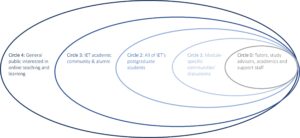
We designed our community’s opportunities into five circles, and it is entirely up to you to decide if and how you want to take any of those opportunities, contribute to them and shape them with us as we go.

  • Circle 0 is our internal circle, where we share information between various modules and community activities to support you the best we can.
  • Circle 1 includes community activities carried within specific modules, such as online discussions, conferences, and student-led activities.
  • Circle 2 aims to bring together all our postgraduate students, no matter which module they are taking at any point, within an online forum and online events, including student-led and student-initiated.
  • Circle 3 opens up opportunities for you to connect with our department and alumni, inviting you to attend webinars and talks related to your topics of study.
  • Circle 4 will open up opportunities to connect with the wider community of online teachers through Twitter and public-faced events.

As a first step, we want to invite all our postgraduate students (existing and new) to a welcome (online) event!

The event will be focused on the new Master’s programme, but we welcome all of our post-graduate students to join us for a fun and relaxing introduction to the programme.

It will take place on the 23rd of March 2023, 18:30-20:00 UK time

The contact details can be found on the Master’s website https://learn2.open.ac.uk/course/view.php?id=206289, or here https://learn2.open.ac.uk/blocks/news/message.php?m=34428029

If you cannot access those links, please drop us an email at [email protected]

Just like you, every one of us at IET is an online teacher and learner, and we know what it’s  like. For whatever reason you chose to embark on this journey with us, stepping into this ever-changing enchanting forest of online teaching and learning world – we invite you to do it together.

 While progressing in any of the modules, you’ll have plenty of opportunities to connect, interact, support your peers, and figure out what kind of community you need around you while learning online.

We designed our community’s opportunities into five circles, and it is entirely up to you to decide if and how you want to take any of those opportunities, contribute to them and shape them with us as we go.

  • Circle 0 is our internal circle, where we share information between various modules and community activities to support you the best we can.
  • Circle 1 includes community activities carried within specific modules, such as online discussions, conferences, and student-led activities.
  • Circle 2 aims to bring together all our postgraduate students, no matter which module they are taking at any point, within an online forum and online events, including student-led and student-initiated.
  • Circle 3 opens up opportunities for you to connect with our department and alumni, inviting you to attend webinars and talks related to your topics of study.
  • Circle 4 will open up opportunities to connect with the wider community of online teachers through Twitter and public-faced events.

As a first step, we want to invite all our postgraduate students (existing and new) to a welcome (online) event!

The event will be focused on the new Master’s programme, but we welcome all of our post-graduate students to join us for a fun and relaxing introduction to the programme.

It will take place on the 23rd of March 2023, 18:30-20:00 UK time.

The contact details of the event can be found on the Master’s website https://learn2.open.ac.uk/course/view.php?id=206289, or here https://learn2.open.ac.uk/blocks/news/message.php?m=34428029

 If you cannot access those links, please drop us an email at:                                                            [email protected]


Commonwealth Scholarships logo

Commonwealth Scholarships available for Masters in Online Teaching

Do you have a serious interest in online teaching, technology-enhanced learning and educational technology?

Would you like to gain a Master’s degree with one of the UK’s leading providers of digital teaching and learning, for study commencing in February 2024? Are you a citizen of one of the following developing Commonwealth countries, a refugee from one of the following countries, or a British Protected Person?

Bangladesh, Belize, Botswana, Cameroon, Dominica, Eswatini, Fiji, Gabon, The Gambia, Ghana, Grenada, Guyana, India, Jamaica, Kenya, Kiribati, Lesotho, Malawi, Malaysia, Maldives, Mauritius, Montserrat, Mozambique, Namibia, Nauru, Nigeria, Pakistan, Papua New Guinea, Rwanda, Saint Helena, Saint Lucia, Saint Vincent and the Grenadines, Samoa, Sierra Leone, Solomon Islands, South Africa, Sri Lanka, Tanzania, Togo, Tonga, Tuvalu, Uganda, Vanuatu, Zambia

Are you permanently resident in one of the above countries?

The Open University’s Institute of Educational Technology (IET) has been awarded 10 fully funded Commonwealth Distance Learning Scholarships for citizens of developing Commonwealth countries who wish to study IET’s Masters in Online Teaching (MAOT). We are pleased to invite applications for these scholarships.

The closing date for applications is 16.00 (GMT) on 28 March 2023.

These Scholarships are funded by the UK Foreign, Commonwealth & Development Office (FCDO) and are intended to contribute to the development needs of Commonwealth countries by enabling talented and motivated individuals to access training and skills required for sustainable development by undertaking part-time Masters study with UK universities while remaining in their home countries.

Intended beneficiaries

High-quality candidates from eligible low and middle-income Commonwealth countries who wish to access training not available in their home countries, who wish or need to remain in their home country while they study, and who have the potential to enhance the development of their home countries with the knowledge and leadership skills they acquire.

About the Masters in Online Teaching

The Open University’s Masters in Online Teaching (MAOT) is studied entirely online. The MAOT develops skills in the theory-informed design of technology-enhanced, blended and online learning and is designed to address educational inequity in all its forms and, as such, is relevant to achieving inclusive, high quality, equitable blended and online education. The Commonwealth Distance Learning Scholarships are for three years’ part-time distance learning, commencing in February 2024. The scholarships will cover the full cost of tuition fees but no other expenses.

It is likely that Commonwealth Distance Learning Scholarship holders will study the following modules, in the order stated. However, there may be some variation in the exact content offered.

Stage 1 – February-October 2024:

Stage 2 – October 2024 – September 2025:
60 credits from either four of the following 15-credit microcredentials, currently presented three times annually:

  • HZFM882 Online teaching: Evaluating and improving courses.
  • HZFM883 Teacher development: Embedding mental health in the curriculum.
  • HZFM884 Online teaching: Accessibility and inclusive learning.
  • HZFM885 Online teaching: Embedding social, race and gender-related equity.
  • HZFM889 Online teaching: Addressing the climate emergency (first presentation date to be confirmed).

Or one 60-credit postgraduate module chosen from:

  • EE845 Social justice, equity and equality: inclusive practice for all.
  • EE842 Exploring educational leadership: values, context and strategy.
  • EE830 Learning and teaching: educating the next generation.

Stage 3 – October 2025 – May 2026:

  • Compulsory module H890 Research and scholarship in digital education. This module develops skills in critically evaluating and conducting digital education-related research and scholarship and is suitable preparation for future doctoral study.

Who can apply?
To be eligible for a Commonwealth Distance Learning Scholarship to study the Masters in Online and Distance Education you must:

  • Be a citizen of, or have been granted refugee status by one of the eligible developing Commonwealth countries listed above, or be a British protected person; and
  • Be permanently in one of the eligible developing Commonwealth countries listed above; and
  • Hold a first degree of at least upper second class (2:1) standard. A lower qualification and sufficient relevant experience may be considered in certain cases; and
  • Be unable to afford to study the programme without this scholarship.

You will also need access to a computer with reliable broadband internet access. You do not need to be working in technology-enhanced learning but you should be interested in developing expertise in this area.

General conditions for the Scholarships are available here: https://cscuk.fcdo.gov.uk/scholarships/commonwealth-distance-learning-scholarships-candidates/.

How to apply

Give me an M! Give me an A!

[Reposted from https://blog.edtechie.net/ou/give-me-an-m-give-me-an-a/ ]
One of the things I have enjoyed working on the most during my 375 year career at the OU, is the Masters in Online and Distance Education (MAODE). I’ve blogged previously about how I was saddened when this was closed down at the OU. Since then we have continued to produce curriculum in IET, most notably very successful microcredentials, under the leadership of my colleague Leigh Anne Perryman.

We have also been working on developing a new Masters in Online Teaching (MAOT). This will comprise of the existing course H880 Technology Enhanced Futures, then 60 points chosen from the array of microcredentials (or a module from the appropriate Education postgrad selection), and then an exciting new module we’re busy writing this year, H890 Research and scholarship in digital education. And today the MAOT was announced and made live so students can now register for it and count modules towards it.

Given the pandemic and the centring of educational technology, lots of people need to develop expertise in this area, and it felt like a real gap for the OU, and IET in particular, to not have a qualification in this space. Well, that gap is now filled. And a jolly exciting gap filling it is too. More info and involvement to come, including new shiny MAOT blog.

Commonwealth Scholar & MAODE alumnus gains prestigious fellowship

Congratulations to Stephanie Akinwoya, graduate of IET’s Masters in Online and Distance Education (MAODE), who has been successful in gaining a prestigious Atlantic Fellowship for Social and Economic Equity.

Stephanie, based in Nigeria, studied for the postgraduate qualification at the OU’s Institute of Educational Technology between 2019-2021, funded by a Commonwealth Distance Learning Scholarship, and has since taken significant strides forward by gaining a respected Atlantic Fellowship, contributing to a community of Fellows focused on tackling persistent global inequities.

Commenting on being awarded the Fellowship for Social and Economic Equity, Stephanie shared:

“It feels amazing to be selected for this prestigious fellowship. I am deeply grateful for this opportunity as it will give me the necessary leverage that I need to address the challenge of inequity in the education space in my country in terms of providing the resources, expertise and network I need to further pursue my research in mobile learning as a means of providing access to education for students in IDP [Internally displaced person] camps.”

The appointment comes after Stephanie graduated with the OU’s Masters in Online and Distance Education and joined a global network of alumni who share a responsibility for implementing online and distance learning across sectors, contexts, and nations. The Masters in Online and Distance Education programme is soon to be replaced by a new Masters in Online Teaching which, together with IET’s suite of credit-bearing postgraduate microcredentials, offers students a unique opportunity to study leading contemporary theory and practice across the field of online and distance education, and technology-enhanced learning.

IET has long led pedagogical development in digital learning and teaching, building a history of exploring innovative ways to drive developments in education and educational technologies. These developments feed into university practice at the OU and showcase our expertise to educational institutions globally, informing innovation worldwide.

Dr Leigh-Anne Perryman, IET’s Associate Director for Curriculum, commented on Stephanie’s achievement in gaining the fellowship: We are very proud of her and are humbled by her achievements. Stephanie has taken the skills she has gained from the MAODE and has applied them in Nigeria to increase educational equity for people typically excluded from education”.

Reflecting on how studying online and distance educational practice at the OU has supported her journey, Stephanie shared:

“As I look back I can confidently say that my studies for IET’s Masters in Online and Distance Education have shaped me into the educator that I am today, every milestone, every achievement so far is tied to the knowledge acquired in one of my offered courses, most especially from my TMA [tutor-marked assignment] and EMA [end-of-module assessment], even my teaching methodology changed as a result of learning acquired in my Master’s course.”

While studying with the OU, Stephanie’s research explored the displacement of people and challenges to educational access in Africa. Building on her experiences and prior research, Stephanie investigated how displacement can challenge access to education. Speaking about these challenges in the context of Africa, Stephanie commented:

“Insurgency, terrorism, religious conflict, as well as natural disasters brought about by climatic change, are some of the causes of displacement.”

Adding further, commenting on how mobile technology can address access-related barriers to learning, Stephanie explained:

“With the mobile evolution in Africa, mobile technology can be used for instruction and learning to provide access to education for students in IDP [Internally displaced people] camps as it enables the delivery of knowledge anytime and anywhere.”

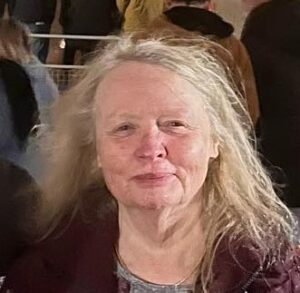
Image of Stephanie Akinwoya
Stephanie, pictured above, completed her Master’s in Online and Distance Education from The Open University in 2021, while developing a passion for education, gender, migration and refugee rights.

Further steps towards improving educational outcomes

Stephanie’s commitment to research and scholarship in learning and teaching extends to her support of fellow OU students, and she features in video and case study content within IET’s suite of innovative microcredential courses, including the IET-led microcredential, Online Teaching: Embedding Social, Race and Gender-Related Equity.

Discussing the value of her research and scholarship contributing to fellow learners’ experiences in education, Stephanie detailed:

“I feel so elated and honoured. I have read and studied other people’s work, and to know that other students will also be reading and reviewing my scholarly work is deeply humbling. I am also happy for the diversity that my work will bring to the course, as that was something I longed for during my master’s course, as most of the content was based on the global south.”

Looking towards the future, and the future impact intended for her research to bring, Stephanie closed:

“So far, I have been able to create awareness and start the creation of the learning platform to be used. I intend to partner with award-winning teachers to create culturally appropriate educational content in line with the national curriculum. and partner with international bodies to deploy mobile learning in two IDP camps in Nigeria.”