Light Documents: The Personal Inspiration for a Research Project

Patrick Wright
PhD student, Creative Writing

It has always struck me as peculiar that academics tend to conceal personal origins or motives for their research. More often than not our deep investment in a subject or area of study appears to have emerged out of a vacuum or with disinterest. Little is said of how intellectual concepts bear a significant and abiding relation with, or are even a sublimation of, our innermost vulnerabilities or concerns.

As a response to this observation, I wish to present a kind of prequel to my area of research (the ekphrasis of dark or near-black paintings), one that will share with the reader how such a rarefied focus developed, organically, in and through my personal life; how, for instance, my recent poem on Kasimir Malevich’s Black Square is beyond any casual or highbrow interest, related with what is most intimate and precious (for the poem click here). Moreover, by writing in this way my hope is to present a hybrid piece of writing that blends academic and confessional registers.

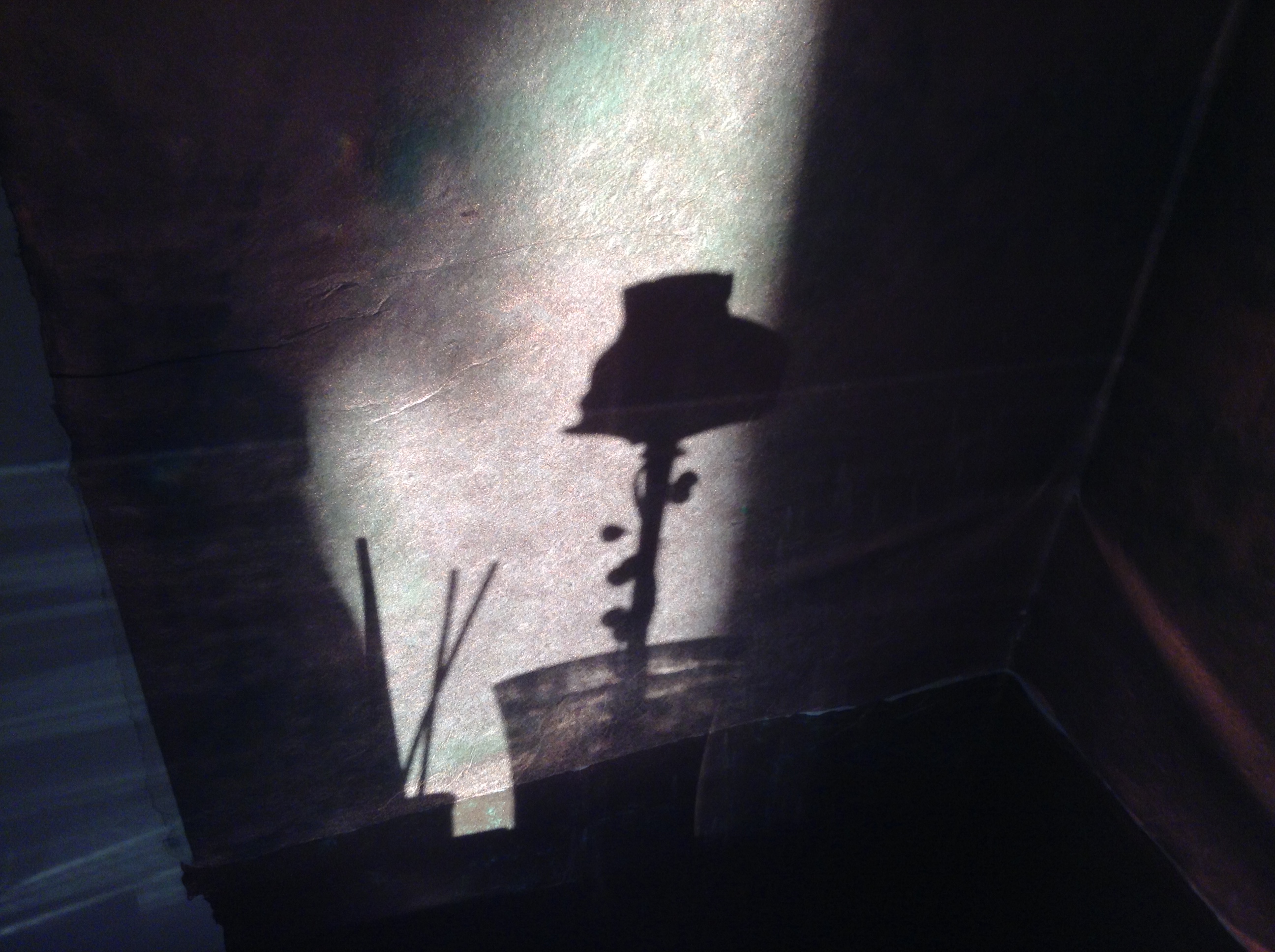
My late wife who passed away in the summer of 2017 was a phenomenally talented photographer and artist; what makes her talent all the more noteworthy is that she was visually impaired. Born blind in her right eye, Kim developed retinitis pigmentosa in her late thirties, and before long she was left with what she described as her ‘two O-clock aperture’ in her left eye, through which she could still discern the odd colour, some contrast and movement. This limitation did not deter her though; her imagination thrived and she advanced a genre of photography which she called ‘light documents’: chance shadows or sun beams thrown on walls or other parts of the domestic space:


Light Document # 2 Image: Kim Parkinson.


I think my interest in ekphrasis (writing poems in response to visual art) was born out of my role as a partner, often tasked with describing how two-dimensional things appeared, from dresses to wallpaper. Essentially, each day, I was engaged in a verbal ekphrasis, as a means of conveying to Kim what aspects of the visual world looked like, particularly patterns, shapes and colours. I was also, with melancholy, striving to reach into her darkness – or to bring her darkness into the light – evoking the Orpheus myth. Her blindness often seemed like a limitation on our closeness; and so I struggled with words to reduce the distance between us. Poetry is about this kind of struggle for me: representing how we continually fall short in our efforts to describe.

I was especially inspired though by Kim’s ability to find so much in the darkness and in shadows (her favourite book was In Praise of Shadows by Jun’ichirō Tanizaki). She discovered such ethereal beauty in random glints of light, spectral colours on walls, or numinous shapes on the ceiling. As a student of Art History, she also had recollections of art works she had previously seen, and was thus able to make comparisons. Her visual acuity was also informed by learning about optics and ideas such as the Golden mean and compositional balance, in anticipation of a condition that she knew to be hereditary.

Now, carrying the burden of grief and the honour of her legacy, I feel it is important to not only acknowledge Kim’s influence upon me – a catalyst in the development of a PhD on writing with dark or near-black paintings in mind – though also to continue to write poems with a heightened awareness that the Orphic task has, if anything, intensified: to insist her vision, in spite of death, is not lost; to allow her presence to live once more in and through my writing. Her lesson for all, as I see it (and encapsulated in the premise of my thesis), is that meaning can be found in even the darkest of images; and, more pertinently, life can be affirmed even after all appears lost.

What is literature for? – and Why do I do what I do?

Sara Haslam, Senior Lecturer in English

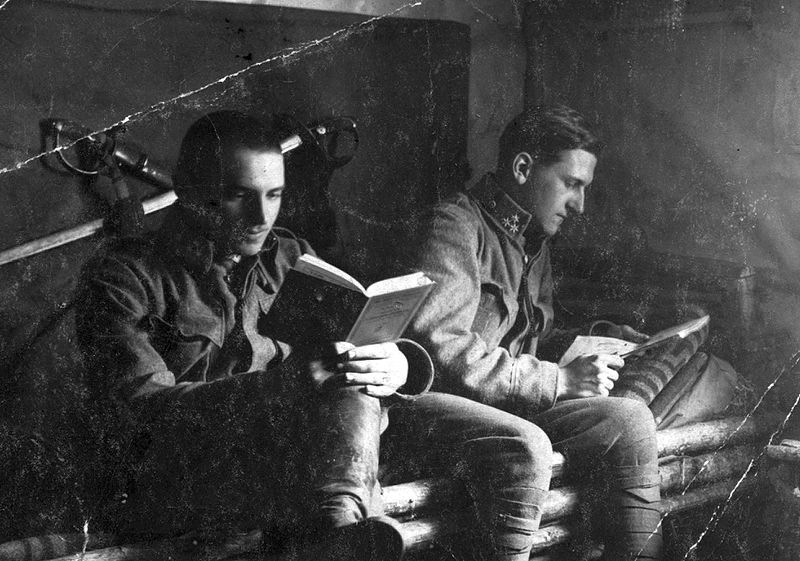
Soldiers reading during the First World War. Shared under the Creative Commons licence. Date:1917 Source http://www.fortepan.hu/_photo/download/fortepan_16325.jpg

We’ve been asking the first question in my title for this blog post for many years in our department. In modules such as A300 Twentieth-Century Literature: Texts and Debates our teaching materials have explored the relationships between art and politics, for example, and asked students to do the same. (My writing on Chekhov, the literary doctor, for A300 was perhaps an early sign of current interests.)

Recent research projects, though, have provided a new set of answers to both questions above, and reflecting on those answers for this post has proved a welcome activity.

Starting to read a thin and battered pamphlet in the spring of 2015 in Oxford’s Weston Library I had one of those ‘aha’ moments the researcher craves. I’d ordered it up because of a couple of key words in the title. Previous searches hadn’t unearthed it and I wasn’t sure until it was in front of me that it was going to be of much interest. But Helen Mary Gaskell’s account of the beginnings of her War Library in 1914 proved a wonderful find. Her epigraph, ‘Take choice of all my Library, and so beguile thy sorrow’ (from Titus Andronicus) had key words of its own, and what followed opened up the history, and challenged the scholarship, of reading during the First World War, particularly that of sick and wounded soldiers. It prompted me to find a name for one kind of organised charitable endeavour in war-time: ‘literary caregiving’ – a phrase I used in the key-note I was writing in 2015 and the article on Gaskell’s war library I’ve published since.

Gaskell’s idea for a library for sick and wounded soldiers, to be stocked in the main by donated books, was realised in the first weeks of the war. She had powerful and wealthy friends – one, Lady Battersea, had a mansion going spare in Marble Arch, which is where they stored the books. Aside from the speed with which the War Library was operational, the most striking aspect of the early weeks was the number of donations. One individual contributed a library of 35,000 books. Gaskell needed them all, and more too; supply rarely met demand. And yet records show that in the first half of 1917, for example, 1,125, 840 units were sent from the library’s London base to its depots around the world.

Gaskell also had a methodology – one related to her epigraph and to a democratised rather than hierarchical understanding of literature and its purpose. She prioritised what she called a ‘personal touch’, meaning that specific requests from wounded soldiers should be met if at all possible. Books, she felt, were a ‘flow of comfort’ that should not be interrupted by lack of effort. Over the course of the war, the War Library collected and distributed millions of books by writers such as O’Henry, Kipling, Marie Correlli, Dumas, Nat Gould – but if a soldier wanted a book on bee keeping, for example, every effort would be made to source that too.

This pamphlet was fascinating in its own terms. It also offered important answers to the question of what literature is for. And these answers, and the research directions they instigated have led to new networks and collaborations with colleagues departmentally, and externally too – a particularly positive outcome when we spend so much of our research time on solitary labours. Some of the results will be discussed in other posts here.

The tone and character of the book-related language used by soldiers and the volunteer librarians caring for them during the war will stay with me. Contemporary experience of a ‘book hunger’, of ‘the bitter cry for books’ led to the idea of books that might ‘heal’ – one that is explored in all kinds of ways in the papers those librarians left behind. The media, too, was fascinated by this work, which shifted the medical focus to include minds as well as bodies.

The Times, for example, told people ‘What to Read to the Wounded’ in 1915. It turns out, though, that both the wounded, and Gaskell and her colleagues, had other ideas. If one of the things that literature is for is healing, these caregivers noted, then feeling freely able to choose, and then being provided with, their own book was the best place for patients to start.

Scholarship and Research

Suman Gupta

Slightly out of focus

The connotations of the word ‘scholarship’ have always been a bit fuzzy, especially in academia. The OED puts it between, on the one hand, ‘learning, erudition; the collective attainments of scholars; the sphere of polite learning’, and, on the other hand, ‘applied, by unlearned speakers, etc., to educational attainments of a more modest character.’ Politeness and modesty in learning are not the average academic’s forte.

In a 1922 book, the linguist Otto Jespersen had decided a touch impatiently to ‘use the word “philology” in its continental sense, which is often rendered in English by the vague word “scholarship,” meaning thereby the study of the specific culture of one nation.’ That didn’t clear things up particularly. In English-speaking circles ‘philology’ was apt to be received with confusion and trepidation. To academic ears now that sounds like a specific sort of esoteric research.

Under the lens

Of late though, we professional academics in Britain are assured by HE bureaucrats that things have been cleared up. There is ‘scholarship’ and there is ‘research’, and these entail quite different activities. They are funded separately, accounted separately in our workload calculations, understood as leading toward distinct sorts of outcomes. Different centres of excellence (I haven’t come across any other sort) are devoted to each. Since the bureaucrats know that ‘scholarship’ and ‘research’ are different animals, they must have a rigorous definition of ‘scholarship’ at hand.

It seems that British HE bureaucrats have worked on it for a while, or rather have looked for guidance to their counterparts in Australia who have worked on it for a while. A policy paper produced by the Australian Minister for Employment, Education and Training in 1988 did the needful (for a discussion see Moses 1990):

Research
systematic and rigorous investigation aimed at the discovery of previously unknown phenomena, the development of explanatory theory and its application to new situations or problems, and the construction of original works of significant intellectual merit.

Scholarship
the analysis and interpretation of existing knowledge aimed at improving, through teaching or by other means of communication, the depth of human understanding.

In brief, one deals with new knowledge and the other with existing knowledge, and one is an end in itself and the other serves teaching.

That should have been the end of the matter, but it wasn’t quite. Questions remained. Is there a relationship between the two? Perhaps research is really an aspect of scholarship, or one is a subset or collateral of the other? Moreover, is the kind of work on existing knowledge that serves teaching also not research? Is that not what passes in Education faculties as research? Insofar as academics across all disciplines are exhorted to undertake ‘scholarship’ (apart from ‘research’) are they not being asked to encroach upon the research areas of their worthy colleagues in Education faculties? In the German education system, space for discipline-specific research into teaching practice was conventionally designated as ‘methodology’ within different faculties – in what way is this conception of ‘scholarship’ different? But that idea of ‘methodology’ allowed for a specific sort of research, so why is ‘research’ here separated from it?

Pellucid

The matter was seemingly laid to rest when the British government made it mandatory for all HE institutions to follow an academic workload accounting system (initially with the punchy acronym TRAC). The first TRAC guidance in 2005 put a lid on any debate, and we are still living with it despite slight modifications:

Research
Research and Experimental Development (R&D) comprise creative work undertaken on a systematic basis in order to increase the stock of knowledge of man, culture and society and the use of this stock of knowledge to devise new applications. R&D is a term covering three activities: basic research, applied research and experimental development.
> Basic research is experimental or theoretical work undertaken primarily to acquire new knowledge of the underlying foundation of phenomena and observable facts, without any particular application or use in view.
> Applied research is also original investigation undertaken in order to acquire new knowledge. It is, however, directed primarily towards a specific practical aim or objective.
> Experimental development is systematic work, drawing on existing knowledge gained from research and/or practical experience that is directed to producing new materials, products or devices, to installing new processes, systems and services, or to improving substantially those already produced or installed.

Scholarship:
Scholarship is activity that updates or maintains the knowledge of an individual; or adds to their skills and experience.  The knowledge base already exists elsewhere.
> Scholarship is therefore different from Research.  In particular, it is different from institution-/own-funded Research.  It is important that these terms are clearly distinguished.

I hope that answers all questions and any further debate can now be considered inefficient and impactless academic dithering.

Reflections on the Imagine! Festival of Ideas and Politics, Belfast, 12-18 March 2018

Patricia Ferguson

I have four days in Belfast and a whirlwind of events, and those are only a dozen chosen from more than eighty on offer, and of those dozen, space available here to discuss only four or five. First of all ‘Belfast as a Restorative City’, a title which expresses the theme of the whole festival. ‘“Imagine!” What does that word bring to mind?’ asked the presenter. ‘John Lennon’s song, of course’, we said. So then, let us imagine Belfast – Belfast of the Troubles – as a place where the police don’t stop and search, they stop and chat, where schools don’t have a discipline policy, they have a relationship policy. A relationship policy? This is something rich and strange to me who has painful memories of the ‘tawse’, an all too common punishment in Scottish schools until the 1980s. These good things are beginning to happen although, as we were reminded at another event (‘Equality: A Question of Attitude?’), the tribal divide with its two completely different worldviews is centuries deep, and political parties thrive on conflict. The students from Liverpool who interviewed residents on the Shankill Road found not one respondent who favoured the idea of a Restorative City, but their interviewees were all of an older generation, and the project for Integrated Schools continues to thrive. As Koulla Yiasouma, the Children’s Commissioner, pointed out (‘Ask the BreXpert’), Northern Ireland now has a whole generation of young people who have no personal memory of the Troubles, and they say to that older generation: please, don’t let Brexit bring them back.

How do you change a punitive mindset into a restorative one? Can the answer to this question be something as simple as, for example, establishing Friendship Clubs (there’s one on the Crumlin Road) with language groups, walks, board games, food? – Ah! Food! Imagine! is a festival of hospitality as much as of ‘ideas and politics’. I heard a woman mutter, ‘You don’t get this where I come from’, as we tucked into ‘The People’s Breakfast’ on Democracy Day. The Belfast Friendship Club certainly thinks so. It meets every Thursday at the Common Grounds Café: ‘fifty people, twenty-five nationalities, one vision’, according to the Café’s website. The answer, in a word, is the craic, defined by the Cambridge Dictionary as that ‘enjoyable time spent with other people, especially when the conversation is entertaining and funny’, which is part of the Irish psyche. The café is a remarkable place, carrying the conversation through an intricate network of barriers. It’s run by City Church Belfast, staffed largely by volunteers, many of whom are refugees or asylum seekers, and gives all its profits to charity. ‘Can Belfast Become a City of Sanctuary?’ was held there; its participants much encouraged by Nuala McAllister, the current Lord Mayor, and her vision of the city as ‘Global Belfast’.

It’s important to remember that underneath all this progress with the twenty-five nationalities lies that hitherto intractable tribal divide. Has it become possible, in these days, to bridge a chasm as profound as this? Perhaps it has: as part of its Oral History Project, The Open University gave us the event called ‘Books that bend bars’, in which three former political prisoners spoke about the books and the Open University courses that had inspired them and given them hope. The reasons for their imprisonment were not trivial: Billy Hutchinson had murdered two Catholics, Jennifer McCann had shot a police officer, Séanna Walsh had been caught making bombs; yet here they were, Loyalist and Republicans sharing the same platform, telling such similar stories of understanding, as they read and studied, that the conflict must cease from violence and become political. All three are graduates of The Open University, and are now prominent in public life. They read authors such as Karl Marx, Thomas Paine, and J. S. Mill. Jennifer read Margaret Ward’s Unmanageable Revolutionaries: Women and Irish Nationalism, and has become a fierce defender of women’s rights. Séanna read Frantz Fanon’s The Wretched of the Earth, that burning exposé of the trauma of colonisation; he would have read in Sartre’s Preface that: ‘if this suppressed fury fails to find an outlet, it turns in a vacuum and devastates the oppressed creatures themselves. In order to free themselves they even massacre each other’.1  And so it proved. Musing about this, I realise the inadequacy of using that old metaphor about bridging chasms. Billy Hutchinson is on record as saying that he does not regret his violent past because it ‘contributed to preventing a united Ireland’, while to Séanna Walsh of Sinn Féin, the Westminster government represents a colonial power to which no allegiance is due.2  Sooner or later the bridge will break, because no matter how heartfelt their desire for peace, neither will give way on that one fundamental point which would secure it.

There do exist, however, some who will give way, and it seems to me that the ultimate hope rests with them. I am thinking of people like Tony Macaulay, whose book Paperboy featured in another Open University event called ‘Reading in Conflict’. For this occasion we gathered in Waterstone’s excellent café (more food and drink!) where we discussed extracts from the works of writers who had lived through the death and destruction wrought by conflict. Paperboy describes, in the most engaging way, Macaulay’s life as a child growing up in West Belfast at the start of the Troubles. He too in adult life, became active in the peace process, and what he chose to do is truly remarkable: in 1985 he and his wife, Protestants from the Shankill Road, moved to New Lodge, a nationalist area nicknamed the Murder Mile, and set up a youth club. Their adventures are told in his new book Little House on the Peace Line: Living and Working as a Pacifist on Belfast’s Murder Mile.

‘Imagine there’s no countries’, wrote John Lennon, ‘It isn’t hard to do/ Nothing to kill or die for/ and no religion too’. Macaulay is a religiously minded person, as am I, but I don’t think he would be disconcerted by those words. Lennon himself said in an interview that what he meant was ‘no denominations of religion – not without religion but without this my God-is-bigger-than-your-God thing’, and then one could indeed ‘imagine all the people living life in peace’.3  A hard sell, but essential I think, and the theme underpinning the whole festival. I shall certainly be back next year, and back to Belfast long before that. I am just beginning a PhD study on the reading experiences of Belfast’s own C.S. Lewis, who would have loved this festival and never forgot that he was from Ireland, and so I finish this post with words that he wrote to his friend Don Giovanni Calabria in August 1953: ‘Tomorrow I am crossing over (if God so have pleased) to Ireland my birthplace and dearest refuge so far as charm of landscape goes, and temperate climate, although most dreadful because of the strife, hatred and often civil war between dissenting faiths. [ … ] Let us, however, with mutual prayers pray with all our power for that charity which “covers a multitude of sins”’.4  And to that, let us all say, ‘Amen’.

Notes:

1    Frantz Fanon, The Wretched of the Earth, preface by Jean-Paul Sartre, trans. by Constance Farrington (New York: Grove Press, 1966), p. 17.
2    Sam McBride, Belfast News Letter, 19 March 2014 <https://www.newsletter.co.uk/news/my-murder-of-two-catholics-helped-prevent-united-ireland-pup-leader-billy-hutchinson-1-5945099> [accessed 27 March 2018]
3    David Sheff, All We Are Saying: The Last Major Interview with John Lennon and Yoko Ono, ed. by G. Barry Golson, new edn (New York: St Martin’s Griffin, 2000), p. 212.
4    Clive Staples Lewis, Collected Letters, ed. by Walter Hooper, 3 vols (Oxford: Oxford University Press, 2000-06), iii, p. 358.


Patricia Ferguson is about to start a PhD in English with The Open University. She is researching the reading habits of C. S. Lewis and his brother, Warren Lewis. She is a longstanding volunteer on the UK Reading Experience Database project.


Expressive writing workshops in Iraq

Dealing with the past, imagining the future

The effects of war stretch far beyond the battlefield. Many women who have suffered sexual violence in Iraq now find that the process of seeking justice through the legal system inflicts new trauma on them as they are forced to relive their experiences. But new research by Dr. Siobhan Campbell, Dept. of English and Creative Writing, The Open University, and Dr. Meg Jensen of Kingston University London, shows that the use of expressive writing techniques may work to enhance resilience, enable victims to seek justice, and even contribute to social integration.

Expressive life writing is a humanities-based intervention often employed in post-conflict situations, or during periods of cultural reconstruction. Using exercises and prompts adapted by Campbell for the ‘safe place’ created by a workshop, expressive writing can elicit stories in ways that one-to-one interviewing based on current protocols cannot. Campbell’s previous research in non-conflict settings and with combat veterans has demonstrated that the process of writing down reflections and working with the imagination to narrate what is previously unsaid helps survivors ‘detach’ from negative experiences by turning them into shareable stories, thus increasing their sense of well-being and of agency.

How the Expressive Life Writing Project works

Expressive Life Writing puts the creative writing tenet ‘learning by doing’ at its core. It values what can be observed occurring as part of the context of convening, encouraging and recording the writing and the founders believe that the story surrounding the emergent writing should also be told as part of its dissemination.

In 2016-17 we collaborated with INMAA for development, a NGO working to foster human rights and provide legal aid. The aim was to offer expressive writing and telling opportunities to women victims of violence and trauma in Kirkuk Governorate, Iraq.  The project also used iterative practice to work with stakeholders on the ground in order to look at current guidelines on the documentation and investigation of rights violations and suggest adaptations to existing protocols for the interviewing process. We developed this work with the support of Beyond Borders Scotland, a not-for-profit organisation facilitating international cultural exchange, and the research was funded by the UK Foreign and Commonwealth Office (FCO), Human Rights fund.

INMAA employ a team of Mobile Human Rights Defenders to document instances of sexual violence in conflict. However, it had come to their notice that as not all cases can be brought the juridical route, there was an opportunity to use the site of interview to begin to elicit and value the stories of individuals in ways which might support them in other ways.

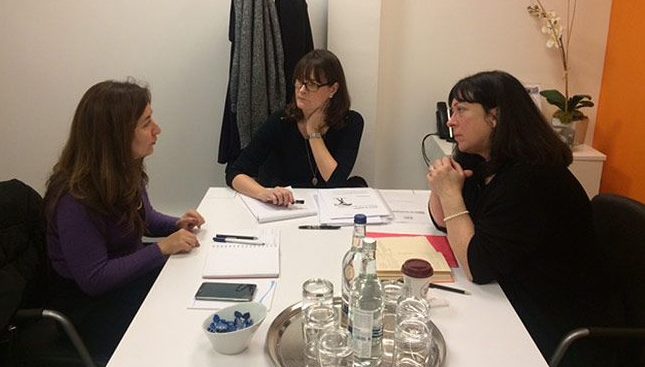
Asmaa Al Ameen (INMAA), Meg Jensen (KUL) and Siobhan Campbell, The Open University

In collaboration with the General Director of INMAA, Asmaa Al Ameen, we developed writing and ‘telling’ (where writing was not useful) exercises in a three-unit model that could be employed at the point of INMAA’s initial interview with prospective clients but that had an implicit follow-up built in, thus making it more likely that the clients would return. We provided training to the social workers in the uses and implications of the workshop exercises, practicing these with them as part of the training. The emphasis was on exercises which allowed for recounting of experience but also for ‘imagining the future self’ as part of the set of tools for enabling the witness/survivor to produce and integrate their whole life story in ways that develop a sense of ownership and agency.

A handbook produced in both English and Arabic, was used by the mobile human rights team.  It contains original Expressive Life Writing exercises and storytelling prompts developed by Siobhan, and is accompanied by guidelines to enable the efficacy of the workshops to be tracked.

Asmaa Al Ameen writes in the project report:

The work by Beyond Borders contract teams from The Open University and Kingston University on the Expressive Writing project has gone well beyond expectations in the depth and comprehensive material they have produced. This in turn enabled the INMAA team to reflect on and improve their working practices especially with respect to the interface with victims/clients. The training you have provided to our team of human rights lawyers and social workers has changed the way we work with victims and allowed us to allow these victims to tell their stories.

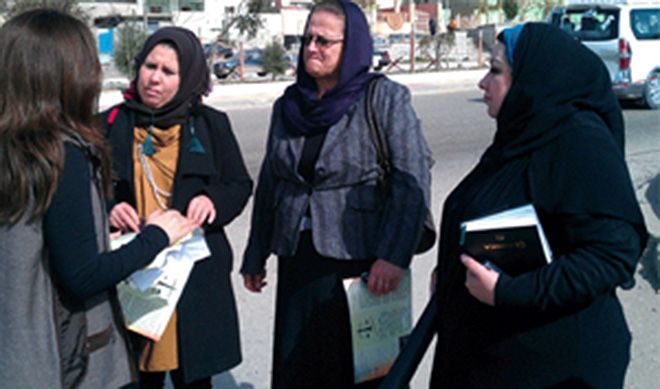
INMAA outreach, Kirkuk
What next? Impact for the future

As we gather quantitative and qualitative forms of feedback, Campbell and Jensen will further develop the virtual learning environment toolkit of research-based and practicable teaching materials for effective, creative life narrative workshops in post-conflict contexts.

Identifiable outcomes of this work include:

>> Relationship Building – allowing for adaptive change in contested situations
>> Capacity Building – both among activists and those they serve
>> Learning to Learn – a distinctive ability to self-reflect on practice is engendered
>> Creative Expression and personal sharing – individual experience is valued over process

Already, this work has resulted (January 2018) in the development of a UNDP SIRI (Support for Integrated Reconciliation) project in Iraq where Campbell and Jensen are providing bespoke training in expressive writing techniques and workshop convening to UNDP reps, supplying PowerPoints and handbooks in Arabic for use on the ground.

For post-ISIL Iraq, as outlined by UNDP to Siobhan and Meg, the top priorities are ensuring stability and a return to peaceful coexistence, with a view ultimately towards implementing transitional justice, de-radicalization and institutional reform.

The value placed on individual experience and the possible functional value of expressing and recording that experience in a supportive and coherent space is what training in Expressive Life Writing techniques can help achieve. It can provide a sense of coherence and unity of purpose within the groups that undertake the exercises, discussions and the group workshop work.

With expressive telling and writing, vital goals such as social integration and de-radicalization are supported, since this expressive work values not only the expression of one’s own personal experiences, but the skill of intentionally listening to the experiences of others. In conflict and post-conflict contexts in particular, Expressive Life Writing can provide a powerful counterpoint to pre-existing social and political divisions and mistrust as evidenced by the research of Campbell and Jensen and our projects in Iraq.

For more information contact Siobhan Campbell on [email protected]