
Chris Cox ~ Learning Designer
The call to adventure. The refusal of the call. Meeting the mentor. Crossing the threshold. The road of trials… Stories are everywhere, from entertainment to news, politics, ideologies… and learning.
Storytelling has been part of the Open University (OU) Learning Design Team for years, as we explored how it works, recurrent patterns in story structures identified in Joseph Campbell’s The Hero’s Journey monomyth, the practical steps of Christopher Vogler’s The Writer’s Journey, and how stories relate to pedagogy. The more we looked the more parallels and links with learning became clear, from designing a student experience, to helping students share their stories, to the structure of a module. Classic story structures and techniques can help us amplify the best of what we do, grab students’ attention, and keep them engaged through the highs and lows of their study adventure.
!['Beginning Act 1' Infographic of Act 1 of Christopher Vogler’s The Writer’s Journey in a table. The banner reads: Ordinary World. The four boxes underneath read: [box 1] The ordinary world; [box 2] The call to adventure; [box 3] Refusal of the call; [box 4] Meeting the mentor.](https://www.open.ac.uk/blogs/learning-design/wp-content/uploads/2026/06/Vogler-Act-1-1.png)
The OU Storytelling and Narrative Group
In 2024, we set up an OU Storytelling and Narrative Group, bringing colleagues across The University to explore how storytelling is being used in our modules already, and how we might design with storytelling to increase engagement with our students.
It’s also arguably more important than ever:
“I think as our society becomes more and more automated thanks to artificial intelligence (AI), those people who are able to communicate effectively, build empathy and engage each other on a human level are going to become more important than ever, and we will see storytelling play a huge part in this.”
– Chris Thomson, JISC Digital Storytelling Community of Practice
But there’s so much to storytelling, and so much research available, where to start? We decided to focus our efforts on identifying storytelling principles we can use in module design to hook our students and keep them on their learning journeys. In other words, our learners are protagonists in their lives, and storytelling can help us weave the elements of an engaging learning journey together that helps them on their quests. As a group, we don’t want to just explore storytelling, we want to build actions which have evidence of impact.
Designing for the student experience
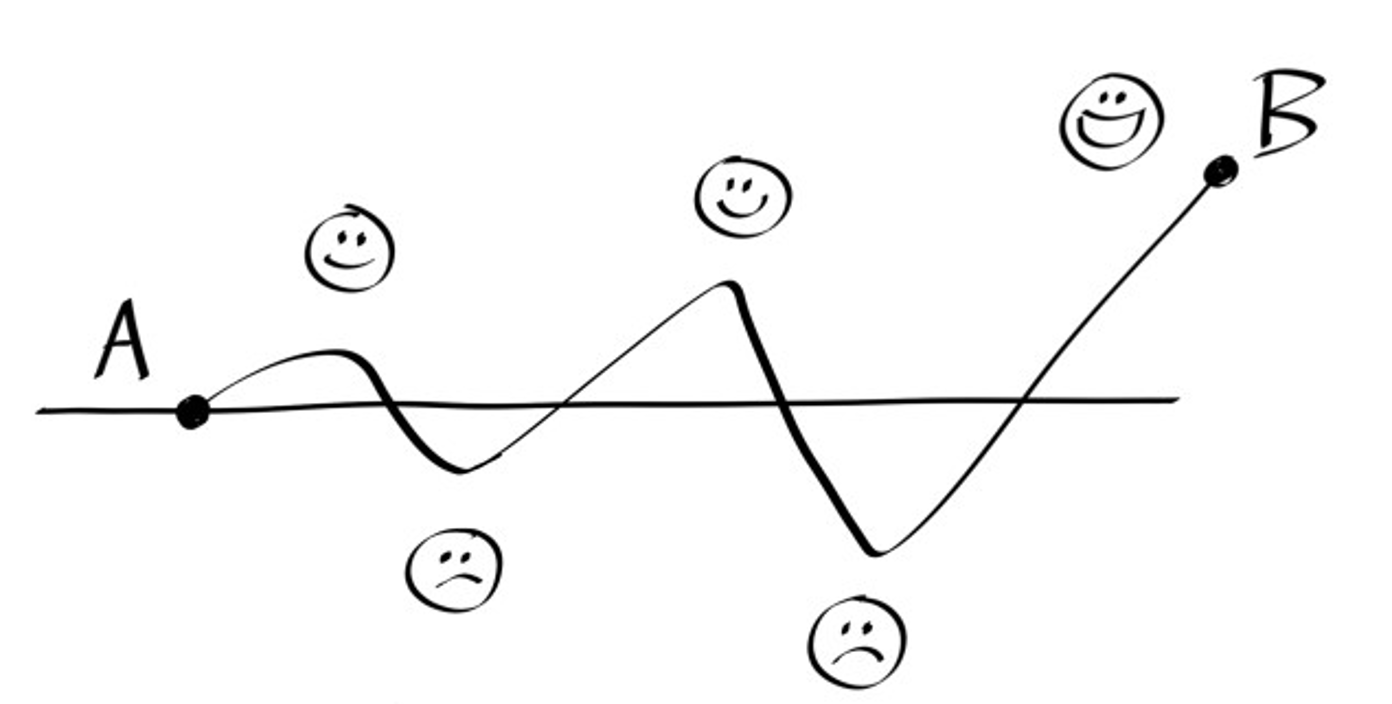
We realised that this gives us a focus on the student experience – their high points, their lows, where struggles arise on their journeys. And crucially this gives us a useful lens to design with, to support them, design in assistance, and smooth out some of the bumps in the road as they climb to their end goals.
Through our work, we’ve found that storytelling can be an essential part of Learning Design – bringing together the various threads that need to be considered when designing learning experiences. We’re testing storytelling approaches, making links with other areas of work within The University and connecting with other teams who are keen to explore further. There are exciting opportunities ahead to build practical story principles into our student learning journeys. In story terms, we’re in Act 2 now, and the road of adventure lies ahead.

If you’d like our team to help you on your storytelling adventures we’d be happy to help with advice or a bespoke session. Contact us at [email protected].
You can also find out more about the work of the OU Storytelling and Narrative Group, by contacting [email protected].
Further Reading:
Joseph Campbell’s The Hero’s Journey is one of the most well-known mythic story structures, and has been adapted into a practical tool for writers by Christoper Vogler’s The Writer’s Journey: https://www.finaldraft.com/blog/3-reasons-you-need-to-show-your-protagonists-ordinary-world
N.B. The Hero’s Journey is an important concept in the world of storytelling, although both Cambell and the concept have attracted criticism. However, it provides a valuable insight into narrative patterns across history and cultures. Indeed, it’s difficult to engage with discussion of story and its workings without being aware of it. It also has proven success in its application in film, most famously Star Wars. Hence our focus on The Writer’s Journey which distils these observed patterns into a practical guide for authors.)
The use of The Hero’s Journey in psychology to help clients: https://time.com/6304708/heros-journey-psychology/