Talking better about Brexit

Last week, Anton Spisak at the Tony Blair Institute produced an excellent paper on how the UK-EU relationship might be fixed. I heartily recommend it to you as an overview of where we are and what might be the way forward.

Of course, being a practical-minded sort, I did have some queries, as set out in this thread:

https://twitter.com/Usherwood/status/1597192804815769605?s=20&t=rJspXYLEH2QH6bL8EOnsKw

Central to my response was a question mark about how to get going the serious debate on what relations should look like. Politicians appear to either not know about the necessary details and trade-offs or not want to spend valuable political capital on a topic that is – frankly – a turn-off for most voters.

It’s no coincidence that ‘get Brexit done’ has been the most successful gambit since 2016: it’s an expression of frustration/disgust at [waves hand expansively] all this. It’s also not really a policy with any substance behind it.

This week has only underlined the point further. Labour’s big constitutional policy paper didn’t mention how relations with the EU (which include the Northern Ireland Protocol’s extensive entanglement and differentiation) might affect matters, while Kier Starmer himself tried to park whether he would rejoin the Single Market, to little avail.

https://twitter.com/Usherwood/status/1599700740163133446?s=20&t=rJspXYLEH2QH6bL8EOnsKw

This really just demonstrates the point that Westminster currently looks like a place where there might be serious discussion of what the 2016 referendum result means in terms of the kind of society the UK should try to be or of its place in the world.

Instead, it looks as if the next government will be just as prone as the current one to treat EU matters in a reactive fashion, fighting fires as they appear.

So what to do?

In other European states, such profound debates have typically ensued in the wake of major national trauma or change: the end of the second World War, the collapse of Communist regimes, etc.

That’s not really a sensible option for the UK: even if you wanted to raise the referendum itself to that level, the fact that it was precisely on this issue makes it very hard to use it in that way. Plus, if we haven’t used that moment during the past 6.5 years, why would we rake it over again now?

An alternative would be to wait until barely anyone cared/noticed, and then change policy either to address obvious problems or to match someone’s interests. That might be a technocratic agenda or it might be a deeply political one, but in the absence of quite so much heat in public debate the temptation to sit things out now is clear.

The problem here is that the issue is unlikely to ever dip off the political radar: witness the concern of leavers about precisely this kind of approach being taken by their opponents. Even Starmer’s rebuffing of the Single Market ‘right now’ was taken by some as a clear signal of an agenda trundling down the line.

In addition, even tinkering to fix the problem would probably not resolve matters, given both the extent of ties and their dynamic nature. Even small steps might have big effects, which could reignite politicisation and undermine confidence in the policy.

Which leaves the option of recasting and recontextualising Brexit into something bigger.

As much as Brexit was about being in or out of the EU, it was also evidently a moment for articulating a lot of other discontents and disillusionments within the British polity.

The long-term drift towards more managerial modes of government have also meant that big-picture strategies for the country have been in short supply, especially ones that establish a strong and compelling narrative about what the country embodies and how it can head there.

Put like this, relations of any kind with the EU – or any other part of the world – become functions of self-image and of actualisation: foreign policy becomes an articulation of values and interests where how we do things is informed clearly by what we are trying to achieve.

Precisely because such a strategy/narrative is all-encompassing, it side-steps the problem of voters (and politicians) not wanting to get into the Brexit thing again.

Likewise, it helps with any fire-fighting because it identifies strategic objectives that can guide responses and inform actions. Yes, things will still come up, but now within a framework that goes beyond ‘make it go away’.

The problem is obvious: who’s going to produce such a strategy?

Logically political parties are central to this, but partisan approaches also tend to be less durable, for all the reasons you might imagine.

Organic, bottom-up deliberation and pressure would be much more lasting and consensual, but incredibly hard to make happen in any organised way (by its nature).

But these barriers should not stop us from trying.

If we have learnt anything from recent politics, then it is that apathy and lethargy in political debates leaves the ground to whoever wants to fill the space. And often those that do are not the most representative of social or political interests, coming as they do from the more extreme parts of the spectrum.

In a week where even a country like Germany – which has hardly experienced the tumult of politics found in other states – can be the subject of a serious coup plot, we have to remember that democracy is founded on participation and engagement.

For citizens, that means being active in political choices and being thoughtful about who represents you. For media, that means facilitating robust public debate. For academics, that means providing evidence-led and impartial contributions from our work.

If the path forward on Brexit isn’t yet clear, then that should not stop all of us working to find ways to address the matter together. Otherwise someone else might do it for us.

Posted in Uncategorised | Tagged | Leave a comment

EU-UK monthly tracking: November

One good reason for doing this regular tracking report is that is means we (i.e. I) can abreast of what is an ever-changing landscape of interactions between the EU and the UK.

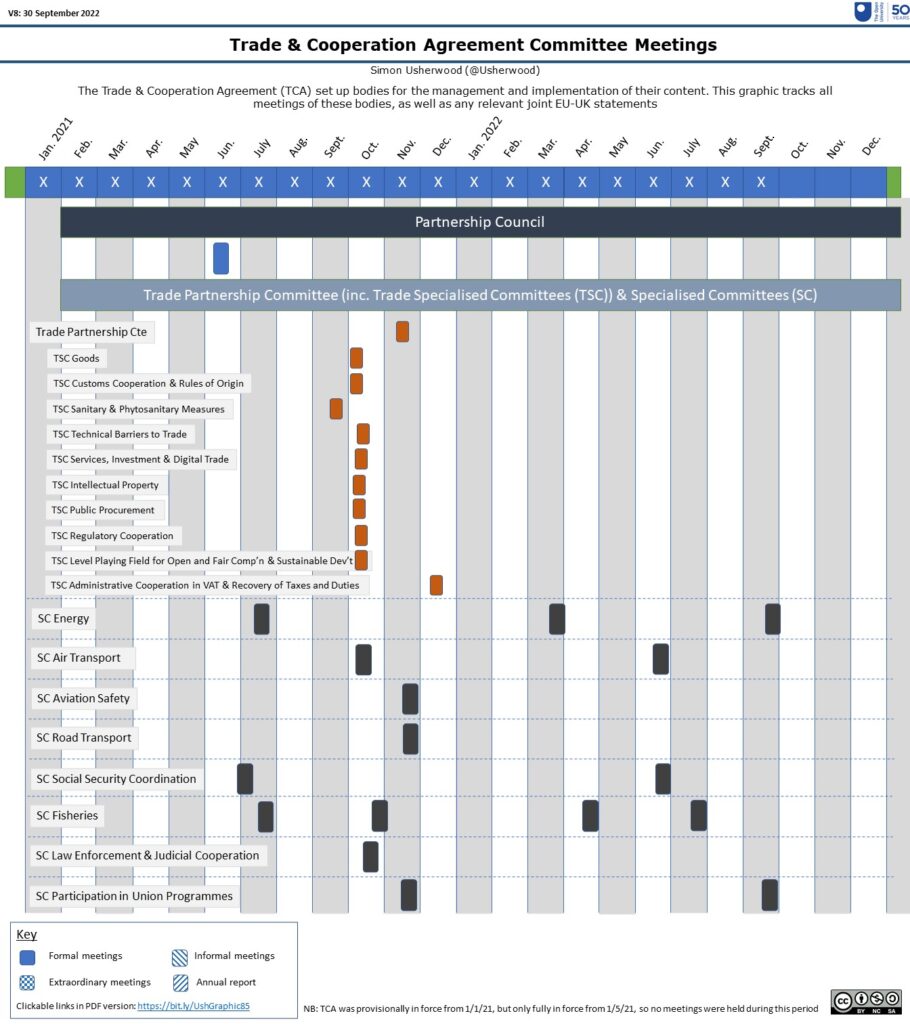
As a case in point, I’d rather missed that the past couple of weeks have been packed with meetings of the numerous Trade & Cooperation Agreement bodies. Possibly that’s a reflection of the lack of substance behind most of those, possibly because the key forum – the Partnership Council – is now some 18 months since it last (and, indeed, first) met.

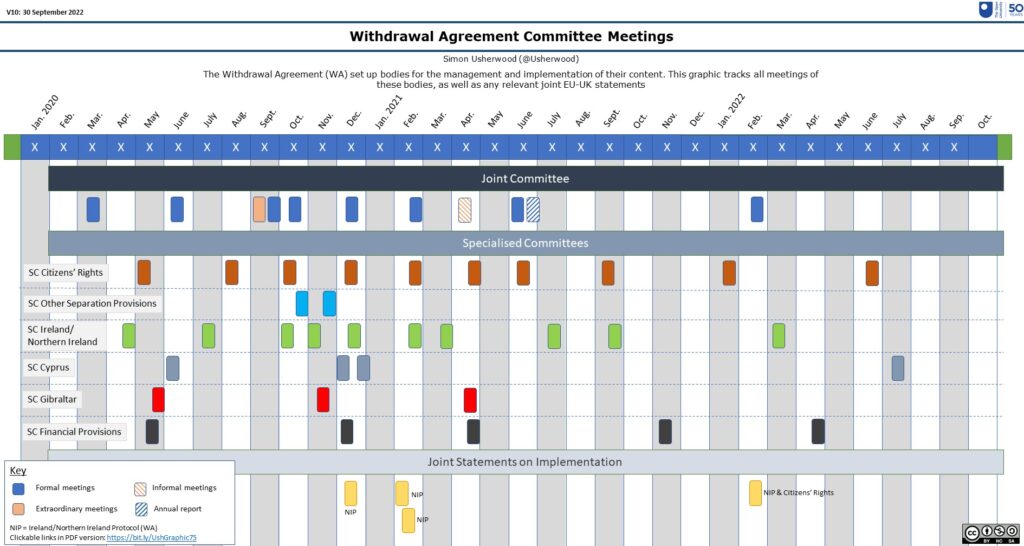
As the graphics below point up, the architecture of regular interaction is present and the channels are open should both sides wish to use them.

But the absence of substantive shift in policy by Rishi Sunak means that while there is a stream of more informal work going on around the Protocol, this has not translated into a need to make more of the WA/TCA bodies.

As usual, you can follow the hyperlink below each one to a PDF version with clickable links to minutes and agendas for each meeting.

Meanwhile, one area that isn’t seeing any obvious activity is the UK’s stated project of removing Retained EU Law (REUL) from the statute books.

Since the government launched its tracker back in June, there hasn’t been a single instance of repeal, amendment or replacement that wasn’t already there.

The generous interpretation would be that someone’s not updating the tracker (the last edit is in September), but as I discuss in a thread on Mastodon (below) there’s probably more reason to think that the big block that remains in force is actually useful.

[and don’t worry too much about that ‘sensitive content’ warning – it’s just a graph, regardless of what the blur might look like to you]

https://mastodon.social/@susherwood/109420668147828762

Finally, you might want to sign up (again) to my podcast, A Diet of Brussels, which is now not only the very first Brexit-related podcast but also one of the few remaining ones.

I might not reach the production values of Brexit Republic (which I heartily recommend to you), but I will be producing new, monthly episodes that might be of interest as I think we’re moving into a new phase of things.

If that sounds like I might be becoming more positive, note that I’m calling that new phase ‘Long Brexit’…

Posted in Uncategorised | Tagged , , , , | Leave a comment

The structural dilemmas for British PMs over the EU

As Rishi Sunak nears the end of his first month in the job as Prime Minister, we might once again consider how much he might engage with, and progress, the European issue.

Like his predecessors before him, Sunak has both a vague sense that this is something that needs sorting, and no real plan about how to sort it. I leave it to others to muse further on the extent to which cakeist thinking – why can’t we just have all the good stuff? – has spread across Westminster, to the disadvantage of considered policy-making.

In broad terms, Sunak looks a lot like Liz Truss in his EU policy so far: warm words, but no desire/ability to move on substance. Unlike Boris Johnson, with his visceral unwillingness to be seen to do anything with the EU or ‘Europe’, Sunak and Truss both made the choice to try a more conciliatory tone and to be seen talking and working with European counterparts.

This is most clearly seen in the Northern Irish element of relations, as set out in the graphic below:

This post-Johnson shift requires some explanation, since it is likely to be the key dynamic for the rest of Sunak’s time in office.

As the next graphic suggests, there are several things going on here:


There are plenty of good reasons for Sunak to seek a settlement with the EU, especially over the Protocol, but these have to be balanced against the more localised constraints he faces. Backbench ERG types have already made it clear they are willing to cause trouble if he drifts off the current baseline, trouble that might be more logically focused on Sunak’s hold on the party leadership – which still looks shaky in the Williamson/Braverman/Raab context of poor ministerial selections – than on EU policy  per se.

The short-term squaring of this has been the warm words pitch: say the nice things, sign up to the collective actions on unproblematic (in the domestic sense) topics and hope to ride it out.

But as the graphic also notes, this can’t work for very long.

The passages of the NI Protocol Bill and the Retained EU Law Bill through Parliament mean that two major headaches are on their way in relatively short order. Each causes new points of tension with the EU just by their existence, even if provisions are not implemented: the hair trigger powers the government would hold are another clear substantive step back from the good faith pitch that Sunak wants to communicate.

Given no apparent willingness to pull or slow the Bills, Sunak will find that warm words aren’t going to suffice, especially if he really wants a resolution for Northern Ireland by the Good Friday Agreement anniversary next spring.

This is all sufficiently clear that choices will have to be made quite soon.

Sunak can step in to do something about the Bills, or he can invest major political capital in trying to mediate in Belfast, or he can chose to let it drift and hope for the best.

Brexit history suggests that the last of this is most likely, leaving everyone having to scramble to find another solution to a situation that never needed to have come about in the first place.

Posted in Uncategorised | Tagged , , , | Leave a comment

Have you tried turning it off and on again?

Another month, another Prime Minister.

The ructions in Westminster might well have launched a thousand memes about lettuce, but have also clearly put any policy work on hold.

This holds true for British EU policy, where the only clear shift since Boris Johnson’s time in office has been a shift in discourse and framing: both Truss and Sunak have gone down the path of warm words and conciliatory statements, instead of a reflexive rejection of anything ‘European’.

Obviously, at this stage in proceedings, it is hard to make any firm judgements about Sunak’s intentions, but the early indications are that he will follow Truss in talking up the possibilities of working better with the EU, but without much scope for moving on policy substance.

This was already evident during Truss’ brief stint:

https://twitter.com/Usherwood/status/1578295261717491715?s=20&t=XtGzcHFLma9j7KJLLoTkvw

And it’s where I am now on Sunak:

https://twitter.com/Usherwood/status/1585552665651531776?s=20&t=XtGzcHFLma9j7KJLLoTkvw

As a reminder, EU policy matters, whether or not a Prime Minister has it as a priority item (which neither Truss nor Sunak do): it touches on multiple fundamentals of British polity, politics and policy, which both requires attention and imposes constraints on the ability to flex positions:

It’s also useful to consider how that plays out in the Northern Irish context across the post-referendum PMs: Sunak seems set to follow Truss rather than either Johnson or May.

The basic challenge remains one of a lack of strategic direction for European policy, something that a new PM will not change by itself. While the new tone will welcome, that cannot be a long-term solution for the problems that exist.

Posted in Uncategorised | Tagged , , , | Leave a comment

WA/TCA Tracker: September 2022

After a summer hiatus for the Conservative leadership campaign, there was much expectation of Liz Truss following through on her stated plans for the Northern Ireland Protocol.

Recall that she had been the lead minister for the Northern Ireland Protocol Bill and that she had done much during the campaign to court the support of the European Research Group: everything seemed to suggest she would leap at the opportunity to follow through where even Johnson had feared to tread.

Of course, things haven’t quite worked out like that, at least just yet.

Firstly, campaigning isn’t governing, so options were open to Truss as she entered No.10:

https://twitter.com/Usherwood/status/1566346013622865922?s=20&t=h1pe_GlNWXa0y4OS0Npf5w

But since then things have got much more difficult for her. The Queen’s death collapsed any space for ‘normal’ politics and then Kwarteng’s budget (which Truss backs very strongly) has been sucking out the air from all the non-economy topics for the past week.

Even before that budget, things looked rather mixed:

https://twitter.com/Usherwood/status/1572841524777586689?s=20&t=h1pe_GlNWXa0y4OS0Npf5w

While we’re still very early days, it’s hard to see a constructive path with the EU coming from Truss or Foreign Secretary Cleverly, even if the former is going to the first European Political Community meeting in Prague next week and if the latter extended grace periods further. There are more bridges being burned than built right now.

So we wait a bit more and in the meantime note that the thinness of regular contacts within the two treaties continues.

PDF: https://bit.ly/UshGraphic78

PDF: https://bit.ly/UshGraphic85

Posted in Uncategorised | Tagged , , , , | Leave a comment

Does ‘make Brexit work’ work?

This post originally appeared on the UK in a Changing Europe website.

As a strapline for Labour’s EU policy, ‘make Brexit work’ has a lot going for it.

An echo of ‘get Brexit done’ – which served Boris Johnson and the Conservatives so well in 2019 – it both highlights how un-‘done’ Brexit is, and it offers the possibility of a more peaceful and constructive relationship with European partners.

Sadly, policy needs more than a slogan and Monday’s speech from Keir Starmer didn’t really offer much more than some soundbites and a very preliminary reopening of this running sore of British politics.

Having been beaten with that particular stick repeatedly over the past six years, Labour has been perhaps understandably shy of giving more ammunition to Johnson, especially when Tories’ internal squabbles seem to be having more of an impact than anything the Labour front bench might do.

In that sense, Starmer’s speech is an attempt to move back into the fray, to show that the party is able to have a more articulated policy on a major issue, while also not upsetting too many of the horses.

Central to this is not what more Starmer would do with the EU but instead what he would not do: re-join the EU, or the Single Market or the Customs Union, or sign up to Freedom of Movement.

Those red lines already place policy very much at the hard end of possible models of UK-EU relations, essentially no different from what Theresa May opened the Article 50 negotiations with 2017.

Just as May found that starting with red lines hampered her ability to negotiate the terms of withdrawal, so Starmer is also finding that there is not much he can offer as an improvement on the current arrangements.

Five steps to meh

The result is a five-point plan that is more of a sticking plaster than a recasting of relations.

Starmer is at least right to identify Northern Ireland as the starting point: the tensions over the Protocol and the long shadows cast by the introduction of legislation to unilaterally disapply its provisions are the immediate barrier to doing anything else.

That said, Labour’s resolution focuses solely on reducing the need for checks, through a veterinary agreement and an expanded trusted trader scheme. Both would indeed alleviate the situation but look less than adequate as ways to rebuild cross-community consent.

Likewise, the second key area of work – tearing down ‘unnecessary trade barriers’ – offers some interesting ideas, but in an incomplete way. While touring musicians have been winning headlines for their plight, there seems to be little recognition that work to ease their situation is a step towards the freedom of movement that Labour professes to oppose.

More significantly, non-divergence from current EU standards could ease trade, but if it is not coupled to a more dynamic alignment – where the UK follows future EU practice – then it is a meaningless gesture.

The third area talks of supporting the service sector and scientists through data adequacy, regulatory equivalence for finance and participation in Horizon, the EU’s flagship research programme. Again, all useful moves, but weakened by the continuation of limits on freedom of movement, which has made it harder to remain key European hubs of activity.

By contrast, the fourth area of security cooperation better reflects the mutual interest in improving joint work on policing, counterterrorism and cybercrime. But military cooperation is conspicuous by its absence, both in the narrow sense of work to support Ukraine’s war again Russia and more generally in terms of how NATO might fit into the picture: with membership of the latter about to become more closely aligned with EU members, how does the UK keep its voice?

However, it is the final key area that really casts doubt over all that has come before.

Starmer talks of making the most of ‘missed Brexit opportunities’ and using the flexibility of being outside the EU to make sure British regulations are adapted to ‘suit British needs’. Such ideas could easily have come from a Boris Johnson speech.

The big picture

This is the most cautious of first steps by Labour.

It picks up all the things that have been most egregiously problematic about the Conservative settlement and vows to sort them out, while still protecting the May-ite red lines to reassure swing voters that the UK isn’t heading back into the EU.

But it fails in two major ways.

Firstly, there’s very little in substance to differentiate from the Conservative offering. They too want to ‘sort out’ the Protocol and make the most of the flexibilities of being outside the EU. As for who might want unnecessary trade barriers, we do not know.

Yes, the tone is different and less conflictual, but with an electorate increasingly of the view that Brexit has been a negative, is that enough to draw voters to Labour?

However, this pales in significance to the bigger failure: the absence of a strategic vision for UK-EU relations.

While each of the problems outlined by Starmer matters, they are not nearly all that matters in finding a resilient and constructive relationship. With the EU’s trust in the UK extremely low, there will have to be an extended and extensive programme of rebuilding confidence that the UK is a partner worth doing more with. The complete absence in the speech of why the EU should agree to any of these ideas was stark and will not be aided by the opportunistic approach outlined.

Just as May and Johnson have struggled to work out what Brexit is for, so too is Starmer now in the same trap. Without a vision of what he sees as the UK’s place in the world, he too will find that he is battered about by circumstance and that the piecemeal logic outlined in this speech will tie him up in knots, sooner rather than later.

Posted in Uncategorised | Tagged , , | Leave a comment

Why the doctrine of necessity can’t apply for the Northern Ireland Protocol

This week’s second reading of the Northern Ireland Protocol Bill moves the UK one step closer to a significant aggravation of the relationship with the EU.

With no Tories voting against the Bill – partly because it was presented as a technical exercise – the government is pushing on with a faster committee stage.

However, as discussed last week, the effects of the Bill are anything but technical, eviscerating almost all the substantive provisions of the Protocol – even those nominally protected.

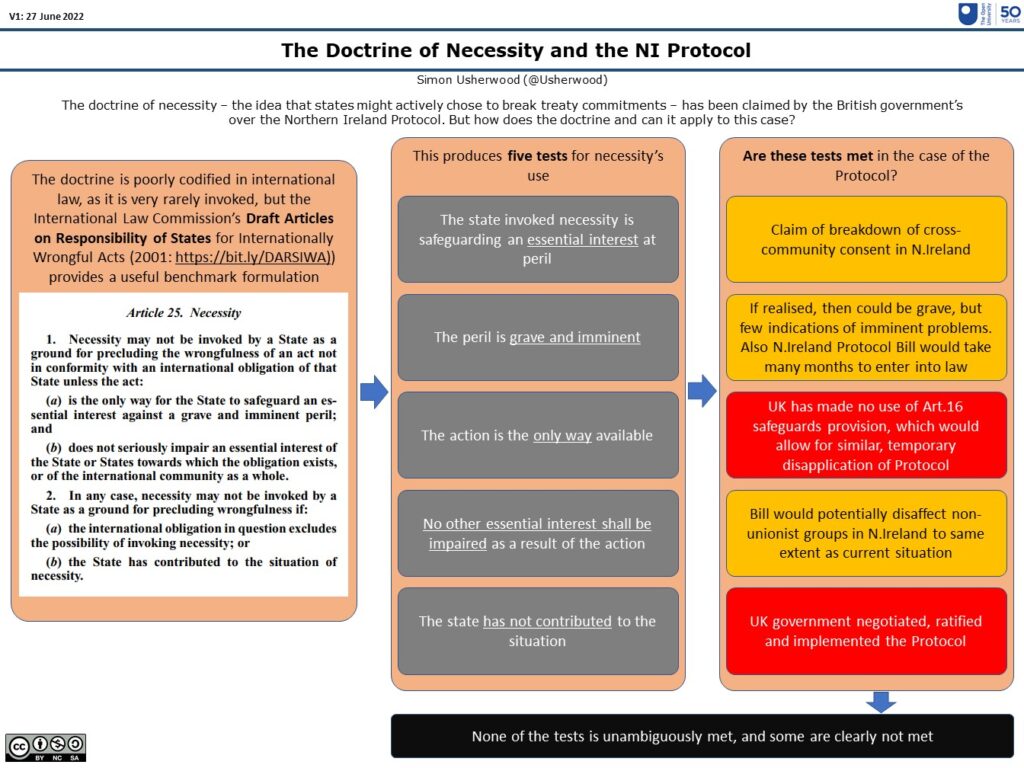
One point that wasn’t addressed in that post was the use of the doctrine of necessity as a justification for the Bill.

In essence, the doctrine is a common law concept that sometimes one is forced to break one’s commitments because that’s the only way to deal with a serious problem. Unlike force majeur, where a state is involuntarily put in a Bad Situation, necessity is a voluntary action.

It’s not much used, mainly because states are pretty careful about signing up to stuff and because the other exit routes – coercion, error, etc. – usually cover it. The only case you might have hear of where it was used was the bombing of the Torrey Canyon after it ran aground in 1967. You’re not supposed to bomb ships [I know], but the action prevented further pollution, and no-one really complained.

As a result, the doctrine is not fully formed in international law.

The main reference point has been the International Law Commission’s Draft Articles on Responsibility of States for Internationally Wrongful Acts, drawn up in 2001. While still draft, there are as close as we get to a benchmark.

The graphic sets out that benchmark, and the key tests that apply, plus whether they are met in the current situation.

As you’ll see, none of the tests are clearly – or even, much – met in the government’s explanatory notes for the Bill.

Moreover, two of the tests are definitely not met. The failure to use Article 16 of the Protocol – despite the government’s extensive discussion of how it would be justified in using it – is only surpassed by the government’s fundamental part in creating the current situation through its negotiation, ratification and implementation of the Protocol in the first place.

Thus, even if one accepts the framing of the threat to cross-community peace and stability as grave and imminent, that still does not allow for use of necessity as a justification for a Bill that not only breaks international commitments, but also very likely creates just the same threat to cross-community peace and stability, albeit by the removal of the Protocol.

This much will have been evident to all involved in Whitehall and Westminster beforehand. Liz Truss’ comments during Monday’s debate highlight that the Bill is much more about trying to push EU member states to reopen the Commission’s mandate than it is about following through on the Bill’s provisions: we might also add in a dose of leadership ambition here too.

But with no sign that the EU is going to move, it is hard to see how the government doesn’t paint itself into even more of a corner on this. With Johnson talking up the need to support Ukraine in defence of a ‘rules-based international system’, it seems especially counter-productive to be playing fast and loose with those rules.

Posted in Uncategorised | Tagged , , | Leave a comment

Making the Northern Ireland Protocol work

The title of this post feels insanely optimistic, given the events of the past weeks, but if we don’t try then we certainly won’t succeed.

Last month I submitted some evidence to the Follow-up inquiry on the impact of the Protocol, run by the Lord’s EU Committee’s sub-Committee on the Protocol. Being very aware of my limits, I only wrote about the dynamics of EU-UK interactions on the issue and how a possible restarting of constructive relations might look.

My unwritten conclusion was that the current UK government was really unlikely to make this work, or would even try to make it work, since its first step was to engage wholeheartedly with the current Protocol system, to show it was making best efforts. Only once that path is exhausted (and seen to be exhausted) would the UK get renegotiation on the table.

Of course, this has been overtaken by the publication last week of the Northern Ireland Protocol Bill.

Resting on a very dubious legal basis of a doctrine of necessity, the government argues that the Protocol’s effects are so terrible as to require urgent action, albeit through passing legislation that may need months to come into effect and while also arguing it is just ‘minor bureaucratic changes‘.

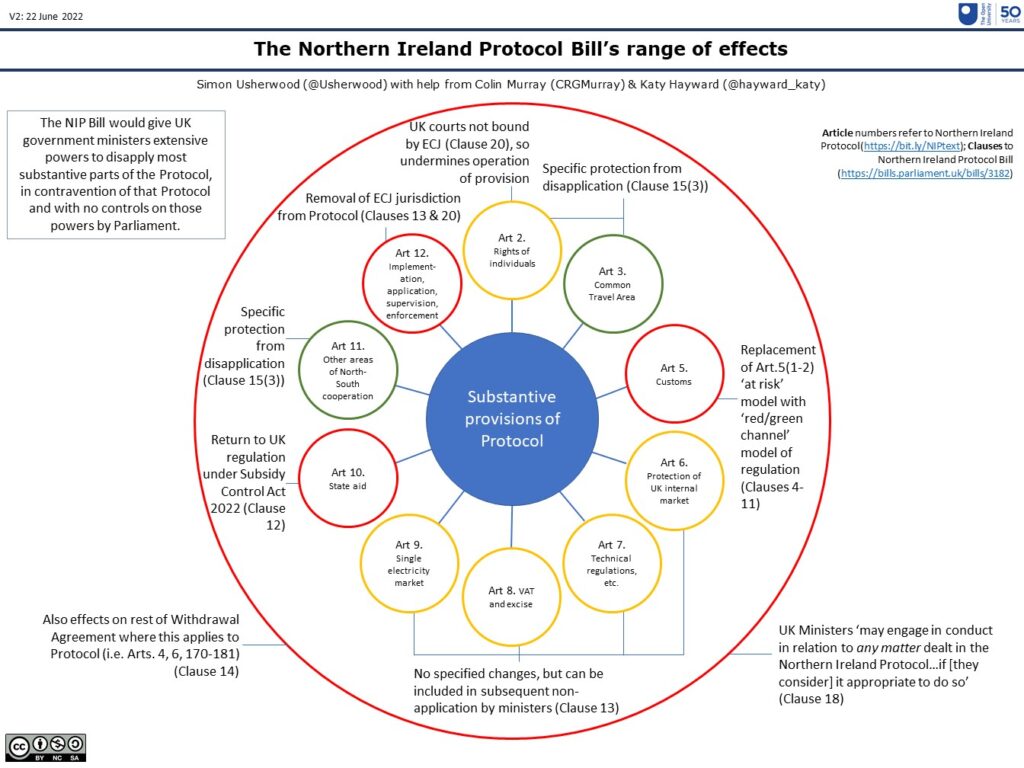
Even if we disregard the justification, then we can still say that the Bill proposes a fundamental reworking of the Protocol, as laid out in the graphic below.

Even those (few) parts of the Protocol that appear to be protected from changes – notably Art.2 rights for individuals – are compromised immediately by the removal of the ECJ from any UK-based legal judgements (so people can’t access definitive ECJ rulings on relevant provisions) and have the shadow of Clause 18 powers hanging over them.

Clause 18 would allow UK ministers to take whatever they like on any aspect of the Protocol as they see fit, without Parliamentary control. To call this sweeping would be an understatement and sets up a much more antagonistic passage through the Lords (and probably with some Tory backbenchers).

As a whole, the Bill reads like a legal embodiment of 1980s Millwall supporters.

Legally, the Bill stands on the weakest of justifications, just as the chances of it forcing the EU to the negotiation table like vanishingly small. Given that both of these things was very evident beforehand,  the key question is ‘why carry on regardless?’

As I’ve long said, it reflects much more on the state of domestic debate than on real, existing international relations.

For more evidence of this, we might look to yesterday’s publication of the Centre for Brexit Policy’s report on Global Britain.

I only focused on the EU/Europe section in my thread below, but it suffers from the flawed assumption that just because you think the EU is rotten, so must everyone else.

https://twitter.com/Usherwood/status/1539548002267934721?s=20&t=cjEWKYKetW2lp_1scEf_jw

And so we continue to go round the same old problems, again and again.

Even if the NIP Bill gets binned and even if the CBP’s ideas don’t become official policy, the issues still remain about how to find a mutually-acceptable and stable solution for Northern Ireland. Which seems rather lost in this debate.

Posted in Uncategorised | Tagged , , | Leave a comment

Challenging implementation of the Northern Ireland Protocol

Since we’re back in a hotter phase of the NIP rhetoric cycle, it’s useful to revisit various points.

None of it’s new and I’ve shared all the content below with you before, but apparently that’s not got through to everyone.

The UK government is seemingly on the verge (again) of producing a bill that would resolve its problems with the Protocol. This time, there’s talk of a dual-track system for checks, which I leave to the trade people to deconstruct.

However, the framing of this current effort is that the primary objective of the government’s push is a negotiated resolution, to address the problematic implementation of the Protocol by the EU. Conor Burn gave evidence on this to Parliament yesterday, helpfully summarising in this thread by Tony Connelly:

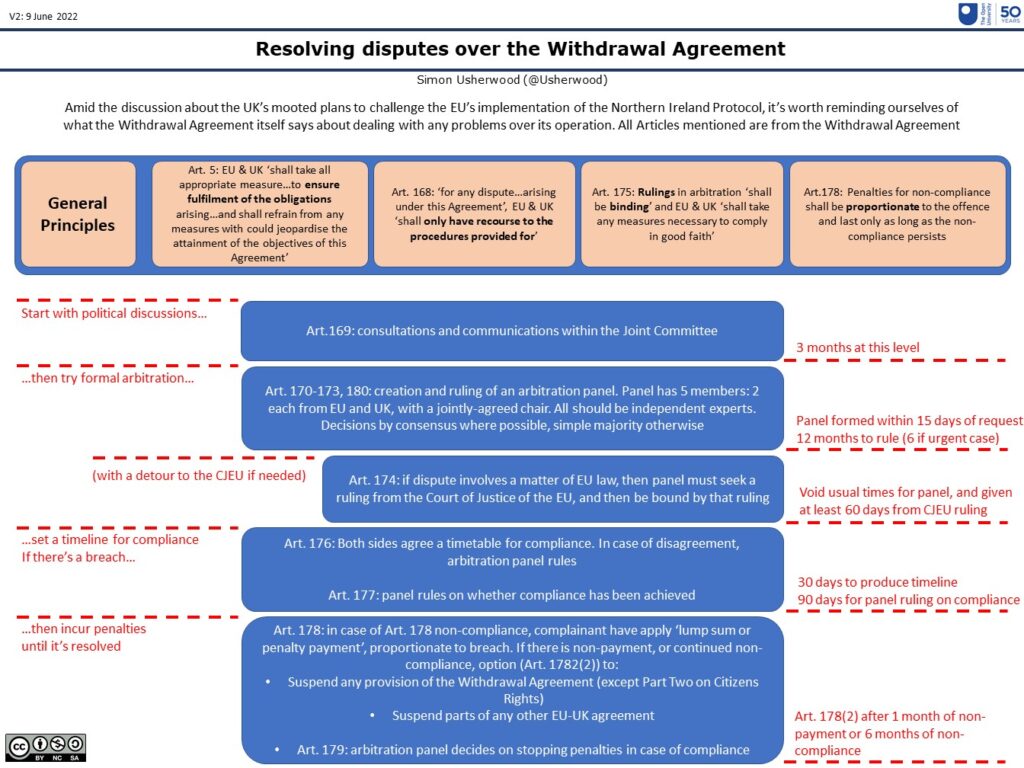
If implementation is the problem, then the Protocol and the Withdrawal Agreement (WA) within which that Protocol sits has a ready-made process: Title III.

Title III deals with dispute settlement, in a graduated and progressive manner, from talks to arbitration to remedies. The graphic below lays out the detail.

This process covers all issues with implementation and (per Art.168) is the only procedure that should be used. That there is no sign of this happening will raise the obvious question about the objectives of the UK government, which makes it less surprising that the EU has trust issues.

We might also note that neither Title III nor Art.16 of the Protocol allows for unilateral domestic legislation to address problems of non-compliance.

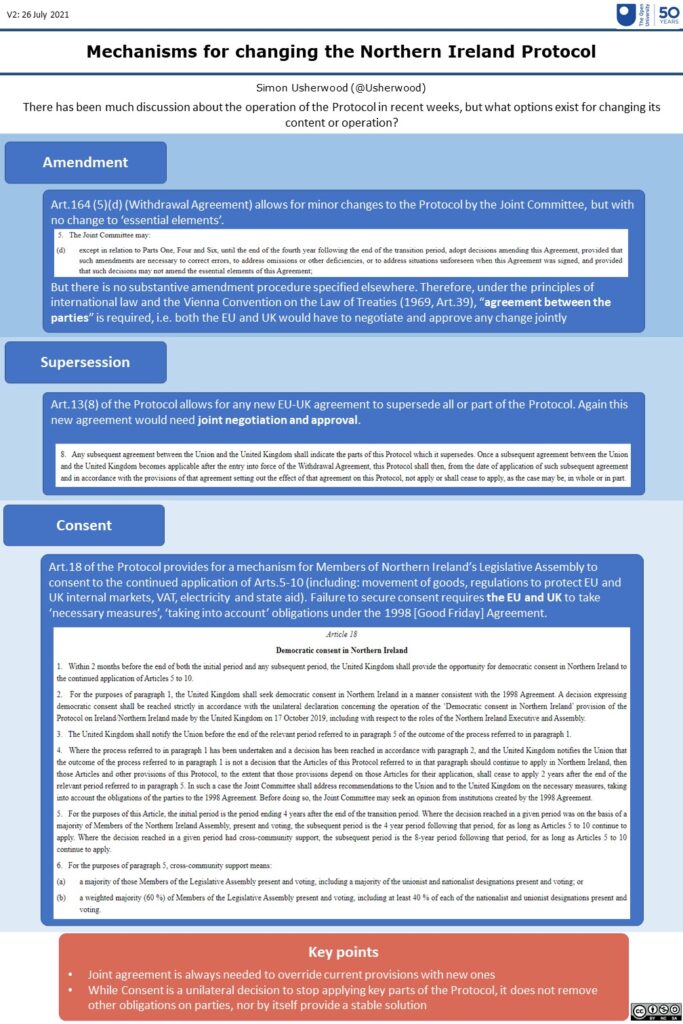
Of course, non-compliance is only one option: the UK government also continues to talk about renegotiating the Protocol.

Again, the mechanisms for changing the text are set out in the Protocol and WA itself, as summarised below:

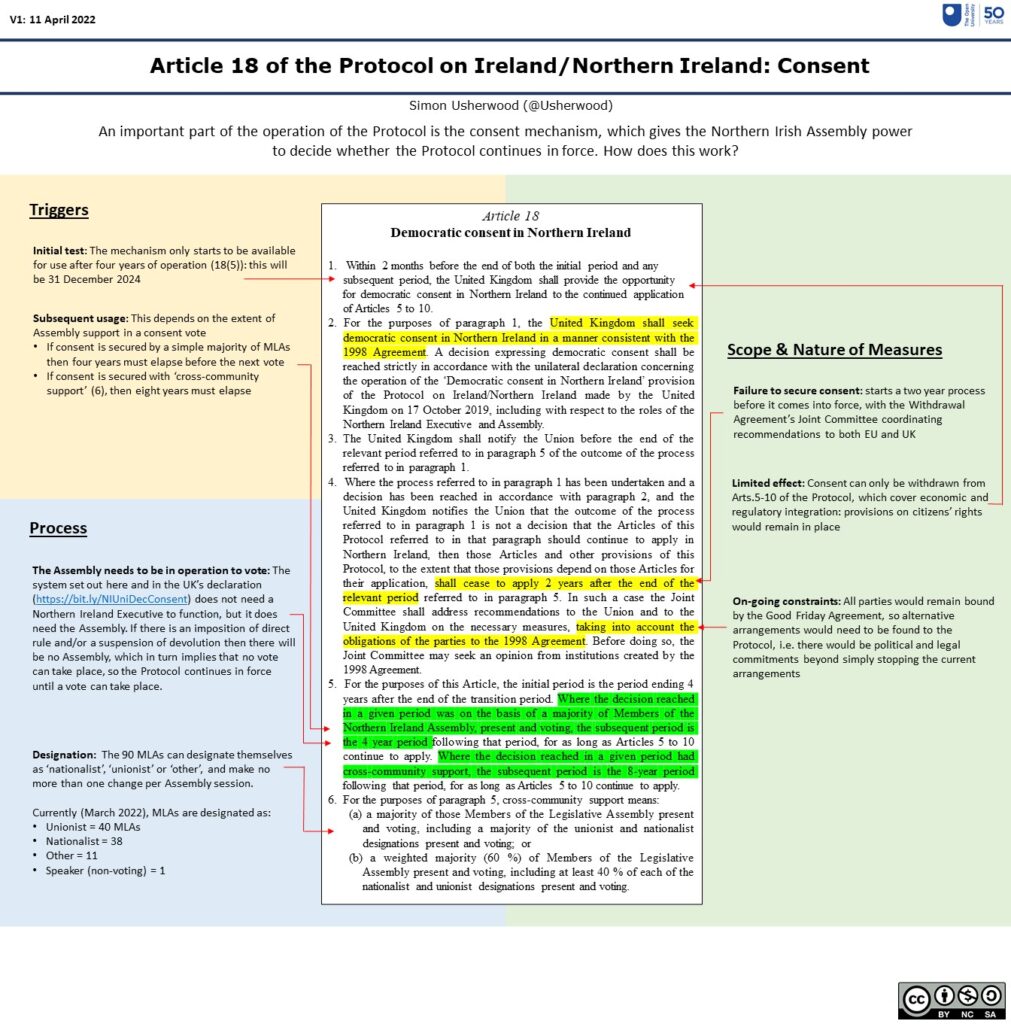
So change is possible, but only by joint agreement: even the Art.18 NIP consent provision ultimately leaves the parties still having to find a common solution to their various obligations (e.g. Good Friday Agreement, EU law, WTO, etc.), which probably brings them back to something like the Protocol.

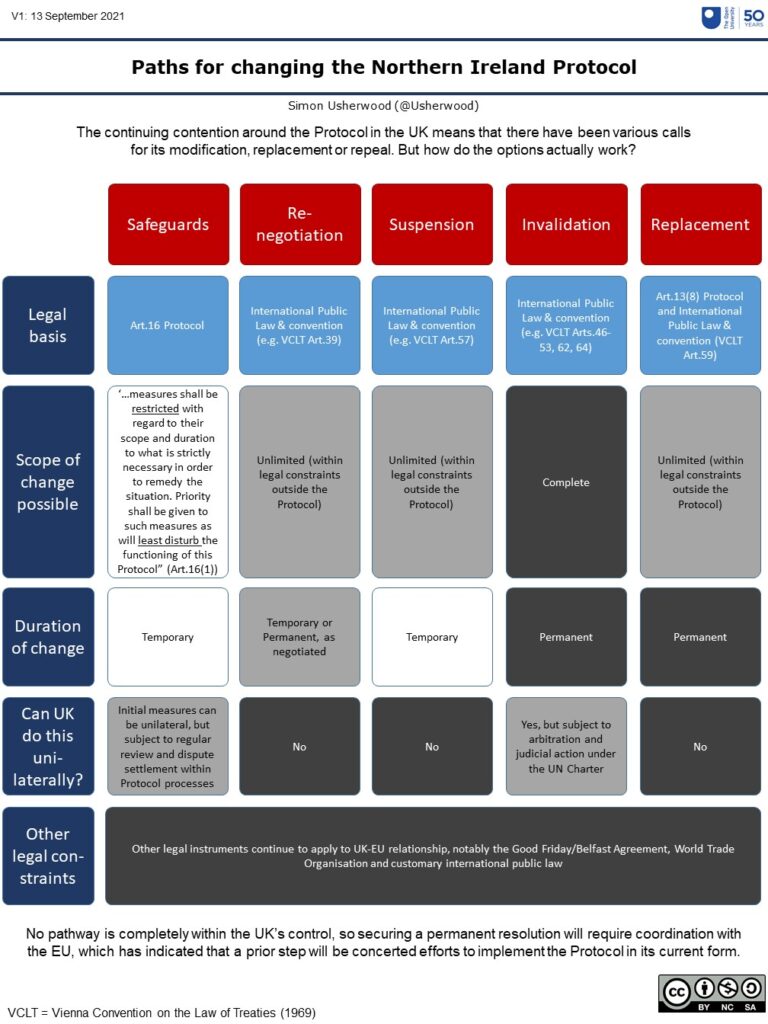
To summarise all this, we can see that options for unilateral action really don’t exist:

Which raises the obvious policy implication that the UK’s best chance of securing change might be to try those joint paths, rather than going off-range with its planned bill. That is almost certainly the advice the government has been given by its advisers. If it does follow through on advancing the bill, then it’s driven by domestic political exigencies rather than the legal or political conditions that materially shape the EU-UK relationship.

Posted in Uncategorised | Tagged , , | Leave a comment

WA/TCA meeting tracker: April 2022

A short post this week, to update the trackers for meetings of the assorted committees of the EU-UK’s Withdrawal Agreement and Trade & Cooperation Agreement.

As you can see, things have been quiet so far this year. WA activity has been winding down (although that might change should the UK follow through on its reported plans for disapplying parts of the Northern Ireland Protocol).

Likewise, the TCA seems to be heading for annual meetings of most bodies, with a few exceptions. The Parliamentary Partnership Assembly has still to meet at all, suggesting that its scope for building more links between the parties is going to be – at best – a long-term prospect.

As always, you can click through the PDF links below to get a version with clickable links to minutes, agendas and reports.


Posted in Uncategorised | Tagged , , | Leave a comment