
by Bob Gaunt
This is the first of two blog posts in which Bob Gaunt reflects on how his research into Michael Danyliw’s photographs of Brinksway, Stockport has sparked new conversations, public events and renewed local interest in a lost working-class neighbourhood.
In 2024 the Open Arts Journal published my essay about an extraordinary collection of photographs taken in the 1960s by Michael Danyliw, an amateur photographer living in the Brinksway area of Stockport. Danyliw took hundreds, perhaps thousands, of photographs of his working-class neighbourhood when it was still a thriving community. Afterwards, slum clearance and redevelopment broke up the community and altered the area for good, with the M60 motorway eventually cutting through the landscape.
What struck me, and still does, is that these photographs are much more than a record of old streets and vanished buildings. They hold onto something of the life of the place itself. They show children playing in the street, neighbours standing together outside their houses, women chatting over backyard fences, Sunday School outings and local celebrations. Looking at them now, you do not just see what Brinksway looked like. You get some sense of how it felt to belong there.
That matters because Brinksway was a place with a strong sense of community, even if life there was often hard. It was crowded, smoky, noisy, poor in many ways, and looked down on by some, but it also had its own warmth, humour, pride and inventiveness. In my article I called this a kind of working-class creativity. By that I meant the ways people made a life together out of what they had: in the care of their homes, in the social life of the Sunday School, and especially in the annual Rose Queen Fetes. These were not just colourful local customs. They were part of how the neighbourhood understood itself.
One of the things I most wanted to write about in the article was the Brinksway Sunday School, because it stood close to the centre of that communal life. It offered much more than religion. It gave children belonging and occasion, brought families together, and created traditions people could take pride in. The Rose Queen Fete was perhaps the richest example of this, bringing together ceremony, dress, music, decoration and photography in a shared neighbourhood event.
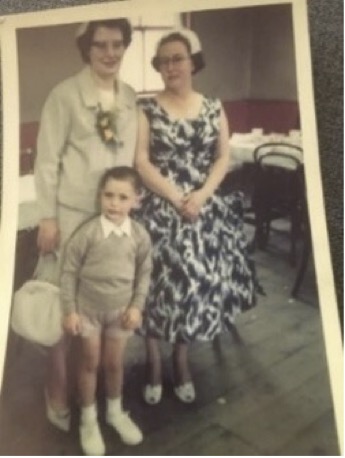
Some of Danyliw’s photographs capture this beautifully. One of the most important to me is the photograph of the tea-and-cakes gathering after the Rose Fete parade, in which I appear as a small boy. [1] It is not a grand or formal image, but that is exactly why it matters. Mrs Cooke leans in towards me, Mrs Danyliw leans in towards her, and Mr Danyliw is behind the camera, quietly holding the whole moment in place. It is a simple picture, but it says a great deal about togetherness, affection and the social closeness that held Brinksway together. For me it captures something of the Sunday School as a second family.
[1]
One photograph I discussed in the article still seems especially important to me. It shows Michael Danyliw’s daughter, Marika, in 1962, dressed in her Rosebud Queen outfit in the back garden of her family’s terraced house. [2] Her mother is nearby and a neighbour leans over the fence to admire her. Behind her, you can see the ordinary surroundings of working-class domestic life, including the outside toilet. Yet there she is, dressed with enormous care, in what was effectively a miniature bridal gown. The picture says so much about family pride and loving effort. It shows the desire to give children dignity and joy even where money was scarce.
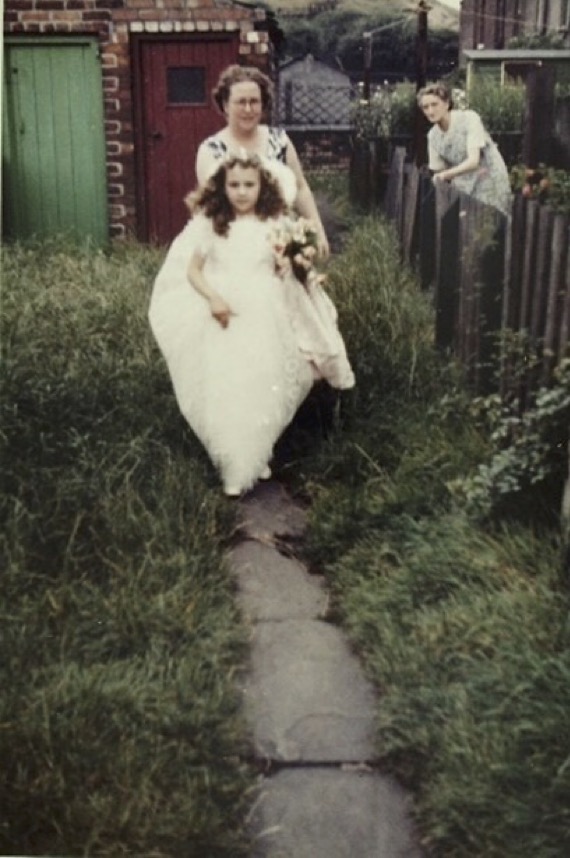 [2]
[2]
Another photograph from 1963 shows me carrying the crown for Rose Queen Lynn Chapman as we cross Woolpack Bridge. [3] The Sunday School is up the hill behind us, and nearby are people gathered outside the Woolpack pub to watch the procession go by. I have always liked this photograph because it catches two sides of local life in one frame. On the one hand there is the Sunday School, with its lessons in respectability, discipline and aspiration. On the other there is the pub, representing a different sort of working-class social world. In the photograph, though, they meet quite peacefully. The onlookers seem to acknowledge the parade warmly.
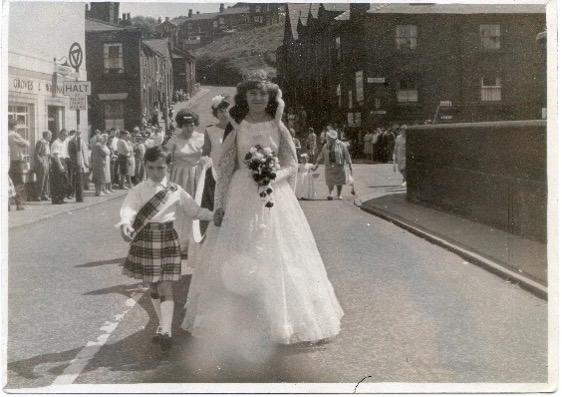 [3]
[3]
This is one reason why Michael Danyliw’s role in the story is so significant. He was not a detached observer wandering round with a camera. He was making a place for himself within the life of Brinksway. He had come to Britain after surviving terrible wartime upheaval in Europe, and in Stockport he built a new life for himself and his family. Photography seems to have been one of the ways he entered into the social world around him. He was a clock-mender by trade, a quiet and intelligent man, and by all accounts not especially confident in spoken English. Yet through the camera he found a way to connect, to record and join in.
I have also always been struck by Danyliw’s self-portrait as a clock-mender, sitting beneath a row of clocks waiting to be repaired. [4] It seems almost too perfect an image now. Here is a man whose earlier life had been broken by history, quietly repairing time while, without perhaps fully knowing it, preserving another kind of time through his photographs.
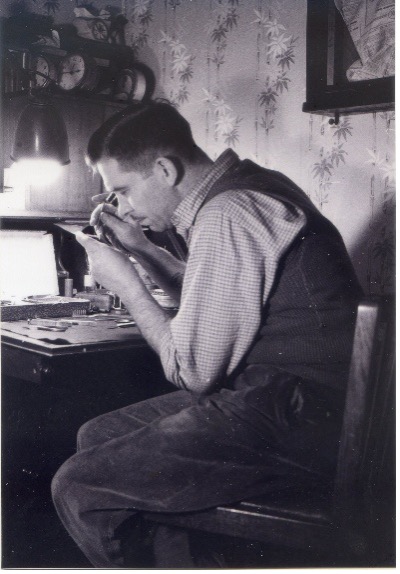 [4]
[4]
The later images connected with the story have a different feeling. In one, much later, I stand on the same bridge where I once walked in the parade as a child, but the old neighbourhood has gone and the motorway now dominates the scene. [5] There is also the image of the Stockport Pyramid, standing where part of old Brinksway once was, a monument to a newer phase of development that itself now looks uncertain. In the article I wrote about putting up an enlarged Rose Fete photograph near the Pyramid, marked with the words “Brinksway Rose Fete 1962”. [6] It did not stay there for long. But that small gesture mattered to me. It was a way of saying that what was there before should not simply be forgotten.
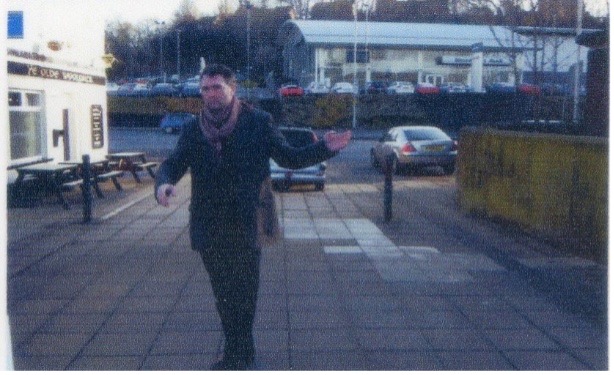 [5]
[5]
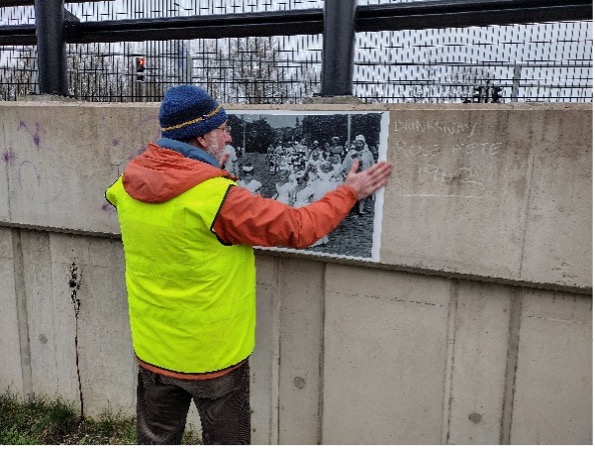 [6]
[6]
What has happened since publication has made that feel even more worthwhile. The article has begun circulating in Stockport itself, often as a hard copy passed among people with a direct connection to the area. Readers have recognised faces, places and events. Some have got in touch. Others have shared memories. The essay has started to move through the community whose history it describes, and in doing so it has helped prompt fresh conversations about Brinksway and about the value of Danyliw’s archive.
Stockport Museum has seen the article and is now planning a display of the photographs as part of its “Living Memories” collection. That matters because it means the work is beginning to find a more lasting public home in the town where it belongs. What was once a private family archive, and then an academic article, is now starting to enter local cultural memory in a different way.
Stockport itself is now going through something of a resurgence after many years of decline. I have also been pleased to be in touch with Dr Anne-Marie Bartlett from the Open University’s Design group, whose own work has connections with Brinksway and with present-day community activity in Stockport. Conversations like these make me think that the Danyliw photographs may yet lead to further work: more oral history, more exhibition activity, more collaboration with local institutions, and more thinking about memory, neighbourhood and the cultural life of working-class communities.
For me, that is really the heart of it. The Brinksway photographs are powerful because they preserve a record of a community that might otherwise survive only in fragments. Many of the people who lived there still carry vivid memories of it, even though the physical landscape has changed almost beyond recognition. What has been especially striking to me is that the article has begun to help those memories circulate again. It has brought photographs, places and people back into relation with each other. In that sense, the work has become part of the afterlife of Brinksway.
For anyone interested in reading more, my original article, ‘Memory and place in the Brinksway photographs of Michael Danyliw’, is available in the Open Arts Journal, in a special issue (no. 11) on the theme ‘Dwelling on the Everyday: Houses, Ghosts, Ellipses’ edited by Helen Hills and Alice E. Sanger. What I hoped to do there was to bring the memory of Brinksway’s creative working-class community to a wider audience. What has happened since suggests that the story is still unfolding, as I will show in the second posting in this blog to follow next week.
After-note
The Open Arts Journal, published by The Open University and led by Leon Wainwright, Alice E. Sanger and Tilo Reifenstein, provides an important space for work that connects academic research with wider public conversations about the arts and humanities. In this case, the publication of the Brinksway essay did more than present research findings: it helped bring a local archive back into public view, encouraged new conversations in Stockport, and supported fresh links between scholarship, memory, place and community.
Images [1] [2] [3] and [4] belong to Marika Anders, she has previously given her consent to OU , they are in the Open Arts Journal article in special issue (no. 11).
Images [5] and [6] belong to me and I give my permission for OU to use them.
Leave a Reply