
Ethical EdTech Award 2025
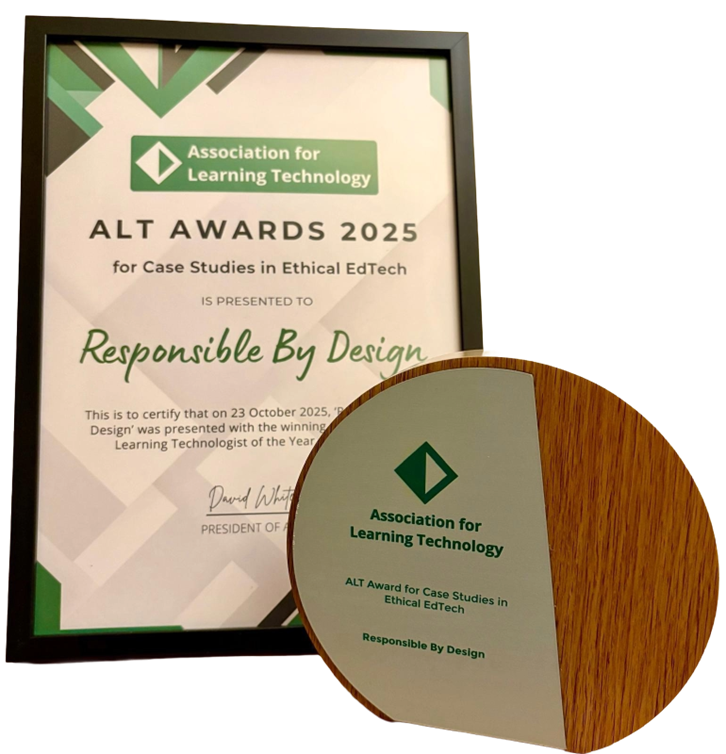
We are incredibly proud to be joint winners of the Ethical EdTech Award category at the Association for Learning Technology conference 2025. Our AI group do incredible work, and it is a real honour for them to be recognised and celebrated for their impact. Openness is a core value of our work, and our award-winning Responsible by Design (RBD) approach is freely available for you to access and use in your context (see the resources section below to access RBD – RBD is also highlighted by Burvill et al., (2025), the ICDE GAC European digital toolkit (2026) and the JISC/EAUC (2026) practical guide ‘AI and environmental sustainability in post-16 education‘.
What is RBD?
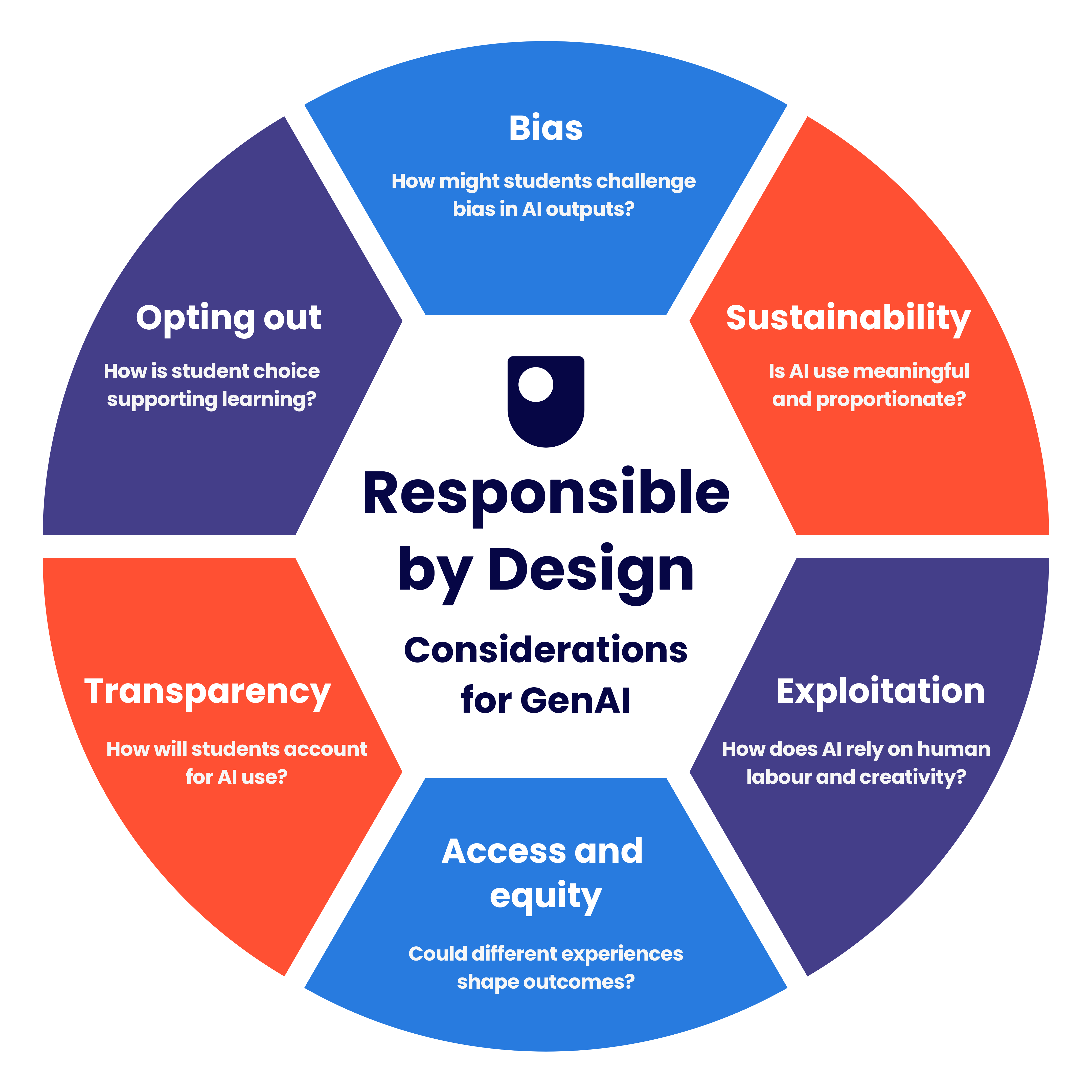
RBD is our pioneering response to the ethical challenges of Generative AI in education. Rooted in student voice and aligned with institutional strategy, the framework enables staff and students to critically examine AI through six pillars: Bias, Sustainability, Exploitation, Access and Equity, Transparency and Opting Out. A practical, values-driven and easy-to-use framework, it provides reflective prompts and actionable solutions. The aim is to empower educators to make informed choices about how to use AI responsibly. The design response bank offers a practical starting point for exploring complex ethical issues, and a way to put suitable actions into practice when designing courses.
Resources
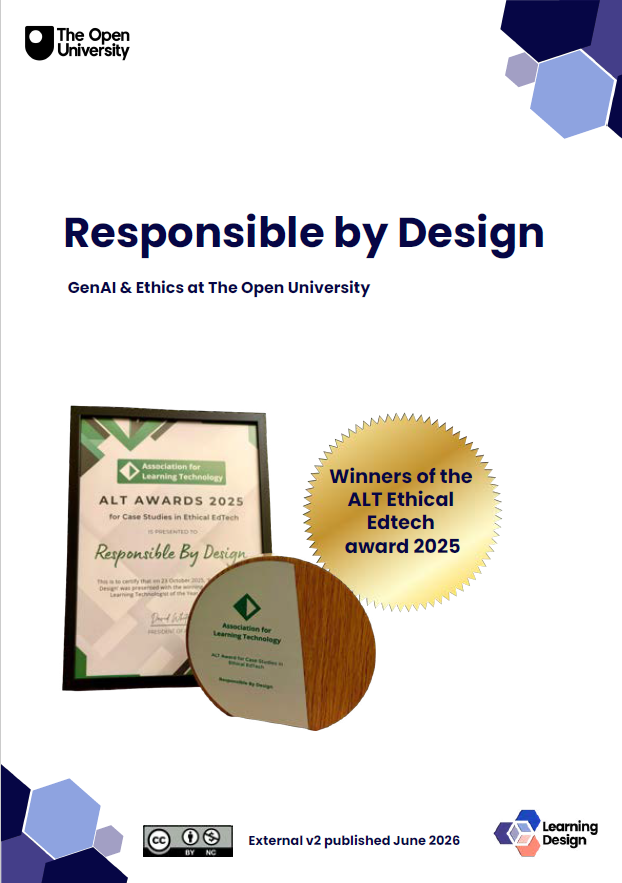
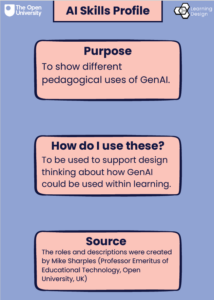
Responsible by Design Critical AI Literacy Skills AI Skills Profiles
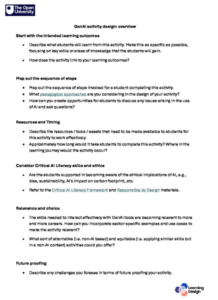
Activity design prompts Assessment toolkit AI and Assessment (Conversation starters)
Podcasts

In this episode, Dr Olivia Kelly interviews Professor Mirjam Hauck – Academic Lead for AI in LT&A, and Eleanor Moore who leads the LDS GenAI Learning Design Team discuss the changing use of AI and GenAI in HE and how the Critical AI Literacy Framework encourages students and HE institutions to critically engage with AI, particularly in an EDIA context.
LD AI team scholarship
Astles, P.; Moore, E.; Openshaw, J.; Shulga, K. and Simper, M. (2023) AI Pearls of Wisdom, Using GenAI in HE teaching, learning and assessment: Inclusive, ethical and sustainable innovation (online). Available at https://sites.google.com/brookes.ac.uk/genaiheteaching/pearls
Astles, P., Moore, E., Openshaw, J., Shulga, K and Simper, M (2024). The impact of GenAI on the production of online distance learning. In: 22nd Academic Practice and Technology Conference (APT2024), 25 Jun 2024, King’s College London, Strand, London. Available at: https://oro.open.ac.uk/98538/
Astles, P., Moore, E., Openshaw, J., Shulga, K and Simper, M (2024). Adapting assessment in Higher Education in response to Generative AI. In: 22nd Academic Practice and Technology Conference (APT2024), 25 Jun 2024, King’s College London, Strand, London. Available at: https://oro.open.ac.uk/98539/
Moore, E., Astles, P., Openshaw, J and Helms, J (2026) Embedding Ethical AI Awareness in Learning Design: Responsible by Design framework, ICDE GAC Europe Toolkit for Inclusivity, Sustainability and Scalability. Available online at Sustainability – ICDE GAC Europe
Moore, E. and Shulga, K. (2023) How can Learning Designers respond to the opportunities and challenges of Generative AI? In: Learning Design Cross Institutional Network, 27 July 2023, The Open University, Milton Keynes. Available at: https://sites.google.com/site/learningdesignsig/home
Moore, E. (2023) Help! A robot wrote my essay! Reflections on webinars about ChatGPT, OU Learning Design Team Blog (online). Available at: https://www.open.ac.uk/blogs/learning-design/?p=1577
Moore, E. and Simper, M. (2023) Student Voice on GenAI: Use, Concerns and Educational Applications, OU Learning Design Team Blog (online). Available at https://www.open.ac.uk/blogs/learning-design/?p=1805#more-1805
Hauck, M., Moore, E., and Wright, C. (2025) A Framework for the Learning and Teaching of Critical AI Literacy Skills. Milton Keynes: The Open University. Available at https://about.open.ac.uk/sites/about.open.ac.uk/files/files/OU%20Critical-AI-Literacy-framework-2025.pdf
Hauck, M., Moore, E., and Simper, M. (2025) Exploring two frameworks from The Open University: Critical AI Literacy Skills and Responsible by Design. Available at: https://www.open.ac.uk/blogs/learning-design/?p=2288