By Dr Katelin Teller
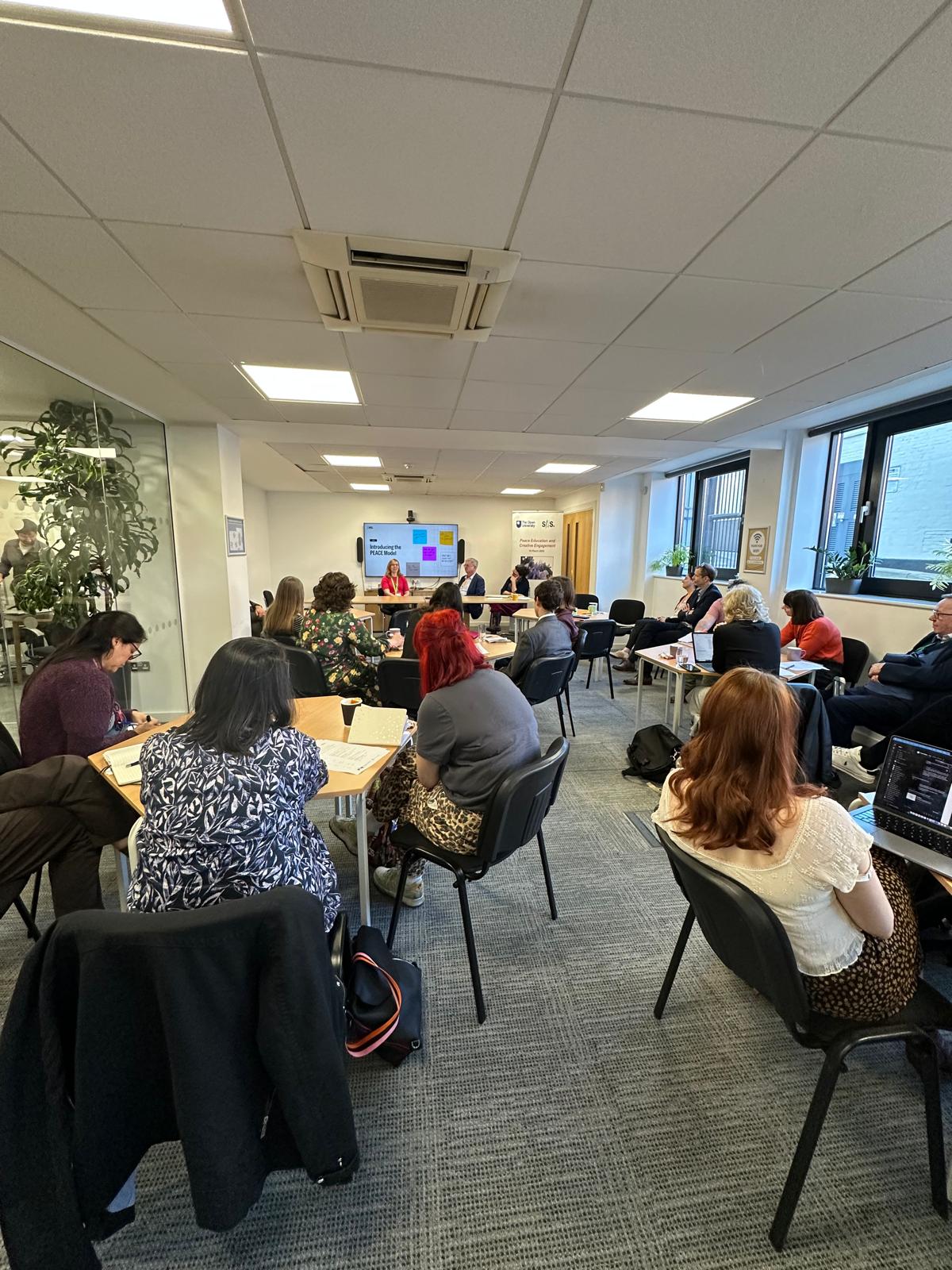
On 18 March, I took the lead with the OU Religious Studies team, John Maiden, Stefanie Sinclair and John Wolffe to join forces with Sharon Booth from the NGO Solutions Not Sides (SNS) to cohost a one-day conference on ‘Peace education and creative engagement’ at the Pears Foundation in London. Bringing together 30 policy specialists, teachers, researchers, curriculum experts and NGO practitioners, the event aimed to tackle a pressing question: How can peace education be more deeply and meaningfully integrated into UK schools? At a time of geopolitical tension and rising misinformation, this conversation could not be more urgent. Ongoing curriculum reforms in England, Wales, Scotland, and now a landmark Supreme Court decision in Northern Ireland calling aspects of current RE provision there “unlawful”, provide important opportunity to incorporate the development of peacebuilding skills into school education.
The NGO SNS, founded in 2019, has long been known for its courageous work bringing young Israeli and Palestinian peacebuilders into UK schools. Through direct, personal storytelling, it helps pupils grapple with polarised and emotionally charged topics while countering both antisemitism and anti-Muslim hate.
This conference was a chance to build synergy across these efforts, draw on diverse expertise, and imagine what a more peace-‑literate educational system might look like.
Session 1, chaired by Prof. John Wolffe, OU, examined the rapidly evolving policy environment around peace, citizenship and RE.
- Naomi Byrne (Educate Against Hate, DfE) highlighted how government resources, including the educate.against.hate website, aim to help schools safeguard against radicalisation and build resilience to extremism.
- Dr Jeremy Hayward (UCL) explored the challenge of confronting conspiracy theories and disinformation in the classroom; an issue increasingly intertwined with misogynistic online content influencing students’ attitudes.
- Dr Stefanie Sinclair (OU Religious Studies) argued that the ongoing Curriculum and Assessment review, and current efforts to include RE in the national curriculum in England in particular, are an important opportunity to ensure that education in schools supports young people to:
- develop peacebuilding and communication skills
- build media and digital literacy
- recognise and challenge stereotypes and misinformation
- explore religious history, including local contexts
- connect local issues to global complexities
- learn with and from one another
- engage safely and creatively with lived experiences of diversity.
The overall message was clear: peace education is not an add‑on, it’s foundational to preparing young people for the world they inhabit.
Session 2, chaired by Dr Sinclair, OU, brought together Prof. John Wolffe (OU) and SNS Director Sharon Booth to reflect on practical methodologies for peace education.
John Wolffe introduced the international RETOPEA project, which aims to broaden young people’s understanding of religious toleration and peace, both in history and in contemporary society. The Open University has developed a method where young people create short documentary-style films by engaging with brief historical sources and then collaborating in small groups to make their own ‘Docutubes’. This hands-on, collaborative process not only deepens their engagement with the subject matter but also helps develop key skills such as teamwork, empathy, curiosity and imagination as well as communication and digital literacy skills.
Sharon also introduced the SNS Peace Model Handbook, a resource designed to strengthen social unity and citizen empowerment, highlighting practical tools that educators can implement now. The PEACE Model is SNS’s five-step peace education methodology – Participate, Equip, Apply, Create, Enact – that guides young people from embracing a win-win mindset and building social-emotional skills, through structured dialogue and human needs-based problem solving, to active citizenship and real-world peacebuilding action.
Both RETOPEA and SNS offer innovative ways for young people to encounter and interpret narratives of peace. Their insights underscored the value of combining historical perspective with lived experience, and the importance of safe, structured pedagogy when addressing conflict.
I chaired the third session which shifted the focus inward, exploring the psychological dimensions that underpin peace education.
- Dr Smadar Cohen Chen (Sussex University) offered a compelling exploration of hope, its role in conflict resolution and its relevance for the classroom.
- Elizabeth Yeomans (John Moores University) examined how trauma shapes learning and argued for a trauma-informed pedagogical approach that recognises the emotional landscapes young people bring into school.
Both talks reinforced the idea that peace education is not just intellectual but is also deeply emotional and relational.
In Session 4, chaired by SNS Director Sharon Booth, teachers Ruairi Geehan (St Dominic’s Grammar, Belfast) and Sarah Macpherson (LAE Stratford) shared experiences from their own classrooms. Their reflections showed the transformative power of school‑based peace workshops in their schools and emphasised the importance of local partnerships between schools, reminding us that peacebuilding often begins with simple acts of connection.
The final session, chaired by Dr John Maiden, OU, invited participants to reflect on four key questions:
- How can we embed peace education within RE, History, PSHE and Citizenship?
- How can we communicate and collaborate more effectively?
- What can each organisation meaningfully contribute?
- Should we form a coalition, and would you join it?
The response was a resounding yes. Participants expressed a strong desire to form a coalition of practitioners, academics, policymakers, and curriculum specialists to jointly advance peace education across the UK.
Feedback gathered from the day will now help determine the first steps toward making that coalition and its collective vision a reality.
Join Us as We Continue This Work
If your work engages with peace education pedagogies, we warmly invite you to be part of this growing community of practice.
Please contact [email protected] to get in touch with us.