This post is written by Anna Kenolty, co-winner of the Stanley Collings prize in 2025, who now works as a Learning Designer at the education company Eedi.
 The Stanley Collings prize is awarded annually by the School of Mathematics and Statistics. The prize is awarded to the student(s) whose Mathematics Education assignment best combines innovation in devising materials suitable for learners and insightful analysis of their learning.
Congratulations Anna!
In my final year studying Mathematics and its Learning, I worked with Ruth, an adult learner who left school six decades ago and has avoided maths ever since. I focused on two key aspects when adapting tasks for her: building confidence and answering the classic learner question of “What’s the point in doing maths?” As I worked through the education modules, I grew to appreciate how applying learning frameworks could help with both of these goals, allowing me to present rich, interesting tasks in a supportive, accessible way.
For my final task with Ruth I chose People Space: estimating whether the entire population of the UK could stand on the Isle of Man. Based on experience of completing the task myself, I decided to provide a map of the island (figure 1) rather than just its area. I also provided a tape measure, ruler and a sheet of A1 paper, as Ruth often struggles with visualisation in problem solving, and I thought it would help her to be able to physically see and measure the space taken up by a person. I did not offer any guidance on how she might use these tools, to avoid influencing her approach to the task.
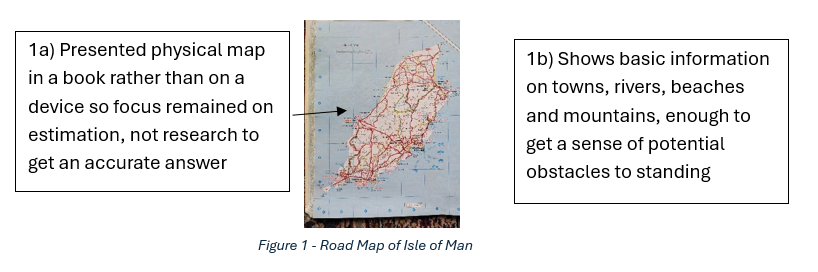
Figure 1 Road Map, annotated to show key teaching moments
In presenting the problem, I chose to provide the area of the island in square miles as well as in square kilometres, as sometimes in tasks which require visualisation Ruth has found it more challenging to work in metric. However, given the option here, she chose to stick with metric to make conversions easier (figure 2b). Still, having the initial area figure provided in a more familiar unit did seem to help her in taking ownership of the task.
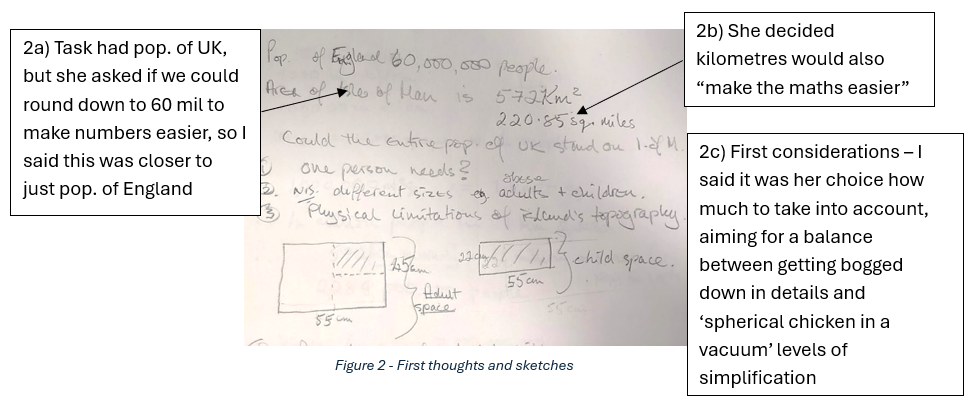
Ruth was initially thrown by the scale of the task, feeling that she did not know enough to form any kind of estimate of how many people could fit on the Isle of Man. Rather than stepping in with suggestions, I encouraged her to write down what she felt she needed to know, and then think about how she could work it out (figure 2c).
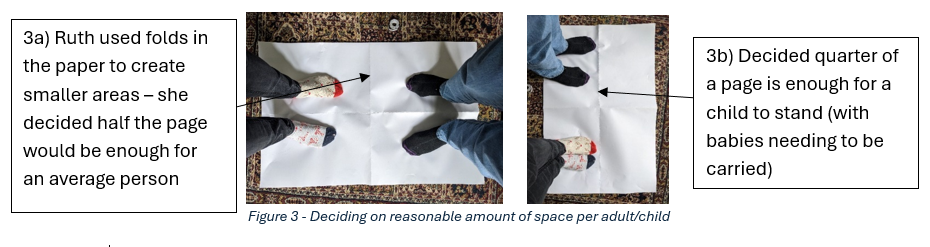
She asked me to stand on the sheet of paper with her to help decide what was a reasonable amount of space for one person. She considered this for children and adults (figure 3), then measured the paper to write down how much space was required (figure 2).
She was able to find the area of these spaces confidently using a calculator, and multiplied to find the space taken up by the whole population, but then did not know how to convert this into square kilometres to compare to the area of land. I suggested that she break down the conversion and draw a shape to help, and she was able to find that 1 square metre is equal to 10,000 square centimetres (figure 4b). I had anticipated this being a challenging step for her, but as I had hoped her engagement in the task motivated her to persevere.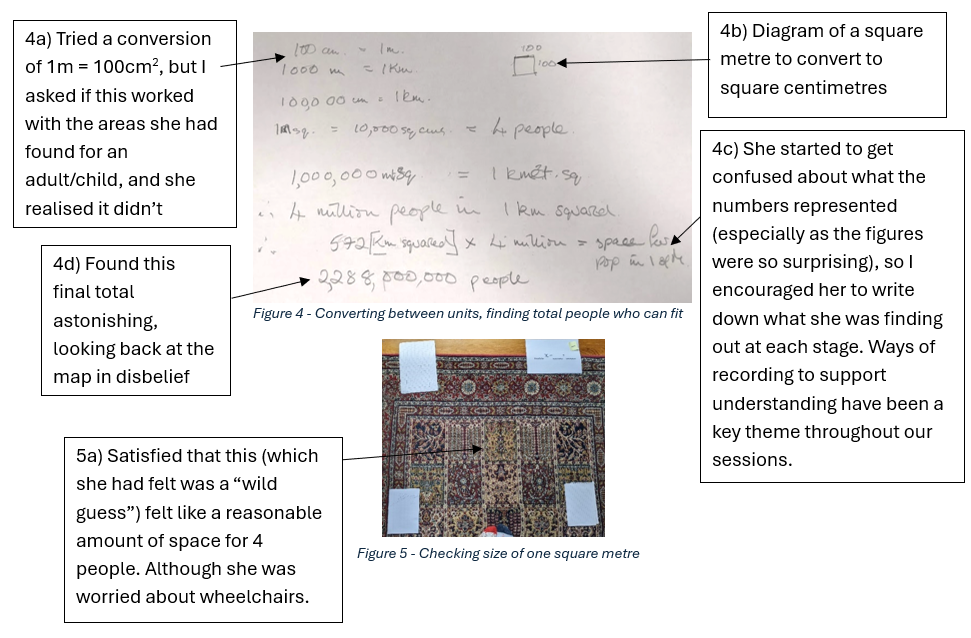
At this point she noticed that this was approximately four times the area she had estimated for one adult, so realised this meant four people could fit in one square metre. She then marked out a square metre to decide whether this was reasonable (figure 5), and decided it was, meaning she could work out a final estimate for how many people could fit on the island (figure 4d) and answer the question posed.
One learning framework I can apply to Ruth’s work is manipulate-get a sense of-articulate (MGA). In People Space, she started by manipulating physical objects, in this case my body and hers as well as paper and measuring instruments (figure 3), to get a sense of the space taken up by a person. This was a vital step for her, as at first she felt lost in the task, even after identifying the information she would need (figure 2c). Being able to physically see and measure the space taken up by a person gave her a concrete starting point, so she could feel that her calculations were based on a realistic estimate.
This initial ‘getting a sense of’ gave her the confidence to scale up to working with the full area of the island in calculations, finding and articulating her final estimates without needing further visual representations (figure 4c); gaining a physical sense first can help develop a mental sense, moving from concrete to abstract. While the problem of how many people can fit onto the Isle of Man is still somewhat concrete, the massive scale of the question and the limited information available can make it feel abstract to a learner.
What I have found difficult in trying to open up tasks to require broader thinking and connect more to real life, is balancing this with keeping my intervention in learners’ work to a minimum. While prompting questions can be effective in helping learners to explore, it is easy to end up directing learners’ thinking and losing the opportunities for them to make connections themselves, as I found in many of my early sessions with Ruth. On the other hand, with too little guidance a problem may feel inaccessible to learners and thus lose the motivating aspects of a rich task.
In People Space I chose to provide limited additional information and resources based on my own frustrations while completing the task (figure 1a), but interestingly Ärlebäck and Bergsten (2013) observed the same initial frustration in their learners and suggested this was part of the strength of Fermi-type estimation tasks. Going forward, I want to learn more about the degree of struggle which supports rather than inhibits learning, which was touched on in Unit 2 in the description of being stuck as an “honourable state”.
One of my favourite aspects of working with Ruth during the module was the reminder that sometimes, “What is the point in doing maths?” is not a complaint but a genuine wondering. A task like this, with such a surprising but easily verifiable result, can help convince a dubious learner that maths makes it possible to answer big questions about the real world.
References (outside OU learning materials)
Ärlebäck, J B and Bergsten, C (2013) ‘On the Use of Realistic Fermi Problems in Introducing Mathematical Modelling in Upper Secondary Mathematics’, in Modeling Students’ Mathematical Modeling Competencies. Dordrecht: Springer Netherlands, pp. 597–609. Available at: https://doi.org/10.1007/978-94-007-6271-8_52 (Accessed: 14 May 2025).