
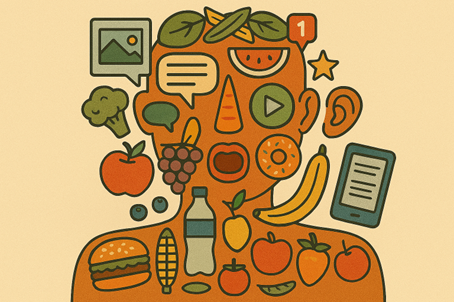
Fig 1: ‘You are what you eat’ image generated using Generative AI
At one level, perhaps this is obvious – the cells that form our body are created using what we consume. But there’s a lot more to the question. It’s not straightforward to connect what I’ve just eaten for lunch with who I am. There could be great diversity in what we consume, and the resulting cells, while similar in many ways, can be quite varied and serve very different purposes. And given that this is a mathematics education blog, what may this have to do with mathematics?
In a 2023 report for the Royal Society, Mathematical and data literacy, five OU academics (Smith et al., 2023) suggested that mathematics, statistics, data science and computing could be aligned in terms of posing and solving data-driven problems.
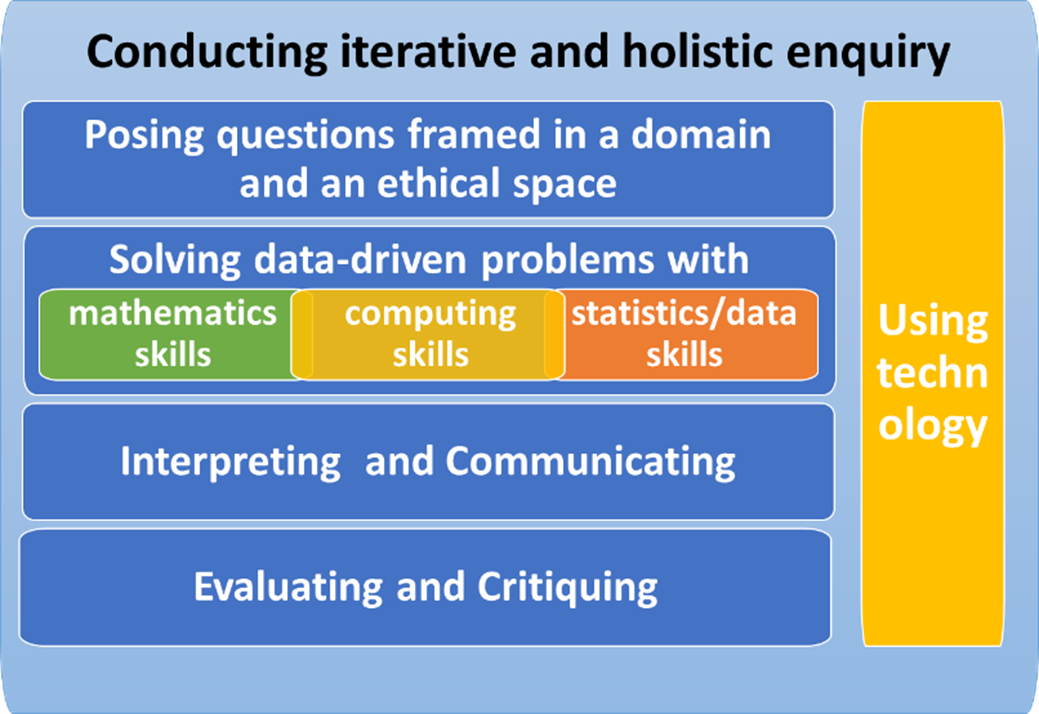
Fig 2: Unifying framework for mathematics, statistics/data science and computing competencies (Smith et al., 2023)
To relate this back to our original question: we are prodigious consumers of data, which gets progressively digested to yield information and then knowledge (we’ll leave wisdom for another time!) and mathematics plays a fundamental role in how we represent and model these processes, in particular for creating Generative AI. The data- and mathematically-dense processes that power Generative AI provide a substantial challenge and opportunity for STEM education. How do we equip learners so that they can be empowered citizens in this data-driven world, both as producers and consumers of data?
There is substantial inequality in the tools and pathways available to different communities and there can be much variation at local and national levels. In the UK, Scotland has developed a much richer data education curriculum for schools https://dataschools.education/ than the other nations. England is currently undertaking a refresh of its national curriculum, with the aim of publishing a revised ‘world-leading’ national curriculum in 2027. The aspiration is that ‘excellence in maths will provide the problem-solvers of tomorrow’ and that the refreshed curriculum will teach pupils ‘how to use data to complete tasks and solve problems’.
Building on our 2023 report, Cathy Smith and I recently undertook a rapid review (Kathotia & Smith, 2026) of some of the literature on data education. We were commissioned to do this by the Joint Mathematical Council of the UK and the Royal Society, to inform the government’s ambition for an empowering mathematical and data education. Our view is that for data education to work cohesively with mathematics, we need a shift in focus, attending to the role of context, ethics, and uncertainty, in mathematics and beyond. Teachers, students, parents – all of us – need to see and use mathematics not as a subject to determine right or wrong but to pose questions, engage in iterative holistic enquiry, and to support judgements amidst uncertainty, with increasing care, and with awareness of the sources and implications of variation.
In the spirit of posing better questions, a refinement of the title would be, ‘how are we what we eat and why does this matter?’ The focus on what we consume is not about body-shaming or driving a particular consumption agenda but about raising awareness. Of potential implications of our choices and the tools available to us to address these.
A few decades ago, I landed in the US. A fresh-faced immigrant from India in search of knowledge, freedom and wealth. One of the first quintessential American proverbs I was taught is that ‘There ain’t no free lunch’. That may seem out of touch at a time when key tools we use – search engines, social media apps, Generative AI programs – are free. So an updated variant of the American proverb is, “If lunch is free, then you are the lunch.” Critically, mathematics and statistics are at the heart of these data-driven ‘free’ engines, and can help make transparent the various equivalences and exchanges powering them. Supporting learners in exploring and navigating this interconnected ecosystem, of what we consume and what consumes us, seems imperative and offers an incredible challenge and opportunity for mathematics and statistics educators.
In keeping with the nutrition theme, if you would like a flavour of such educational opportunities, and the shifts we could help bring about, then experiment with the following activity (aimed at 11-13 year olds) from the excellent ProDaBi project in Germany, on classifying food items based on nutritional data (this links to resources in English, introducing data-based decision trees and machine learning).
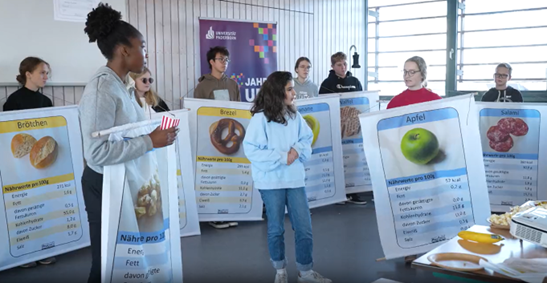
Fig 3: Grade 6 students enacting ‘apples or popcorn?’ Image:ProDaBi, photo taken by Jens Kupsch
We’ll be following up with a blog about this activity – do join us then for a second helping!
References
Kathotia, Vinay; and Smith, Cathy (2026). Rapid Review of Data Education within Mathematics 5-16. The Joint Mathematical Council, London, UK. Accessed 13 April 2026. https://www.jmc.org.uk/2026/02/12/rapid-review-of-data-education-within-mathematics-5-16/
Smith, Cathy; Kathotia, Vinay; Ward-Penny, Robert; Howson, Oli; and Wermelinger, Michel (2023). Mathematical and Data Literacy: Competencies and curriculum implications at the intersection of mathematics, data science, statistics and computing. The Royal Society. Accessed 13 April 2026. https://royalsociety.org/-/media/policy/projects/maths-futures/intersection-mathematics-data-statistics-computing.pdf