This post is written by Cathy Smith from the Open University.
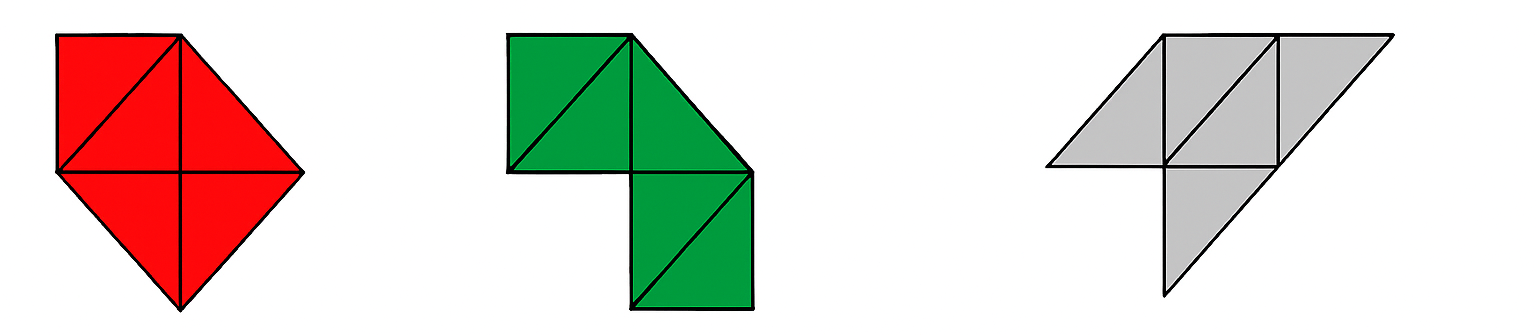
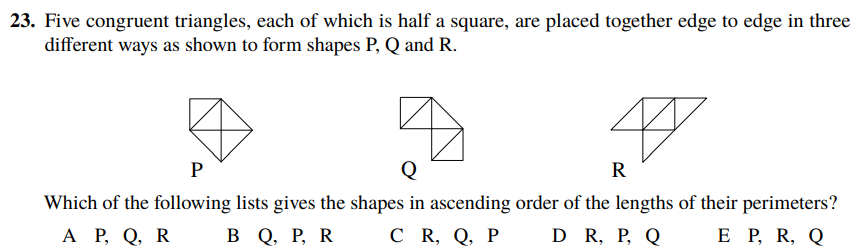
I started December with a new and intriguing mathematics puzzle from the excellent UK Mathematics Trust (https://ukmt.org.uk), who have been a source of consistently excellent maths problems since I started as a maths teacher. This problem was presented to a group of maths teachers and researchers with the aim of understanding what problems we want, and can reasonably be expect, 11–16-year-olds to solve.
Our group discussed:
- what are the problem solving skills secondary school student should learn?
- What contexts should they learn and use them in?
- How difficult should those problems be?
- How familiar/unfamiliar? And how many solution steps or connections are needed?
This framework of questions reminded me of work done by the Nuffield foundation fifteen years ago, analysing the difficulty of the mathematics used in science A levels (SCORE, 2012). It highlights that much mathematics is not done in the maths classroom but is used to solve problems in other subjects. The 2025 event, where this discussion happened, was run by Maths Horizons who are consulting widely while they develop a map of mathematical problems and associated resources that they hope will inform and support the future curriculum, classroom practice and assessment design. You can find more about them here: https://www.mathshorizons.uk/.
Here is the problem. You might like to read it and notice your initial reactions.
I noticed several things and, because I am used to teaching on the Open University mathematics education modules, I have the habit of labelling some of these ‘noticings’ with the names of relevant module ideas.
Perceptual and discursive reasoning (PDR)
This is a module idea from Learning and Doing Geometry. In this problem, my attention was first drawn to the shapes P, Q and R. I recognised what kind of objects were involved by using my senses – what we call perceptual noticing – and that each was made of five identical triangles. I was not yet reasoning, but I had an intuition that my reasoning would involve comparing these similar-but-different shapes. On the other hand, my mathematical habits reminded me I must read the description in words – because it is usually discursive reasoning, using words, symbols and diagrams, that is characteristic of school maths. It took me a while to feel sure that the technical language used did not give me any extra background information than my perception had shown me.
Freedom and constraint
This module idea appears in both Learning and Doing Algebra and L&D Geometry. I know I need to find perimeters – a constraint on the problem – but I don’t know any lengths. This is the kind of freedom that stops many learners in their tracks. They cannot calculate so what can they do next? If they try to think, will it be a disappointing waste of effort? The mathematical resilience experts Clare Lee and Sue Johnston-Wilder suggest teachers need to be explicit about discussing the emotional side of mathematical problem solving (Lee & Wilder-Johnston, 2017). Students develop resilience by remembering experiences of trying a non-routine strategy that was successful.
You might like to stop here and work on the problem yourself here before reading on.
My experiences reminded me that this is exactly why algebra was invented! In Learning and Doing Algebra we discuss Radford’s description of algebraic thinking (Radford, 2014) as characterised by indeterminacy, denotation and analyticity. This problem involves quantities – the triangle’s side lengths – whose values are unknown (indeterminate). On the diagrams below you can see the notation I used to represent (denote) those quantities: s for the length of a short side and L for a long side. I could then reason analytically – first of all, recognising and writing that the perimeter was the sum of the exterior lengths and then combining like terms to get a concise symbolic expression.
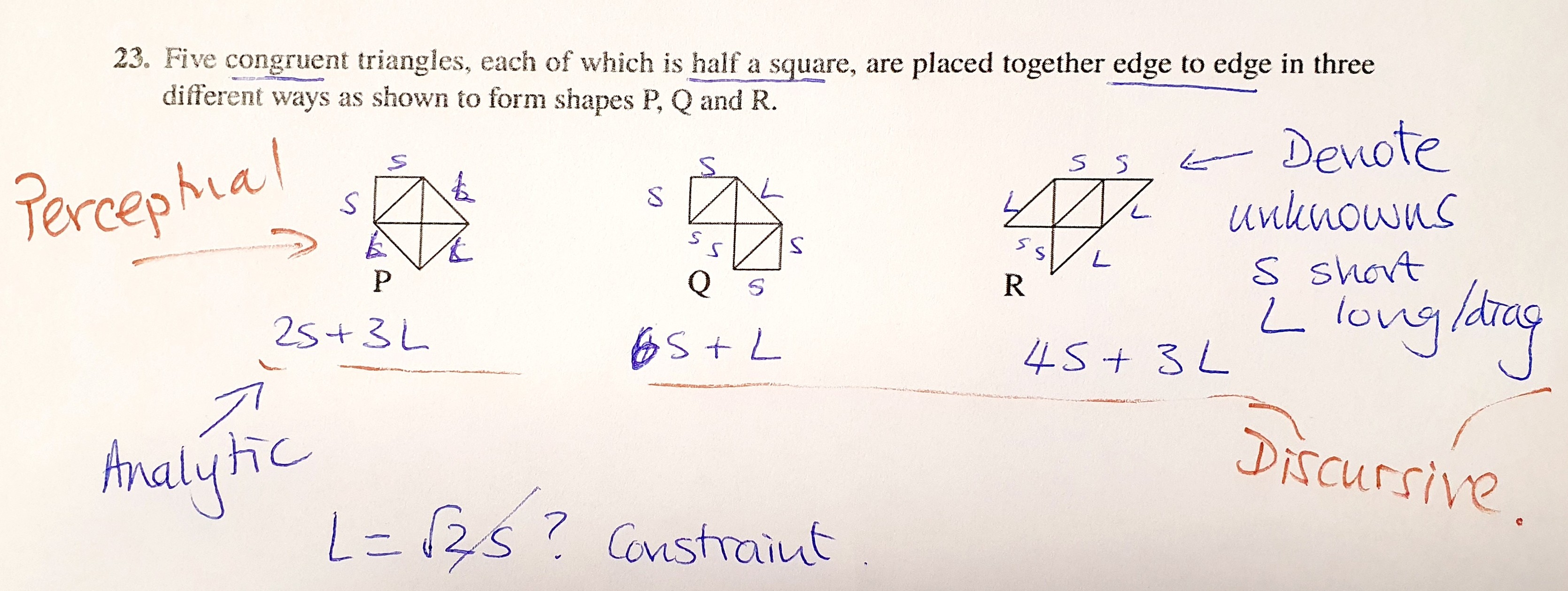
I noticed another freedom in that I did not know who might be tackling this problem. We have lengths and right-angled triangles, but could I assume the students would know Pythagoras’s theorem and be wiling to use it in a non-routine way? I decided to give myself a constraint and try and reason keeping the two variables separate.
Combining Perceptual and Discursive Reasoning
My problem has now involved me in managing unknown lengths and I have combined perceptual knowledge (the perimeter is the sum of exterior segments) with discursive knowledge (forming three similar symbolic expressions even when I don’t know their value). I decided to annotate my diagram to show my perceptual and discursive reasoning (in brown).
In this next figure, I had organised the symbolic expressions and compared them. I could expand my notes to claim: P must have a greater perimeter than R because P’s expression is 2s more than R’s (and s is positive). I expected that all my reasoning would now be discursive, similarly based on symbols.
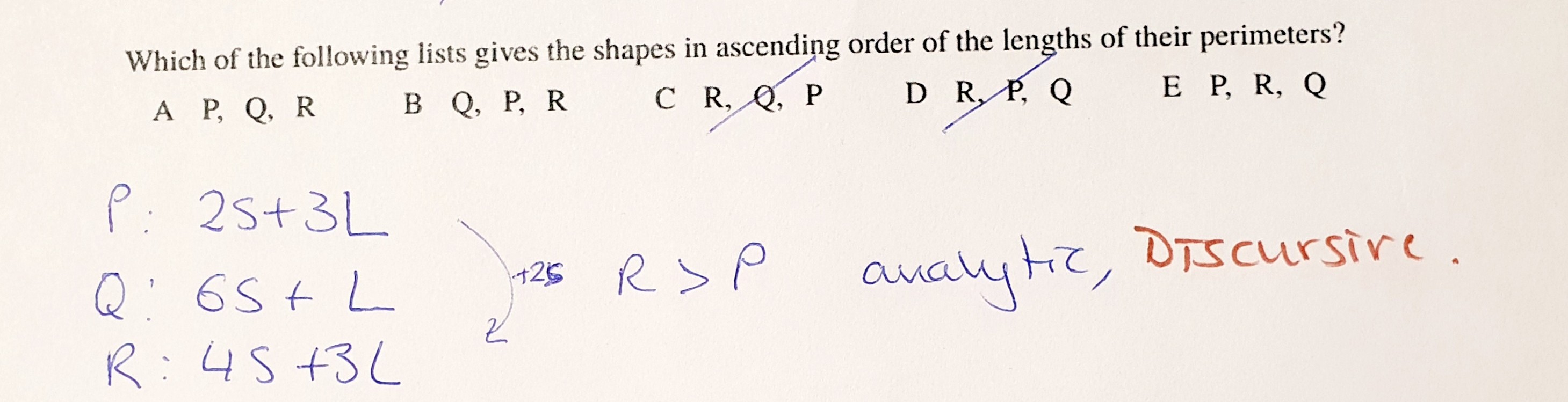
I don’t want to spoil your enjoyment of the problem, as there are many ways to make the remaining two comparisons. What I noticed was that I could indeed decide the ascending order by using two useful facts about the side lengths and diagonal lengths of squares. This wasn’t discursive knowledge from words and symbols but sensory, spatial knowledge of comparing journeys round a square. I didn’t use the more complicated algebraic technique of reducing the expressions to one variable (e.g. by writing L = √2 s) but I did combine perceptual and discursive knowledge into one strand of reasoning to get a convincing answer.
The Royal Society’s Early years and Primary Expert panel has recently reviewed evidence on the value of spatial reasoning. They report that “teaching children to think and work spatially results in substantially improved mathematics performance” (RS ACME, 2024, p1). For this problem, I wondered whether the depth of problem solving involved in combining spatial and algebraic reasoning was perhaps of more lasting value to most students – and perhaps more authentic to their lives after school – than a purely algebraic approach. The problem appears in the 2020 UKMT Intermediate challenge, which is designed for students up to age 16 so some will have used Pythagoras’ Theorem and others will not. I would be fascinated to know which approaches the students used.
Lee, C., & Wilder-Johnston, S. (2017). The Construct of Mathematical Resilience. In U. Xolocotzin (Ed.), Understanding Emotions in Mathematical Thinking and Learning (pp. 269–291).
Radford, L. (2014). The Progressive Development of Early Embodied Algebraic Thinking. Mathematics Education Research Journal, 26(2), 257–277.
RS ACME (2014) RS ACME Primary and early years expert panel perspective: Spatial reasoning. Available at: https://www.royalsociety.org/-/media/policy/projects/mathematics-education/expert-panel-perspective-spatial-reasoning.pdf
SCORE. (2012). Mathematics within A level Science 2010 Examinations. SCORE (Science Community Representing Education). https://www.stem.org.uk/resources/elibrary/resource/25956/mathematics-within-level-science-2010-examinations#&gid=undefined&pid=1