This blog post is written by Roshani Senior, an OU graduate and intern.
I was delighted to be invited to speak on the Open University’s Diversity in Mathematics Careers panel, where professionals from a range of backgrounds shared how studying mathematics had shaped their careers. As a trainee Clinical Scientist in Radiotherapy Physics, I was excited by the opportunity to introduce students to a career that many people may not have heard of.
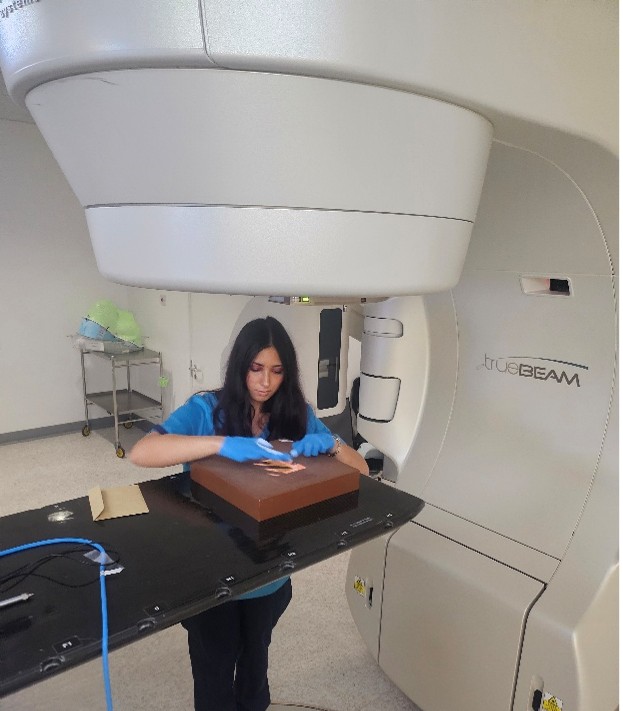
Me carrying out commissioning measurements on Gafchromic film, a special type of film used to measure radiation dose in radiotherapy
I completed a combined BSc in Mathematics and Physics with the Open University in 2021. Due to my circumstances at the time, attending a traditional face-to-face university was not possible, and the Open University provided me with an opportunity to pursue higher education in a way that was both flexible and accessible. The OU’s supportive approach allowed me to continue following my interest in mathematics and physics while accommodating my personal situation. Although studying through this route was challenging, I am extremely grateful for the opportunity it gave me to complete my degree and continue my education.
Towards the end of my degree, I became aware of some of the applications of mathematics and physics within healthcare. This encouraged me to research further and introduced me to the field of medical physics. As someone with an interest in medicine and passionate about STEM, it seemed like a great career choice for me. I then went on to complete a MSc in Physics and Engineering in Medicine at UCL. My dissertation project was carried out in collaboration with the National Physical Laboratory (NPL) and focused on the different algorithms used in radiotherapy treatment planning systems. My mathematical background gave me a strong foundation for understanding these algorithms and the principles behind them.
Since then, I have begun training to become a registered Clinical Scientist in Radiotherapy. The role involves supporting the safe and accurate delivery of
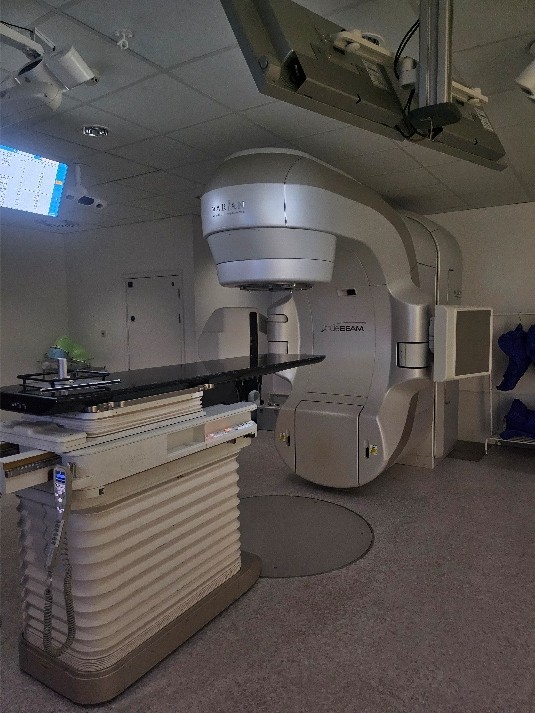
A linear accelerator (LINAC), the machine used to deliver precise, high-energy radiation treatments to patients
radiotherapy treatments through treatment planning, quality assurance of treatment machines, the development and evaluation of new techniques, and involvement in clinical research and trials. Clinical scientists are also responsible for commissioning new radiotherapy equipment, carrying out extensive testing to ensure it is safe and performs accurately before it is introduced into clinical practice.
Additionally in 2022 I had completed an internship with the OU in Mathematics Outreach and Communication. My role included the development of educational resources to improve STEM outreach as well as the creation of materials for events, and the presentation of mathematics classes for children. Delivering mathematics classes was a completely new experience for me, but it proved to be one of the most valuable aspects of the internship, helping me build confidence in teaching and communicating technical concepts. In my current job, we work with a wide multi disciplinary team including doctors, radiographers, engineers and more and the skills I obtained during this internship have been so valuable in my daily work life.
This internship also led to the opportunity to become a masterclass speaker at the Royal Institution which I continued for a couple of years due as I found it so enjoyable and rewarding. I would highly recommend students explore the OU internship schemes as the experience was so valuable for me.
One of the main reasons I accepted the invitation to speak on the Diversity in Mathematics Careers panel was to inspire students. When I was choosing my own career path, I was not aware of the wide range of opportunities available to mathematics graduates. My own experience has shown me the importance of introducing students to careers they may not have previously considered, as I may never have discovered medical physics without learning about the real-world applications of mathematics and physics during my degree. By sharing my journey, I hoped to encourage students to explore the diverse career pathways available to them and recognise the possibilities that a mathematics degree can offer.
One of the most enjoyable parts of the event was answering questions from students. It was encouraging to see so much curiosity about different careers and post graduate study. I enjoyed explaining how mathematics is applied in a real clinical setting and highlighting the variety of career opportunities available to people with quantitative skills.
One of the questions raised during the panel was how a mathematics degree from the Open University compares with other universities. This was not something I had previously considered in depth, and it prompted me to reflect on my own educational journey. During the discussion, I explained that the colleagues I work with all attended different universities, yet we have all entered the same profession. Showing that, in the long term, success is not determined solely by the university you attend, but by the knowledge, skills, and experiences you develop and how you apply them throughout your career.
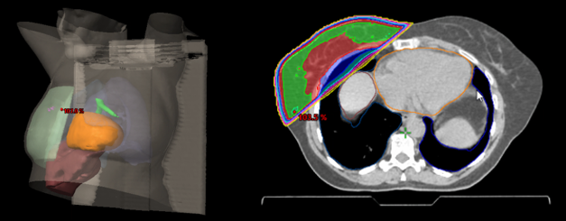
An example of a treatment plan I created, illustrating how radiation doses are shaped to target the tumour while minimising exposure to healthy tissue.
Many of the students expressed an interest in pursuing postgraduate study, particularly at universities other than the Open University, and were keen to know how an OU degree is viewed during the application process. This was something I had also been concerned about when I was considering postgraduate study. Drawing on my own experience, I was able to reassure them that I had no difficulty being accepted into my master’s course. I also shared that the course organiser told me they have found students from the Open University often perform very well, as independent study helps them develop valuable skills such as self-motivation and time management which are key to post grad study. Being able to offer this personal perspective felt particularly valuable, as it addressed a concern I had once shared and, I hope, gave students greater confidence in pursuing their own ambitions.
The theme of diversity was particularly important. Hearing from professionals with a wide range of backgrounds and career paths demonstrated that there is no single route into a successful career involving mathematics. I hope that seeing such varied experiences helped students recognise that their own background or educational journey does not limit the opportunities available to them.
As someone from a minority ethnic background, I know that greater representation in STEM careers when I was younger would have given me more confidence in pursuing my interests. This experience reinforced for me the importance of showcasing diverse role models and helping students see that they too can have a place in STEM.
I’d like to thank the Open University for inviting me to take part and for organising such a valuable event. I hope the discussion encouraged students to feel confident pursuing careers that inspire them.