
We are delighted to share the post below, written by Dr Dave Hewitt. Dave has contributed to OU mathematics education materials over the years. He is currently at Loughborough University, where he set up their new Mathematics PGCE in 2014. His research interests include the design and use of technology in teaching and learning mathematics and the teaching and learning of number and algebra in schools.
In the early 1990s, the Open University came into my classroom and video recorded some of my lessons with students aged between 12 and 14 years old. The video produced was originally sold by the Open University as part of a professional development resource and has been used to provoke discussion on a number of teacher education programmes and professional development sessions. It is now freely available at https://learn1.open.ac.uk/mod/oucontent/view.php?id=60386
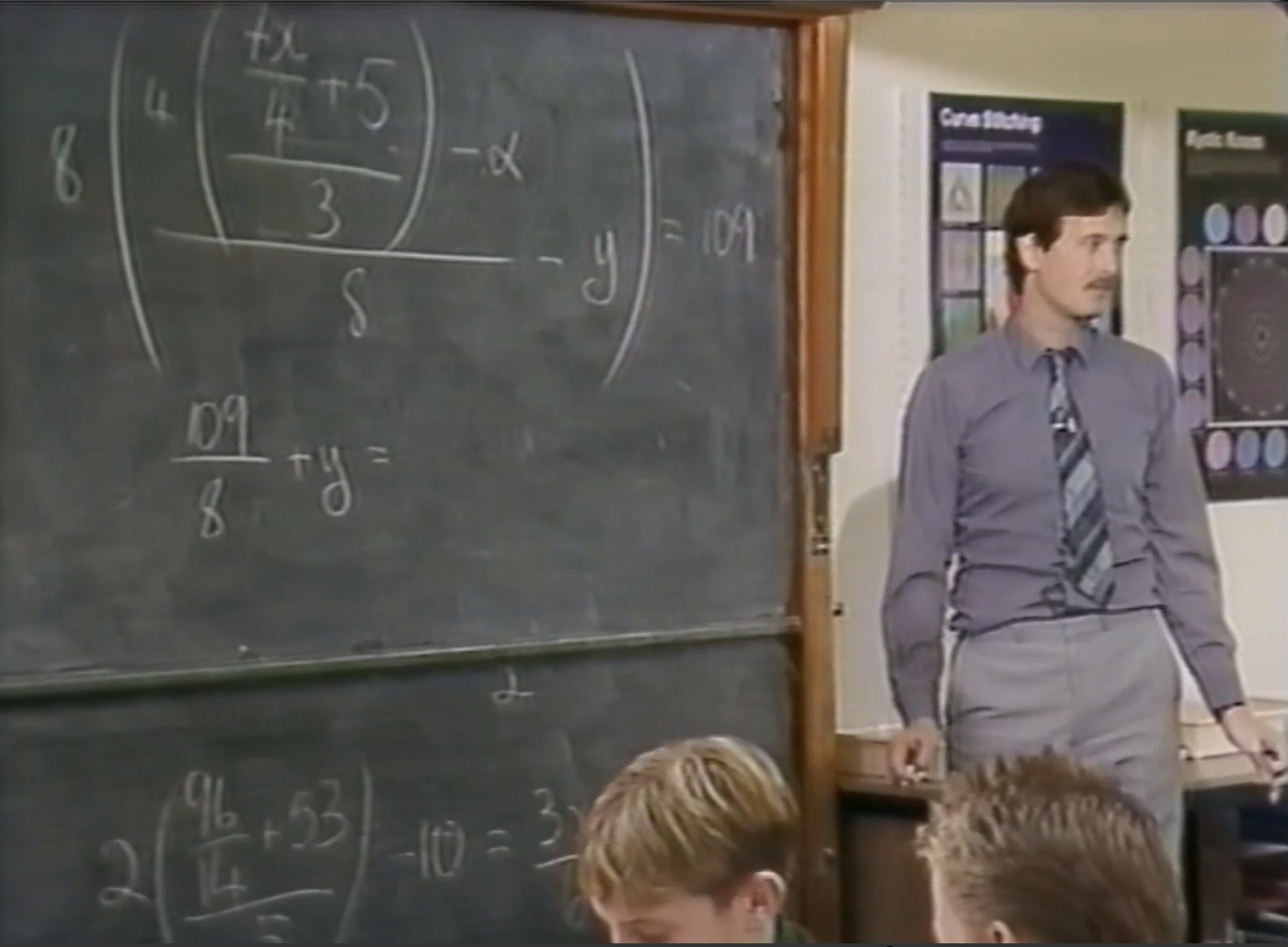
Fig 1: An equation beginning to be solved – Think of a Number lesson [Screen shot at 36:49]
One of the approaches, labelled Rulers, shows the original classroom activity which led to the development of the software Grid Algebra, freely available at gridalgebra.com. The other approach is labelled Think of a Number, and I will discuss both of these in relation to some common issues found when teaching early algebra.
Introducing a letter
It is not unusual for students to feel confused when a letter is first introduced and research from the 1980s onwards has shown that students struggle with gaining a mathematics sense for letters (Küchemann, 1981; Ayala-Altamirano & Molina, 2020). There is a danger that letters get associated with the objects themselves rather than the quantity, or cost, of those objects (Klingbeil & Moons, 2025). For example, 3a + 2b might be interpreted as 3 apples and 2 bananas rather than the cost of those items.
Both Rulers and Think of a Number use the notion of subordination (Hewitt, 1996) by introducing a letter only when attention is elsewhere, not on the letter itself. The letter is introduced at a time when students have already gained a sense of what they are doing, and that the letter will not affect the processes with which they are already feeling reasonably comfortable. In both approaches, attention is on operations rather than numbers. This is a shift from the realm of arithmetic to that of algebra. Algebra is essentially concerned with operations on operations (Gattegno, 1988). The operations are those of arithmetic: addition, subtraction, multiplication and division. The algebraic focus comes when attention is on what can be said about, and done with, these operations.
Operations as movements
Rulers starts with creating an imaginary number line through tapping with a metre ruler on the board, and, indeed, extending that around the classroom walls. At this stage, the focus is on numbers. However, after numbers are established, the focus shifts onto horizontal movements between those numbers, such as adding three and then subtracting two. This is done by banging on the board three places to the right followed by two places to the left, with the question “What have I done?” Now the focus is on movements and mathematical operations. Later, there are vertical movements, with these representing multiplying (down) and dividing (up). Through movements in all four directions, a sequence of all four arithmetic operations can take place.
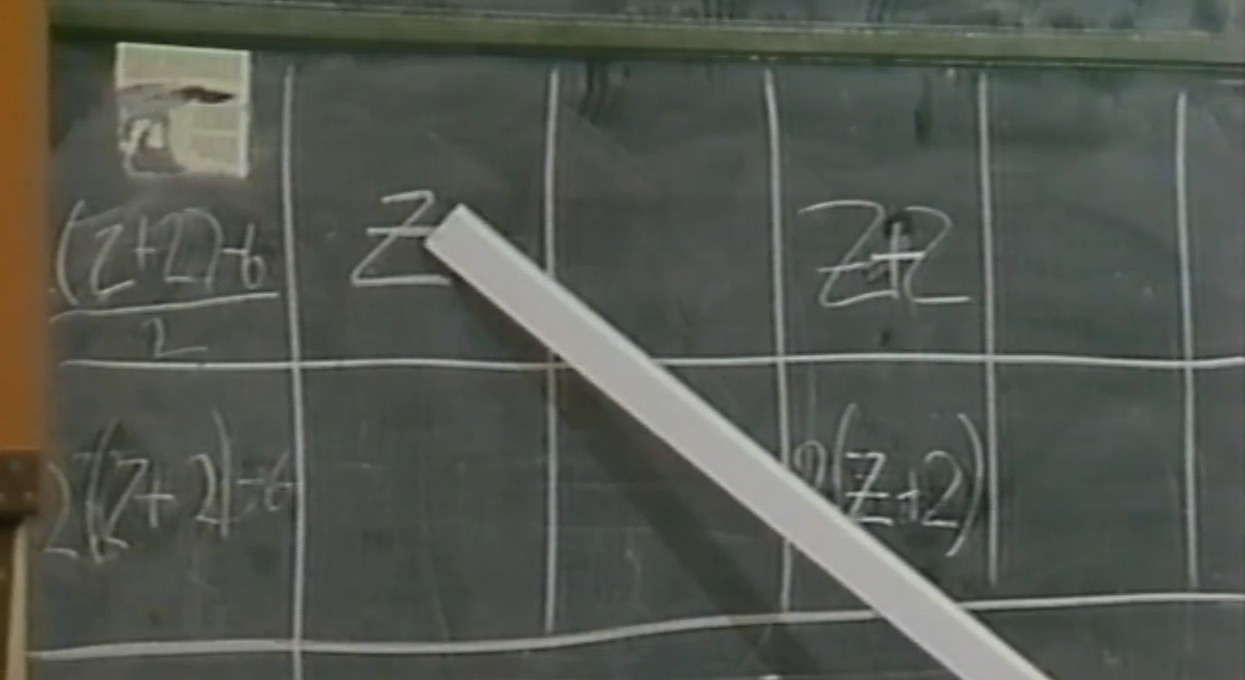
Fig 2: Expressions created through movements in the grid – Rulers lesson [Screenshot at 47:20]
x + 3 – 2 = x + 1 is true for any value x takes.
Operations: what is the same, what is different?
Think of a Number starts deliberately as a purely verbal activity. I decide that the initial question of “I am thinking of a number, I add three, then I times by two, and I get fourteen” is within the students’ ability to work out what my number is. Having established that my number is four, this no longer becomes the focus of attention. Instead, I ask how they can work out what my number is just from what I said. This focuses attention on to the operations. I only need one person to tell me that they start with fourteen, divide by two and subtract three in order to then work with the class as a whole. We check that this process does, indeed, get me to what my number is. I then work as an editor (Hewitt, 1997) by using two students to stress certain aspects whilst ignoring others. One student repeats what I said and the other says how they can get back to my answer. Through repeated articulation of parts of these, I invite the rest of the class to notice what is different.
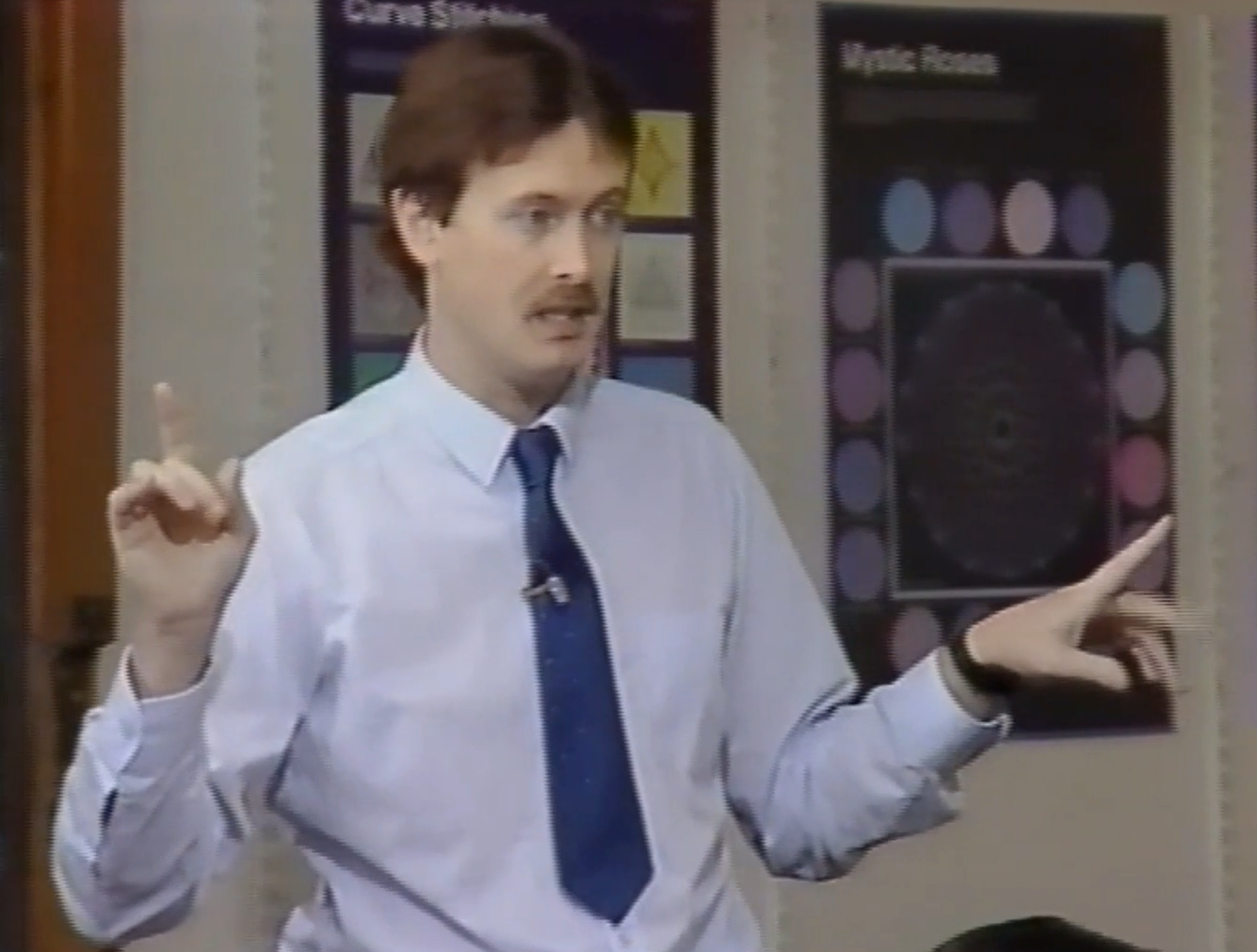
Fig 3: Orchestrating one person repeating what I did with my number, and another saying what they did to get back to my number – Think of a Number lesson [Screen shot at 24:54]
Notation
A key aspect of Think of a Number is that it is initially done purely verbally. There comes a time when the students know that to find my number they need to start at the final number, reverse the order, and change the operations to their inverse operations. They do this with some examples I offer verbally. When I feel they appear confident with what they are doing, I deliberately say a sequence of operations that I do to my number which are too many for them to remember. If only they could remember, then they would know what they need to do. At this point I offer to write those down for them. There are two aspects to how I write these down:
(a) they are written in formal notation (with brackets, division lines, and a careful placing of an addition or subtraction following a division – at the height of the division line);
(b) I write the equation in the order of the operations and not in a left-to-right order.
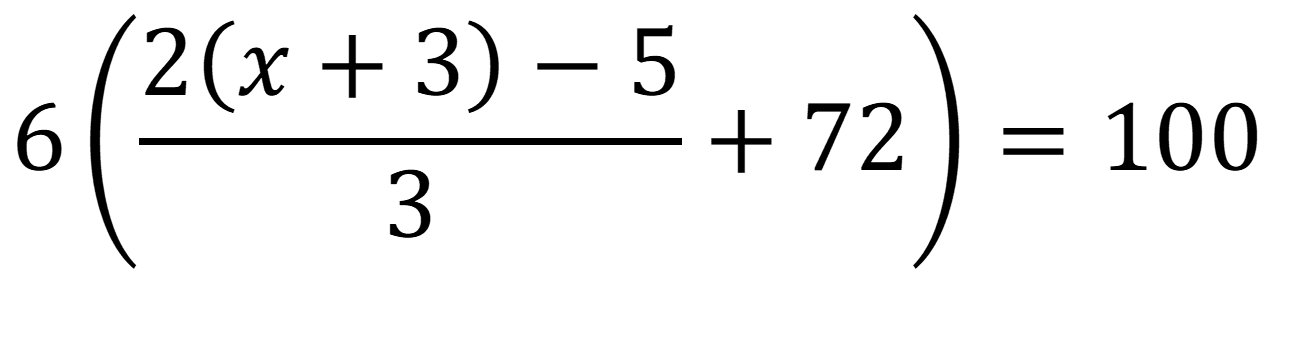
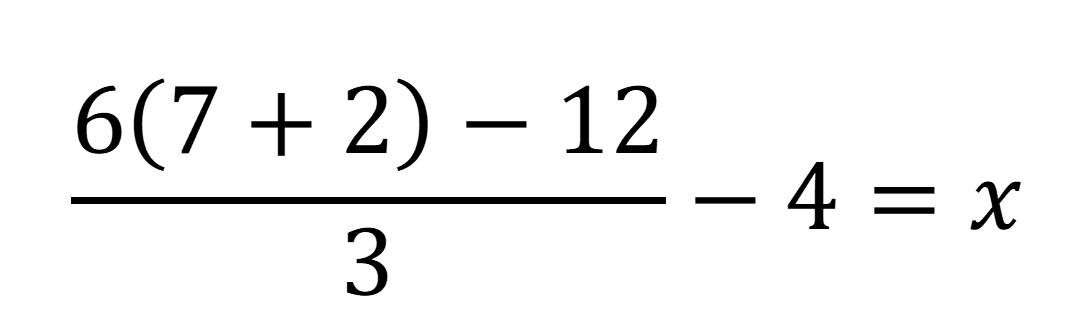
The latter helps them see the equation being built up in the order of the operations. The former (use of formal notation) seems to be accepted relatively easily since they already know what they need to do with the operations and so that is the focus rather than the particular way in which the equation is written. In the video, the first written equation they solve is
 The formal notation is only introduced when the students are already quite confident with how they are going to solve the equation. The notation just acts as an aide-memoir, rather than the focus of their attention. I find that students become confident with this way of writing operations quite quickly and are comfortable with relatively long and complex equations. They also become proficient with reading the order of the operations within such an equation.
With Rulers the notation appears more gradually, with just addition and subtraction before any multiplication and division appears. I have found that it takes a little longer for students to become confident with writing expressions in formal notation with this approach. However, the confidence does develop as they begin to read the order of the movements made on the grid within the building up of the formal notation. Two journeys starting and finishing in the same place, provide opportunities for students to see equivalence within the different algebraic expressions produced from each journey.
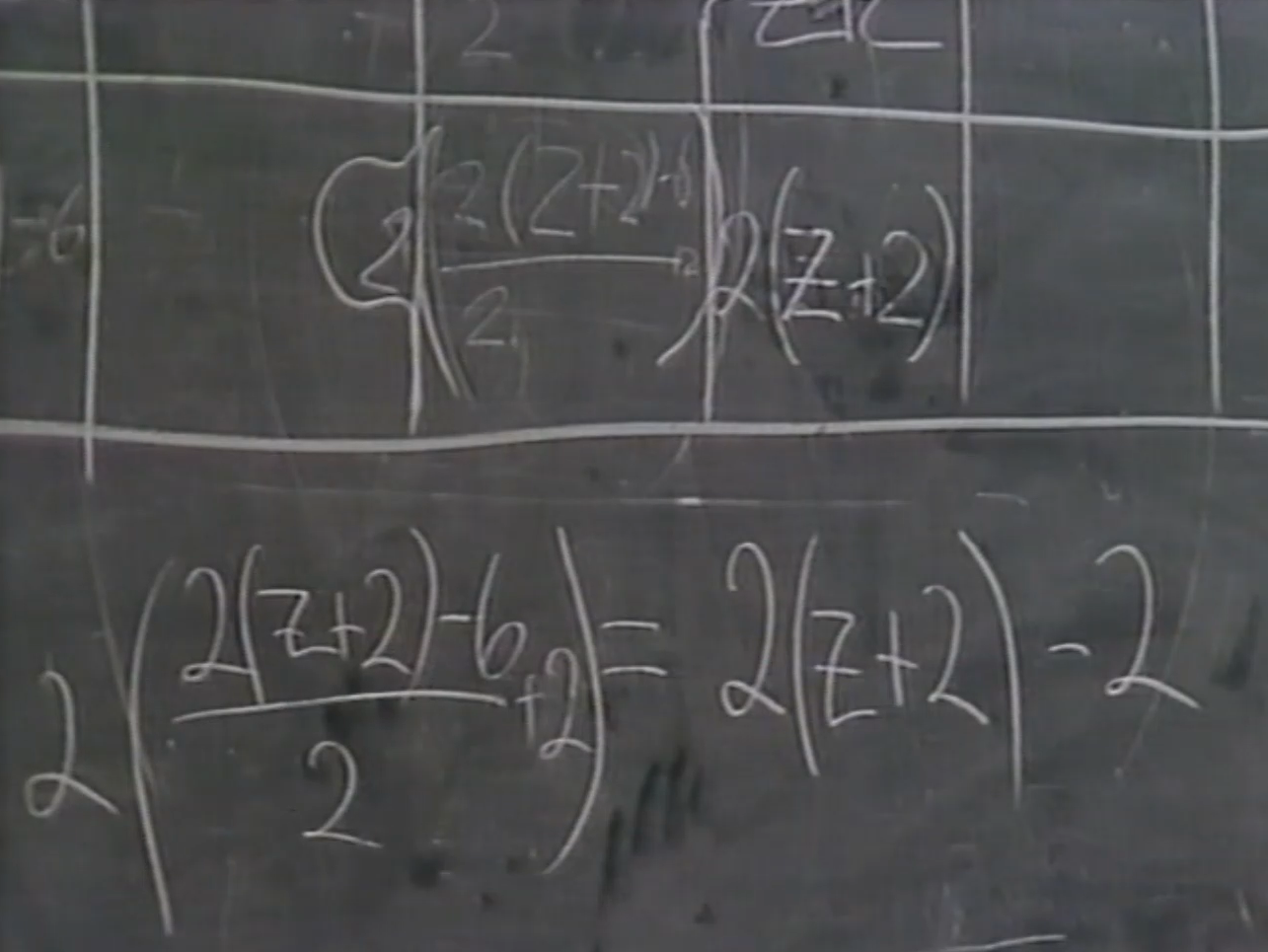
Fig 4: Equivalent expressions created by taking two different routes – Rulers lesson [Screenshot at 52:30]
Attending to operations and who has control
The two approaches captured in the video have in common that attention is shifted from numbers to operations. The lessons are about operations and what can be said about operations. This fact that students are operating on operations makes these lessons fundamentally algebraic, even before any letters appear. When watching the video, you might try to notice the moment during each of these approaches when ‘control’ shifts from myself to the students. The timing of that shift is when I feel that enough students have a sense of what is happening so that they can carry on and decide how to continue. Anything done which is either mathematically incorrect or – more usually with these lessons -conventionally incorrect prompts me to stress certain conventions or to discuss which operation might be next, etc.
Progression
These lessons are only the beginning of a longer sequence of lessons, involving equivalent expressions, substitution, inverse operations, and solving linear equations involving several letters. The Rulers approach continues with several rows being constructed (effectively based upon the 1, 2, 3, 4, etc., multiplication tables):
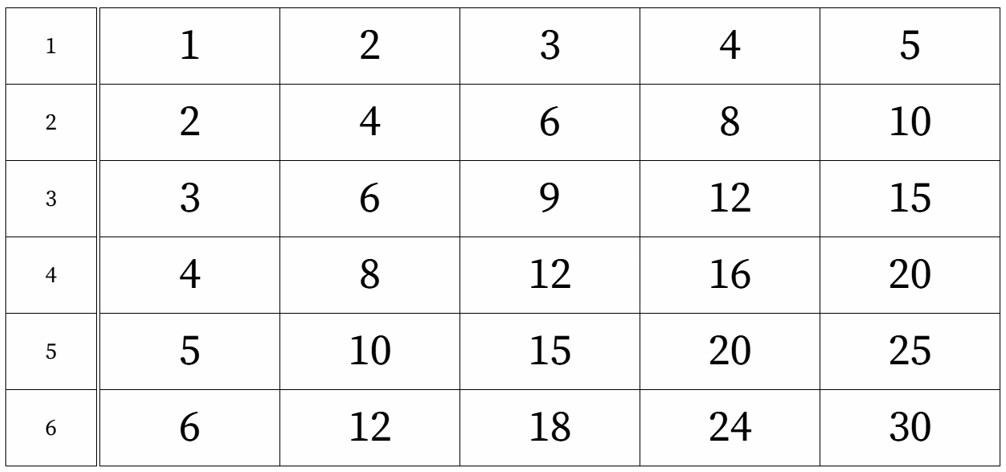
Fig 5: An extension of the grid can involve more multiplication tables
All students have experience of journeys and their experiences can be used through the close association between a movement on the grid and a mathematical operation. For example, starting with the grid above but empty of numbers, a journey is made from an unknown letter which involves vertical and horizontal movements, such as
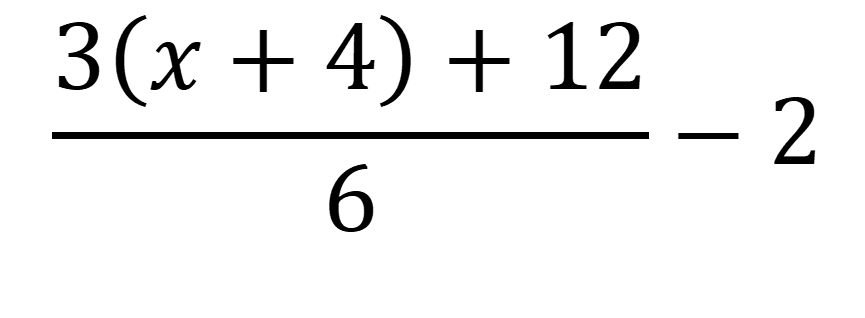 A number, such as 7, is then allocated to the place where the journey ends to create the equation
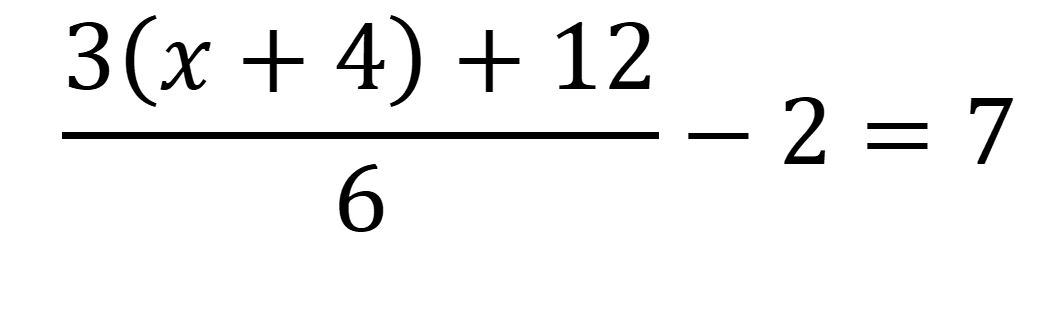 It can then be quite intuitive for students to make the inverse journey on the grid, noting the mathematical operations for each part of that journey, to end up back at the letter having created
 and thus solving the equation.
The Think of a Number approach continues by developing the awareness of inverse operations and order being reversed. Students become adept at writing down the solution to an equation (as a sequence of operations) in formal notation, and write that solution in one go, without the need for any intermediate steps. Later on equations are introduced with the same letter appearing on both sides of the equation. Bringing those letters together on the same side is no different to bringing a number from one side to the other since attention is on the operations and the generality has been established that it does not really matter what the number is, it is just that the operation changes to its inverse. The video already shows the introduction of equations with several letters, such as
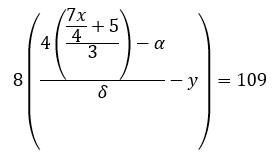 This proves no more difficult than if the letters, other than x, were numbers. This is once again because the attention is on operations and not the particular numbers themselves. Once the solution is written down as
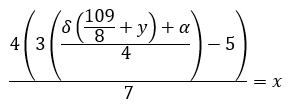 then values can be given to α, δ, and y, and a calculation can be done to find the numerical solution for x.
Focusing on mathematical structure and what to tell (and not tell) students
A final note is about my own role as teacher. One aspect of my role is creating an activity which has as its basis a relevant mathematical structure. In the case of Rulers this is the structure of movements and what they represent. For Think of a Number the structure is based upon what is different between what I said (in describing an equation) and what they do (in getting back to the number I was thinking of). Another aspect of my role is that I use questions, rather than statements. The things I tell them only concern the notation, the way in which things are written. Notation is arbitrary in the sense that different choices could have been made (and indeed were made in the past!) and we could have ended up with different ways to notate operations and a sequence of those operations. What is ‘necessary’ is the mathematics (Hewitt, 1999), and I try to develop the students’ awareness of this through questioning.
References
Ayala-Altamirano, C., & Molina, M. (2020). Meanings Attributed to Letters in Functional Contexts by Primary School Students. International Journal of Science and Mathematics Education, 18(7), 1271—1291. doi: 10.1007/s10763-019-10012-5
Gattegno, C. (1988). The science of education. Part 2b: the awareness of mathematization. Educational Solutions.
Hewitt, D. (1996). Mathematical fluency: the nature of practice and the role of subordination. For the Learning of Mathematics, 16(2), 28—35. doi: https://www.jstor.org/stable/40248202
Hewitt, D. (1997). Teacher as amplifier, teacher as editor: a metaphor on some dynamics in communication. In E. Pehkonen (Ed.), Proceedings of the 21st Conference of the International Group for the Psychology of Mathematics Education (Vol. 3, pp. 73—80). University of Helsinki & Lahti Research and Training Centre.
Hewitt, D. (1999). Arbitrary and Necessary: Part 1 a Way of Viewing the Mathematics Curriculum. For the Learning of Mathematics, 19(3), 2—9.
Hewitt, D. (2012). Young students learning formal algebraic notation and solving linear equations: are commonly experienced difficulties avoidable? Educational Studies in Mathematics, 81(2), 139—159. doi: 10.1007/s10649-012-9394-x
Klingbeil, K., & Moons, F. (2025). The omnipresence of the Letter-as-Object misconception: a multilevel Latent Transition Analysis on understanding variables. Educational Studies in Mathematics, 120(3), 455—476. doi: 10.1007/s10649-025-10428-7
Küchemann, D. (1981). Algebra. In K. M. Hart (Ed.), Children’s understanding of mathematics: 11-16 (pp. 102—119). John Murray.