
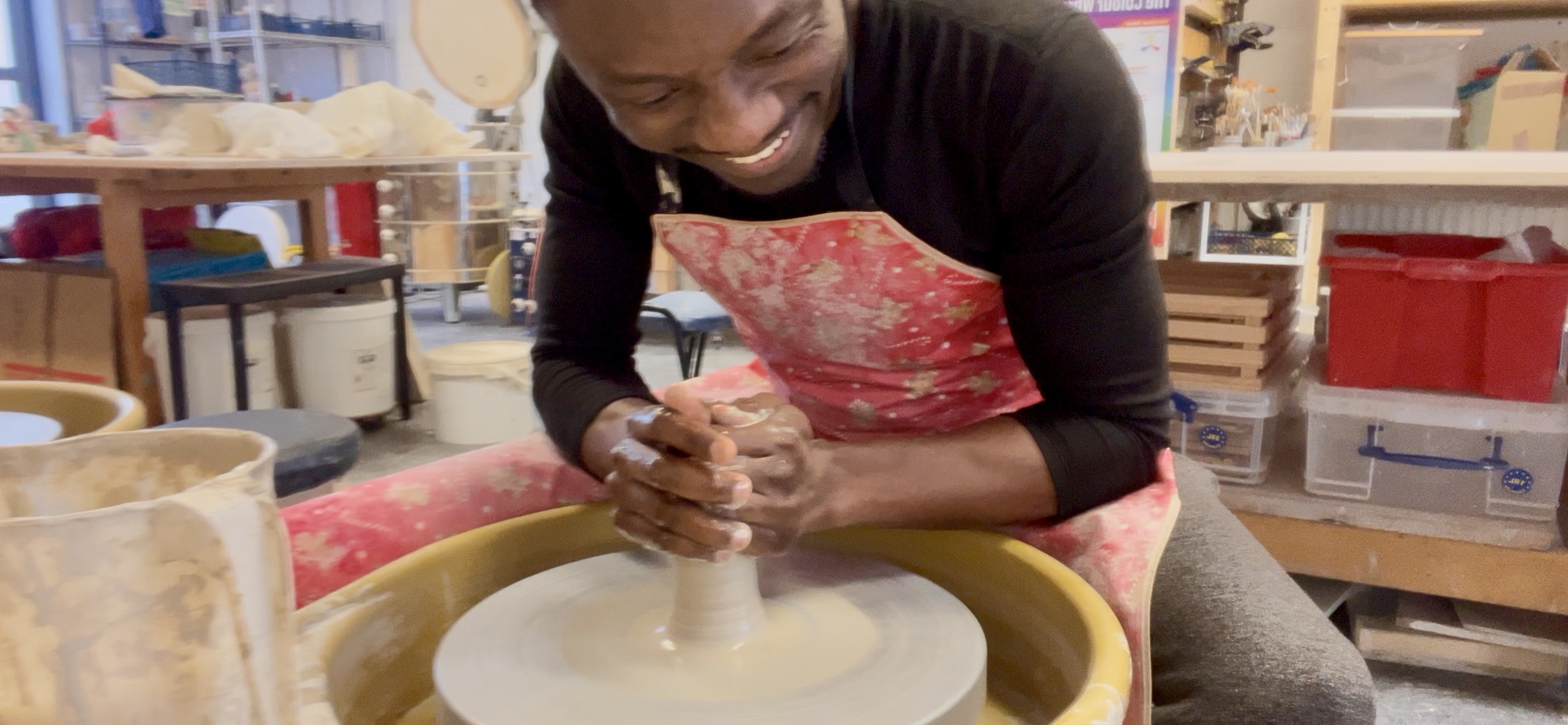
Fifteen years is long enough for a skill to either disappear completely or lie in wait like a smug little party trick. This weekend (31 January 2026), I walked into a pottery studio for the first time since 2011 and sat down at the wheel with the exact confidence of someone about to take an exam they definitely didn’t revise for.
I remembered the idea of throwing (centring, opening, pulling, and shaping) but not the feeling. Not the timing reveal of “too fast,” the instant consequences, or the very specific panic that arrives when a lump of clay starts wobbling like it’s trying to leave the room.
And then something annoying happened: my hands remembered. Not perfectly. Not gracefully. But enough that, within a couple of hours, I’d produced a casserole dish and two small vases and a renewed respect for the kind of muscle memory you don’t realise you still own until it’s suddenly working overtime.
This post is the story of that reunion tour: me and the pottery wheel. Four stages, a few near-disasters, and a surprising number of lessons that felt uncomfortably familiar to life in design.
Centring: Alignment or Chaos
I started with the classic “act confident and hope the clay believes you” approach. The wheel was fast, the clay was enthusiastic, and I had about three seconds to remember what my hands were supposed to do before it became a spinning conspiracy.
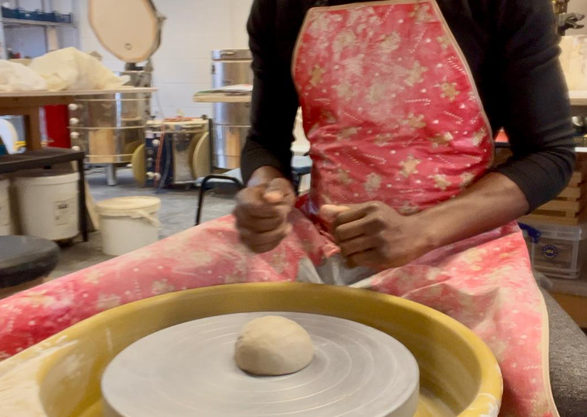
Centring is where you convince the clay to sit perfectly on-axis. The wheel speed stays high because momentum helps, and your hands do that firm, slightly aggressive choreography by drawing the clay up into a cone, then pushing it back down. Repeat until the clay stops wobbling and starts cooperating.
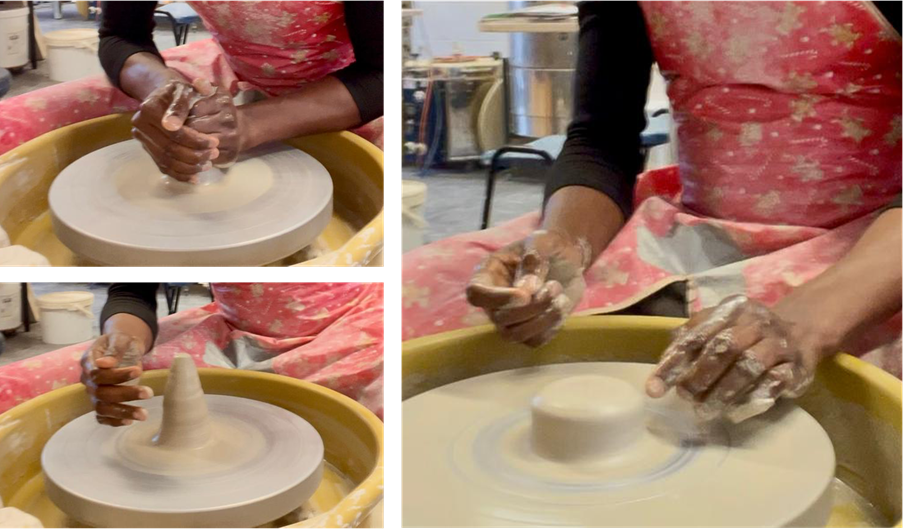
This part felt exactly like the start of a design project. If you don’t align early on the real problem/challenge, the constraints, and what “good” looks like, everything you build on top will carry a tiny wobble that becomes a big one later. You can still ship something, sure, but you’ll spend the entire time compensating. So, if it isn’t centred, you’re not designing, you’re firefighting.
Opening: The Calm Before the Wobble
The next step is opening, which was the brief moment where I thought, “Wait, I’m fine? I’m totally fine.” This is the pottery equivalent of a project kick-off where everyone is unusually upbeat, and no one has mentioned timelines yet.
Opening is exactly what it sounds like: you start from the centre and press down to create space inside the clay; a room to pull the walls up later. The wheel speed often stays similar to centring. It’s usually one of the easier stages because the clay is still thick, stable, and less likely to punish your overconfidence.
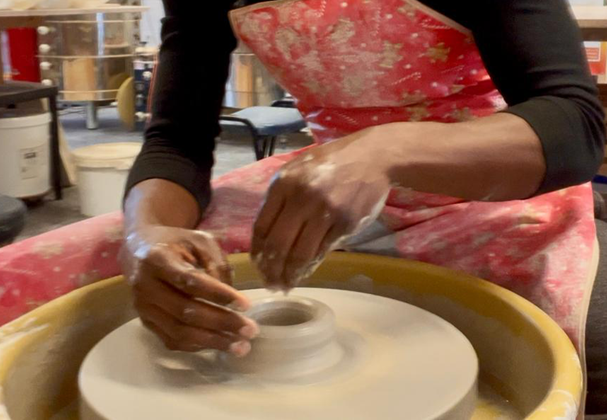
In design practice, opening is like making the container for the work or creating space for iteration. In design terms: clarifying scope, setting constraints, defining what you’re making and what you’re not, so you’re not trying to squeeze a whole product strategy into a single sprint deliverable. When you “open” properly, everything that follows has somewhere to go. Hence, before you build the thing, remember to build the space for the thing.
Pulling: Iteration, but with consequences
Then came pulling, the sensitive bit. The moment where the clay politely reminds you that it is still a physical object with laws and consequences. And this is where I made my first proper mistake: I forgot to reduce the wheel speed, and the clay started wobbling. Not subtly. More like: “Hello, I’m instability, and I’ve arrived early.”
The good news is that I noticed it fast. The better news: I knew why. So, I slowed the wheel immediately, steadied my hands, and the wobble calmed down.
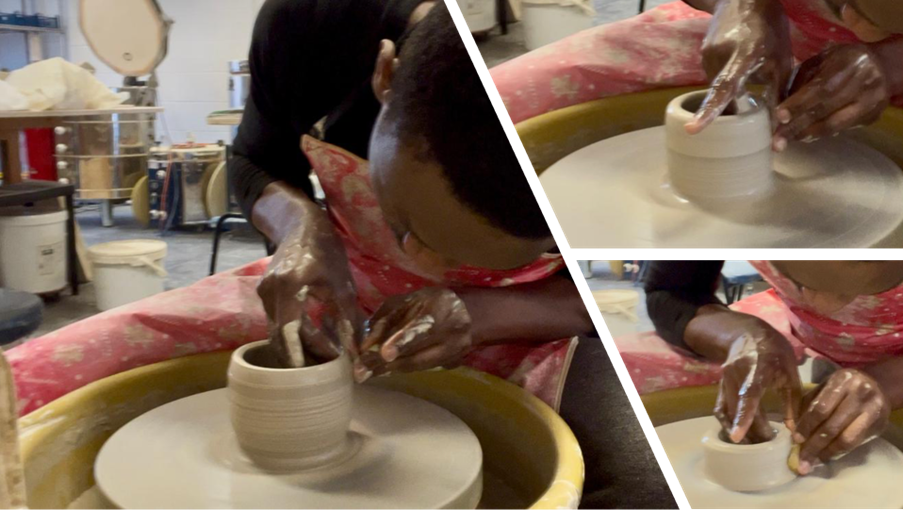
Pulling is where you gradually bring the walls up in repeated passes, increasing height while controlling thickness. You slow the wheel because you need precision and sensitivity, not chaos. And you have to constantly monitor the wall thickness: even, strong enough to stand, not so thin that it collapses. This stage is basically “tiny adjustments forever.”
This was the most design-like moment of the whole session. Pulling is prototyping in real time: small moves, constant feedback, adjust before it collapses. And the wobble? That’s user feedback, stakeholder feedback, the sudden discovery that your assumption was wrong. A reminder that the best makers don’t “execute perfectly,” they correct quickly.
Shaping: The perfection trap of “just one more tweak”
Shaping is where confidence returns and immediately becomes a problem. On my first attempt, I got carried away. I over-shaped the clay and pushed it into a form it couldn’t structurally hold because the walls weren’t thick enough. The result was dramatic and humbling: collapse (Instant pottery karma). On the second attempt, I almost did it again but caught myself in time. I felt that familiar creative impulse: “Just a little more, just one more touch, I can perfect it.” And I had to actively stop, hands off and let it be.
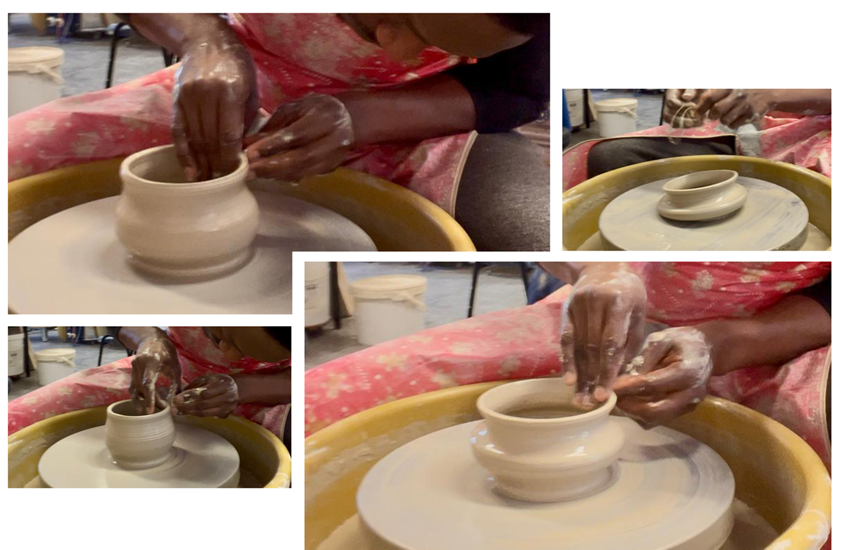
Shaping is where you mould the form into what you want it to be. But shaping only works if the structure can support it. Your form is limited by thickness, moisture, and how much the clay has already been worked. The more you fuss, the weaker it gets. Clay does not reward overhandling.
This is the perfection trap in its purest form. In design, overworking can blur clarity. You can tweak and polish until the thing loses its original intent or until you weaken the structure that was holding it together (such as the rationale, the hierarchy, the system, etc.).
And the bigger lesson is that “knowing when to stop” is a skill, not a surrender. There is a moment where refinement becomes interference. Shaping taught me that “better” isn’t always “more”; sometimes, better is hands off.
What I took home
By the end of the session, I wasn’t just relieved that I could still throw; I was reminded why I loved it in the first place. Wheel throwing is essentially a live conversation with feedback, and the clay has absolutely no interest in protecting your feelings.
Too fast? It wobbles.
Too thin? It collapses.
Too much “just one more tweak”? It weakens and quietly prepares to humble you.
And weirdly, that’s what made it feel so relevant to design. The potter’s wheel compresses a bunch of principles we talk about all the time into something you can literally feel in your hands:
- Centre early: This means alignment before action. That is, before you start designing, you need shared alignment on the axis of the work (such as problem framing, who it’s for, intent, criteria for success, etc.). If you don’t centre early, your designs might look great but drift off-axis, and you’ll spend the project compensating.
- Make Space: Design quality is often a function of the container you’re working inside (such as time, scope, decision-making, access to users, and room to iterate). Without space, you default to “first idea, polished,” which is usually weaker than “rough ideas, tested.” Space isn’t luxury; it’s what allows learning, and without it, you’re just decorating assumptions.
- Correct quickly: Good designers don’t avoid mistakes; they detect them early and course-correct fast. “Wobble” shows up as small signals, such as confusion in testing, inconsistent stakeholder reactions, edge cases breaking flows, a metric not moving, etc. Early correction prevents late-stage rework.
- Respect structure: A design can look elegant yet be structurally weak and unable to survive real constraints (like implementation, accessibility, edge cases, scalability, or future features). Thickness is the underlying support that lets a design stand up over time, built through mapping the full system and grounding decisions in evidence.
- Know when to stop touching: Overworking is a common failure mode. At some point, touching the design more doesn’t make it better; it makes it noisier, inconsistent, or harder to build.
Reflecting on this experience, the real takeaway wasn’t what I produced; it was what the process surfaced: how much design competence sits in tacit knowledge. After a long gap, my hands didn’t return with a full verbal explanation; they returned with sensitivity to feedback, an ability to adjust, and a growing sense of when to intervene and when to step back.
And maybe that’s the most reassuring part: skills don’t only live in recent practice. Sometimes they settle into the body as judgement; that quiet ability to notice, decide, and adapt. The kind of competence that shows up on an ordinary workday when something starts to wobble, and you don’t panic, you just correct quickly and keep going.


Leave a Reply