
I am Sejal Changede, and I am thrilled to join the Open University as a Lecturer in Design.
The first time I truly questioned what I knew about design, I was sitting in a small workshop in India, watching an elderly silversmith work a piece of silver over a portable forge. He shaped and hammered the metal with complete certainty, without any measuring instruments or written patterns, just knowledge and practice refined over decades and passed down through his family.

I had come to collaborate with traditional artisans as a newly graduated designer, excited to share ideas about how design could help improve their work for modern markets. But as I watched him work, something wonderful happened. This was not craft that needed fixing; this was beautiful, sophisticated knowledge I didn’t understand yet.
That moment changed everything.
My Journey Here
After my Product and Lifestyle Accessory Design degree at NIFT Bengaluru, I spent few years working with traditional artisans across India. The more I collaborated with weavers, potters, and metalworkers, the more uncomfortable I became with how we designers approached their work. My colleagues would say things like “we need to intervene to uplift these traditional practices” or “design thinking can help them reach modern consumers.”
But here is what I was seeing: A weaver who understood complex mathematical patterns that would make an engineer jealous. A potter who knew exactly how local clay would behave in different weather conditions. A metalworker whose understanding of alloys and heating processes was refined over decades of experimentation.
We were not there to teach them about design. We needed to learn FROM them.
The Question That Wouldn’t Let Go
That realisation haunted me. What if centuries-old practices held solutions to problems we are struggling with now? What if the communities living sustainably for generations had already figured out what we are desperately trying to invent?
I needed to explore this properly. So, I headed to Lancaster University for an MA in Design Management, then stayed for a PhD to investigate what contemporary design can learn from traditional Indian products and practices.
During my PhD and later as a research associate, I embraced many opportunities: teaching undergraduate and postgraduate students, co-leading the Sustainability Special Interest Group. I worked on projects ranging from climate strategies with Lancaster City Council to reimagining healthcare futures, from sustainable soils policy to child protection processes.
Each project reinforced something: the best insights emerge at intersections. Where traditional knowledge meets digital innovation. Where academic research meets community needs. Where different cultures and perspectives tackle shared challenges.
The Bed That Taught Me About Integrated Design
Let me share the Charpai story because it beautifully captures what traditional knowledge systems understand about sustainability.
For my PhD, I studied traditional Indian products. The Charpai, a traditional wooden bed with woven surface, revealed something profound about how design can integrate environmental care, social connection, personal meaning, and economic sense all at once.
The name means four feet: four wooden beams and legs joined with mortise and tenon joints, natural fibres woven for the sleeping surface. During the day, it is seating for chai and conversation, a surface for drying grains, a workspace. At night, your bed. One piece serving multiple needs beautifully exemplifying design for sufficiency.
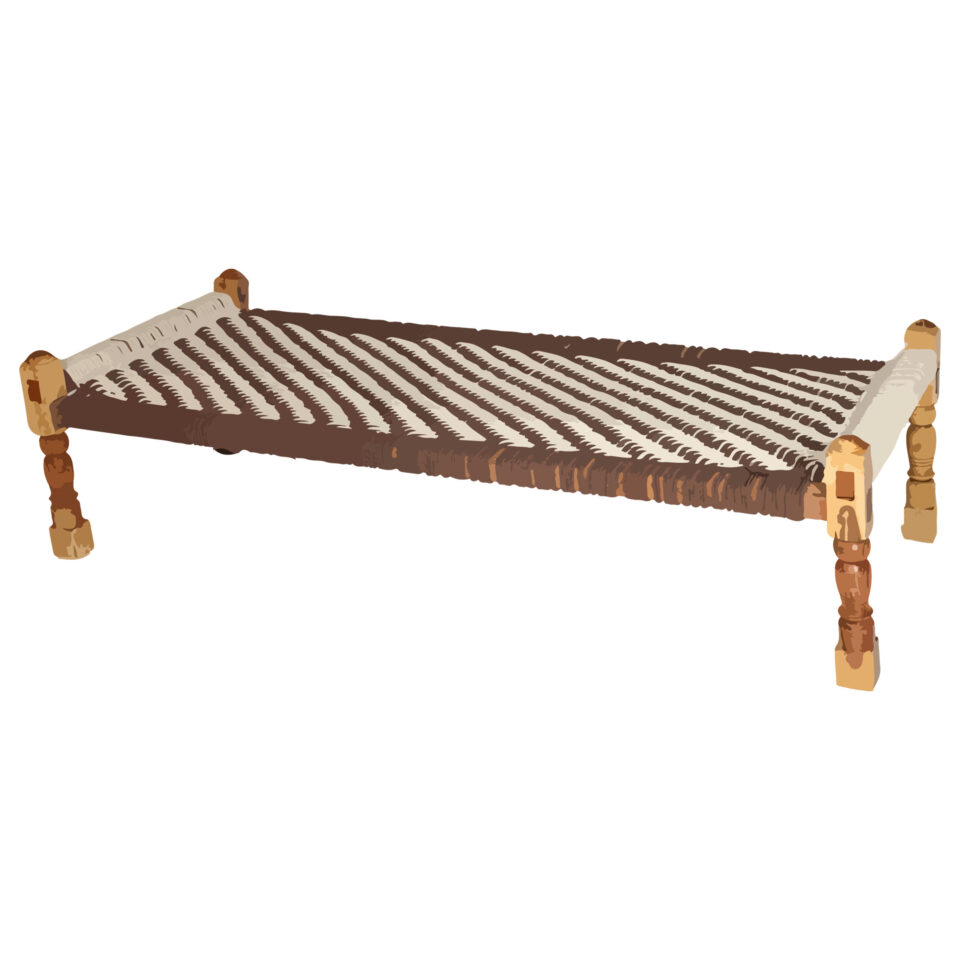
When the woven surface sags after years, you do not discard the bed. You reweave it with fresh rope whilst the frame stays strong. The materials (local wood and natural fibres) eventually return to earth.
Compare this to contemporary beds: millions mattresses in UK go to landfills yearly, leaching chemicals as they break down over decades. The Charpai works within natural cycles. It takes what is locally available, serves faithfully for years, allows repair, and returns to soil. This is regenerative design that communities have practised for millennia.
Woven with Meaning
The Charpai carries something deeper. There are hundreds of regional variations: different patterns, local woods, unique styles. Each reflects the creativity and identity of its place. For communities using them, these beds witness life: babies born, families gathering, elders sharing wisdom, wedding preparations. 5,000 years of experience, holding memories and meaning.
The making itself carries spiritual and social significance. Creating a Charpai is often family work, skills passed from parent to child. The craft connects people to materials, place, heritage. There is pride in the work, identity in the patterns, community in the process.
Not Romantic Nostalgia
Before you think I am advocating we all abandon modernity and live in villages, let me be clear: I am not romanticising the past. Traditional systems are not perfect. Many Indian traditional practices carry serious issues of inequality, caste discrimination, and gender exclusion that must be acknowledged and addressed.
What I am advocating for is something more nuanced: learning from principles that transcend specific contexts whilst remaining critical of the systems that produced them. The Charpai revealed possibilities for designing practices rather than just products, for creating meaning alongside function, for building systems that regenerate rather than deplete.
Bringing These Principles to Lancaster
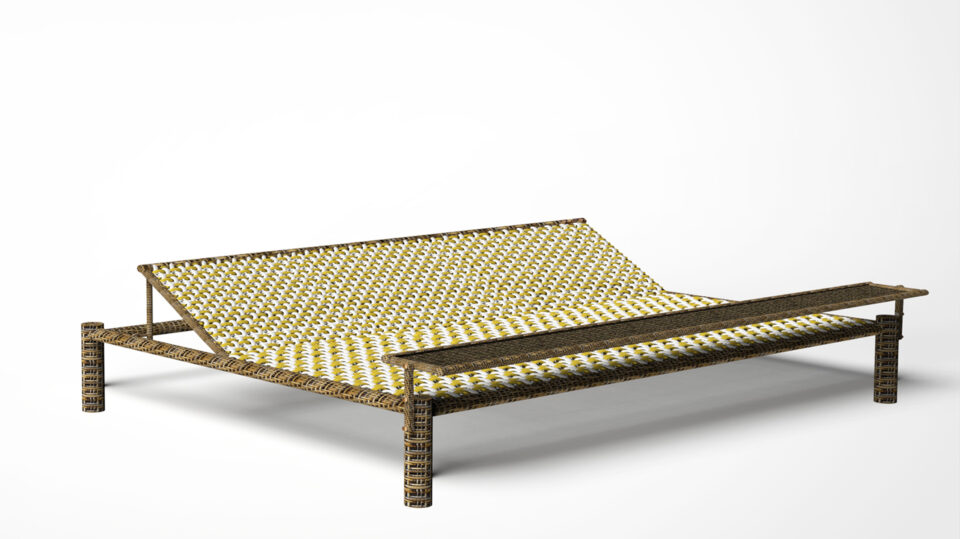
Could these principles work in a different context? I designed the Willow Bed for Lancaster to find out, inspired not by copying the Charpai’s form, but by understanding the integrated thinking behind it.
The design begins with place. Willow for the frame: we have woven with it in Britain for thousands of years, and in Celtic traditions it represents renewal and healing. These cultural associations matter because they create connection and meaning. Herdwick sheep wool from Cumbria for the surface: hardy, temperature regulating, often wasted because its coarse texture makes it unsuitable for garments. Using it honours the landscape, supports hill farmers, and and prevents good material going to waste.
Like the Charpai, the Willow Bed embodies multifunctionality: bed, sofa, dining table. The materials regenerate within natural cycles. Willow grows back vigorously after harvesting, sheep produce wool annually, and both eventually return to soil. The frame lasts decades whilst the woven surface invites re-weaving when needed, embedding repair and longevity into the design itself.
Beyond the physical object, I imagined opportunities for community engagement: seasonal gatherings to harvest willow, collaborative crafting sessions, repair workshops. When you participate in making something, it becomes woven into your narrative. You develop what might be called ‘craft attachment’: you repair rather than replace, maintain rather than discard.
The project creates a local production to consumption system, connecting willow weavers, sheep farmers, yarn spinners, and knitters. It is about building resilient local networks where materials, skills, and economic value circulate within the community, keeping traditional knowledge alive whilst creating contemporary livelihoods that work with nature rather than just extracting from it.
Why the Open University
When I learned about the OU design lecturer position, something clicked. The Open University’s commitment to accessible education for diverse learners aligns perfectly with what my research has been showing me: the best solutions emerge from diverse perspectives.
What is Next
My research explores how communities create meaning through objects and practices, from traditional crafts to contemporary fandom cultures, and how automation and AI are changing these material rituals. I have also recently joined an OSC project with The Crichton Trust developing frameworks for Regenerative Greenspaces: working with heritage estates to balance net zero goals, community wellbeing, biodiversity, and heritage management.
These projects connect to a fundamental question: rather than simply reducing unsustainability, can we fundamentally rethink how we live? This requires moving beyond redesigning products to reimagining practices themselves, unlearning conventional approaches and relearning how to live meaningfully within planetary limits.
Let us Connect!
I would genuinely love to hear from you, whether you are an OU student, colleague, or just curious about these ideas.
Everyone has valuable perspectives. Perhaps you have traditional knowledge from your background, or you are curious about other cultures’ practices. Maybe you are developing contemporary approaches to sustainable living or simply interested in these conversations.
So, whether you are wondering about design research or interested in collaboration, please get in touch!
Sejal
Sejal Changede is a Lecturer in Design at the Open University’s School of Engineering and Innovation, interested in sustainability, traditional knowledge systems, and decolonial design approaches. When not researching, she is usually learning new crafts, experimenting with recipes in the kitchen, and finding joy in feeding friends and discovering beauty in unexpected places.


Leave a Reply