
Social prescribing might feel like a new initiative but its key principle of connecting individuals with what matters to them, offering moments of joy and respite from personal struggle, echoes ideas found in the writings of some of the earliest philosophers. On A111, an arts and humanities module I teach alongside the design module, U101, students study Schopenhauer who, although notoriously pessimistic, was an advocate for the transformative power of art. He believed that aesthetic experience provided a temporary escape from the suffering caused by the ceaseless, irrational “Will” (our frustrated striving and desires). In moments of deep artistic contemplation, he argued, we enter a “will-less” state, transcending individuality and perceiving Platonic Ideas or truths: the universal, essential forms behind all phenomena, which allows us to escape the cycle of desire and pain. He saw the artist as a genius who captures these universal truths, making art the highest form of human expression, (and music even more so) to almost be a substitute for religion. I would suggest that designers, too, sometimes occupy this space. While they may not capture universal truths in quite the same way, they can create objects or experiences of such elegance and satisfaction that they momentarily lift us out of ourselves. Is there even a line between art and design? Recent years have layered international tension and uncertainty on top of any personal disquiet. I didn’t set out to test Schopenhauer’s advice but over the summer I found myself coming back to his thoughts time and time again, particularly when looking up!
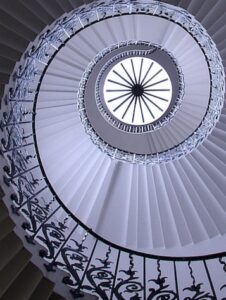
Armed with an Art Pass and a spreadsheet (yes, really – there were over 800 options during the London Open House Festival!), I planned my campaign on the South East, discovering, as if I didn’t know already, that it was soaring spaces that moved me, in some cases, even causing an involuntary gasp! I thought I’d share some of them.
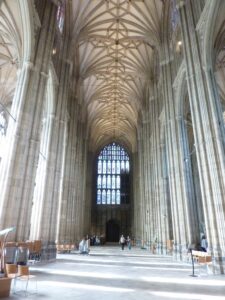
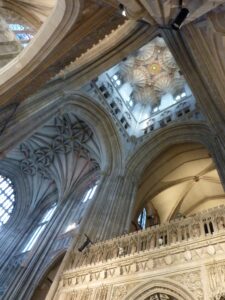
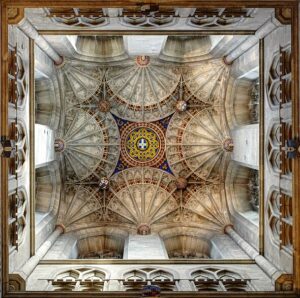
In the UK we are blessed with some beautiful spaces. Our medieval Gothic architects knew a thing or two about using design to inspire awe and to create a sense of spiritual connection through their cathedrals’ exhilarating soaring height, pointing ever heavenwards. Such space also creates feelings of peace and contemplation, reinforcing our diminutive presence in their face of their vast grandeur. Colour and light come together to enhance the spiritual experience blending mystery and history. Canterbury Cathedral (also on the curriculum for A111) offered that sense of awe and wonder; an incredible feat of engineering for those working so long ago. As I entered the south aisle, the afternoon sun played its part to bathe the columns in light, and then bringing further brilliance to the Miracle Windows in the Trinity Chapel around the shrine of Thomas Becket – the material of many a primary school RE lesson.
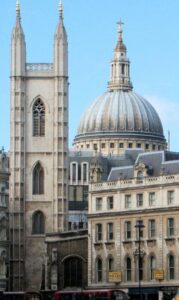
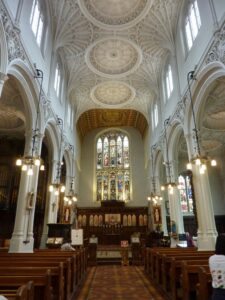
Much more intimate, but eminently beautiful was the 17th century St Mary Aldermary, squashed into a tiny oddly shaped corner in the shadow of St Paul’s Cathedral and offering a mix of coffee and meditation. The designers must have had a real headache making sure everything matched up when there was a lack of right angles! The mathematics in the intricate fan vaulting makes trigonometry feel wonderfully exciting.
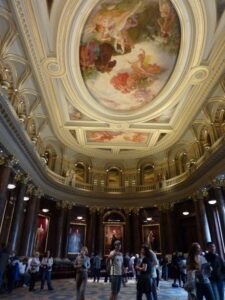
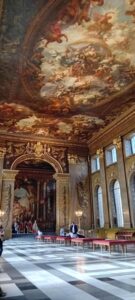
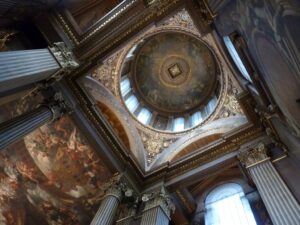
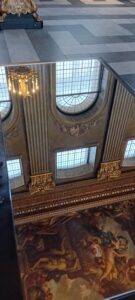
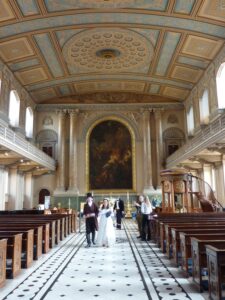
Moving forward to the age of merchants the ceilings might have been lower, but none the less impressive. Walking into The Drapers’ Livery Hall, even having seen photos, the experience was Schopenhauerian! Any cares were left at the rather impressive door. So too at the Old Royal Naval College, where contemplation was encouraged in the form of padded banquettes, so you could lie flat, looking upwards to immerse yourself in James Thornhill’s portrayal of history and mythology, celebrating British naval power and the Protestant monarchy.
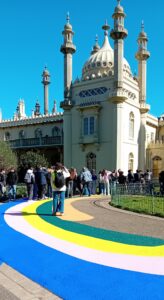
In Brighton it was a flight of fantasy; Chinese dragons, serpents and lotus flowers, in George IV’s meringue-like seaside party palace, but then back to London to Horace Walpole’s Strawberry Hill House and a different kind of confection; a return to the Gothic, now in revival, spectacularly created in papier mâché. The attendants urge you to move around the fairy palace in a particular order, knowing the impact THE room will have on visitors, and I can’t imagine anyone being disappointed.
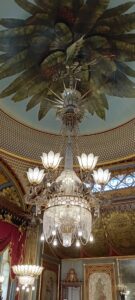
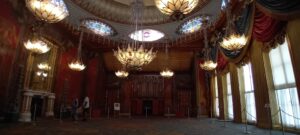
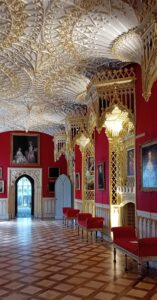
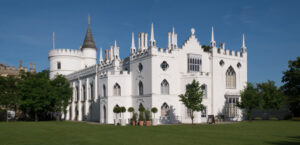
I sought out glazed ceilings and atriums too, enjoying Victorian engineering and light. I had to use my imagination on my pilgrimage to the final site of the humongous Crystal Palace where only a few stumps remain, but I got more than a fix in the conservatory of Syon House and joined Harry Potter aficionados (something I’m not!) at Leadenhall Market where visitors take selfies at Diagon Alley’s Leaky Cauldron.
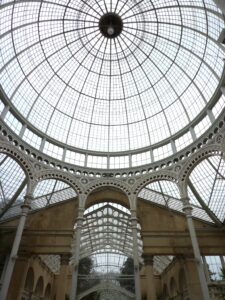
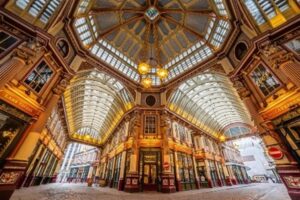
There is a compelling argument to be made for the psychological and aesthetic value of elevating one’s gaze. The painter Georges Seurat, intentionally incorporated upward lines in his compositions to evoke a sense of gaiety and optimism. Similarly, the act of immersing oneself in something vast and beautiful resonates with Immanuel Kant’s conception of the sublime; an experience that arises when one feels like a small presence within an overwhelming and expansive environment. This encounter, though humbling, can also be profoundly uplifting.
Friedrich Nietzsche, another with a reputation as a philosophical pessimist, also acknowledged the transformative potential of art. He emphasized the importance of balancing order and chaos, what he sometimes referred to as the Apollonian and Dionysian elements, in artistic expression. This synthesis, according to Nietzsche, can produce a euphoric and life-affirming experience.
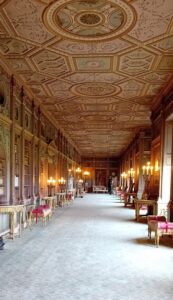
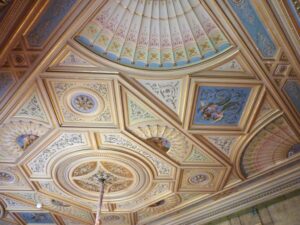
I visited many other places; not quite the 800 but far too many to mention! Not all involved looking up – I entered the cells in the bowels of Royal Courts of Justice! I can confirm, though, that Schopenhauer’s theory of aesthetics works, even if it is only temporary. Looking at things of beauty does, as art historian Kenneth Clark commented, “produce in us a kind of exalted happiness. For a moment there is a clearing in the jungle: we pass on refreshed, with our capacity for life increased and with some memory of the sky.”
Theodora Philcox
All photographs by Theodora Philcox unless otherwise stated.


Leave a Reply