
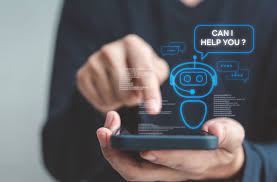
Image: A person holding a smartphone displaying a chatbot interface, with the message ‘Can I help you’
It’s a common misconception that people who are non-sighted or partially sighted rely solely on highly specialised, complex equipment to interact with the digital world. While dedicated assistive technology (AT) certainly plays a vital role, the real revolution lies in a powerful, simple concept: Universal Design and the ability to effectively use standard, off-the-shelf technology. While dedicated assistive technology (AT) remains essential, the true paradigm shift in accessibility is driven by Universal Design (UD)—the principle of creating products usable by all people, to the greatest extent possible, without the need for adaptation [1].
Over the years this philosophy has transformed the notion that standard, mass-market devices—like smartphones, tablets, and personal computers, offer some communities a powerful, inclusive tool. Specifically offering users without sight perception unprecedented access to employment, education, and social participation that was once segregated by proprietary systems.
Universal Design: The Foundation of Digital Inclusion
Universal Design, which has roots in architecture and urban planning, aims to dismantle environmental barriers and enhance usability for everyone [1]. When applied to technology, UD dictates that core features and interfaces must be inherently flexible. The goal is to move beyond mere “barrier-free” design toward a fully inclusive approach where accessibility is baked in, not bolted on.
The Role of Built-in universal design
The most significant evidence of this universal approach is the integration of high-quality accessibility tools directly into mainstream operating systems (OS). This strategy fundamentally changes the accessibility equation, making powerful tools instantly available to billions of users at zero extra cost.
- Screen Readers: These are the critical non-visual interfaces. Standard features like VoiceOver (Apple iOS/macOS), TalkBack (Android), and the highly popular third-party reader NVDA (Non-Visual Desktop Access), which is free and open-source, convert text and interface elements into speech or Braille [2, 4]. Screen readers allow a user to navigate an entire system via auditory cues and keyboard shortcuts, turning a visual interface into a tactile and auditory one [2]. Their integration into standard OS platforms has been hailed as a monumental step toward greater independence in academic and daily life [2].
- Keyboard Navigation and Shortcuts: A standard QWERTY keyboard, when combined with a screen reader, replaces the visual dependence on a mouse. Users navigate websites, documents, and applications using an extensive set of intuitive keyboard commands. This approach is not a specialised workaround but a powerful mode of interaction available on every major operating system.
Voice Control and Smart Assistants
The rise of voice-activated technology, originally developed for general convenience, has become a core accessibility tool. Devices with Siri, Google Assistant, or Alexa offer a completely hands-free, non-visual way to manage communication, control smart homes, and access real-time information.
Image: A visually impaired person holding a smartphone displaying a chatbot interface, with the message ‘Hello! How can I assist you today?’
“Whereas for sighted people, innovations such as the iPhone and voice interactive smart assistants are nice things to have, for [non-sighted users], they have been life changing.”
— Chris McCausland, Comedian and Technology Advocate [3]
These features demonstrate the “Curb Cut Effect,” where a design intended to help a specific group (like wheelchair users benefiting from a curb cut) ends up providing a major benefit to everyone (e.g., parents with strollers, delivery drivers, or cyclists) [2]. Similarly, voice control and screen readers, while vital for the non-sighted, also aid users with learning differences, literacy challenges, or those needing to multitask.
Impact on Employment and Education
The ability to proficiently use standard technology, rather than specialised hardware, has dramatically lowers barriers to entry in professional and academic settings.
- Workplace Inclusion: When a blind employee can use the same version of Microsoft Office, web browser, or email client as their sighted colleagues, the need for complex, time-consuming accommodations is reduced [4]. The American Foundation for the Blind (AFB) highlights that accessibility failures in the workplace, such as inaccessible training materials or digital platforms, are often the primary barriers to career advancement, not the visual impairment itself [4]. Standard, accessible technology provides a crucial step toward equal access to information and job functions.
- Academic Equity: In higher education, screen readers and accessible learning platforms enable students with visual impairments to access digital textbooks, online assignments, and research materials on an equitable footing with their peers [2]. Researchers emphasize that while challenges persist with visual-heavy content like graphics and charts, the foundational accessibility of digital text via screen readers is a key factor in promoting independent learning [4].
Witnessing the Future of Integrated Tech
Recently, I have been delighted to become an academic consultant, joining with Dr Hannah Marston, the programme was produced by OpenMike and presented by BBC, that works on the notion that standard is good enough. The programme offers a deeper dive into how these seemingly obligatory technologies are actively transforming lives and what the next generation of universal tools might look like, the following documentary provides a personal and insightful perspective:
Chris McCausland: Seeing into the Future
Image shows Chris McCausland, arms folded, standing in side of MIT building with augmented leg attachments, various MIT technology is assembled behind him.
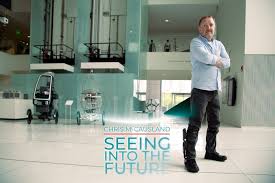
In this BBC Two documentary, comedian and tech enthusiast Chris McCausland—who lost his sight in his early twenties—travels to explore cutting-edge innovations. He examines how AI, smart glasses, and driverless vehicles, developed for the general consumer market, are poised to offer revolutionary independence to the blind community.
• Programme: Chris McCausland: Seeing into the Future
• Broadcast Date: Sunday, 23 November, 8pm
• Channel: BBC Two
• Availability: The programme will be available to watch on BBC iPlayer shortly after broadcast.
This show goes someway to illustrate that the most significant advancements for accessibility are increasingly ranging from the integration of smart features into the technology that everyone may use, reinforcing the principle that designing for disability ultimately means designing for a better, more functional digital future for all.
________________________________________
Citations
[1] Erdtman, E., Rassmus-Gröhn, K., & Hedvall, P. (2025). Universal design is “not only” a Design for People with Disabilities. Journal of Architectural Research and Design Studies, 9(1). (This source discusses the origin and scope of Universal Design.)
[2] Level Access. (2024). Screen Reader Accessibility | Empowering Every User. (This article discusses the function, benefits, and accessibility best practices related to screen readers, including the “Curb Cut Effect.”)
[3] Dessau, B. (2025). Chris McCausland to Front BBC Documentary About Technology. Beyond The Joke. (This article provides context and quotes related to the BBC documentary.)
[4] American Foundation for the Blind. (2025). Workplace Technology Study. (This study examines the role of accessible technology in the employment experiences of workers with vision loss.)
_______________________________

Leave a Reply