
~~ By Catriona Matthews and Clare Hill, Learning Designers
When you become a student, you don’t suddenly exist in an educational bubble where the reality of life fades away and your only worry is your next assessment. It is not always possible to avoid the impact that wider life events, experiences or responsibilities can have on your capacity for study.
The messy reality of students’ lives is something that as Learning Designers we try and keep at the heart of our educational design. To ensure all learners can access and participate in meaningful and challenging learning opportunities we must design in a way that acknowledges and accounts for learner variability – this is known as Universal Design for Learning (CAST, 2024). Although we can’t design for every eventuality, nor design in anticipation of the life-changing events many students experience in their personal or professional lives, we can still design with compassion, flexibility and inclusivity in mind.
To help colleagues empathise with and understand the impact of our students’ diverse life experiences on their study and reflect on how module design can help or hinder them, we created ‘Small Steps’, a student experience game.
About the Game
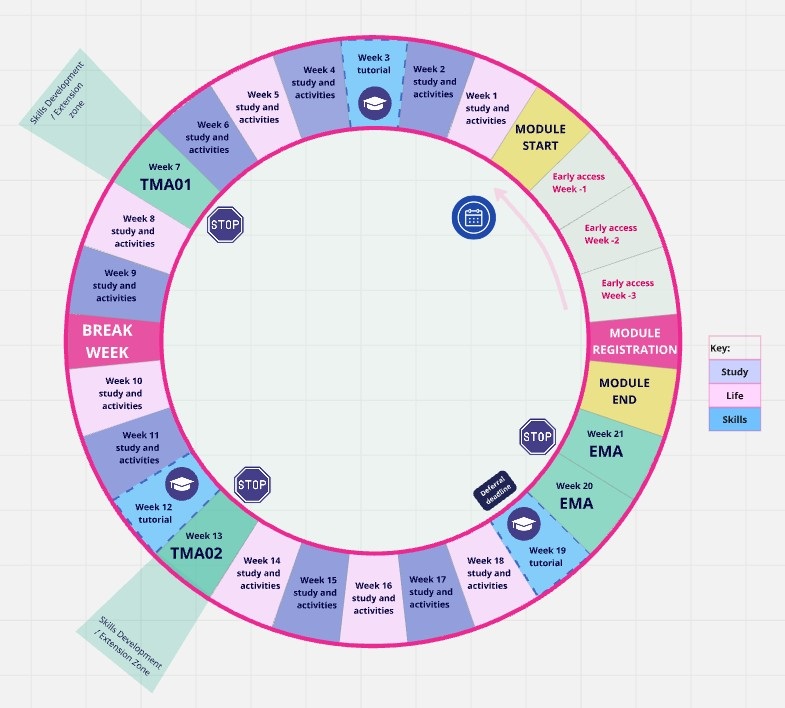
Our game ‘Small Steps’ is a facilitated interactive game delivered via an online whiteboard tool called Miro. In the game, players adopt student characters who are studying a Level 1 OU module. Players throw a die to move around a game board, which imitates progression through weeks of study. They encounter different life and study events, taking ‘small steps’ in a students’ shoes (see what we did there?) in each turn. Through guided discussion, players consider how their character’s lived experience and identity interact with life events and module design to create challenges and opportunities which can affect their progress on the module. The diverse characters and the life and study experiences that are encountered in the game are based on real OU students’ experiences gathered through our Curriculum Design Student Panel – a panel of student volunteers who share their experiences of learning to help us design inclusively.
Playful and gamified learning approaches can increase feelings of belonging, support group working and retention of knowledge, and inspire behaviour changes (Walsh, 2019., Triantafyllou, S. et al., 2025). Taking a playful approach helped us to create a safe environment for players to use reflection and discussion to consider the ‘whole student as a person beyond the cognitive role of education alone’ (Canterbury Christ Church University, 2026). This is a key component of compassionate pedagogies that promote staff and student wellbeing by actively mitigating distress and disadvantage in the learning environment (ibid, 2026).
Creating the game was a long iterative process of testing, gathering feedback, reflecting and learning, then improving the game. We spent a lot of time puzzling over how to represent complex experiences such as skills development and assessment, and how to support individual players from diverse teams to feel confident working together, all whilst trying to keep gameplay as simple as possible. Feedback from the five sessions we ran in 2025 were overwhelmingly positive. Players indicated that the gamified, collaborative approach and use of student characters provided a ‘great way to learn about others’ roles and experiences and helped them to think empathically about their adopted student character and the other characters being played in the game.
Whilst our Small Steps design journey is ongoing, we have learned a few things along the way. Here are our top tips for educational game design.
Six tips for educational game design
1. Get creative
Finding time and space (whether that’s head space or a physical space) for creative conversations can lead to interesting game ideas. Our game design journey started with an idea for a fun team-building activity.
2. Make steady progress
Protect time to progress your idea but recognise that it doesn’t have to happen overnight. We employed a sustained but intermittent focus over a long period, with clear milestones and regular catch ups to keep things moving.
3. Keep it real
In our game, drawing from real student experiences resulted in a more authentic and compelling player experience. Our diverse design team also drew from their own life and study experiences to maintain a strong focus on inclusivity and accessibility throughout our design journey. Whatever your game is about, carefully research the source material and draw directly from it.
4. Simple yet effective
Be prepared to make compromises to convey complex concepts and experiences in a simple way. Having a clear and specific understanding of what you want players to take away can help with this. Focus on a few key learning objectives and include only what is needed to achieve them.
5. Testing, testing… and more testing!
Take an iterative design approach. Plan testing with small, trusted groups initially, broadening out to more players as your game develops. Gather feedback during the game and afterwards, to ensure thoughts from those who need to reflect on the experience before providing feedback are included. Carefully consider and prioritise which points of feedback you will act on and make sure you will be able to evaluate which actions have resulted in an improved experience for players.
6. Support each other
The process of designing a game can be a whole lot of fun and very rewarding. At times, it can also be hard work and a little frustrating. Make time to support each other if it’s taking longer than you hoped. Also manage your own and each other’s expectations around your game’s universal popularity – it’s unlikely everyone will enjoy playing it and that’s okay.
If relevant to your game, you might also need to find ways to support your players to hear about difficult experiences. We highlighted where challenging life and study experiences may be revealed so players had a choice about whether to engage with them.
Tell us your top tips:
Have you made an educational game, or have you supported colleagues to connect with student experiences using novel or innovative approaches? If you have, we would love to hear about your project and experiences and any top tips you have from them. Contact us at [email protected] or get in touch via LinkedIn or BlueSky.
If you’d like to talk with the Learning Design team at The Open University about any design-related support you’d find useful for your organisation or department, you can contact us at: [email protected].
References:
Canterbury Christ Church University. (2026). Compassionate approaches to inclusive learning. Available at: https://www.canterbury.ac.uk/learning-and-teaching-enhancement/resources-for-academics/Compassionate-Pedagogy/Compassionate-approaches-to-inclusive-learning.aspx.
CAST. (2024). CAST Universal Design for Learning Guidelines version 3.0. Available at: https://udlguidelines.cast.org.
Triantafyllou, S., Georgiadis, C., Sapounidis, T. (2025). ‘Gamification in education and training: A literature review’, International review of education, 71, pp. 483-517.
Walsh, A., (2019) “Giving permission for adults to play.”, The Journal of Play in Adulthood 1(1), p. 1-14.