
When news broke of the devastating flash floods along Nepal’s Trishuli River in Nuwakot in September, one image immediately captured global attention: a four-decade-old, mint-green house standing completely solitary amidst a sea of mud and debris in Dunge Bazaar. While surrounding unreinforced stone masonry collapsed under the lateral surge of floodwaters, this single building held firm. In social media threads and forums, observers celebrated the house as a triumph of reinforced concrete framing and deep structural footings. But as I reflected on this image I found myself asking a deeper, more uncomfortable question: does celebrating an isolated surviving structure obscure the systemic climate crisis unfolding across fragile mountain landscapes?
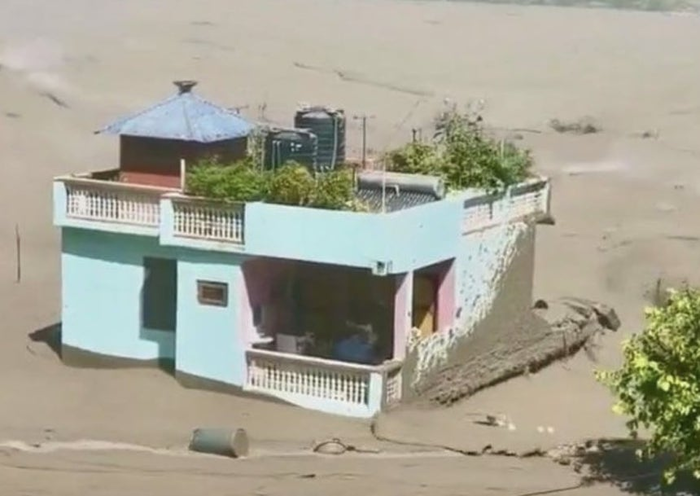
When we look at climate adaptation in low-resource, high-risk environments, focusing solely on single-building fortresses can blind us to the broader socio-ecological fabric. A home standing alone in a scoured, uninhabitable mudflat is not a picture of thriving human resilience; it is a stark monument to systemic breakdown. When floodwaters wash away drinking water pipelines, electricity grids, access roads, and agricultural terraces, physical survival in isolation falls far short of what true climate adaptation demands.
During a workshop on ‘Climate Creativity’ I ran with design students in Nepal, we explored the concept of living in reciprocity with nature, drawing on Traditional Ecological Knowledge (TEK) and reflecting on what ancestral practices can teach us about environmental relationships. Real climate resilience cannot be achieved by attempting to conquer nature through ever-thicker concrete walls. Instead, it demands a systemic, basin-scale approach that integrates physical engineering with hydrological landscape planning, natural flood buffers, and dynamic land-use zonation that works with natural ecological cycles rather than against them.
Equally vital is the human and relational infrastructure. Physical structures are only one layer of disaster preparedness. During the Nuwakot floods, early warning alerts distributed through local mobile networks saved countless lives by giving families time to evacuate long before peak floodwaters arrived. This reminds us that desire-based, community-led design – where local populations actively co-design hazard maps, decentralised alert systems, and multi-use community shelters – is just as essential as concrete foundations.
The viral mint-green house offers useful engineering lessons in structural shear resistance and foundation anchoring. But its truest invitation to us as designers is to expand our lens. By engaging critically with locality, community agency, and ecological reciprocity, design can help navigate the climate emergency in countries, like Nepal, that are at the forefront of the climate crisis, not by building isolated towers against nature, but by co-designing systemic, community-rooted futures.
Leave a Reply