
On my way to Nigeria, I read an article in Wallpaper* magazine (October 2025) about ‘informal designs’ in Nigeria. This felt like a coincidence because I was travelling to Lagos to give a keynote address at the 4th International Colloquium of the Distance Learning Institute at the University of Lagos. The audience included more than 1,000 students, staff, and invited guests from industry and the public.
The topic of my talk was inclusive and sustainable open distance learning. I drew on my research into social engagement, belonging, and learner agency in distance education. I did not expect my talk to resonate so strongly with the audience. I spoke about the role of informal learning and relational pedagogies which highlights the importance of building and maintaining relationships. This is very important in Nigeria.
The in-person audience showed a strong culture of belonging and pride. I learned, however, that it is difficult to recreate or maintain this culture at a distance or online. Maybe designs for online learning should be more informal and sociable?
Informal Design
In our teaching materials, we refer to informal design as ‘quiet designs’. This term highlights the idea that, unlike the well-known “star designers” often featured in the media, everyone participates in some form of design. In Lagos, where life is highly informal and constantly negotiated, informal design becomes necessary for survival. The process of designing involves a lot of social engagement, negotiation and flexibility.
During my time stuck in traffic, I observed street traders and their creative approaches. I also noticed how traffic systems and services have evolved to address constant traffic jams. For example, I was fascinated by the trays designed by traders to sell refreshments as they swiftly move through both fast and slow-moving vehicles.
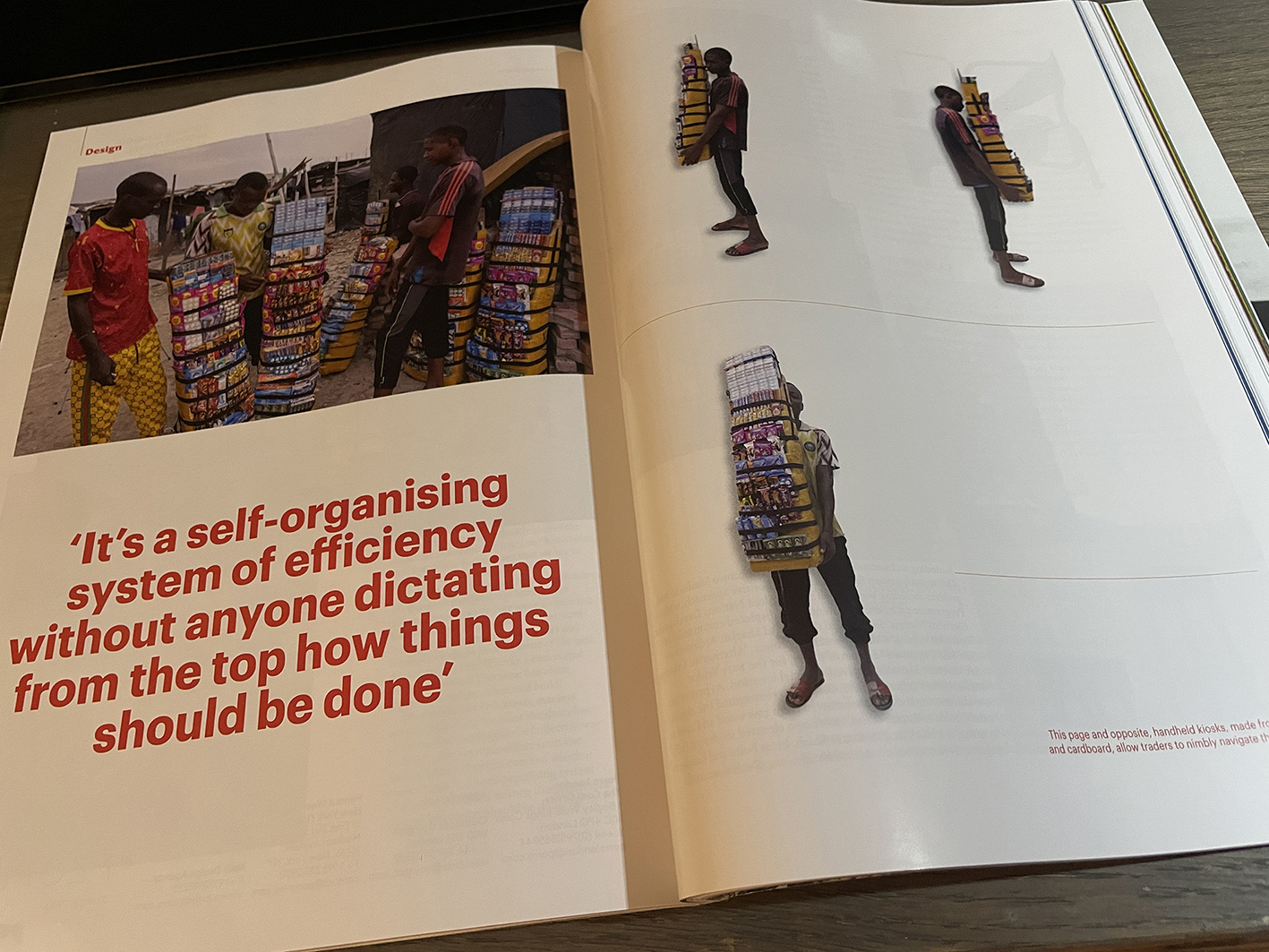
The Wallpaper* article included an image of these trays, as I could not take a good photo from the car. The trays are made from discarded packaging materials, and the materials change over time. Tradespeople previously used plywood but now use Styrofoam. The flat design is essential, as sellers need to move efficiently not only on the roadside but also between moving vehicles, which can quickly accelerate from a crawl to normal speed.
Services and systems
Anyone who has driven in Lagos knows that road rules, although written somewhere, are rarely followed. On the streets, rules are constantly being negotiated. Intersections are especially interesting. There is no right of way or stop sign. Vehicles approach the crossing and inch forwards, regardless of what other drivers do.
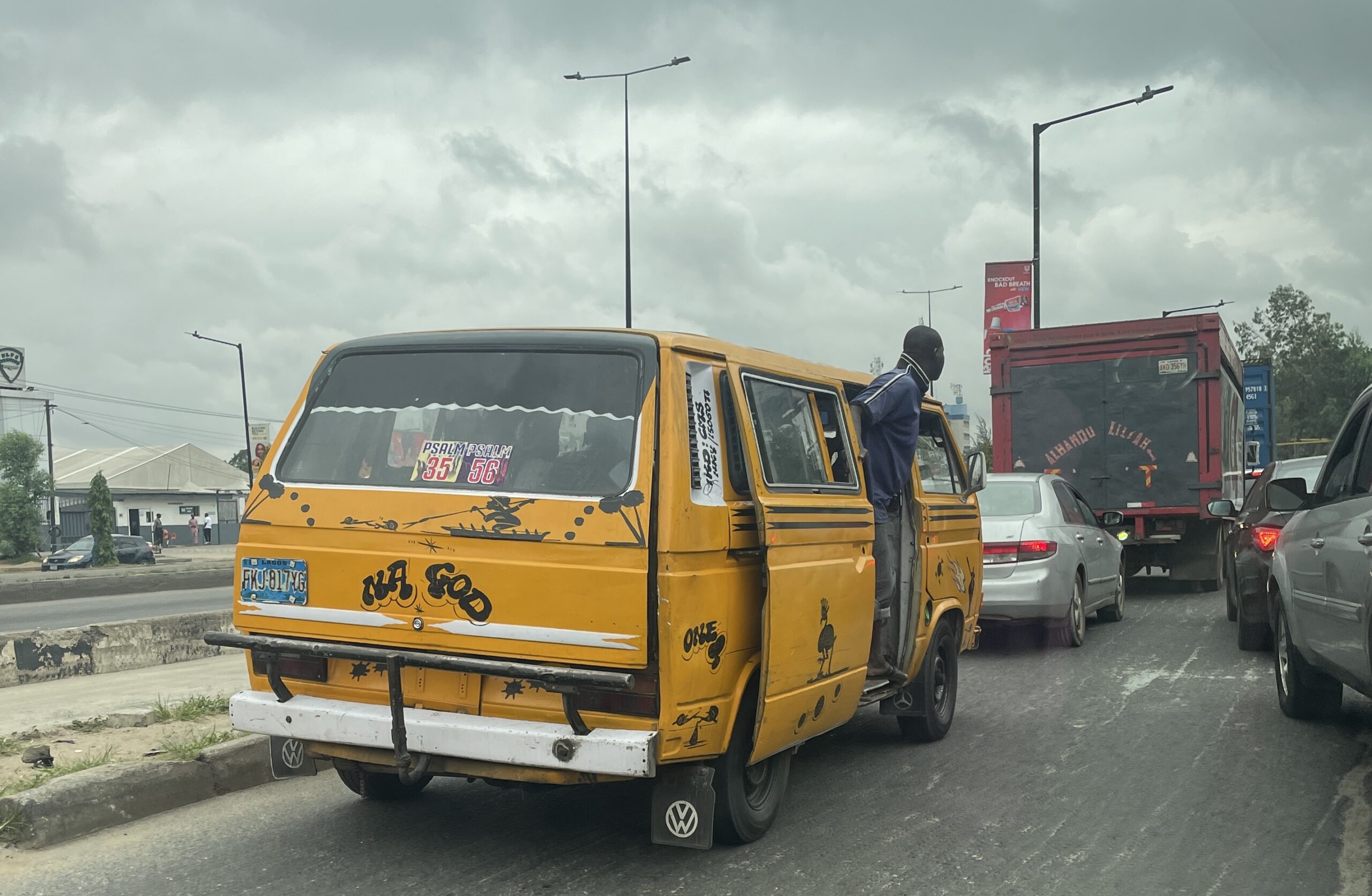
The public bus system needed to deal with this challenge and created artificial corridors with concrete blocks to separate a public bus lane from the other traffic. Bus stops look like those for trains or trams in Europe. There seems to be a rivalry between public buses, which appear to follow rules, and privately operated yellow minibuses. These yellow buses are often overloaded with people and goods, and it is not unusual to see someone standing at the open side door picking up passengers. For more detail, I recommend the article “For Danfo Buses, Death Bell Tolls”.
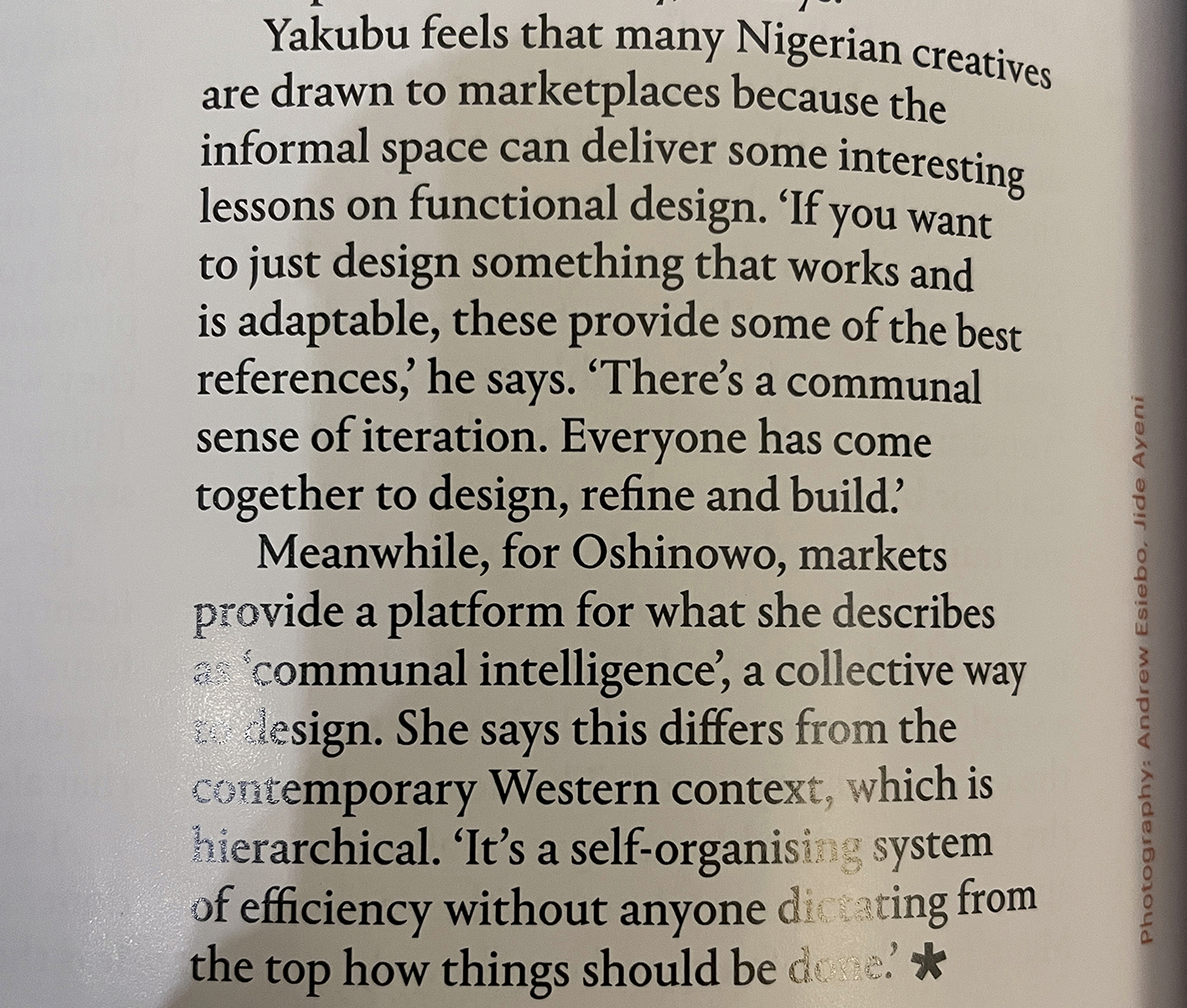
If you wonder why I focus on informal design, a quote from the Wallpaper* article (October 2025, page 178) explains it well: “There’s a communal sense of iteration. Everyone has come together to design, refine and build.” This is possibly how online learning should also be designed in Nigeria, and elsewhere.
On the topic of transport, I met Nurain Saka, General Manager at Golden Transport Division, Nigeria Flour Mills Plc. He helped me understand what I saw during my visit. Professional drivers usually work in pairs. One drives, and the other helps negotiate tight spaces and busy areas. Mr Saka explained how he manages his fleet and values the relationships between his drivers and their partners. Many processes and services are performed twice. For example, at the airport, after checking your passport with one officer, you join another line to show it to a second officer. This redundancy is likely a form of quality control.
Mr Saka runs his company with a focus on tidiness and safety, quite different from what I saw outside the transport hub. I enjoyed hearing about his approach to using materials in a circular way. His PhD research looks at human-scale recycling supply chains, which sounded similar to service design.
Decolonisation
I also listened to Kola Adesina, Executive Director at Sahara Power Group. He spoke with great pride about Nigeria’s culture, including fashion and community spirit. He highlighted the practical benefits of culturally sensitive clothing, especially when a power cut left keynote speakers sweating in western formalwear while local dress would have been much more suitable. He discussed the struggle to move beyond colonial influences, pointing out how unwritten histories can be lost, and how biased technologies, like some AI systems, can pose risks for the future.
This brief visit to Nigeria has strengthened my belief that any design should be sociable and flexible. I believe products and services should be unfinished, open to ongoing negotiation and co-design, so that users can keep shaping and improving them over time.


Leave a Reply