Religion and culture – two overlapping categories and concepts – determine how people see the climate crisis. For the 20th-century anthropologist Clifford Geertz, cultures are made up of ‘structures of meanings or meaningful structures that allow participants in the same culture to correctly interpret the words, gestures, activities, or symbols that were part of their own cultural context’ (Geertz, 1973: 7). Therefore, they are important concepts that can help us understand both climate activism as well as its public and media reception. It has not been too important in my ethnographic work to make a distinction between the terms ‘religion’ and ‘culture’ on the ground, but I aim to use and apply both these concepts, as far as possible, in connection with how the people I interview and observe (often during marches and protest actions) understand them. I suggest that religion could be understood as a culture of resistance in the context of a growing global, transnational climate movement, which can in turn be understood as a meeting place for many different cultures of political resistance.
Religion and culture are encoded into the many different networks that make up the climate movement, particularly through ritualised and performative actions which can include singing, dancing, drumming, acting or chanting. But to what extent are these forms active elements or just inert relics inside the protest repertoire of the climate movement? In other words, to what extent can they be understood to actively shape the movement or do they simply provide a cultural resource to activists? My research (Nita, 2024) suggests that religious traditions have a lot of influence and impact, and that they represent key cultures of resistance inside the British climate movement.
The British climate movement has been strongly influenced by Contemporary Paganism and has become increasingly open to support from and collaboration with other religious traditions, such as Rebel Christians and XR (Extinction rebellion) Buddhists. Despite its initial opposition to institutionalised and organised religion, during the 21st century there has been increased acceptance and support for Christian churches and Christian movements and grassroots networks, like the influential Christian Climate Action (CCA) founded in London in 2014 or the Laudato Si Movement, which was launched as a response to the late Pope Francis’ letter with the same name, issued in 2015. Christianity and Contemporary Paganism are not as different as they might appear. Contemporary Paganism – and particularly the Eco-Pagan faction of the movement that developed post 1960s – can be seen in various guises, as a countercultural movement, or even on the edge of the spectrum of new Christian reformulations, that simply benefited from increased cultural visibility given the decline of institutionalized Christianity in the second half of the 20th century.
In addition, the British climate movement developed new and influential forms of direct-action like the climate camps in the mid-2000s – which have roots in transatlantic models of civil disobedience. Post 1960s, in Britain and the US, new forms of direct action emerged through the commitment of religious and spiritual countercultural movements. In the US, Black churches contributed to the traditions of civil disobedience within the civil rights movement. In the UK, Pagans shaped British green activism, especially in the 1990s and early 2000s (Letcher, 2001; 2002). Contemporary Paganism is itself a transatlantic movement with roots in the 18th and 19th century Romantic Movement, as well as the British Druid and Celtic revival that took place around this period. During the 1990s Pagans in the UK played an important role in the development of key activist methodologies – such as non-violent direct action (NVDA). Today NVDA represents the bedrock of British climate activism – contemporary protest actions generally start with some form of NVDA training. The Contemporary Pagan ‘witch camp’ which began as a form of protest in Britain’s forests during the 1990s British anti-road movement became the model of the climate protest camp.
Scholars have argued that religious traditions have a key part to play in supporting wider environmental values and attitudes, both inside religious communities and the wider public sphere. Whilst religious leaders like the late Pope Francis played an important role in raising awareness of the ecological crisis, it is the Laudato Si green movement that had a tangible impact. Moreover, research shows that top-down efforts from religious leaders and eco-theologians have not had an impact on ‘the streets’, for ordinary people, ‘rank and file Christians’ and local churches (Clements, McCright, & Xiao, 2013). In contrast, greening coming from grassroots networks in the UK has been more successful in influencing the churches (Nita, 2016). This is particularly the case with green Christians in largely Protestant/ Anglican contexts, like the UK and the United States, who have been able to develop new religious practices and protest methodologies – such as climate vigils for example.
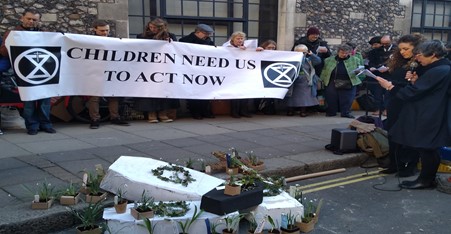
Green Christians have been using climate vigils to combine political protest with ritualized and performative actions in their varied ‘bottom up’ efforts to reach out to Christian communities and churches, as well as the wider unengaged public. Members of Christian Climate Action led many campaigns of support to the wider climate movement and demanded that the Church disinvested from the fossil fuels industry. We can see an example of such a protest in the image below, where members of Christian Climate Action and other green Christians are protesting outside of the building where the Church of England General Synod was being held in February 2020. As it becomes clear in this image, Green Christians who protest in public spaces ‘face’ both their own Christian communities and the larger public sphere. The protest methodologies activists use in these settings often combine artistic and religious symbolism. In the image below the artistic display that can be seen in the foreground of the picture, represents children’s coffins – the future victims of the climate crisis. During the event participants knelt to make flower offerings as one would do in front of a real memorial. The site became a ritual representation of an uncertain future. Importantly, such actions can be said to have been successful, given that only a few years later, in 2023, the Church Commissioners and the Church of England Pensions Board announced that they would independently disinvest from fossil fuels.
References
Clements, J. M., McCright, A. M., & Xiao, C. 2013. ‘Green Christians? An Empirical Examination of Environmental Concern Within the U.S. General Public’. Organization & Environment, 27(1), 85-102.
Geertz, C. 1973. The Interpretation of Cultures. New York: Basic Books.
Letcher, A. 2002. ‘“If You go Down to the Woods Today…”: Spirituality and the Eco-Protest Lifestyle, Ecotheology: Journal of Religion, Nature and the Environment, vol. 7, no. 1, pp. 81-87.
Letcher, A. 2003. ‘“Gaia told me to do it”: Resistance and the Idea of Nature within Contemporary British Eco-Paganism’, Ecotheology: Journal of Religion, Nature and the Environment, vol. 8, no. 1, 61-84.
Nita, M. 2024. ‘Sacred Waters, Sacred Earth – Contemporary Paganism inside Extinction Rebellion: A Relational Analysis of Protest Death Rituals’, Extinction and Religion, Jeremy H. Kidwell and Stefan Skrimshire eds., Bloomington: Indiana University Press, pp. 114-154.
Featured image:
Christian Climate Action vigil protesting during the Church of England General Synod in February 2020, London (Copyright: Maria Nita).