By Hugh Beattie
In November, New York for the first time ever elected a Muslim Mayor – Zohran Mamdani, who since 2020 has been a member of the New York state legislature. His background is a cosmopolitan one. His mother, Mira Nair, was brought up as a Hindu. She is an internationally-acclaimed Bollywood film director (her best-known film is probably Monsoon Wedding, released in 2001). His father, Mahmood Mamdani, is an academic who specializes in colonial, anti-colonial and decolonisation studies. His publications include Good Muslim, Bad Muslim (2005) which explores American attitudes to Islam. Mahmood Mamdani comes from a Khoja background. Khojas are members of a trading caste living mainly in western India, Pakistan, Uganda, Europe and the USA. Their ancestors became Muslims in the 14th century CE; today the largest Khoja community is found in Bombay. Most Khojas identify with the minority Nizari Ismaili Muslim tradition, led by Aga Khan V, Shah Rahim al-Husayni. There are also Sunni and Twelver Shi’ite Khojas. Zohran Mamdani (who was born in Uganda and has lived in New York since he was seven) identifies with the Twelver Shi’a Khoja tradition.
Khoja Islam has been characterised as flexible, diverse and tolerant. In many respects Zohran Mamdani’s approach seems to be a liberal one; for example he is a supporter of the LGBTQ+ Community, and is a hip-hop fan who has composed, performed, and produced rap music. His views on Palestine and Israel, however, have attracted ‘criticism from across the political spectrum’ (Mays, 2025). While a student at Bowdoin College, he helped to found the campus chapter of Students for Justice in Palestine. He is also a supporter of the Boycott, Divestment, Sanctions (BDS) movement, which uses non-violent means to try and pressure the Israeli government into recognising Palestinian rights. This has helped to make him a controversial figure who has been condemned by some as an anti-Semite, and accused of calling for the destruction of Israel. It is true that he has described Israel as an apartheid state, criticised American military support for it, and called for New York-based organisations funding Jewish settlements on the West Bank to lose their charitable status. Nevertheless he argues that ‘Israel has a right to exist as a state with equal rights’ for all its citizens, and he has challenged anti-Semitic views and said that, whatever their identity, the killing of civilians is always wrong. He criticised a rally held in New York on October 8 2023 which celebrated Hamas’s actions on October 7, and on the second anniversary of the attack said that on that day Hamas committed a ‘horrific war crime’ (Friedman and Bartov, 2025). During his mayoral campaign Mamdani reached out to New York’s million or so Jews, for example visiting synagogues and engaging with Jewish organisations. Some 30% of the Jewish electorate in the city voted for him (Demir, 2025).
Mamdani has also been accused of being anti-Hindu, mainly because he has been a critic of the Hindu nationalist Indian Prime Minister, Narendra Modi, for what some have called Modi’s anti-Muslim rhetoric and policies. However, during his mayoral campaign Mamdani also tried to win the support of the substantial Hindu community in New York, for example visiting two Hindu temples during his campaign, and proclaiming that he was ‘proud of [his] … Hindu heritage’ (Dutt 2025). Many Hindus voted for him too.
Another accusation levelled at Mamdani is that he is an Islamist extremist. During his campaign some Christians claimed that if elected he would use his position to ‘launch an Islamic revolution from New York that would threaten their vision of America as a Christian nation’ (Brumley, 2025). Christians make up 57% of the city’s population, and to counter accusations like these he visited and spoke at Christian churches; around 37.5% of the city’s Christians voted for him (Demir 2025, Pew 2025).
In fact, although he makes no secret of his Muslim identity, it is difficult to detect a distinctively Islamic agenda in Mamdani’s stated aims; during his mayoral campaign he does not seem to have advanced any Islamist views. He made no references to Sharia law for example, and focused mainly on economic issues which affect most New Yorkers regardless of their religious identity, He said that if elected he would make New York City a more affordable place in which to live, undertaking to introduce a range of measures which would benefit the less well-off, including free bus travel, a rent freeze and raising the minimum wage. This has led to accusations that he is a socialist, even a communist.
Some Muslims might argue that this focus on improving the lives of ordinary New Yorkers actually aligns with core Islamic values. It has been suggested that the Prophet Muhammad himself was a socialist; for instance by the German academic Hubert Grimme in his biography of Muhammad published in the 1890s. This view has not been widely accepted, but during the 20th century some Muslims did begin to talk about Islamic Socialism and continue to do so today. At the same it seems that there is nothing uniquely ‘Islamic’ about Mamdani’s programme. New York has had reforming mayors in the past. The best-known example is Fiorello La Guardia (1882-1947) who during the 1930s and 1940s among other things modernised the city’s subway system, supported the development of public housing, playgrounds, parks, and airports and reorganised the police (Britannica 2025). It will be interesting to see whether Mamdani can be equally successful in the face of the major challenges which confront him.
SOURCES:
Britannica (2025) Fiorello La Guardia | Mayor of NYC, Civic Reformer | Britannica (Accessed 12 November 2025).
Brumley, Jeff (2025) Christian nationalists and some Jews foresee doom in Mamdani’s win – Baptist News Global
Demir, Gizem (2025) New York mayor-elect Mamdani found strong support among Jewish voters: Polls (Accessed 15 November 2025).
Dutt, Yashica (2025) Inside the Battle To Win New York City’s Growing Hindu Bloc – New Lines Magazine (Accessed 15 November 2025).
Friedman, Gabe and Bartov, Shira Li (2025) What NYC Mayor-elect Zohran Mamdani has actually said about Jews, Israel and antisemitism | The Times of Israel (Accessed 15 November 2025).
Grimme, Hubert (1892 and 1895) Mohammed Das Leben Nach den Quellen, 2 volumes, Münster.
Mays, Jeffery (2025) ‘Balancing Act Over His Faith Tests Mamdani’ https://www.nytimes.com/2025/06/12/nyregion/zohran-mamdani-muslim-mayor.html (Accessed 11 November 2025).
Mustafa, Maysa (2025) Zohran Mamdani under fire from all sides following 7 October statement | Middle East Eye (Accessed 14 November 2025).
Nanji, Azim, Khojas (Accessed 14 November 2025).
People in New York | Religious Landscape Study (RLS) | Pew Research Center (Accessed 18 November 2025).
Phillips, Melanie (2025) The Islamist capture of New York | Israel National News (Accessed 15 November 2025).
Pitchfork (2025) 5 Songs That Define Zohran Mamdani’s Campaign for New York Mayor | Pitchfork (Accessed 17 November 2025).
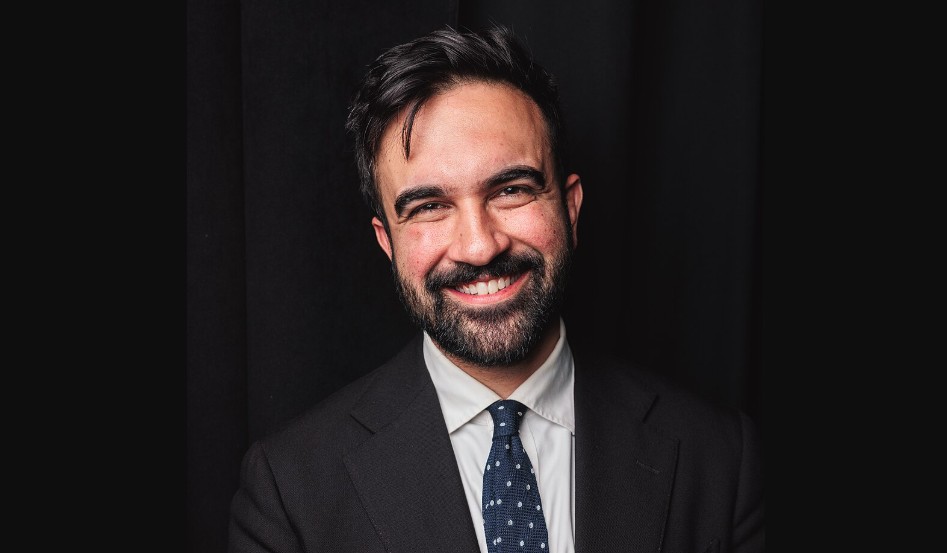
Featured image: Zohran Mamdani (Credit: Creative Commons/Dmitryshein)