
Research Rooms are informal online spaces for discussion with members of research teams from academia, practice and communities, organised by The Glass-House Community Led Design and the Design Group.
We kicked-off the 2026-2027 series with a look back on the project Prototyping Utopias and explored a variety of topics and questions around the value of future thinking, and how creative and participatory methodologies and approaches can help activate collective visions and ideas for change in local places.
Here is a summary with some key takeaways:
Following short introductions from all participants, the research team introduced Prototyping Utopias briefly. Participants then posed questions and shared their experiences and reflections on participatory design work and the power of dreaming and prototyping as a methodology. Participants also talked about the challenges of sustaining and scaling up project impacts and the importance of capturing and connecting learning across time and place.
Introducing Prototyping Utopias
The project was funded by the Arts and Humanities Research Council (AHRC), as part of their 2016 Connected Communities Research Festival inspired by the 500th anniversary of the publication of Thomas More’s Utopia. It was led by the Open University and The Glass-House Community Led Design in collaboration with Bow Arts, Bow Church, Bromley by Bow Centre, Poplar HARCA and local artists. The project explored the concept of ideal places and how design can help transform utopian ideas into propositions for change through collaborative dreaming and prototyping. The exploration had three phases: a dreaming day at Bow Church inviting local families to share their dreams about their place; a prototyping workshop at Bow Arts reflecting on the community input and exploring small actions to make ideas happen; and a public sharing event at Somerset House.
Creative methodologies and tools
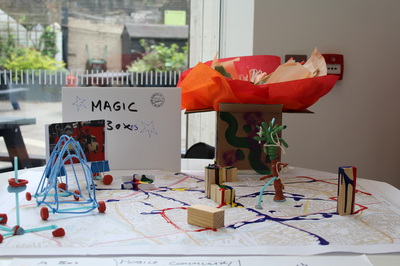
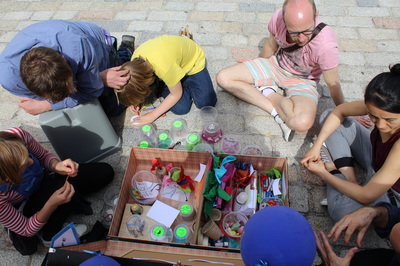
A key theme of the discussion was the role of creative making as a methodology for opening up conversations about futures, place and change. The original Dreaming Day was deliberately centred on making activities, enabling participants of all ages to express ideas that could be both playful and serious at the same time. The project used a range of creative tools, including a recording booth where visitors could capture and listen to one another’s visions for the future, art and craft activities, and the memorable “magic box” concept, first developed during the prototyping workshop and later realised at Somerset House as a travelling chest filled with materials for making, play and conversation. Participants related these approaches to their own practices, sharing examples of portable boxes, games, community-making kits and other creative artefacts designed to spark interaction, imagination and civic participation. The discussion also highlighted the importance of making underlying assumptions and mental models visible, using creative methods to generate ideas but also to explore how people imagine and negotiate possible futures.
Tangible and intangible impacts and legacies
The conversation explored both the visible and less visible impacts of participatory projects. While Prototyping Utopias began as a small, time-limited initiative, it played an important role in supporting ongoing conversations about opening Bow Church to a wider range of users and activities. It helped test ideas about how different groups might use shared spaces and contributed to strengthening relationships between local organisations and residents. Participants also stressed the importance of recognising intangible legacies, such as increased trust, new relationships, confidence, inspiration and networks that continue beyond the life of a project. Several contributors noted that bringing together people who would not otherwise meet can have long-lasting effects, even when these outcomes are difficult to measure or formally capture. The discussion highlighted that the most significant legacy of participatory work is often found in the connections, conversations and capacities that endure long after a project has ended.
Funding challenges
Participants reflected on the limitations of current funding models for community-led change. A recurring concern was that communities are often invited to imagine and design better futures but are not always given the resources needed to translate ideas into sustained action. The discussion highlighted the tension between short-term project funding and the longer-term investment needed to build community capacity, relationships and local infrastructures. Participants argued for funding models that support enduring partnerships rather than isolated projects, and that create space for imagination and experimentation rather than focusing solely on immediate problems. There was also discussion about who ultimately benefits from regeneration funding, whether resources genuinely reach local communities, and how funding mechanisms might give residents greater control over decisions affecting their places and futures.
Scaling up action and sharing learning
Another important topic was the need to better connect learning across projects, places and generations of participants. Participants recognised that many communities experience repeated cycles of engagement and participation, with similar ideas, methods and ambitions reappearing over time. While this repetition can be frustrating, several contributors suggested that meaningful change often emerges through successive rounds of experimentation and relationship-building, with each project leaving behind knowledge, confidence and connections that others can build upon. At the same time, there was concern that valuable learning is frequently lost when projects end, websites disappear, funding runs out or participants move on. Discussion focused on how experiences, stories and practical tools might be captured and shared more effectively, enabling communities and practitioners to learn from earlier work rather than repeatedly “reinventing the wheel”. Examples from regeneration programmes and community-led initiatives highlighted the importance of creating mechanisms that connect projects across time, support local champions, and sustain momentum beyond individual funding cycles.
Resources
Project website: http://prototyping-utopias.weebly.com/
Prototyping Utopias film: https://vimeo.com/171563836
Leave a Reply