What is literature for? – and Why do I do what I do?

Sara Haslam, Senior Lecturer in English

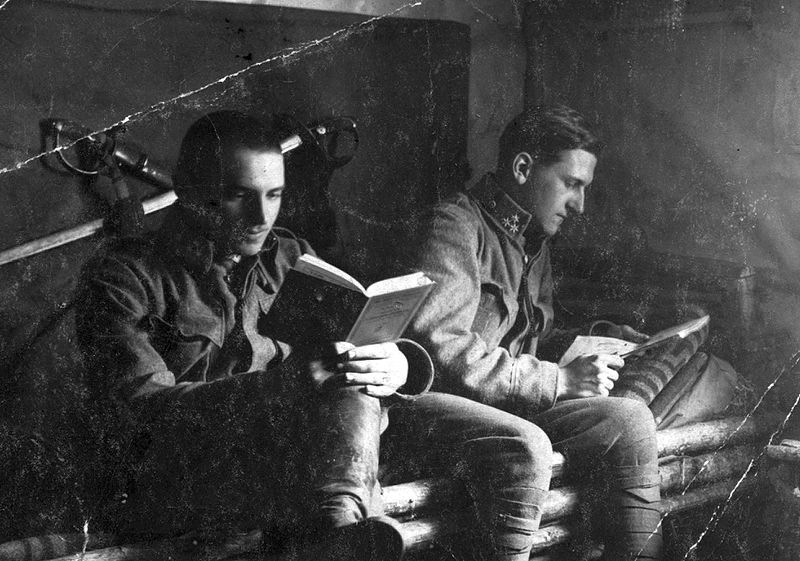
Soldiers reading during the First World War. Shared under the Creative Commons licence. Date:1917 Source http://www.fortepan.hu/_photo/download/fortepan_16325.jpg

We’ve been asking the first question in my title for this blog post for many years in our department. In modules such as A300 Twentieth-Century Literature: Texts and Debates our teaching materials have explored the relationships between art and politics, for example, and asked students to do the same. (My writing on Chekhov, the literary doctor, for A300 was perhaps an early sign of current interests.)

Recent research projects, though, have provided a new set of answers to both questions above, and reflecting on those answers for this post has proved a welcome activity.

Starting to read a thin and battered pamphlet in the spring of 2015 in Oxford’s Weston Library I had one of those ‘aha’ moments the researcher craves. I’d ordered it up because of a couple of key words in the title. Previous searches hadn’t unearthed it and I wasn’t sure until it was in front of me that it was going to be of much interest. But Helen Mary Gaskell’s account of the beginnings of her War Library in 1914 proved a wonderful find. Her epigraph, ‘Take choice of all my Library, and so beguile thy sorrow’ (from Titus Andronicus) had key words of its own, and what followed opened up the history, and challenged the scholarship, of reading during the First World War, particularly that of sick and wounded soldiers. It prompted me to find a name for one kind of organised charitable endeavour in war-time: ‘literary caregiving’ – a phrase I used in the key-note I was writing in 2015 and the article on Gaskell’s war library I’ve published since.

Gaskell’s idea for a library for sick and wounded soldiers, to be stocked in the main by donated books, was realised in the first weeks of the war. She had powerful and wealthy friends – one, Lady Battersea, had a mansion going spare in Marble Arch, which is where they stored the books. Aside from the speed with which the War Library was operational, the most striking aspect of the early weeks was the number of donations. One individual contributed a library of 35,000 books. Gaskell needed them all, and more too; supply rarely met demand. And yet records show that in the first half of 1917, for example, 1,125, 840 units were sent from the library’s London base to its depots around the world.

Gaskell also had a methodology – one related to her epigraph and to a democratised rather than hierarchical understanding of literature and its purpose. She prioritised what she called a ‘personal touch’, meaning that specific requests from wounded soldiers should be met if at all possible. Books, she felt, were a ‘flow of comfort’ that should not be interrupted by lack of effort. Over the course of the war, the War Library collected and distributed millions of books by writers such as O’Henry, Kipling, Marie Correlli, Dumas, Nat Gould – but if a soldier wanted a book on bee keeping, for example, every effort would be made to source that too.

This pamphlet was fascinating in its own terms. It also offered important answers to the question of what literature is for. And these answers, and the research directions they instigated have led to new networks and collaborations with colleagues departmentally, and externally too – a particularly positive outcome when we spend so much of our research time on solitary labours. Some of the results will be discussed in other posts here.

The tone and character of the book-related language used by soldiers and the volunteer librarians caring for them during the war will stay with me. Contemporary experience of a ‘book hunger’, of ‘the bitter cry for books’ led to the idea of books that might ‘heal’ – one that is explored in all kinds of ways in the papers those librarians left behind. The media, too, was fascinated by this work, which shifted the medical focus to include minds as well as bodies.

The Times, for example, told people ‘What to Read to the Wounded’ in 1915. It turns out, though, that both the wounded, and Gaskell and her colleagues, had other ideas. If one of the things that literature is for is healing, these caregivers noted, then feeling freely able to choose, and then being provided with, their own book was the best place for patients to start.

Reflections on EastSide Arts Festival, Belfast, 2-12 August 2018

Patricia Ferguson, PhD Student, Department of English

The Director of the EastSide ArtsFestival writes, in the brochure’s welcome page: ‘…if this part of the city is your home, the festival is our annual invitation to you to celebrate and enjoy the creative energy that surrounds you. If you’re a visitor, let us be your hosts; you will receive the warmest of welcomes’. I am a visitor, and the welcome could not have been warmer. A Big Top has gone up in C. S. Lewis Square for circus events, family fun, and evenings filled with music. There are venues for authors to give readings of their poetry and prose, guided walks and bus tours, one hundred and twenty six events in all! Choosing between so many is not easy, but I decide in favour of readings and walking tours because, as the welcome page points out, the inspiration comes from ‘the landscape, history, culture and above all, people of east Belfast‘.

These four go together because, as I see for myself on the two walking tours, in every part of east Belfast, from the working class terraces of Newtonards Road (‘Communities Shaped by Conflict’) to the detached houses and gardens of Belmont and Sydenham, (‘C. S. Lewis Walking Tour’) the landscape is dominated by history and culture in two forms, and these likewise belong together. Look around you anywhere in east Belfast, and on the skyline you will see Samson and Goliath, Harland & Wolff’s enormous, bright yellow gantry cranes, and lining every street you will see Loyalist flags. Harland & Wolff grew from small beginnings in 1861 to an enterprise which, by 1919, owned 220 acres, employed 22,000 people, but was plagued by sectarianism.[1]  ‘The shipyard workers identified with a Protestant state for a Protestant people’. Catholic workers were expelled, violence followed so deadly that in 1969 ‘Catholics whose homes had been attacked when they were children found themselves being attacked again in what seemed like a re-run of the 1920s pogroms’.[2]

As on the one side, so on the other. On the ‘Conflict’ walk we visited the Andy Tyrie Interpretive Centre, an Ulster Defence Association museum named in honour of one of its earliest commanders. The Tyrie family was one of many Protestant households forced out of their homes by Catholics. As time went on Andy came to realise that the way forward must be political, but many others did not. He himself narrowly escaped death in a car bomb attack set by UDA hardliners in 1988.[3]  As we leave the museum, still reflecting on these things, a different guide – as it must be, even in 2018 – takes us a mere yard or two into a different world. This is Bryson Street in the Short Strand, a Catholic enclave of around 3,000 people surrounded by the 60,000 Protestants of Inner East Belfast.[4]  This is where in August 1971, as a consequence of the internment debacle, the residents had to flee while the wall went up, destroying houses to partition the streets. A headline in the Irish News for 12 August 1971 reads: ‘Bryson Street Dies in “Scorched Earth” exit’. Although I am Catholic myself, I am glad not to be alone here; forty years have gone by, but the fear and suspicion remain.

This is an Arts Festival. Can the mere act of painting, or writing plays and poetry, have any healing properties? Shelley Tracey, who read to us from her new collection of exquisite lyrical poems (‘Prose, Poetry, and Pastries’) told me about an oral history project of her own which demonstrates this very clearly.[5]  The Prison Arts Foundation provides Northern Ireland’s prisons with mentors, writers, and artists-in-residence ‘to release the creative potential of those previously excluded or from marginalised communities, as well as those serving custodial and community sentences’. (p. 10) This fits perfectly with the concept of the Restorative City discussed at the Imagine! Festival earlier in the year. I am especially moved by ‘SG’, a young man whose experiences in helping to create a Holocaust Museum at Magilligan transformed his prejudices into ‘a desire to communicate the importance of tolerance and acceptance’. (p. 7) He came to understand that ‘dehumanization can start even by calling people names’. (p. 41)

It is ‘ZM’, however, who has me in tears. She is out of prison now and thriving, except that she uses an alias because of ‘the people who wouldn’t want me to be doing OK’. I become aware that this malignant mindset, all too common and constantly aggravated by social comment, is a stain in my own heart too. One of Hickey’s respondents described this barrier in the mind as ‘the point of no return’. (p. 43) Belfast’s festivals provide an antidote: they show that, against all the odds, barriers can be dismantled, a point of return can be found.

[1]     ‘Harland and Wolff’, in Grace’s Guide to British Industrial History <https://www.gracesguide.co.uk/Harland_and_Wolff> [accessed 25 August 2018]

[2]     Kevin Johnson, Irish Times, 29 November 2008 <https://www.irishtimes.com/news/sectarianism-and-the-shipyard-1.916936> [accessed 25 August 2018]

[3]     Belfast Telegraph, 15 September 2002 <https://www.belfasttelegraph.co.uk/imported/struggle-for-power-within-uda-28130828.html> [accessed 25 August 2018]

[4]     Rosalind Hickey, Reflected Lives: Intergenerational Oral Histories of Belfast’s Peace Wall Communities (Belfast: Belfast Interface Project, 2018), p. 15

[5]     Shelley Tracey, Building Foundations for Change through the Arts: An Inquiry into the Impact of Participation in Prison Arts Foundation’s Programmes (Belfast: Prison Arts Foundation, 2017)

“What Do We Do Now?” Part 1

Thoughts on Enright, Academic Travelling and Critical Distance

Robert Fraser, Emeritus Professor of English

One afternoon in October 1974, I was standing in a somewhat Spartan corridor in the University of Leeds in desultory conversation with a tall, lean, slightly stooping gentleman in his mid-fifties. He wore a suit, held a thin-stemmed pipe between his teeth, and was delivering diffident remarks between successive puffs of smoke. There was a slightly gloomy air to his conversation, gloomy but also droll, as if a little dejected and at the same time laughing at his own dejection. On this occasion, however, he had a subdued gleam in his eye, because I had just brought up a subject that interested him. In effect, I had become a participant in his wry despondency, since at this moment in time we had two things in common. Broadly speaking, we possessed a common invitation and a common problem, which could be summed up in the words “What Do We Do Now?”

The pipe-smoking gentleman was the poet D. J. Enright, not long returned to Blighty after a peripatetic lecturing career in, successively Egypt, Japan, Berlin, Thailand and most famously Singapore, writing all the while. His nick-name was “the mendicant professor” and that had been the title of his memoirs, published five years previously. I was not quite as mendicant as he was, but had myself just returned from a lengthy and enjoyable spell lecturing in Africa. Both of us had been invited to spend some time in Leeds, teaching and taking our bearings. The topic of our conversation that afternoon was this: how do you approach the challenge of teaching English Literature in England when all your experience is of teaching it just about everywhere else?

Two qualities, I believe, are necessary to the successful teaching of literature to any student audience: intimacy and distance. When the teacher originates from the same environment as the text, but the students do not, the lecturer must exercise all of his or her imagination and resourcefulness to bring the text alive by translating it into terms the students will appreciate and understand. You begin with a distance that you then attempt to cross, so that by the end of the process the text is as intimately known to the students as to yourself, but in a different way. When the students and the text have a common background, the same factors do not occur, at least to the same extent. But, of course, there are different sorts of distance. There is the kind of distance that is achieved by time, when an historic text has to be made accessible to modern students (which is why a play by Marlowe or Paradise Lost is more challenging to teach anywhere than a modern text, and often a lot more fun). There is the distance achieved by theory, which I usually find unsatisfactory since it sometimes amounts to erecting a barrier of jargon between text and reader. In any case, some students find it alienating, and since the object of the exercise is to remove obstacles, the question arises, why erect this particular barrier in the first place, except to mystify? And then there is the sort of distance posed by some postcolonial books where the element of cultural alienation re-asserts itself, but as it were the other way round.

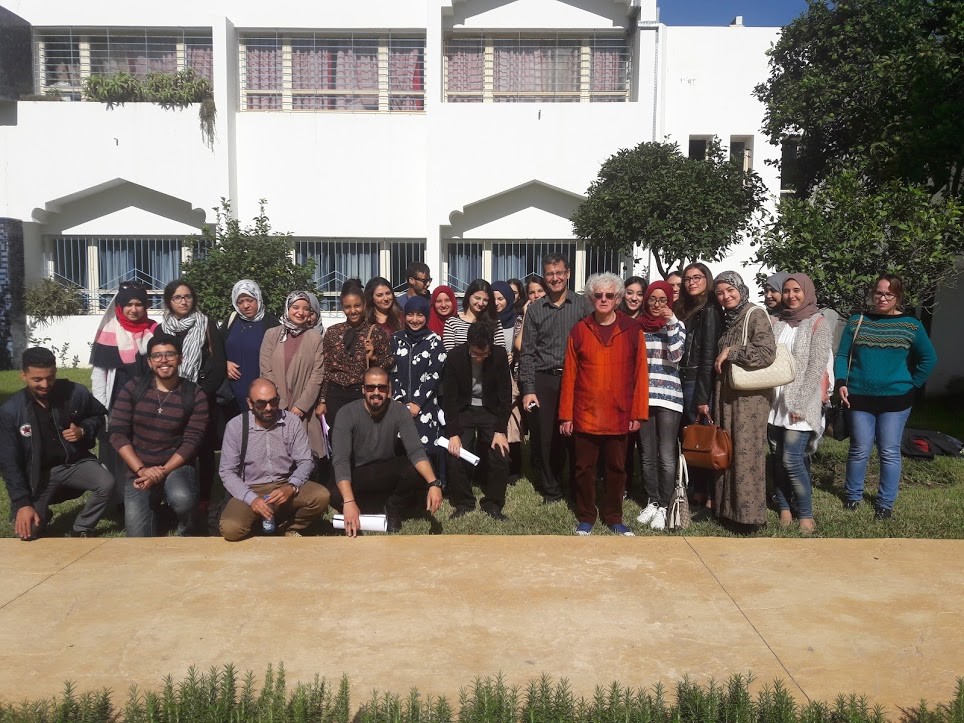
So when in 2015 I became an Emeritus, and the question posed itself once more – “What do we do now?” – the answer seemed to be to return to my academic roots and re-establish that geographical distance between audience and text which I have always found so stimulating. The first chance came towards the end of that year when Dr Nourdin Bejjit, whose doctoral thesis I had co-supervised at the OU, invited me to Morocco on a lecture tour. I flew in to Casablanca, which did not live up to its cinematic reputation, and then journeyed on to Rabat and Fez. I ended with four days in Tetouan, former capital of Spanish Morocco. As in the other locations my primary assignment was to talk about the reception of Eng. Lit abroad, as it is in the present piece. But on the last evening mine host Dr Jamaleddine Benhayoun asked over coffee, “The quatercentenary of Shakespeare’s death is coming up soon. Tomorrow, why not just slip in a talk on the Bard?”

I thought this an excellent idea. The only problem was that, though at Leeds I had spent most of my teaching week on Renaissance Literature and Shakespeare, since moving to London in 1978 I had hardly touched the subject. There was nothing to do except wing it. So at eight-thirty the following morning I was standing on the stage in the largest lecture hall in the university armed with my Kindle and no notes. Before me was an audience of about 500, with some people standing at the back. I had already made up my mind that I would focus my talk on King Lear, drawing inter alia on James Shapiro’s book 1606: William Shakespeare and The Year of Lear, which had recently appeared, but I would obviously have to talk about much else besides, and to set Shakespeare and his theatre in historical context. I started talking as, as I did so, all my buried and neglected knowledge came flooding back.  Nobody moved. There are certain moments in one’s life when one loses sense of time, as when writing something, or painting a picture or composing music. When I thought I had finished, I asked Jamal the time. It was half-past eleven, and I had been talking extempore for three hours. That should have been it, but we had already agreed that we would have time for questions. Did anybody have one, I asked. Someone stuck up their hand in the front row and asked if Shakespeare’s plays had anything to tell us about Shakespeare the man. Not the plays, I answered, but the poems were a different matter. As an example I started reciting Sonnet 116: “Let me not to the marriage of true minds/ Admit impediments”. As I started on the second line, I became aware of a slight but growing susurrus in the hall. Gradually, row by row, they were joining in. By I time I reached the concluding couplet the whole hall was involved as the entire student body shouted out the lines: “If this be error, and upon me prov’d,/ I never writ, nor no man ever lov’d.”

We often hear of the incompatibility of Western liberal and traditional Islamic values in North Africa and the Middle East, and the impediment that this places between certain audiences and Western secular literature. What nobody tells us is that the deeply embedded religious culture of these lands allows them continuing access to the rapt expression of ethical truths that the secular West has almost lost sight of. The sanctity of marriage is one of them. How many large roomfuls of British university students know Sonnet 116 by heart?  Answers on a very small postcard, please.

“What Do We Do Now?” Part 2

Thoughts on Enright, Academic Travelling and Critical Distance

Robert Fraser, Emeritus Professor of English

Continuing from Part 1 …

I returned to Tetouan in 2016 and 2017, and will go back there again this coming October. In the meantime, a fresh opening arrived from quite a different direction. Our son works in the amusingly and inclusively entitled “Department of the Universe” at Chulalongkorn University in Bangkok, where he has a postdoc in String Theory. Coincidentally, this is the very university where Enright worked as a lecturer between 1957-9, and so I was very glad when, on one of my paternal visits, the English Department approached me with a peculiar assignment. The Brexit referendum had already happened, and nobody in Thailand could quite understand it. Why should the British nation take such a stupid step? They had invited the British ambassador to explain it all; he had accepted, and then on second thoughts ducked out. Could I step in? I am quite sure that my views on the British withdrawal from the EU were and are the very opposite of those that the ambassador in question might have felt obliged to defend in public, whatever his private misgivings about the matter. I agreed, provided I could go back in time and show how English insularity and English expansiveness have run alongside one another for centuries, and how both are evidenced in the literature. So, John of Gaunt’s “This sceptred isle speech” from Richard II against Defoe’s “The True-Born Englishman”, Hardy alongside Kipling, etc.. The modern parallels were not hard to draw, and de-colonization, I speculated, had brought this identity crisis to a flash-point:

As a result, the British people have been driven into two camps, each of which suffers from a different variety of postcolonial stress disorder. One half of the population has renounced imperialism and the jingoistic patriotism or nationalism that went with it. The other half still espouses a vestigial and sentimental form of  patriotic affiliation, a shadowy sense of entitlement without an empire to support  it. They clung to this myth or paradigm with increasing desperation as employment opportunities shrank, while in the meantime their globalized compatriots appeared to flourish as never before. In 2016, the tables turned. It was the second group, from which the Brexit campaign had drawn so much of its support, that Theresa May addressed last October in her conference speech, calling them simply the “public”. 

In the ensuing question and answer session I was left in little doubt as to relevance of what I’d been saying, not simply to Britain, but also to Thailand. Most countries when you come down to it have their own variety of identity crisis, and Thailand is no exception (nor is Morocco). To address this question in the lecture itself would, of course, have been miles beyond my brief. Neither Enright nor myself were exactly friends to cultural nationalism, but I was not going to fall into his trap when, in delivering his inaugural lecture on “Robert Graves and the Decline of Modernism” at the University of Singapore in November, 1960, he opened with an assault on the government’s policy of nurturing “sarong culture”. Singapore should be open to all influences, he had said, but the following day he found himself hauled before the Ministry of Labour and asked to account for his statements. He was brusquely informed that foreigners should keep their noses out of local affairs, which were none of his business as a mere “mendicant professor”, etc., etc.. Upon which he turned into a Penitent Professor and issued a letter of apology.

There was no need for me to weigh in thus clumsily in 2016 because, almost as soon as I had finished talking, the conversation backwards and forwards across the room took off in a most satisfactory and vigorous way. Just about everybody had an opinion as to the coherence or incoherence, integrity and need for openness of the nation. In Thailand there is a very lively tradition of public debate and dissent, not least among the students. Every year, in February, a football match is played between Bangkok’s two leading universities, complete with cheerleaders and shouting crowds. For the last few seasons this has culminated in a demonstration against the military authorities, pilloried on satirical floats. The latest fixture had just happened, and the authorities had shown no inclination to intervene. The principal comment in the English-language newspapers (of which there are two) was that this year’s offering had been disappointingly low-key and tame.

But it is not just nations that are afflicted with identity crises; authors and texts experience them too. The following year I was asked to return to talk about T.S. Eliot and, seeing as a book of mine on cosmopolitanism and cultural migration had just come out, I chose to concentrate on his polyglot and polymathic affiliations. It is no secret that many of these are Eastern since, on registering as a doctoral student at Harvard in 1911, Eliot had chosen to take a whole range of elective courses in Pali and Sanskrit. The result is that, even as late as 1941, coded references to the sacred books of the East pepper his writings. When I sought to demonstrate this, the result was a remarkable and rewarding instance of reverse instruction. I had no difficulty finding people to read out extracts from Buddha’s Fire Sermon or the Baghavad Gita in the original tongues. I supplied translations, but afterwards one member of the audience (admittedly a Russian) took me aside and told me that these had not strictly been necessary. In this context, and with these students, the poems by Eliot that I had been discussing, mostly The Waste Land and Dry Salvages, had stood on their heads. What had seemed supreme expressions of, in one case post-war disillusion, and in the other, of revived Christian spirituality, had become Asian landscapes with incidental glimpses of a crumbling Western world beyond. As a result, the distance and the intimacy had reversed themselves. What was familiar to the students was unfamiliar to me: it was their job to bring me closer to the source. It is my pious hope that the experience had been mutually beneficial. In any case, I had learned a lot.

Teaching, as many of its practitioners will concede, is largely a process of learning. Especially if you are talking to diverse audiences, one of your most valuable pieces of equipment is ignorance, and preparation is often a matter of clearing the mind. As for ignorance, I flatter myself that I am unusually well qualified in that respect. It is a quality not to be scorned by any mendicant professor as he or she next opens up an Atlas, turns to the sunnier pages and inquires “What do we do now?”

One answer is to return to Morocco next February to organize a weekend creative writing workshop in the lovely hill town of Chefchaouen. Would anybody care to join us?

What I love about this job, or learning the merits of language

Richard Danson Brown, Professor of English Literature
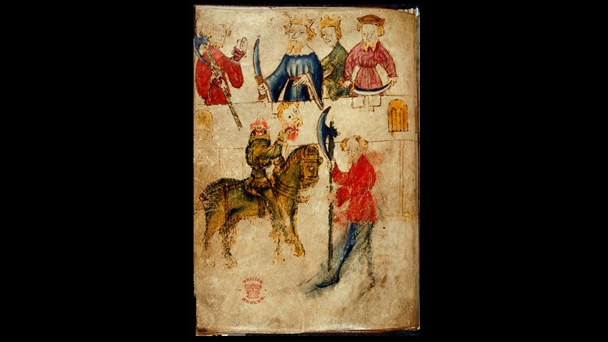
Four anonymous poems in Middle English: Pearl, Cleanness, Patience and Sir Gawain and the Green Knight. Created: c. 1400, North-West Midlands, Creator, Anonymous. Held by: British Library

One of the things that can be the hardest to explain to people who haven’t worked at the OU is how we teach. I’m not in this post going to get into the debates about teaching media (the pros and cons of digital and print have been energetically debated here and elsewhere recently) but rather want to focus on the pleasurable process of writing material for a new module, since I’ve just finished a first draft – in OU parlance, a D1 – on Sir Gawain and the Green Knight.

This will be part of a new level 2 module, The Novel and Beyond, due for first presentation in 2019.  (Level 2 is what the rest of the sector calls level 5, and again I’m going to resist the allure of a longer discussion of the manifold weirdnesses of OU nomenclature. If the OU were a religion, you’d see the success of its evangelical strategies in the readiness with which its staff adopt these slight but distinct deviations from normal registers: we work in codes which are just aslant of everyone else’s usages).

I mentioned the pleasurable process of drafting material. In the twenty years I’ve worked at the OU, I’ve always found this part of the job uniquely creative and enjoyable because that process is undertaken in a team environment which is typically energetic, questing and supportive. Added to this, the materials we devise will be studied by thousands of students: unlike conventional classroom teaching, OU modules are less ephemeral, being typically taught for around eight to ten years. That means your work – your enthusiasms and sometimes inevitably your errors of emphasis and judgement – will be shared by a large and shifting audience of students. At its best, working on a new module feels like you get the chance to say something perhaps you wouldn’t say elsewhere, about topics which you otherwise wouldn’t have a chance to engage with, to students and colleagues who are highly receptive to your efforts. That means that your register as a writer needs to be more sprightly – more demotic, less buttoned-up – than it would be in a monograph or book chapter.

This brings me to Sir Gawain and the Green Knight. As a specialist in Renaissance poetry, I often work with medieval texts and writers – Chaucer, Henryson, the Reynard the Fox stories are often on my desk; if pressed, Dante’s Inferno would probably be my Desert Island Book. But I’m not a medievalist, and I hadn’t anticipated getting a Middle English poem onto our curriculum. There are a range of reasons for this. In the dark backward abysm of OU time, a decision was taken that the Literature Department (as it was then) would focus chiefly on texts from the modern and early modern periods, with a smattering of works studied in translation; to all intents and purposes, Literature began with Shakespeare. Much of this was pragmatic: teaching Middle English at a distance was felt to be a step too far, and the staff and practices of the Department developed accordingly.

But new modules promote new ways of thinking. When the team designing The Novel and Beyond started work, we were sure that although we wanted our primary focus to be on prose fiction, we didn’t want that to exclude other genres, other ways of telling stories. After a protracted and increasingly nervous dalliance with Paradise Lost, I thought of Sir Gawain, and in particular Simon Armitage’s scintillating translation – could this be worth a try? It readily fitted into the module’s themes, and everyone was enthusiastic – much more enthusiastic than they were about poor old Milton. In the past couple of months, I have been working on this poem, which students will read in Armitage’s translation, with a smattering of Middle English terms introduced as needed. To adapt a line of Bertilak’s, when Gawain first arrives at the castle, if students listen, they ‘will learn the merits of language’ (l.918).

One of the perennial challenges of this process is integrating written materials with audio and video. When I consider the language and culture of Gawain, I do this through an interview with Professor Helen Barr, who is a specialist on alliterative poetry, and who taught me when I was an undergraduate. This interview outlines both what we know about the poem’s linguistic and cultural contexts, and most importantly, explains the poem’s stylistic recipe – how its alliterative verse form works. During recent months, Gawain has retuned my ear to the charming, distinctive idiom of Middle English alliterative poetry. I chose Armitage’s translation both because he’s a superb poet, and because his version tries to replicate the original poem’s alliterative patterns, which he neatly calls ‘the warp and the weft of the poem’ (p.viii).

Here’s an example from the stanza which Helen reads in our interview. In this passage, the poet describes the hardships of Gawain’s midwinter journey:

Nere slayne with the slete   he slepte in his yrnes
Mo nightes than inogh,   in nakede rokkes.

Armitage’s version isn’t a literal translation, and he finds some wonderful equivalents here:

With nerves frozen numb he napped in his armour,
bivouacked in the blackness amongst bare rocks (ll.729-30).

In the interview, Helen pointed out that one of the difficulties of alliterative poetry is the premium it sets on synonyms. The Gawain poet has a multitude of terms for man: burn, gome, rynk, tulk, wye – and, funniest of all to the modern eye, freke, a term which has survived, but with connotations which make it unusable in translation. The Gawain poet thought in synonyms to make his verse form work line after line. What a passage like this shows is that the alliterative pattern can generate evocative new phrases in modern English – ‘with nerves frozen numb’ is a nice periphrasis for ‘Nere slayne with the slete’, while ‘bivouacked in the blackness’ presents a new metaphor for Gawain’s grim journey.

What I particularly enjoyed about this aspect of our conversation was the way that it chimed with aspects of my own research. In my forthcoming monograph, The Art of The Faerie Queene, I argue that it is the limitations of a difficult form – in Spenser’s case, the intricate interwoven pattern of the Spenserian stanza – which enfranchise poetic experiment and new ways of writing. The Gawain poet and Armitage illustrate the same phenomenon. For all these poets, difficult forms lead not to the perhaps overpraised virtues of poetic concision but rather to an increased fullness of expression.

That’s what I hear in Armitage’s rendition of Gawain’s camping trip – a deliberate laying on of it thick, which, while it isn’t conventionally rhetorical, has a zip and a zest which mirrors the north midlands dialect of the original poem. That led me to thinking that there should be more experiment with these old, alliterative forms, and to read a different poem by the Gawain poet, also miraculously preserved in the single Cotton Nero A.x manuscript, Cleanness. Here’s a brief snippet from that poem – a couple of lines I found resonant in this summer of bright sun and elusive shade – when God appears to Abraham to warn him of the destruction of Soddom and Gomorrah:

He was schunt to the schadow   under shyre leaves.
Then was he ware on the way   of wlonk wyes thrynne (ll.605-06)

And here’s my own attempt at a poetic paraphrase:

He had shifted to the shadows under the shining leaves,
then he noticed on the bridleway three brilliant beings.

I’m not sure whether I’ll continue with this experiment, but the feel of this poetry, with its emphasis on a more elastic, variable sense of stress than the iambic pentameter of Spenser or Shakespeare is exciting and liberating. In brief, working closely with Gawain has made me newly aware of the oddness of English meters and the chances which have lead to the dominance of some forms rather than others.

Gawain is of course a quest poem. Gawain takes up the Green Knight’s challenge of the ‘lethal’ beheading ‘game’ (l.489), and has to undergo a series of tests which in his own reckoning diminish his self-esteem as he fails to be quite as honest, or as chaste, or as truthful (one of the poem’s key terms) as he would like to think of himself. Writing on this brilliant poem hasn’t been an ordeal to me, but it has reminded me of some of the things I love about working for the OU, which are in themselves related to the idea of a quest: the challenge of writing teaching material on something I am unlikely otherwise to research; the chance to blend different teaching media in what I hope will be an illuminating whole. And, as always, the desire to explain why this particular work might be interesting and worthy of study – how such a fantastical, unrealistic yarn may have some purchase on the way we live our lives today. I don’t yet know how students will react to the poem or my material, nor what my colleagues will think. But I am looking forwards to these encounters in a more optimistic frame of mind than Gawain when he sets off towards the Green Chapel in the last section of the poem:

‘So I’ll trek to the chapel and take my chances,
have it out with that ogre, speak openly to him,
whether fairness of foulness follows, however fate
                    behaves.’ (ll.2132-35)

Works cited

Simon Armitage, trans. (2009) Sir Gawain and the Green Knight. London: Faber and Faber.

Ad Putter and Myra Stokes, eds (2014) The Works of the Gawain Poet: Pearl, Cleanness, Patience, Sir Gawain and the Green Knight. London: Penguin ebook.

Somewhere in Between – Review

Somewhere in Between: Four Collaborations, Wellcome Collection, Euston Road, London, 8 March-27 August 2018

Sally O’Reilly, Lecturer, Creative Writing

‘Under’: Martina Amati and Kevin Fong. Courtesy of The Wellcome Collection. Used under Creative Commons Attribution 4.0 International Licence

I walk into a black box, disorientated for a moment as the space resolves itself. Giant blue screens show human shapes dancing on tightropes, strange sub-aqua acrobats. Sliding down against one dark wall, I take out my notebook and write in the darkness, wondering if by doing this I am rendering the experience of being here inauthentic. Over-thinking, under-feeling, creating responses that sound coherent when in reality I’m confused. There is a sound track which has a rhythm of breathing, suddenly interrupted by a tannoy announcement from Reception – the ‘Teeth’ tour commences shortly. I am here, but should I be?

The ‘Somewhere in Between’ exhibition at London’s Wellcome Collection is described by the Londonist as ‘wonderfully immersive’ and yet for me its reach and diversity make it a curiously distracting experience. Four collaborations between artists and scientists have created work which explores ideas relating to HIV, food production, sensory perception and the potential of the human body. There is a 54-page booklet providing copious background information, and yet somehow I feel lost.

Given that there are fine distinctions between definitions of ‘multidisciplinarity’,‘ interdisciplinarity’ and even ‘transdisciplinarity’, the title ‘Somewhere in Between’ is usefully vague. Outside in Euston Road, the temperature is close to 30 degrees. Inside the building, there are expensive books, delicious cakes, metropolitan cool.

The figures now flit against the turquoise blue. In the installation ‘Under’ artist Martina Arnati and anaesthetist Kevin Fong present an undersea vista in which free divers – diving without breathing apparatus – seem to inhabit a different world. I remember an Oscar Wilde story about a pearl diver who dies after bringing a pearl to the surface. The three screens are all different – I twist and turn to look at them. More visitors filter in, black silhouettes against the blue.

Next door, ‘Alien Sex Club’, John Walter’s collaboration with scientist Alison Rodger, is set up in a maze that feels like a 1980s party. The harsh subject matter – attitudes to HIV – is offset by the bright and garish colours, the vaguely party atmosphere. It’s another world again. There is a set of Tarot cards – I’d like to look more closely – but a herd of tourists are standing in the way. Should a reviewer be a curious mind on a stick, channelling responses? I’m feeling dizzy, and retreat.

‘Sire’ is the work of artist Maria McKinney and scientists Michael Doherty and David MacHugh. Eight bulls have been photographed, each magnificent and solitary, like portraits by George Stubbs.  They stare massively at the camera, monsters of testosterone, small eyes glinting with malign intelligence. They are astonishing creatures, emanating violent rage. McKinney has made sculptures from woven semen straws, which are used for artificial insemination, and each bull carries one of these on its back. I’m wondering what this is telling me. The flimsy, coloured structures might be a metaphor for extrinsic art, the add-on ‘nice to have’. Each bull has a nose ring, its minder holding it at a distance with  a metal rod.

And finally, two films by artist Daria Martin and scientist Michael Banissy: ‘Sensory Tests at the Threshold’. I watch these before reading about them, baffled, intrigued. A woman is told to say which cheek is being patted, left or right, and the sound track melds her robotic responses with various peculiar sounds – no tannoy interruption this time. A hi-fi speaker is placed before her, then a lamp, finally a red-lipped young man. She is distracted by him, loses the thread. The second film is longer, there seems to be a story, there are slatted blinds casting a strange light on the face of a Hispanic woman, some sort of tension. I remember when they used to show two Tarkovsky films in a row at the Ritzy in Brixton, you would emerge into the light of late afternoon barely knowing your own name.

Afterwards, I go to the café. Someone has spilled black coffee all over the service area. Eventually, I am given my pot of Earl Grey and a tiny chocolate brownie on a blue patterned plate. I sit among the cool people. Art and science, collaboration and conversation. It’s the eyes of the bulls that linger in my mind, that savage dignity.

Tolkien Exhibition: Review

Francesca Benatti, Research Fellow in Digital Humanities

I recently visited this exhibition, which is the first Tolkien exhibition in 26 years and showcases artefacts from the Bodleian, Marquette University Library and the Tolkien family private collections, some never exhibited before.

As an avid Tolkien reader since my teenage years, I approached the exhibition mostly from the point of view of someone interested in all things Middle-earth. The collections definitely satisfied my readerly expectations; indeed, they exceeded them by appealing also to my scholarly interest in the history of the book and of reading. Let us explore them in greater detail.

Firstly, I was pleased to see that the exhibition avoided a purely biographical focus. The life of the author is illustrated through photographs, letters and personal documents, such as an endearing “account book” where the undergraduate Tolkien recorded his study hours, to be exchanged for kisses from his future wife Edith. But these are supporting materials for the main story of the exhibition: the processes through which Tolkien created Middle-earth and took it from handwritten sketchbooks to the printed versions of The Hobbit and The Lord of the Rings.

The exhibition revealed to me Tolkien’s skills as an illustrator and calligrapher, which were somewhat obscured by the cheap editions of my student days or by the more recent reinterpretations of his works in numerous media. In fantasy literature, illustrations are central to the creation of a shared fictional world. Tolkien is revealed as profoundly involved with the material format of his books as well as their textual side. He shows himself a more than capable illustrator, for example through his original watercolours for The Hobbit and especially through his striking wraparound cover for the first edition of the novel, which is still in use today.

Compared to the visual feast of The Hobbit, the section dedicated to The Lord of the Rings focuses instead on the transformation of ‘the new hobbit’ into an altogether more ambitious tale. A manuscript title page captures a key moment in this process, when Tolkien crossed out the early working title ‘The Magic Ring’ and substituted it with the definitive The Lord of the Rings.

The centrepiece of the exhibition for me are the numerous draft maps of Middle-earth. Tolkien used his maps to provide a geographical framework for his readers and to aid himself in the composition of the plot. The maps in the exhibition also highlight the complex and collaborative nature of his writing process. The early maps are a mosaic of additions and deletions, held together by glue and parcel tape. Later versions show Tolkien engaged in a dialogue with other co-creators, from his son Christopher to illustrator Pauline Baynes (whom he recommended as the illustrator of his friend C.S. Lewis’ Chronicles of Narnia).

Finally, the biggest positive surprise for me was the exhibition’s explicit acknowledgement of the most important of Tolkien’s co-creators: his readers. The section entitled ‘Reading Tolkien’ displays hundreds of editions of his works in numerous languages, together with moving letters from readers famous and less so.

These artefacts testify to the breadth and diversity of reader perspectives (the counterculture pins reciting “Frodo lives” or “Gandalf for President” are especially poignant). Even more so, they demonstrate the fundamental role of the reading public in the unlikely transformation of a weighty one-thousand-page tome into the most successful book of the twentieth century. While J.R.R. Tolkien is indeed, at a textual and visual level, “the maker of Middle-earth”, readers like me and the visitors of the exhibition can certainly claim a level of co-authorship through their continued support and reinterpretation of his imaginary world.

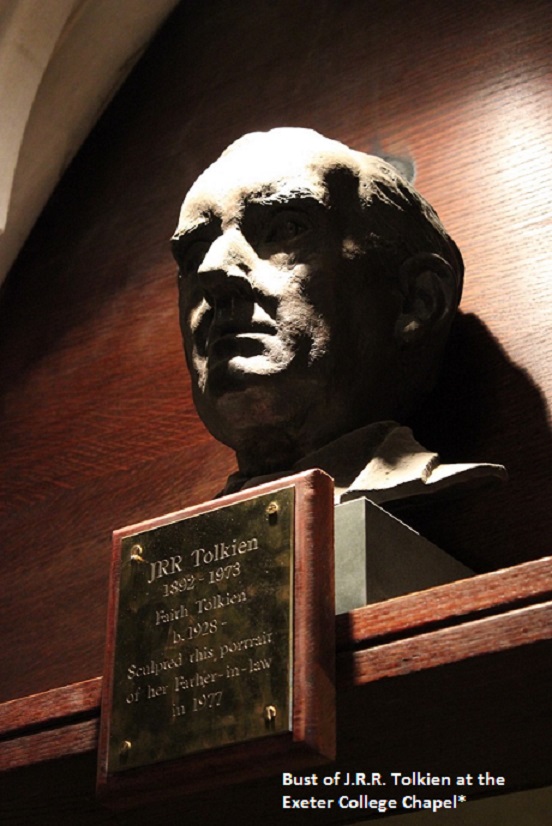
*Image credits: Bust of J.R.R. Tolkien in the chapel of Exeter College, Oxford. By Julian Nitzsche [CC BY-SA 3.0], from Wikimedia Commons


How Brexit is driving a rise in the language of everyday racism

Philip Seargeant, Senior Lecturer in Applied Linguistics

A hostile environment

In the aftermath of the Windrush scandal there’s been a great deal of discussion about the ‘hostile environment’ that was purposefully created by the government to persuade illegal immigrants to feel so unwelcome in the UK that they’d want to ‘go home’. The policy dictates that employers, landlords and even NHS staff must insist on scrutinising people’s documentation before they can offer them their services, thus creating a bureaucracy-based surveillance system which uses paranoia as a deterrent.

A hostile environment of this sort isn’t simply restricted to bank checks and paperwork, of course. It’s an ideology that permeates society as a whole, stoked by the pronouncements of politicians and the media. It’s created through the promotion of attitudes which discriminate against marginalised and minority groups. And as with the actual policy, it doesn’t necessarily make a distinction between legal and illegal immigration.

Much of the anti-immigration rhetoric that contributes to this hostile environment plays on explicitly racist ideas in the way that it stigmatises certain nationalities, and mocks characteristics which mark them out as different. One notable way in which it does this is through what’s known as linguistic xenophobia: discriminating against people based on way they speak or the language they use. For instance, in an article in The Sunday Times at the end of last month, the columnist Rod Liddle offered up an anti-immigration broadside based on the argument that the UK is already full. The piece was prompted by news from the Office for National Statistics that the number of Romanians living in the UK had overtaken Irish and Indians to become the second most-common non-British community. This provided Liddle with the opportunity to revisit Nigel Farage’s assertion from a few years ago that British people would rather live next to a German family than a Romanian one. Refuting that this should be seen as racist, Liddle argued that ‘Germans were more likely to be in employment and speak English – both qualities we tend to like in neighbours’.

His central argument here is that it’s fine to discriminate against certain nationalities living (perfectly legally) in this country if their levels of English are poor. And this, in turn, is based on the idea that to be a proper part of British society one must, by default, speak English. The trouble with this argument is that it’s founded on the patently false idea that the UK is, and has always been, a monolingual society, and that multilingualism is a problem rather than a boon to a rich and harmonious culture.

Multilingualism 

Some very basic facts show how misguided this is. The English language is not native to England, nor to the UK. It was imported from northern Europe in the 5th century, and it wasn’t used for government documents until 1430. The first British monarch to have English rather than French as his native language was Henry IV, who came to the throne in 1399. And as with a language such as Romanian, English has been greatly influenced by Latin, via the French. At present, the only official language in any part of the UK from a legislative point of view is Welsh in Wales.

This history of multilingualism in the UK continues to be the norm. 8% of the population in England and Wales reported in the 2011 census that their main language was something other than English, with a total of over 100 languages being spoken through the country.

Widening the context further, societies which have a single language are very much the exception around the globe. A report published by the British Academy in 2013 recorded that two-thirds of the world’s population are raised in multilingual environments. Although English is, today, the pre-eminent global language, it’s still only spoken by 6% of the world population as a native language. So the idea that a single language is a prerequisite for a harmonious society is simply wrong. Liddle’s remarks are thus a clear case of linguistic xenophobia.

And there’s a lot of evidence that there’s been a spike in this type of discrimination post- Brexit. There have been several reports of people being abused on the street simply because of the language they were speaking. There’s also evidence that this sort of discrimination is particularly aimed at immigrants from Eastern Europe.

This isn’t a problem restricted to the UK, of course. Much the same thing is happening in the US, as illustrated by the case of New York lawyer Aaron Schlossberg who was caught on video ranting against Spanish-speaking staff at a restaurant. In the video Schlossberg is shown saying that he’ll call Immigration and Customs Enforcement and have the workers ‘kicked out of my country’, then adding that in America ‘staff should be speaking English’. The language he uses here echoes almost precisely the assertion that Donald Trump himself made in the run-up to the presidential election, when he chastised his opponent Jeb Bush for speaking Spanish at public meetings by asserting that ‘This is a country where we speak English, not Spanish’. The fact that over 37 million US citizens now speak Spanish does little to undermine the ‘English only’ ideology.

Rhetorical strategies

Rod Liddle’s rhetoric may not be quite as direct as this, but the purpose is very clearly to mock and disparage. For instance, he quotes the first economic migrant to arrive in the UK from Romania when EU regulations changed in 2014 as saying ‘I haf not come to rob your country’. Transcribing the speech in this way uses what’s known as ‘eye dialect’, a way of representing regional or non-native dialect by spelling words in nonstandard ways. For instance, you can write ‘I woz’ or ‘he sez’ – on in this case ‘I haf’. In most cases, the nonstandard spelling would be pronounced in exactly the same way as the standard spelling. But it flags up the fact that the speaker’s accent is different from the norm. As the linguist Mark Liberman writes, it’s not necessarily a racist technique for describing people, but ‘there are a lot of racists out there; and many of them use eye dialect as a focus for their feelings of disgust and hatred’.

Throughout his piece Liddle uses a style of comic exaggeration, hiding the message behind a rather arch and hyperbolic style. This is much the same technique that Boris Johnson has used, and which has somehow allowed him to get away with racist slights such as suggesting that Barack Obama had an ‘ancestral dislike’ of the UK because he was ‘part-Kenyan’, and talking of the ‘crowds of flag-waving piccaninnies’ in the Commonwealth, and the inhabitants of the Congo having ‘watermelon smiles’.

And now we have the same ideas pushed in serious mainstream publications such as The Sunday Times. It’s done via techniques such as eye-dialect and stylistic exaggeration. But at its base it’s discrimination against a group based on culture not behaviour, and carried out by means of mockery. These are the sort of rhetorical strategies which don’t help to advance the debate around immigration, but instead simply normalise a crude from of hostile prejudice.


Scholarship and Research

Suman Gupta

Slightly out of focus

The connotations of the word ‘scholarship’ have always been a bit fuzzy, especially in academia. The OED puts it between, on the one hand, ‘learning, erudition; the collective attainments of scholars; the sphere of polite learning’, and, on the other hand, ‘applied, by unlearned speakers, etc., to educational attainments of a more modest character.’ Politeness and modesty in learning are not the average academic’s forte.

In a 1922 book, the linguist Otto Jespersen had decided a touch impatiently to ‘use the word “philology” in its continental sense, which is often rendered in English by the vague word “scholarship,” meaning thereby the study of the specific culture of one nation.’ That didn’t clear things up particularly. In English-speaking circles ‘philology’ was apt to be received with confusion and trepidation. To academic ears now that sounds like a specific sort of esoteric research.

Under the lens

Of late though, we professional academics in Britain are assured by HE bureaucrats that things have been cleared up. There is ‘scholarship’ and there is ‘research’, and these entail quite different activities. They are funded separately, accounted separately in our workload calculations, understood as leading toward distinct sorts of outcomes. Different centres of excellence (I haven’t come across any other sort) are devoted to each. Since the bureaucrats know that ‘scholarship’ and ‘research’ are different animals, they must have a rigorous definition of ‘scholarship’ at hand.

It seems that British HE bureaucrats have worked on it for a while, or rather have looked for guidance to their counterparts in Australia who have worked on it for a while. A policy paper produced by the Australian Minister for Employment, Education and Training in 1988 did the needful (for a discussion see Moses 1990):

Research
systematic and rigorous investigation aimed at the discovery of previously unknown phenomena, the development of explanatory theory and its application to new situations or problems, and the construction of original works of significant intellectual merit.

Scholarship
the analysis and interpretation of existing knowledge aimed at improving, through teaching or by other means of communication, the depth of human understanding.

In brief, one deals with new knowledge and the other with existing knowledge, and one is an end in itself and the other serves teaching.

That should have been the end of the matter, but it wasn’t quite. Questions remained. Is there a relationship between the two? Perhaps research is really an aspect of scholarship, or one is a subset or collateral of the other? Moreover, is the kind of work on existing knowledge that serves teaching also not research? Is that not what passes in Education faculties as research? Insofar as academics across all disciplines are exhorted to undertake ‘scholarship’ (apart from ‘research’) are they not being asked to encroach upon the research areas of their worthy colleagues in Education faculties? In the German education system, space for discipline-specific research into teaching practice was conventionally designated as ‘methodology’ within different faculties – in what way is this conception of ‘scholarship’ different? But that idea of ‘methodology’ allowed for a specific sort of research, so why is ‘research’ here separated from it?

Pellucid

The matter was seemingly laid to rest when the British government made it mandatory for all HE institutions to follow an academic workload accounting system (initially with the punchy acronym TRAC). The first TRAC guidance in 2005 put a lid on any debate, and we are still living with it despite slight modifications:

Research
Research and Experimental Development (R&D) comprise creative work undertaken on a systematic basis in order to increase the stock of knowledge of man, culture and society and the use of this stock of knowledge to devise new applications. R&D is a term covering three activities: basic research, applied research and experimental development.
> Basic research is experimental or theoretical work undertaken primarily to acquire new knowledge of the underlying foundation of phenomena and observable facts, without any particular application or use in view.
> Applied research is also original investigation undertaken in order to acquire new knowledge. It is, however, directed primarily towards a specific practical aim or objective.
> Experimental development is systematic work, drawing on existing knowledge gained from research and/or practical experience that is directed to producing new materials, products or devices, to installing new processes, systems and services, or to improving substantially those already produced or installed.

Scholarship:
Scholarship is activity that updates or maintains the knowledge of an individual; or adds to their skills and experience.  The knowledge base already exists elsewhere.
> Scholarship is therefore different from Research.  In particular, it is different from institution-/own-funded Research.  It is important that these terms are clearly distinguished.

I hope that answers all questions and any further debate can now be considered inefficient and impactless academic dithering.

Three Books

Sally O’Reilly, Lecturer, Creative Writing

I’ve no idea how many books I’ve read in my life. I know I started young and read avidly from the age of five. My earliest reading focused around magic and adventure, and I developed a passion for Roman warfare via the medium of Rosemary Sutcliff. The obsession with the details of shield deployment in a battlefield situation has faded; the love of reading that transports me to an unfamiliar place has not.

Here are three books that stand out from the rest:

The book I remember from my childhood

My common law step-grandfather gave me a boxed set of all the Narnia books when I was seven. I loved and re-reread them all, but the one that blew me away was The Magician’s Nephew, by C.S. Lewis, the tale of two Victorian children who travel back to the Genesis of Narnia. (I had yet to make the discovery that all of these books were Christian allegories, though very little seems to be under the radar when I look back on them now.) What I liked best was the evocation of lost London, in particular the attics that connected a row of tall houses, and the way in which Lewis boldly sets out his own Creation story, with Aslan breathing the new Narnia into being. It seemed that anything was possible, anything could be described in a book, and I found that so exciting.

My all-time favourite book/ultimate recommendation

It’s impossible to be accurate about this, as these things do shift around as you find new things, but I keep coming back to Emily Bronte’s Wuthering Heights, which recently took a bit of a drubbing among some of my Facebook friends for its poor plot structure.  There is a danger in teaching creative writing that you might suggest that there are absolutes in writing, when I would say there are just two – read a lot and write a lot – and this book is proof of that.

This is what I wrote on Facebook in its defence: ‘It’s not a sensible book at all, but so mad and intense that it creates its own weird magic space, unlike anything. Charlotte Bronte’s books, crazed as they are, are positively Austen-like in their restraint compared to this one.’ What stays with me from this book is its character, the moor, the intensity of teenage passion, something bleak and mysterious that doesn’t make any sense. It’s my ultimate recommendation (today) because of this – few writers can communicate the essence of obsession and contrariness as Emily Bronte does in this book. And I also actually love the Russian doll structure, tales within tales, the enjoyment in a story told by a fireside with the wind howling outside.

The book I am reading now 

I’m currently reading Reality Hunger by David Shields, which is opening my eyes to the extent to which my own genre of writing, historical fiction, overlaps with creative nonfiction as well as fiction.  I’d describe this book as an opinion-starter, and it’s a bit ‘novel is dead’ (or at least in intensive care) for my taste. I think the novel, literary or generic, will absorb all comers – the success of Karl Ove Knausgaard’s maximalist My Struggle series is an example of fiction that encompasses many of the tropes and conventions of nonfiction.