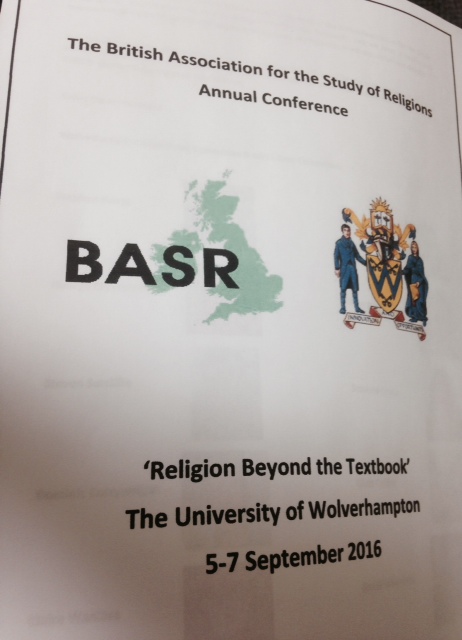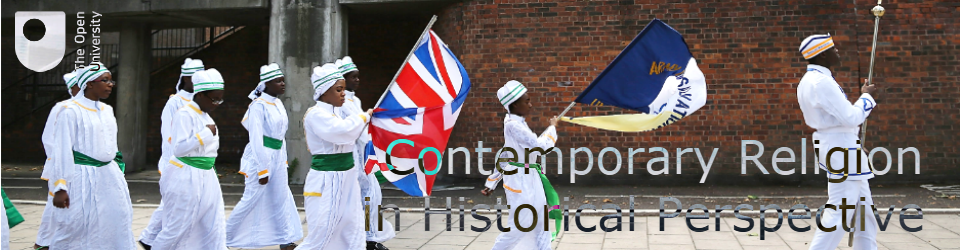
A very strong OU Religious Studies presence at BASR Conference this year: four faculty, four PhD students and 2 former PhD students. All taking a very active part in proceedings, giving papers, chairing round table discussions, etc.
Apply for fully-funded PhD studentships at the OU
To mark the launch of our Graduate School in October 2016, The Open University is making a strategic investment in up to 30 PhD studentships. As part of this initiative, the Faculty of Arts and Social Sciences is keen to receive applications for studentships in history/historical studies or sociology (both broadly defined to include historical and/or sociological approaches to any area of the Arts and Social Sciences). Open University Graduate School PhD studentships will cover full fees and stipend (currently £14,057 p.a.) for 3 years commencing October 2016 (or shortly thereafter). Applications are invited from both UK and EU citizens for full-time study.
Specialist expertise in religious history in the Religious Studies department at the OU includes evangelical and charismatic movements in the 19th and 20th century North Atlantic world, modern Hinduism, historical approaches to religious conflict, and the history of pilgrimage.
You can find out more information here – http://www.open.ac.uk/Arts/research/funded-studentships.shtml
Expertise and engagement
The following article is by a Ph.D student in the department:
My name is Theo Wildcroft, and I’m currently undertaking a doctoral research project looking at unusual forms of modern yoga practice.
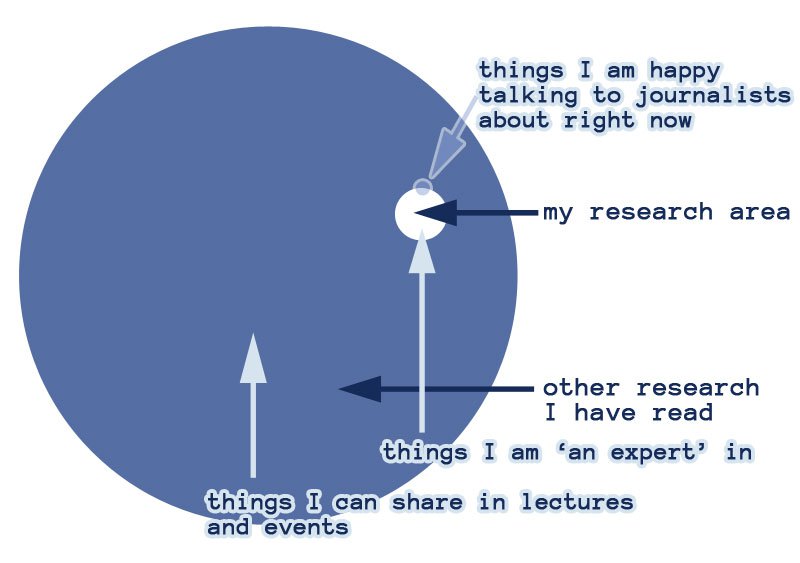
One funny thing about doing a PhD is that you enter into the status of An Expert. By the end of the process, you should know more than anyone about this one tiny area you’ve studied in a very specific way. And PhDs can be very tiny and deep in scope. So one of the first tasks of the research project is to draw a line around what it’s possible and interesting for you to study, and in what way.
Star Wars
Yesterday was Star Wars day. Can Jediism be classed as a religion, or is it merely a cultural fad?
http://www.open.edu/openlearn/whats-on/events/star-wars-vii-can-jediism-be-classed-religion
A notice of forthcoming attractions: Anglicanism since 1688
Friends, we are now on Twitter…
Why not follow us on Twitter…?
@religion_ou
Religious Studies Project at OU Digital Humanities
Last Monday we enjoyed an excellent Digital Humanities seminar and workshop courtesy of Chris Cotter and David Robertson of the Religious Studies Project. Their seminar topic was Impact and Engagement, and for those of you who weren’t able to make it they have kindly made available the slides of their talk here https://docs.google.com/presentation/d/1ayLLtJXNmsEpJ7TYbZEIlkheh02UfrYO0kf9A27HYjU
There are some really interesting insights here on using podcasts, online collaboration and networking.
Art, Pilgrimage and London Stations
Among the many interests of the researchers on the AHRC funded project Pilgrimage and England’s Cathedrals, Past and Present [http://www.pilgrimageandcathedrals.ac.uk/about] is the role of art and material culture in English cathedrals: what sort of art is displayed in, and commissioned by, cathedrals, and how do people react to and interact with such art? I was fascinated, therefore, to learn of ‘Stations of the cross’, described on its own website as a
‘unique exhibition—held in 14 locations across London—[that] uses works of art to tell the story of the Passion in a new way, for people of different faiths. In this pilgrimage for art lovers, viewers will travel across London, mapping the geography of the Holy Land onto the streets of a “new Jerusalem”.’ [http://www.coexisthouse.org.uk/stations2016.html]
In some denominations of Christianity, the Stations of the Cross depict and reconstruct the last journey of Jesus through Jerusalem, from being condemned to death to being laid in his tomb. Around Easter especially, this relocation and replication of sacred time and place can take on a particular resonance. The rationale of the London Stations of the Cross art trail is to break up the traditional grouping which miniaturises the last journey within one space. Instead, it spreads the 14 stations across London. Artworks in a variety of locations (cathedrals, art galleries, churches, outdoor sites) are designated as particular stations, inviting contemplation of the works of art, their locations, and their contemporary resonances with each station’s traditional story.
How Indigenous festivals contribute to understanding ritual(s)
As part of the REDO team of researchers (funded by the Norwegian Research Council*) exploring the relationships between rituals and democracy, I have been privileged to spend time at a number of Indigenous festivals. In particular, I have been considering the multiple activities that make up the Riddu Riddu festival in arctic Norway. More properly, it is located in a valley in the Sámi territory of Sapmi. Each July large numbers of people gather to hear Indigenous performers from round the world as well as to hear talks, join in discussions, buy crafts, and party in the continuous sunlight of the arctic summer. Many different styles of music are performed on the main stage, from rock and reggae to the traditional chants of various Indigenous peoples, especially the Sámi yoik. I’m interested in the different ways in which performers draw on the resources and repertoires of Indigenous rituals to create and offer what they offer to their audiences. Then there are theatre pieces that catch people up into something transformative, illustrating the ways in which entertainment can take on the flavour of profound ritual. In this vibrant context of cultural interchange and spectacle, I’m examining the subtle and explicit expressions of Indigenous vitality, sovereignty and community-making. I’ll be writing more about that soon.
Alongside that annual event, I’ve been participating in other Indigenous gatherings. Every two years there is a wonderful extravaganza of Indigenous cultural display in London’s Origins Festival of First Nations. I should note, then, that I have been deliberately capitalising the word “Indigenous” to refer to peoples, nations or cultures that self-identify as such, and have found recognition in international forums such as the United Nations. There is a large debate about what “Indigenous” might mean and how scholars might use the term – especially because it is employed, like many self-designations, somewhat polemically or perhaps strategically. It is, perhaps, roughly synonymous with words like “native”, “aboriginal” or “First Nations” – all of which draw attention to modes of belonging to particular places, lands or communities. This too deserves more discussion!
In June 2015, I was involved in the making of the short film above. It showcases some of the performers and artists from the Origins Festival, especially in events at the British Museum, at RichMix club and in a park in west London. These provided unrivalled venues for considering what these eloquent Indigenous people wanted to convey to their audiences and others. I think there’s a richness in the video that deserves watching more than once to catch its nuances. It is intended to provide insights into significant issues for Indigenous peoples as well as to encourage further discussion and engagement.
Graham Harvey (Open University)
*http://www.tf.uio.no/english/research/projects/redo/
A new Swaminarayan Hindu temple in Preston
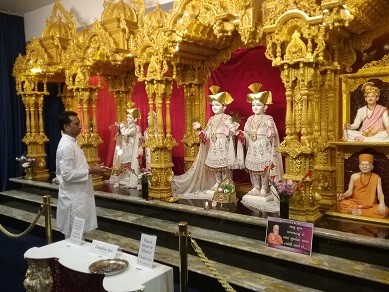
The weekend of 7-8 November saw the official opening of the new BAPS Swaminarayan temple in Preston. The celebratory Nagar Yatra (round-city procession) on the Saturday afternoon started in Preston Market Place where the procession formed with the new images, which would be installed in the temple on the Sunday, being adorned on ornately decorated vehicles. The main shopping street in the city centre was closed off while the procession made its way slowly through the Saturday-afternoon shoppers. Continue reading