
When in 1987 I joined the OU’s Design Department (as it then was called) it was to work with Robin Roy in the Design Innovation Group (DIG) on a project to evaluate the commercial impacts of the Design Council’s Funded Consultancy Programme. Under this, SMEs were awarded a grant to employ a design consultant to help develop or improve a wide range of product or graphic designs. The Design Council wanted to know how these projects had fared and what wider economic impacts they had produced.
Recently, I was having dinner with my cousins in a restaurant near Chelmsford when a conversation with the waiter produced a flashback to that old design research work. The waiter mentioned that he worked part time at the local vineyard and that a busy time was coming up for harvest, followed by pruning the grape vines and his job was to re-tension the supporting wires. A memory of that 1980s project came back to me and I asked ‘do you use Gripples?’. Delighted by this question, he then expounded the merits of the Gripple wire joining and tensioning device and how the vineyard had tried cheaper alternatives, but they returned and stuck with the Gripple because it was so well designed and worked better than anything else.
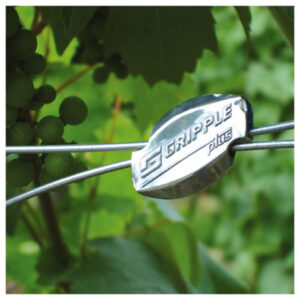
The reason I knew about Gripples was that, in 1988, I had visited their factory as part of the DIG Commercial Impacts of Design project, and they had a design consultancy grant for a consultant to improve the Gripple design. The picture here shows the present version of the Gripple (appropriately linking two wires on a grapevine support).
When I visited the company in 1988, they were a relatively small wire fencing manufacturer. In 1986, wire salesman Hugh Facey had a conversation with a Welsh farmer about how time-consuming and awkward it was to tension the fencing wires. Hugh gave this some thought which led to the original “Gripple” wire tensioner and joiner. This was seen as a supplementary product to their core wire fencing business, with the first Gripples being sold about the time I visited them. Rapidly the Gripple proved a commercial success. Today, Sheffield-based Gripple Ltd employs 950 people in the UK and across its operations worldwide and produces over 30 million Gripples every year, some of which end up in an Essex vineyard near Chelmsford.
The results of our Commercial Impacts of Design project were published in a Design Studies article in 1991 (see Open Research Online), which does feature a short case study of the Gripple. Possibly we should check up on how the other Funded Design Consultancy projects fared in the long term. There is, perhaps, also a lesson here for today. The government is (rather desperately) seeking economic growth and throwing money it possibly does not have at a range of infrastructure and other projects. 35 years ago, our research on the impact of SMEs employing, for just a few weeks, a professional designer, showed that this did produce good economic returns. Long term, the Gripple story shows that a good design can produce substantial dividends. The role that our design industry can play in Britain’s economic recovery should not be overlooked.
Leave a Reply