The Design Wishes Tarot builds on a long tradition within the U101: Design Thinking module. For over a decade, students have been provided postcards so that they could post them back to the Open University, addressed to LOLA—’the spirit’ of the module. On these cards, they were invited to express their wishes and hopes for the future. Many did. The result is a remarkable archive: thousands of short, personal statements capturing a wide spectrum of anxieties, aspirations, and playful imaginings. Some wishes are light-hearted or mundane, others ambitiously focused on study, career, or personal transformation. Taken together, they offer a collective snapshot of what students hope for in their studies, their lives, and their futures.
For many years, these postcards had simply accumulated. As part of a scholarship project with Georgy Holden and James Warren, we decided to take them seriously: to analyse and categorise them and explore how they might be put to new use. The process began with transcription and analysis, which turned out to be more complicated than expected. We may write a separate post about this analysis another time.
For me, I approached the postcards in a very immediate way. I was struck by the language itself. Some phrases made me laugh out loud; others were unexpectedly sad or surreal. I wanted to do more than categorise them—I wanted to give them a visual form that could communicate their sense, humour and emotional weight.
The metaphor I chose was Tarot. Tarot cards have a long history, beginning as playing cards for a competitive social game before gaining mystical and symbolic interpretations. They are both playful and reflective, with built-in affordances: the four suits and the Major Arcana, populated by archetypes such as The Hermit and The Devil. This dual character—serious and light, structured yet open—seemed a perfect fit for the student wishes to give them a sense as a coherent collective Tarot deck.
Designing with Generative AI
Translating the spreadsheet of textual wishes into Tarot cards was a long design process of experimentation with generative AI as well as old skool Photoshop and JavaScript coding. I tried a number of AI platforms. MidJourney was striking in its ability to merge concepts into a single image, but the results often drifted into kitsch, with a visual language that felt railroaded. Ultimately, I found Adobe Firefly offered more control over composition and style. By guiding it with examples from the classic Rider–Waite Tarot deck which is the most widely known Tarot used today. It allowed me to produce a deck with a coherent colour palette that combined medieval mysticism and symbolism with contemporary elements such as sports cars, laptops, paragliders, and pressure washers.
What fascinated me about the design with AI process were the glitches and misunderstandings it involved. These often became productive starting points rather than mistakes. The AI disallowed certain prompts for imagined infringements or gave me cheesy suggestions. People forget about the hidden labour that’s involved in creating anything with AI. Anyway, I enjoyed learning what worked and what didn’t. Often, I had to try many prompts in order to capture a particular sense or to link a Tarot card to a visual image. But the end results were often surprising and intriguing. These hybrid images—part overly literal, part surreal—give the deck a layered quality that felt true to the imaginative and ambiguous nature of the wishes themselves.
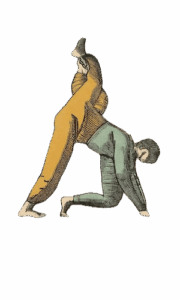
The Ace of Body card was based on the wish: get fit, I want to be able to do some amazing yoga poses, sort life out! Move to Amsterdam. The resulting image resembled a woodcut or a de Chirico figure with multiple arms and legs, contorted into an impossible yoga pose. The Ace of Hearts card, based on the wish teach my cat to give me his paw, shows a stern gentleman in elaborate hunting garb holding a paw aloft, while the cat is a strange panther-like creature with two tails. The Three of World card came from the wish: get to grips with Rhino 3D and build my first website. The AI produced a satisfied-looking gentleman riding a giant rhino in front of a giant full moon and a blood-red sky.
I loved making the cards and often found myself enthused by their otherworldliness of magical creatures hiding in corners. Many cards required manual touch-ups—editing out gibberish texts or distorted elements the AI had inserted. They needed in-painting, out-painting, framing, tidying, making borders and polishing—across late nights over the Christmas period—selecting which ones resonated, which made me laugh, and which intrigued me enough to keep.
In all their mundane and glorious strangeness, these cards began to feel alive to me. I felt warmly towards them, not as the product of alienated AI labour but as mashups pieced together from centuries of visual culture: fairy tales of strange wanderers, pop culture poses, AI glitches, mystical Tarot magicians—while always tethered to the student wishes that inspired them.
Connecting with Students
I hope the Tarot cards ultimately allow us to do is to engage with the open-ended, expansive, and contradictory design student wishes. These wishes are not data points or evidence in the conventional sense, but prompts for reflection, surreal humour, and refracted empathy. Drawing a card means temporarily inhabiting someone else’s longing and considering how it resonates with our own.
The Design Wishes Tarot is not a finished product, but a playful, open-to-interpretation tool for engaging with design wishes in the making. I invite you to try it yourself. Maybe you’ll find the Card of the Day will give you inspiration for your own design. Maybe the Celtic Cross allows you to do some detailed analysis of the past, future of problems. Maybe the SMART layout will allow you to set measurable and achievable objectives 😉
The deck can be viewed and installed on Android, iOS, and desktop computers:
https://softhook.github.io/Tarot/

Leave a Reply