
“There is something very special about the studio as a place of practice and learning”
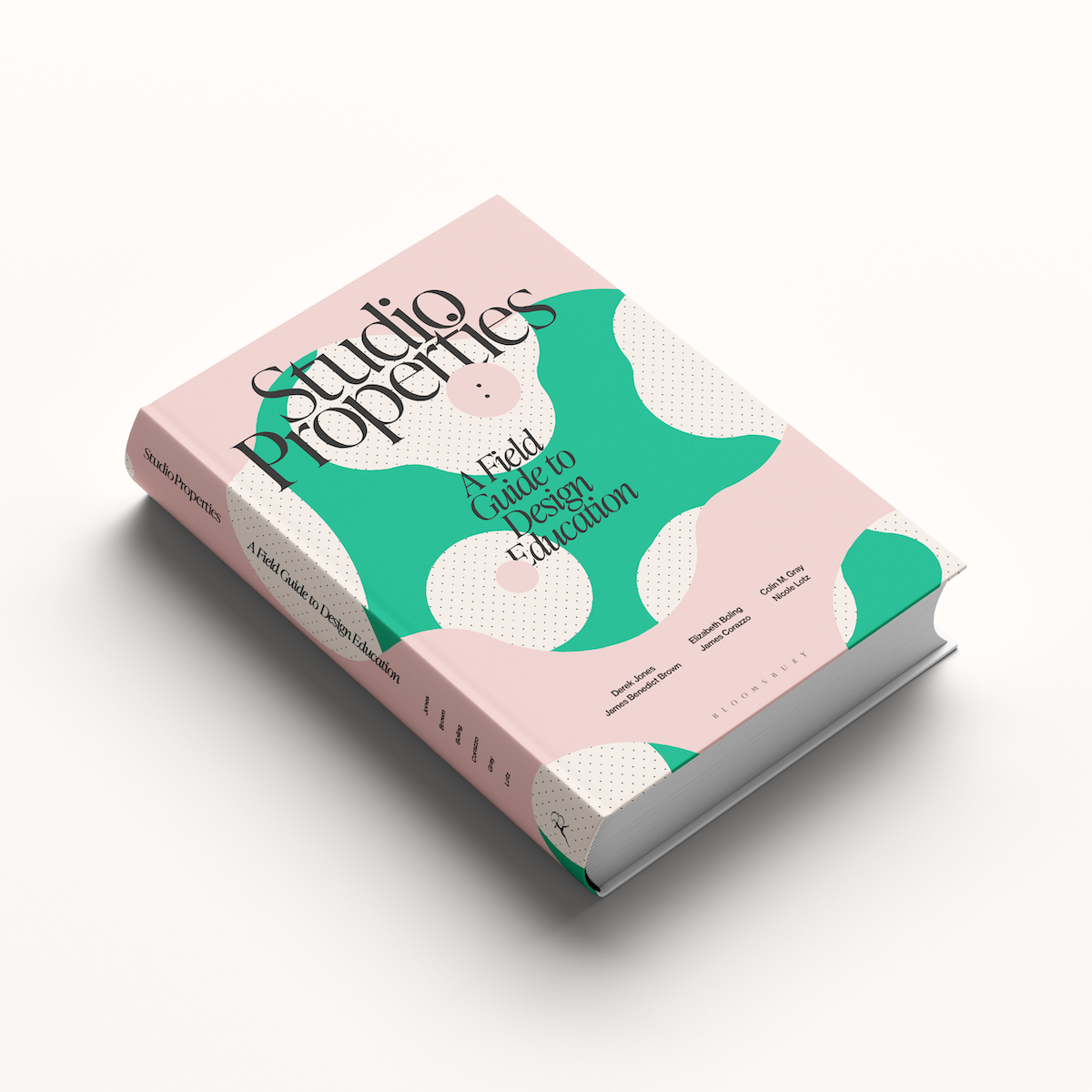
After years of research and writing, Studio Properties: A Field Guide to Design Education is now out!
The book is co-authored by a team of international design educators and scholars, including myself (Derek Jones) and Nicole Lotz. It builds on a lot of the work we’ve both done on studio applied in online and distance settings.
From the back:
Studio is a complex form of teaching and learning. If you have not experienced studio, it may seem mysterious, even chaotic. If you have experienced studio, you may want to know more about how and why it works. Either way, Studio Properties will deepen your understanding of studio to help you teach, research, or administer design education more effectively and with greater confidence and creativity.
The book is the first in a new series on Design Education by Bloomsbury Academic, which highlights the growing importance of this as a knowledge discipline. In fact, one of the findings of the book was the fact that design educators have a huge body of knowledge to inform practices but that this is very often distributed across different sub-disciplines of education.
What we really hope is to offer a single point of reference for a lot of this existing work – a place to start scholarship and research into design education.
Why studio?
Studio is special because it has been maintained as a human practice for thousands of years. It has also been central to almost all areas of design education – you learn design by doing design in a studio environment. It’s a particular place and pedagogy that operates in a distinct way.
However, as a place of practice and learning, it also evolves and adapts to those participating in it and the contexts in which it operates.
That makes it both really complex and really simple. Complex because it’s people, place, values, cultures, customs, and the usual human stuff. Simple, because it is what it is, and educators just get on with teaching the next generation of designers.
So, writing a book that attempts to preserve both characteristics was an important challenge for us as authors. We hope we’ve found the right balance in how we’ve presented studio – as a series of properties, not as a definition.
The physical thing itself
One thing that really mattered throughout was the design of the book itself. We have not created a traditional book that has chapters and that can be understood as a linear narrative. Studio is not easily broken into chunks and it is most definitely not linear.
We spent a long time working with A–R Studio, a design company that have experience in book design and they came up with what we think is a fantastic looking object.
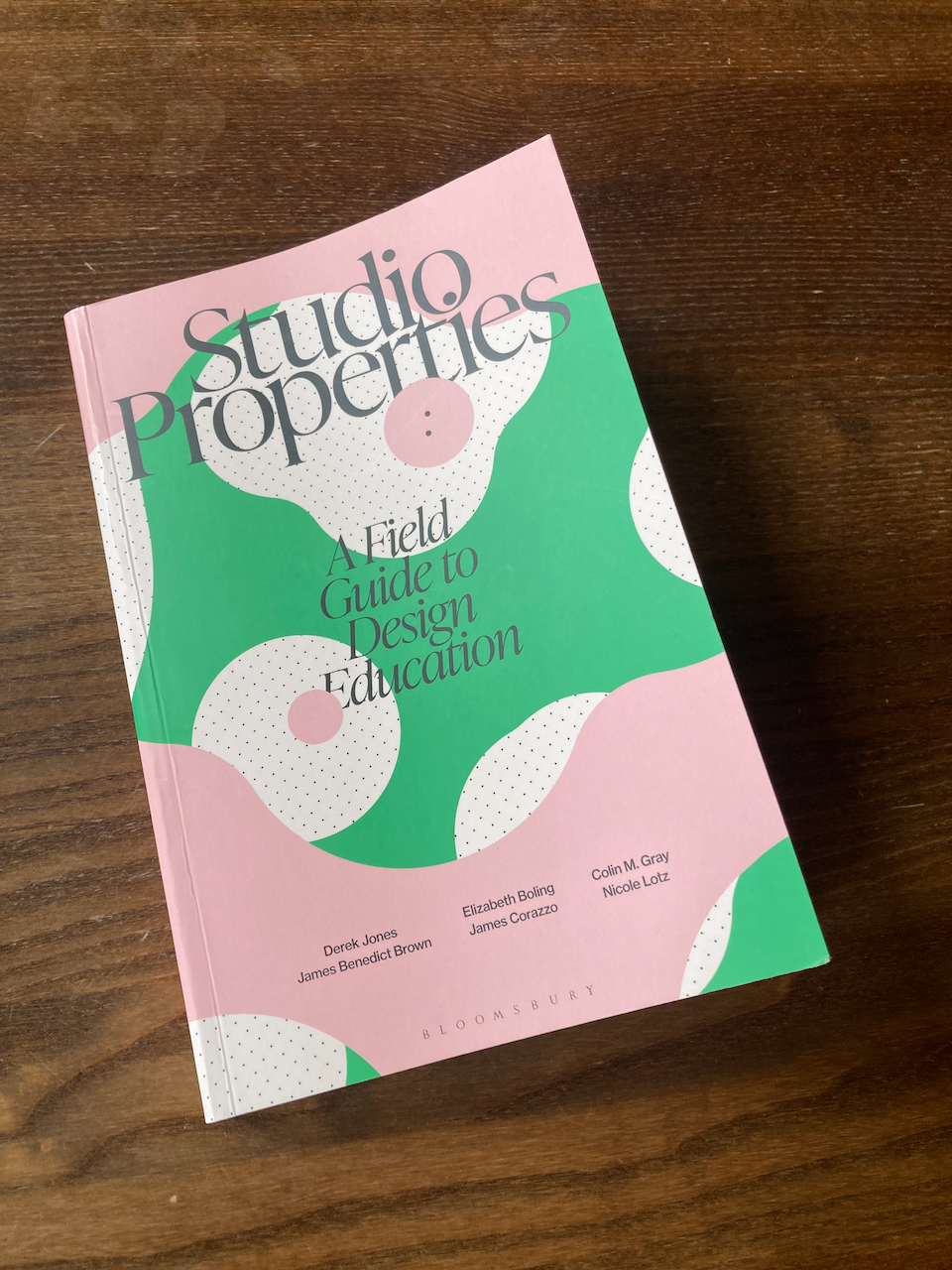

But it’s also a very practical book. To read it about studio you have to flick between different elements of it. If you’re thinking about engagement you need to know about several other aspects of studio (like Confidence to Speak, Immersion, Social Networks, Dialogue, etc.).
That’s why we spent a lot of time on how readers will use the book (and it does feel nice to hold the actual thing itself, something I’ve written about on the Studio Properties blog Lickability, Heft, and Looking Good – Studio Properties).
Open Access
The book is also an Open Access Resource, thanks to the incredible support of eSTEeM, the Faculty of Science, Technology, Engineering and Mathematics Centre for Scholarship and Innovation.
Both Nicole and I have worked on many eSTEeM projects in the past and it’s fair to say that these experiences have influenced us both. The way we create learning and teaching materials at the OU is different to traditional institutions and it demands that you take scholarship and research seriously by applying it directly to how we create materials. That, in turn, that feeds into new scholarship and then research.
This virtuous cycle of teaching > Scholarship > Research and then back again, is most most definitely a strong cultural thing at the OU and one that is embodied in eSTEeM, which supports many educators at the OU to engage seriously with their own scholarship. Without esteem we wouldn’t have been able to publish the book as an Open Access Resources.
You can get the Open version of the book on Bloomsbury Collections.
Contribution to knowledge
What the book really shows in the enmeshment of parts that make up studio. It contributes to knowledge around complex and rich systems by showing how interrelations of parts (which are themselves important elements of a system) create a far greater value than simply adding them together. This goes some way to supporting the idea of studio being ‘more than the sum of the parts’ but does so in a really pragmatic and realistic way.
To put it simply, you cannot just take a bit of studio and isolate it without understanding that it is deeply connected to many other bits. For example, understanding social learning in studio requires some acknowledgement of the many other properties and factors that relate to it. As our own previous work has shown, you cannot apply simplistic learning models, such as social learning, to studio without amending them to suit the context of the study (Jones, Lotz, Holden, 2021). Similarly, the additional value and benefit that is derived from this often goes unmeasured as opposed to not existing (Lotz, Jones, Holden, 2018; 2019).
What’s next?
The book is really just the start of what we’d like to do.
Studio is increasingly under pressure in higher education because it’s often seen as a space and not a pedagogy (fellow author Prof. Elizabeth Boling writes about this in her blog post Cost-effective studio education is not a finance problem. As the book says, ‘There is something special about studio as a place” and if we don’t take that seriously as a pedagogical need in design education (not just a nice thing to haver) then we could end up losing more than we think. Studio is a pedagogy, not just a room or online service.
It can also be used as a critical framework to examine existing practice, think creatively about how to change studios, as well as support the development of new curricula – regardless of how this is delivered. The book is, like any good design, deliberately incomplete. There are certain things we definitely did not cover because it would be better for others to do that.
And, as noted above, studio is always changing and adapting, meaning the properties that make it up also change.
But that’s for Studio Properties 2…
Studio Properties is available to buy on the Bloomsbury website and is free to download from Bloomsbury Collections.
You can find out more about the book, as well as additional materials, on the Studio Properties blog.
If anyone is interested in using the book in their own studio teaching then please get in touch (mailto:[email protected]).
Leave a Reply