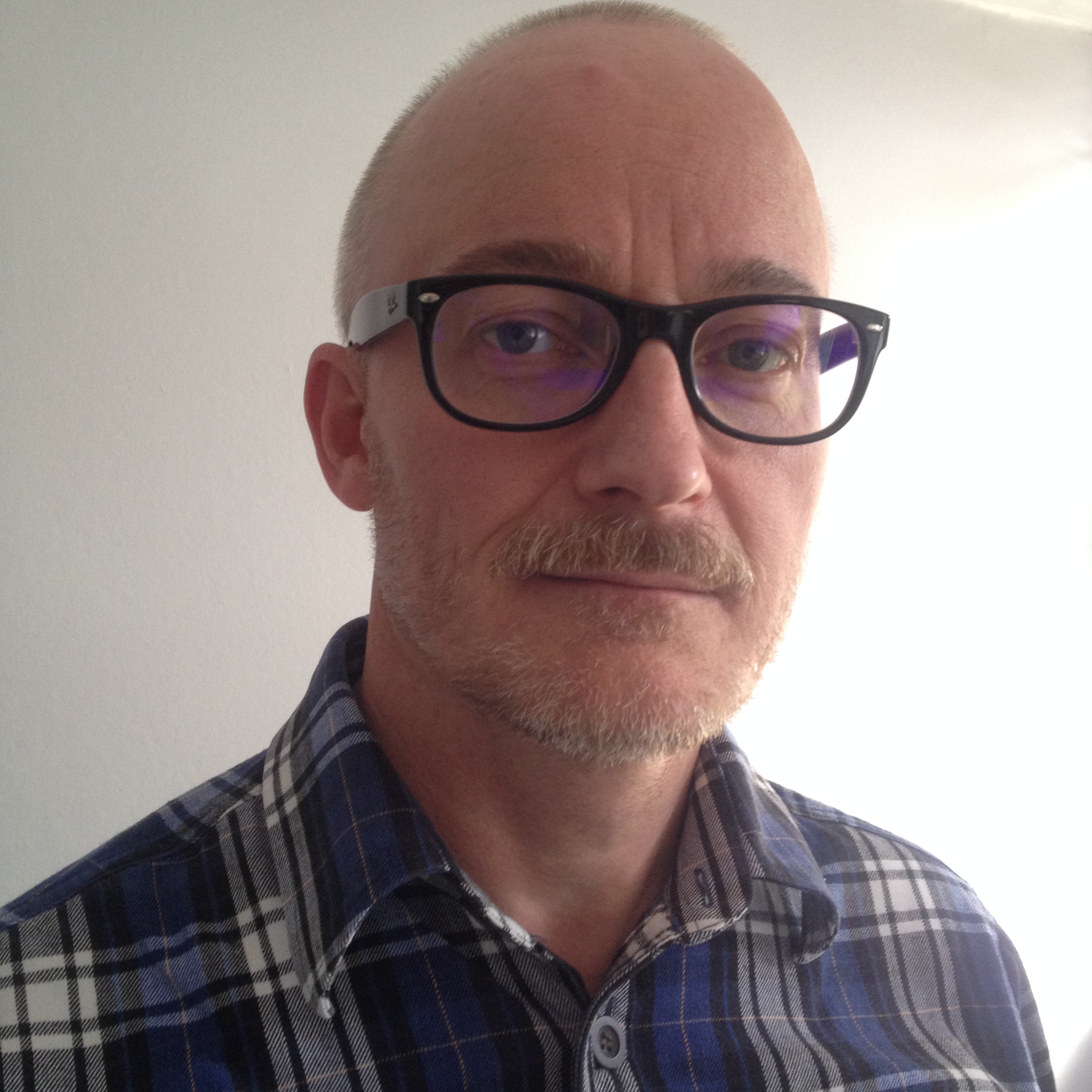
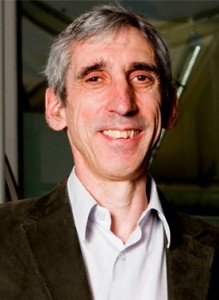
Professor Richard Holliman, The Open University. Credit: Jane Perrone.
Students from Walton High, a school in Milton Keynes, have been finding out that the sky is definitely not the limit when it comes to research at The Open University (OU).
In late July, as part of their digital media production course, ten BTEC students visited the OU campus to find out more about its work on Europe’s comet-chasing spacecraft Rosetta – the world’s first mission to land on a comet.
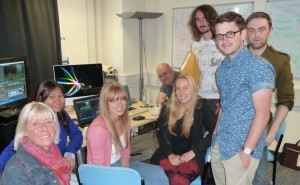
Media Training Workshop, l-r: Janet Sumner, Hnin Myint, Mairi Walker, Gerard Giorgi-Coll, Phillipa Smith, Jamie Dorey, Frazer Bird and Tom Ryan
When I got an email from Richard Holliman about an Open University (OU) media skills training course, it took me all of 30 seconds to double-check with my PhD supervisor and sign up. I’d previously attended a one-day event with the Royal Society, and was keen for a more in-depth course. I had no idea what to expect, but was excited to hear that the aim of the course would be to build up the skills needed to design, produce and edit a short film.
From the 2nd to 6th June I worked with fellow OU PhD students Frazer Bird, Jamie Dorey, Hnin Myint, and Phillipa Smith, under the expert guidance of presenter Janet Sumner, cinematographer Gerard Giorgi-Coll and Assistant Producer Tom Ryan to create a short film about a collaborative research project between the OU and the Field Studies Council (FSC), an environmental education charity that provides opportunities for people of all ages to engage in fieldwork. You can watch the results of our efforts by selecting the video below.
Another week of media training, this time looking at space science!
Jessica Carr - Open University Intern
Monday
I worked today with the new group of media students from Walton High. I got the chance to meet them last week at the briefing but in the space of a week had managed to forget everyone’s names; obviously not my strong point.
Monday is always the day that the students learn how to interview. Luckily I managed to get out of being the guinea pig and instead got to watch Manisha, the teacher, squirm.
Although very shy to start with the students slowly started to come out of their shells a little, especially when put in front of a camera.
Nazlin Bhimani, Research Support & Special Collections Librarian
Early in June 2014, members of the Newsam Library & Archives met to discuss ways to better promote our services and collections to our users via Twitter. @IOELibrary joined Twitter in June 2011 and has gathered about 625 followers. We wanted to get a team, representing all the different sections in the Library (Collection Development, User Services, Technical Services and Administration), that would take responsibility for tweeting for @IOELibrary. We had no special requirements for the staff. They didn’t need to be experienced users of Twitter. We simply wanted interested people who had interesting things to say. Continue reading →
Ah, the irony. A workshop on how researchers use social media that was conducted entirely through the medium of a board game and cut-out paper snakes. Continue reading →
Creating and sustaining an online research presence
As part of a small team of researchers working within the OU’s Public Engagement with Research Catalyst team, Trevor Collins and I have been exploring how researchers across the OU are using digital tools as part of their public engagement with research activities to develop an online presence that sustains public engagement with their research. Here’s an update on the work we’ve been doing…
Research staff surveys
The first step was to include four questions in the Vitae CROS and PIRLS research staff surveys in 2013. In one, we asked respondents to give us an example of a public engagement activity they had undertaken; only 3.5% (six people) identified some form of digital engagement (e.g. blogging, citizen science, podcasting, etc.). This suggests either that respondents are unaware of the potential of digital tools as an engagement technology or do not think of digital technologies as a means for engagement.
The conference celebrated 10 years of science communication programmes based at the SCU and it was lovely to see that around a fifth of delegates on the day were our graduates.
The programme was packed with interesting plenary talks, vibrant presentations and quick paced PechaKucha chats. The Science Communication Unit @SciCommsUWE Twitter feed captures some of the online discussion, and we’ve also created a Storify of the day.
On Friday 4th April 2014 I’ll be involved in hosting the second conference in our Evolving Science Communication series. You can find details of the first, held five years ago, in this report.
This conference celebrates 10 years of science communication programmes based at the Science Communication Unit (SCU), University of the West of England, Bristol. We’ve been delighted to work with our graduates to design a conference programme that we hope appeals to them, as well as to others currently working in and/or researching the ‘field’. Continue reading →
Dr Richard Holliman, OU Champion for Public Engagement with Research
Leadership; Mission; Communication
Champion’s blog; star date 2014.03.10 (in effect, an update on the first post on this blog, ‘An open research university‘).
Nearly two years of the mission completed; 14 months of funding left. “Where do we boldly go from here?”
I was interviewed late last year by Lucian Hudson, the OU’s Director of Communications, to explore this question. We also discussed progress with the core mission of the OU’s Public Engagement with Research Catalyst.
You can see the results of our discussion in the video below. If you’d prefer to read the text of the interview, select transcript.
The Open University is over 40 years old. To celebrate this anniversary the university decided to document the rich social history of the OU.
As a social historian I was delighted to be given the opportunity to lead this project. Below I document some of the contributions Open University students have made to an open research agenda.
Constructing distributed publics of learners
Since it was opened to students in 1971 The Open University’s structures and pedagogies have shifted the notion of public research. A ‘public’, Michael Warner argued, is formed when texts (in the broadest sense) circulate among strangers and enable those people, through those texts, to organize together and to have experiences in common. Continue reading →