
What Maslow’s hammer and design fixation has taught me about methods, power, and adaptive design practice by Rachel A.Wood
Most of us know Maslow’s hierarchy of needs. Less familiar, but equally useful for designers, is Maslow’s hammer: the tendency to treat every problem as if it can be solved by the tool already in hand. Bringing this idea together with design fixation raises a practical question for systemic service design and co-design: when does familiarity shape the methods and problems we see, and whose knowledge and priorities influence our response?
Imagine a designer walking into a complex project with a well-used toolbox. Inside are the methods that are known, trusted, and have seen work: journey maps, workshops, interviews, personas, prototypes, and systems maps. The toolbox is a mark of experience. But there is a subtle risk. The more familiar we become with our tools, the easier it is to reach for the same one, and to start seeing the problem through it. Our expertise helps us recognise patterns, but those same patterns can narrow our attention. The tool isn’t necessarily the problem. The question is whether familiarity has begun to shape what we notice, what we imagine, and what we miss.
Designers build confidence through methods, the frameworks, tools and processes that move us from uncertainty to action. Over time, experience becomes fluency: we recognise patterns quickly and reach for approaches that have served us before.
But that same fluency has a shadow side. The patterns of expectation that expertise builds can quietly narrow what we’re able to see. We stop asking “what is this situation, actually?” and start asking, “which of my usual approaches fits here?”, a subtly different question, and in complex systems, often the wrong one.
In complex systems, expertise is a resource rather than a guarantee. It helps us recognise patterns, draw on experience and act with confidence, but it still needs reflection. The same tool, model or ‘best practice’ can be right in one setting and wrong in another because relationships, histories and power dynamics differ. The challenge is therefore not simply to find a solution, but to keep asking which intervention is appropriate, for whom and in what context.
This leaves us with an important central question:
Are we choosing methods because they fit the system and the people within it, or because they are familiar, fundable, and institutionally easy to defend?
Maslow’s Hammer: The psychology of familiar solutions
If every problem starts to look like something your favourite method can solve, it may be time to pause. Maslow’s warning that “if the only tool you have is a hammer, [it is tempting] to treat everything as if it were a nail” was not just a call for a bigger toolkit. In The Psychology of Science, he was challenging method-centred thinking: the tendency for familiar techniques to shape the problems we notice, the questions we ask and the solutions we imagine (Maslow, 1966, pp. 15–16). Kaplan’s earlier ‘law of the instrument’ makes the same risk visible, once a method becomes comfortable, it can quietly become the default response to every situation (Kaplan, 1964).
For systemic service design, this distinction matters. Real-world problems do not arrive neatly labelled as journey, behavioural, research or co-design problems. They arrive as messy human situations shaped by lived experience, relationships, organisational routines, policy, incentives and power. A pracademic response therefore starts not with “Which method should we use?” but with “What is this situation asking of us?”
Tool-sensing means noticing when a method fits, needs adapting or combining with others, or should be avoided. Behavioural science helps because designers are also subject to cognitive ease, status quo bias, and the expertise paradox. A workshop, journey map or behavioural framework may feel right because it is familiar, understood or reassuringly structured, but ease is not fit. Before selecting a method, pause to ask What kind of problem is this, and who defined it? What assumptions are we carrying? Where does power sit? What evidence is missing? What would affected people define as success?
Methodological maturity is not knowing more methods but judging when, why and how to use them (Cash et al., 2022; Khadilkar et al., 2024).
This question feels personal because my own design research involves exploring a large and growing range of methods and tools. The more tools I encounter, the more important it becomes to distinguish methodological breadth from methodological judgement, knowing a method exists is different from knowing when it fits.
From familiar tools to design fixation
Why do designers sometimes keep circling the same ideas, even when a better solution is waiting to be discovered? The answer may lie in design fixation, a cognitive bias that causes us to rely too heavily on familiar forms, previous solutions, and dominant trends (Jansson and Smith, 1991; Youmans and Arciszewski, 2014).
The phenomenon has its roots in the Einstellung effect. In Luchins’ famous water-jar experiments, participants became so accustomed to solving problems with a complicated formula that they continued using it when a much simpler answer was available (Luchins, 1942). Designers can fall into the same trap. Think of the predictable kitchen island, the ubiquitous black tap or the digital interface that closely resembles a competitor. What begins as inspiration can quietly become imitation.
Fixation is particularly influential during the early stages of a project. Instead of spending time understanding people, context and the real problem, designers may leap straight towards an attractive solution. This can undermine exploratory frameworks such as the Double Diamond and Triple Diamond, which encourage designers to investigate and define a challenge before developing an answer (Design Council, 2005; Morelli, de Götzen and Simeone, 2021).
Fixation can be managed by noticing where ideas originate, are they responding to users or repeating something familiar? Delaying mood boards and precedent research can help designers generate possibilities before external examples narrow their thinking.
Divergent exercises, generating contrasting concepts, designing the ‘worst’ idea first or using unexpected analogies, can loosen habitual assumptions. Imagining a home as a forest or a website behaving like jazz may reveal possibilities conventional brainstorming misses. Constraints can also unlock creativity when they challenge rather than reinforce assumptions.
Finally, designers need time away from the problem. Incubation allows familiar patterns to loosen and new connections to emerge (Leahy, Sobel, and Smith, 2018).
Design fixation is not a sign of failure; it is a natural consequence of experience and memory. The goal is not to forget what we know, but to question it. By staying curious, resisting premature solutions, and becoming comfortable with uncertainty, designers create space for ideas beyond the obvious.
The same tendency can extend beyond the individual designer. When familiar assumptions are repeated across teams, organisations and funding environments, fixation becomes systemic, each level shapes the next, reinforcing which problems are recognised, which methods appear credible and which responses become possible.
Fixation can operate at three reinforcing levels. At the individual level, designers return to familiar ideas and methods. At the team level, shared habits and established processes narrow the approaches considered. At the system level, funding rules, evaluation measures and institutional expectations reward interventions that are already known and defensible. Each level strengthens the next, turning personal preference into an organisational pattern.
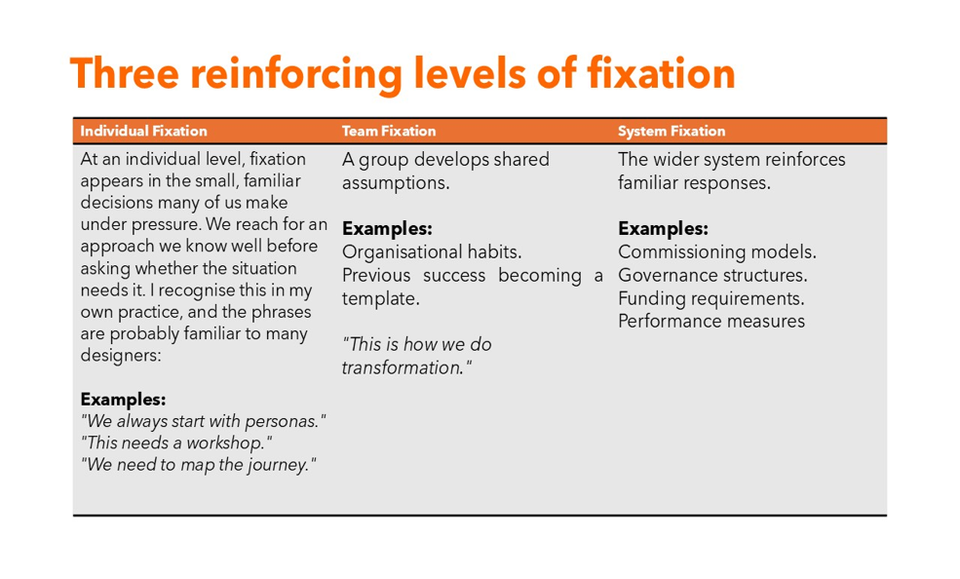
Sometimes what looks like resistance to change is a system protecting what is familiar because familiarity feels safer, is easier to fund and can be defended through established measures. In that sense, fixation is not simply an attitude held by individuals, it can be reproduced by the conditions in which people are asked to act.
Why this matters in systemic service design
Maslow’s hammer is usually framed as an individual habit (Maslow, 1966). In systemic service design, however, the tool can be embedded in an organisation, a co-design method, persona template, or workshop format that ‘worked before’ and is reused regardless of fit.
Design fixation research shows that exposure to an example solution can narrow the ideas a designer generates, even when the example is flawed (Jansson and Smith, 1991). At the scale of a team, commissioner or funding body, fixation becomes structural, systems repeatedly select the same intervention, evaluation metric, or ‘proven’ model because it is institutionally available.
This matters because of how complexity actually behaves. Traditional problem-solving assumes a linear progression in which a problem is defined, a solution is chosen and then put into practice. It’s a hammer-shaped logic, define the nail, apply the tool, done. Complex systems don’t cooperate with that sequence. They ask instead for a loop, a process that begins with understanding, deepens through relationships, moves into experimentation, generates learning and leads to adaptation, where what counts as ‘working’ is provisional and gets renegotiated as relationships and evidence shift (Dorst, 2015).
For systemic service design, naming Maslow’s hammer and design fixation isn’t just diagnostic cleverness. It’s a discipline, a reminder to keep asking whether the tool already in hand is quietly shaping the problem we think we’re solving, and to build in the slower, relational work that complexity actually requires.
In complex systems:
- Problems are interconnected.
- Multiple perspectives are needed.
- Causes and consequences are not always visible.
- The intervention changes the system.
These characteristics change the designer’s task. Rather than isolating a problem and applying a predetermined response, systemic service design asks us to attend to patterns, relationships, assumptions, and missing perspectives.
A systemic designer needs to ask:
- What patterns are repeating?
- What relationships influence this outcome?
- What assumptions are shaping our response?
- What perspectives are missing?
The goal is not to abandon our tools, nor to distrust expertise. It is to hold both more lightly, to use methods intentionally, adapt them responsively and remain willing to put them down when the system tells us they no longer fit.
Escaping the familiarity trap: Five reflective questions
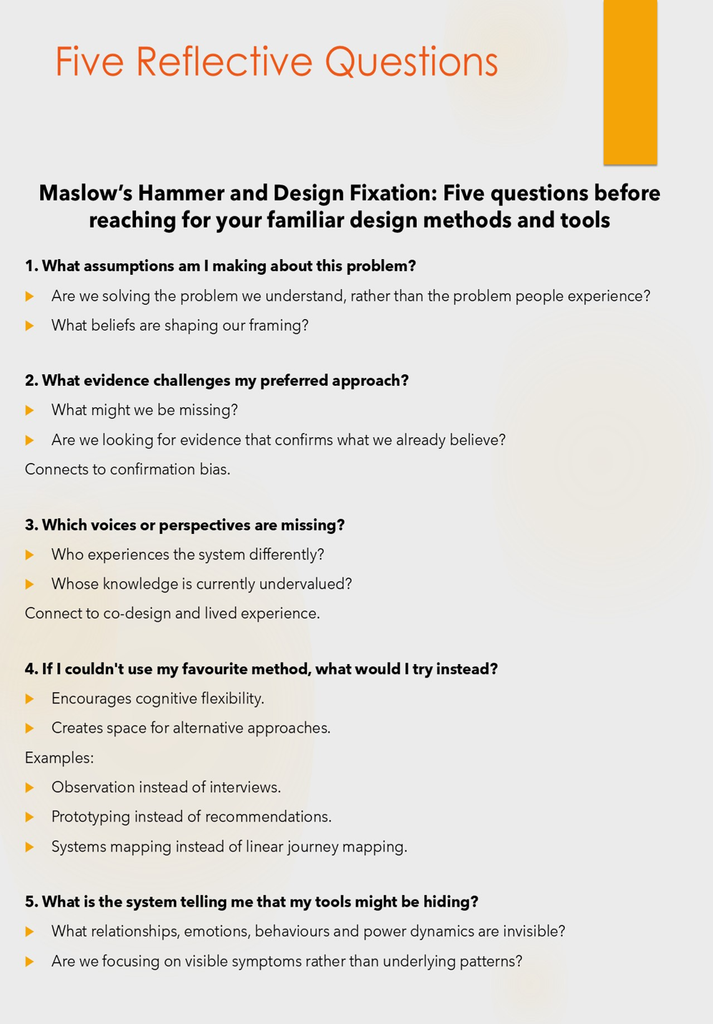
These are five questions I am beginning to use in my own practice. They are not a checklist or a substitute for judgement. They are prompts for creating a pause between recognising a problem and reaching for the method that feels most familiar.
From tool users to adaptive designers
Good design is not about having the biggest toolbox. It is about becoming adaptive enough to know when to reach for a tool, reflective enough to notice whose view it privileges and humble enough to put the toolbox down and listen.
A final reflection:
- Methods are important.
- Expertise matters.
- Tools create shared language.
- But systemic challenges require curiosity, humility, and adaptability.
Methods are important, expertise matters and tools create shared language. But systemic challenges require curiosity, humility and adaptability. The opposite of Maslow’s hammer may not be having more tools; it may be developing the wisdom to recognise when we need a different question.
Maslow’s hammer reminds us to notice what familiarity is doing. Design fixation shows how previous solutions narrow individual imagination, systemic service design shows how those habits become embedded in teams, organisations, and their operating conditions. The practical response is a more reflective practice, pause before selecting a method, test the framing with people who experience the system differently and treat each intervention as an opportunity to learn. When a problem looks like a nail, ask who named it, what else it might be and what the familiar tool prevents us from seeing.
References
Cash, P., Vallès, X., Echstrøm, I. and Daalhuizen, J. (2022) ‘Method use in behavioural design: what, how and why?’, International Journal of Design, 16(1). Available at: International Journal of Design.
Design Council (2005) The Double Diamond Design Process Model. London: Design Council.
Dorst, K. (2015) Frame Innovation: Create New Thinking by Design. Cambridge, MA: MIT Press.
Jansson, D.G. and Smith, S.M. (1991) ‘Design fixation’, Design Studies, 12(1), pp. 3–11.
Kaplan, A. (1964) The Conduct of Inquiry: Methodology for Behavioral Science. San Francisco: Chandler Publishing Company.
Khadilkar, P., Cash, P., and others (2024) ‘The power and potential of behavioural design: practice, methodology and ethics’, Journal of Engineering Design. Available at: Taylor & Francis.
Leahy, K., Sobel, L., and Smith, S.M. (2018) ‘Fixation in design idea generation: Causes, consequences, and countermeasures’, in The Cambridge Handbook of Creativity and Design. Cambridge: Cambridge University Press, pp. 144–160.
Luchins, A.S. (1942) ‘Mechanization in problem solving: The effect of Einstellung’, Psychological Monographs, 54(6), pp. i–95.
Maslow, A.H. (1966) The Psychology of Science: A Reconnaissance. New York: Harper & Row.
Morelli, N., de Götzen, A. and Simeone, L. (2021) Design for Social Innovation: The Triple Diamond Framework. London: Routledge.
Tversky, A. and Kahneman, D. (1974) ‘Judgment under uncertainty: Heuristics and biases’, Science, 185(4157), pp. 1124–1131.
Youmans, R.J., and Arciszewski, T. (2014) ‘Design fixation: A cloak of many colors’, in Proceedings of the DESIGN 2014 13th International Design Conference. Zagreb: Design Society.
Leave a Reply