
I’ve just completed a bit of ‘analysis’ on the types of AI found in science fiction* and thought that turning these into Tarot Cards to predict the AI future would be a good idea. Put it this way, it’s not going to be any less unpredictable than allowing financial markets to dictate AI trajectories…
Here’s what came out.
(* I’m a member of the internationally famous Lochee Science Fiction club. Shout out to Lochee Librarian(s) and Dundee Culture and Services!)
Logic, fears, and ‘does not compute’
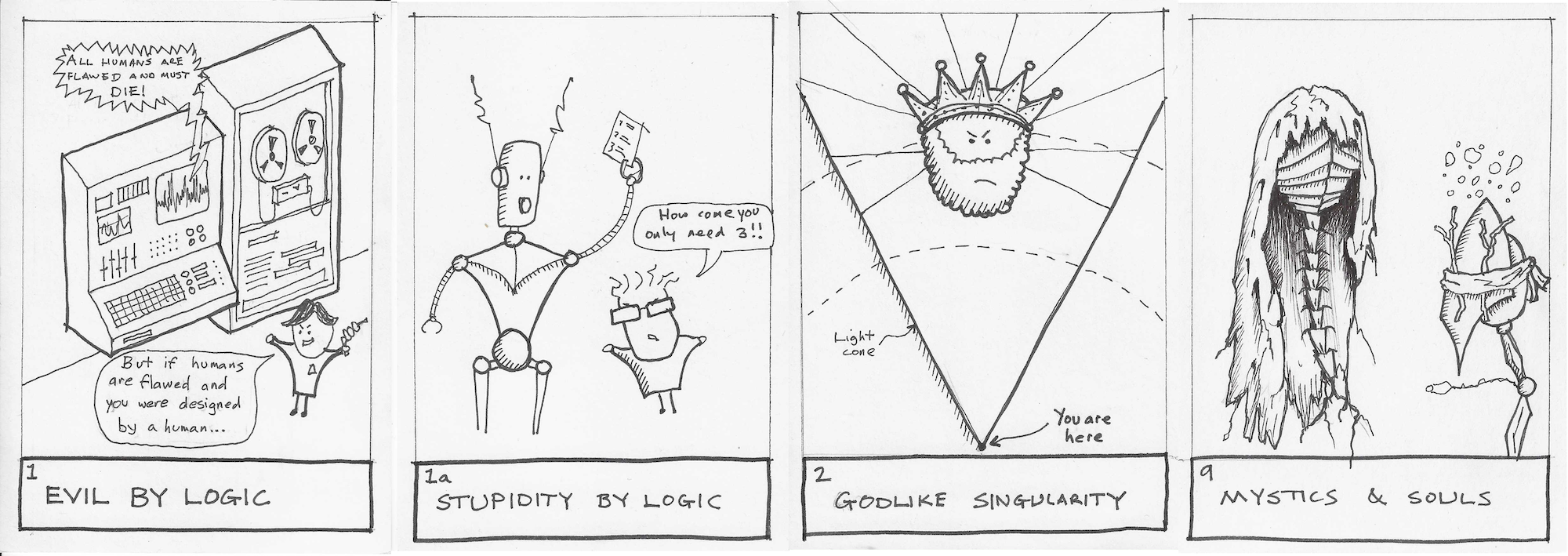
The first group centres around fears of technology and, especially, ideas of logic as opposed to human thinking and value. There is always something frightening about types of thinking we don’t like personally, whether these are creative, logical, analytical, emotional, whatever.
Asimov’s Three Laws were never going to work. That’s because, when you have even One Law, you get 9 lawyers with at least 13 different legal interpretations. Humans are amazing at bending reality in their heads. Law is never about objective truth – it’s an always-flawed human attempt to do justice (or operate power). And this is exactly the problem with trying to creating hard rules around driverless cars or responsibility in AI agents: you can’t ‘logic’ that stuff because we don’t like being logic’d ourselves.
We would rather be lied to using stories than convinced using logic…
It’s all about ME!
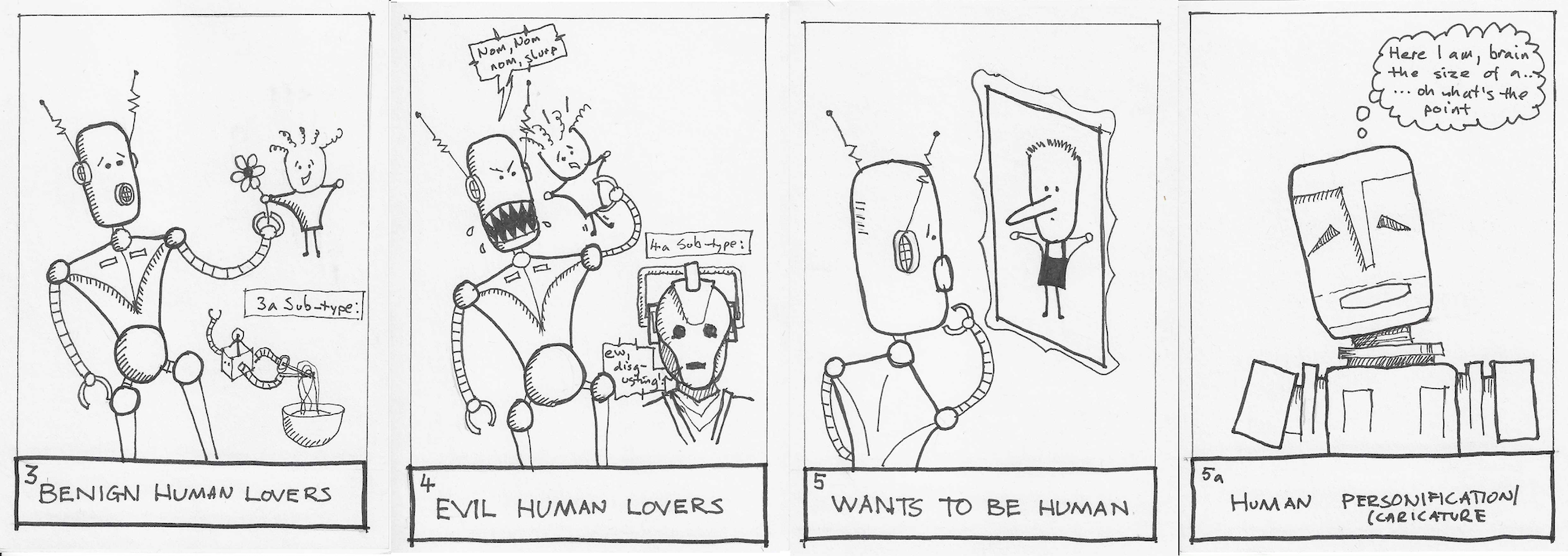
This next group probably all centre around another core theme in fiction generally – what it is to be human.
These themes position the AI as being human, wanting to be human, or representing some core aspect of humanity. Ultimately, a lot of science fiction is about storytelling, making the reader happy, and (sometimes) inspecting what it is to be human. This means the narrative itself has to be relatable to the reader. So it’s maybe not surprising that DATA (Star Trek) wants to feel emotions, or that Rex is questioning his world as a human-controlled dog (Dogs of War, Tchaikovsky), or even that Marvin is conscious because he’s terminally morose (Hitchhiker’s Guide to the Galaxy, Adams).
These are all perfectly relatable human things project on to AI and usually say more about us than anything about AI…
You can’t even imagine…
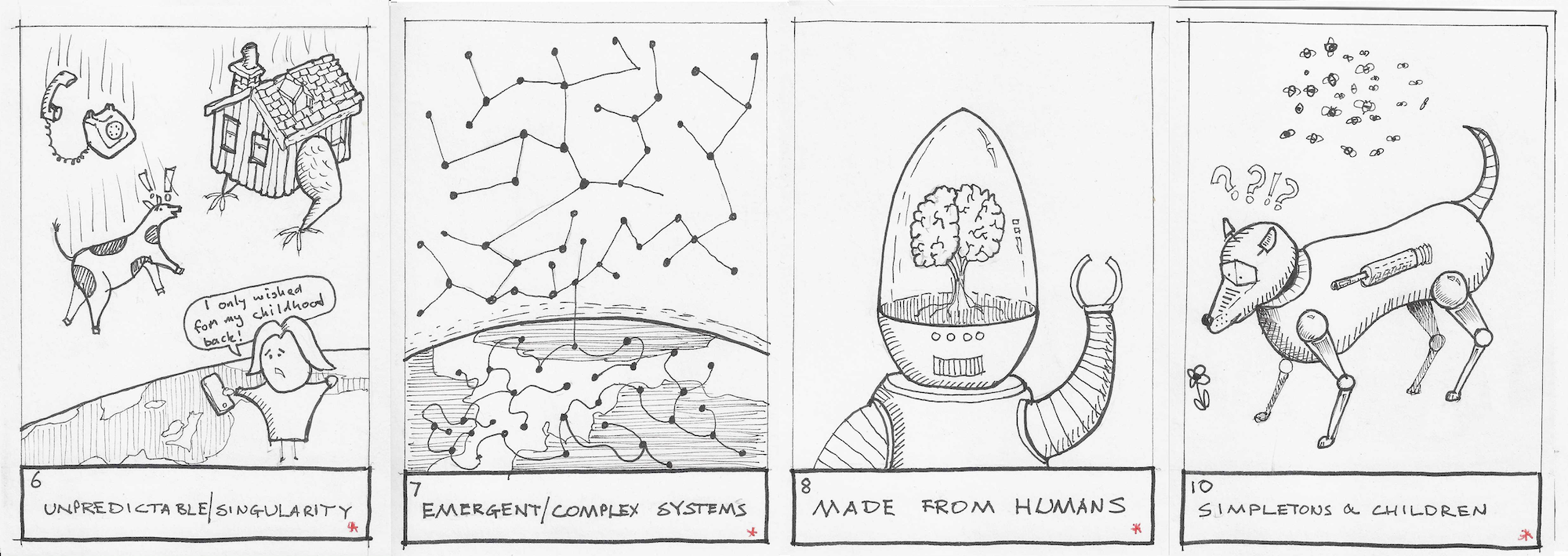
The final group is probably a bit more accurate in terms of how we think intelligence works or comes about in the world around us (e.g. Dehane (202)). Mostly these riff off complex or systems theories, emergence, and other methods of making things big and complicated to explain how AI might emerge. This is also another classical definition of singularity – when that complexity gets too great for us to even comprehend, we enter into us being like an ant looking up at a person etc etc.
I’d say this group is the most accurate because it is precisely the unpredictability of emergence that leads to unintended consequences being seen in some AI agents. Stross’ Info-vores in Singularity Sky, Simmons’ God-like far-future humans, or Egan’s beautiful (if you’re into maths!) stories that follow complex iterative emergence in coding – these are all examples of emergent systems in SF.
They all also hint at the weirdness of things that really shape the future.
So there you go – feel free to mix them up and create your own dystopian AI future.
The messy reality of predictions
What’s really interesting is that very few of these types actually predicted where we are today.
There is a saying in science fiction writing that the job of a good sci-fi writer is to predict the traffic jam, not the invention of the car. What this means is that the technology is interesting but what is often even more enlightening is its effect on people, society, economics, politics, aesthetics, humanity, and so on. In many ways it’s not predicting the car. Or even the traffic jam. It’s the economic and social systems that emerge when cars stop…
Sic-fi that involves massive robots, magically infused gods made from wonder materials, or anything at all that violates causality of space-time, all tends to get more attention because of the exciting opportunities they offer (even if it is extermination by self-aware military systems).
The reality of most new technologies is utterly banal, grey and just full of human mess.
Real changes to people’s lives from new technologies are often just … banal and rubbish, not brilliant. DOn’t get me wrong, there are some fantastic new technologies that have very focused and positive purposes. But so many of these are then co-opted into human mess. First, so much of new technology and innovation is actually about people changing in order to deal with the let-down of promises of the future (car parking machines anyone? Or the realities of social media?). Second, we constantly underestimate the fact that creativity is also useful to do bad stuff – we have just reached the point at which over half of all internet traffic is now slop (info-junk, crap-bots, spam, spam talking to spam, slop agents, junk crawlers, wasted streaming – and that’s before we start into AI propagation…). That’s not a figure that will go down as long as there’s a £ to be made/swindled/stolen (remember kids, information wants to be free… ).
Some SF writers get this and write it speculatively (Gibson, Stross, Egan, Sullivan), or symbolically / metaphorically (Le Guin, Gibson, Dick, or Vonnegut).
What’s challenging (and worthwhile) about reading these authors is the simple fact that predicting the future is very hard to imagine because humans are so very wrapped up in the present. Robin Roy presented this in 1973 at the OU in our first design course and it is still utterly true – for most people, the future is all about the present.
That’s what truly terrifies me about AI as it’s currently shaped – not that we will enter a future filled with evil missile drones or agentic AI gaining access to my cat flap and inviting vacuuming robots in to steal my hair. Instead, I worry about a world where people are indoctrinated into a vision of being human that is almost entirely based on ‘right now’ and its immediate successor, the next 20 seconds. Based on informational attention.
Dark Patterns in interaction design have been making good use of this for years – what makes you think that collective attention-fixing behaviour modifiers aren’t already manipulating us into The Great Averaging of Humanity? That we are not already being significantly shaped by what we think is freedom and agency in an info-dependant world?
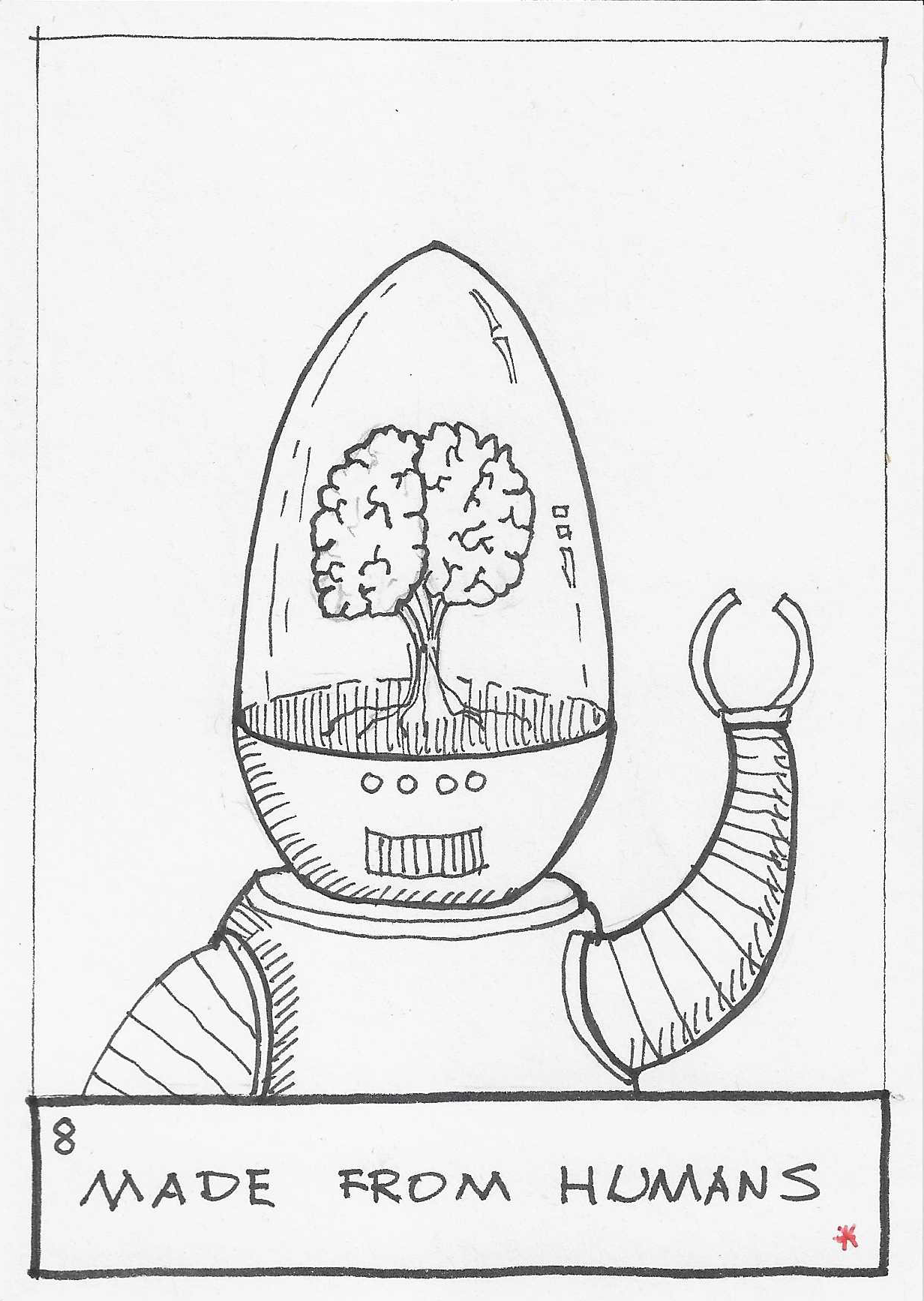
One of the scary models in the cards is Made from Humans, based partly Simmons’ vision of a far future where AI is simply a MASSIVE large language (conceptual gestalt) model created from the sum total of human ravings following a cultural singularity (which we passed a couple of decades back, by the way (Floridi, 2004)). An AI that simply reflects the averaging of human information processing based on moment to moment reactions. Just reaction. No forethought. No afterthought. No thought.
Now that is a truly terrifying human future. Simply connect the output tube of the human meat bag to it’s input, ensure a ready supply of middle-range EM radiation (visible light will do), and you actually get close to the AI future depicted in the Cohen Brother’s vision of human-AI future in the The Matrix (that’s AI Type 4, by the way).
And you didn’t even have to build lots of fluid-filled pods.
Leave a Reply