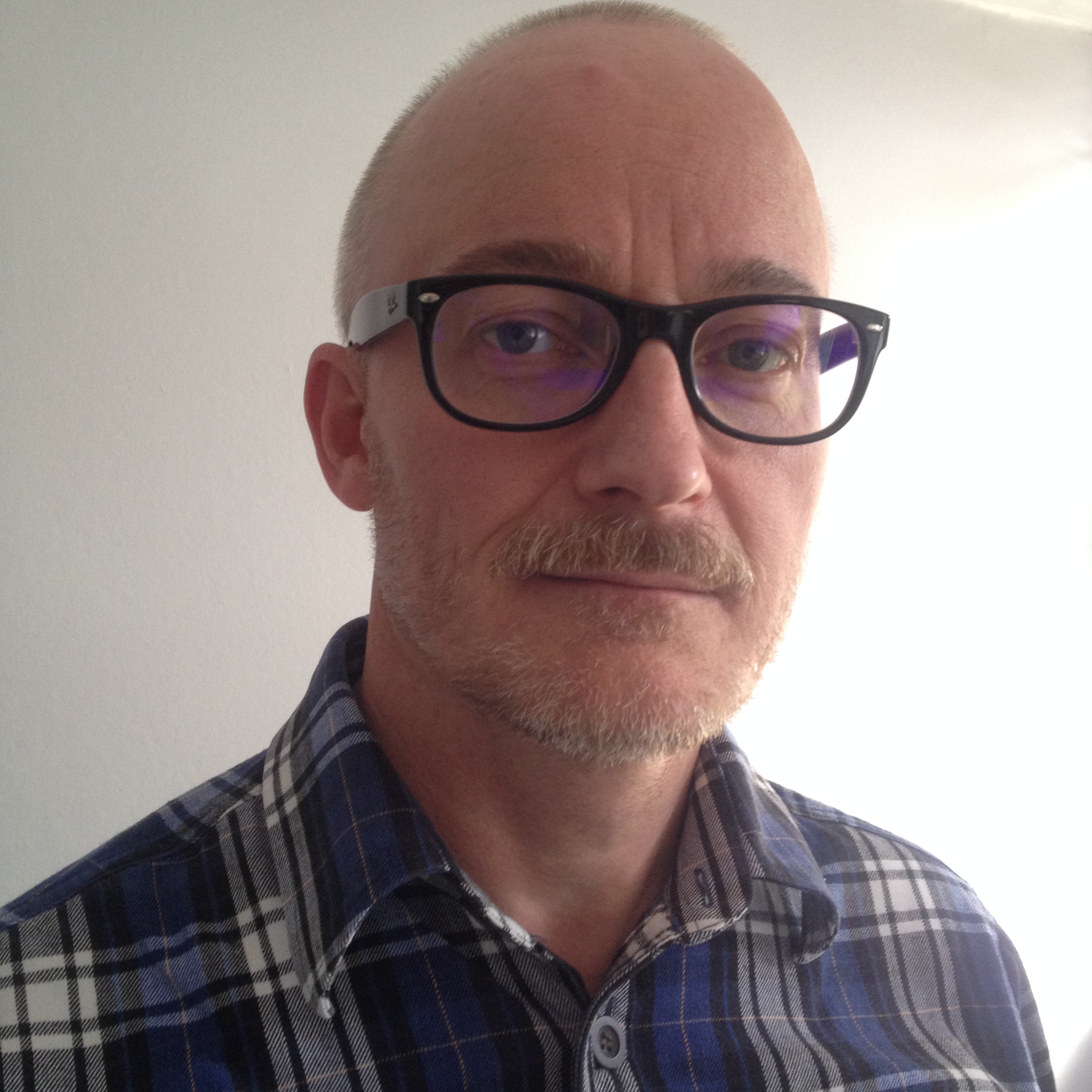
Professor Richard Holliman, The Open University. Credit: Jane Perrone.
Students from Walton High, a school in Milton Keynes, have been finding out that the sky is definitely not the limit when it comes to research at The Open University (OU).
In late July, as part of their digital media production course, ten BTEC students visited the OU campus to find out more about its work on Europe’s comet-chasing spacecraft Rosetta – the world’s first mission to land on a comet.
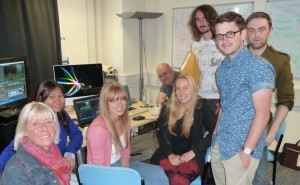
Media Training Workshop, l-r: Janet Sumner, Hnin Myint, Mairi Walker, Gerard Giorgi-Coll, Phillipa Smith, Jamie Dorey, Frazer Bird and Tom Ryan
When I got an email from Richard Holliman about an Open University (OU) media skills training course, it took me all of 30 seconds to double-check with my PhD supervisor and sign up. I’d previously attended a one-day event with the Royal Society, and was keen for a more in-depth course. I had no idea what to expect, but was excited to hear that the aim of the course would be to build up the skills needed to design, produce and edit a short film.
From the 2nd to 6th June I worked with fellow OU PhD students Frazer Bird, Jamie Dorey, Hnin Myint, and Phillipa Smith, under the expert guidance of presenter Janet Sumner, cinematographer Gerard Giorgi-Coll and Assistant Producer Tom Ryan to create a short film about a collaborative research project between the OU and the Field Studies Council (FSC), an environmental education charity that provides opportunities for people of all ages to engage in fieldwork. You can watch the results of our efforts by selecting the video below.
Before I joined the OU, my background was in risk-based decision-making. I looked forward to finding innovative ways of gathering evidence of the impact of public engagement with research (PER). However, it seemed like whenever PER was mentioned evaluation would either become the pink elephant in the room or be quickly forgotten, and the conversation would focus on public engagement as opposed to public engagement with research.
In my experience, this doesn’t arise from ill intent but rather from a lack of understanding about the affordances of different PER activities and the methods and techniques used to evaluate the impact of PER.
This seminar was an opportunity to test a theoretical framework that I believe has the capacity to address this issue. Continue reading →
Another week of media training, this time looking at space science!
Jessica Carr - Open University Intern
Monday
I worked today with the new group of media students from Walton High. I got the chance to meet them last week at the briefing but in the space of a week had managed to forget everyone’s names; obviously not my strong point.
Monday is always the day that the students learn how to interview. Luckily I managed to get out of being the guinea pig and instead got to watch Manisha, the teacher, squirm.
Although very shy to start with the students slowly started to come out of their shells a little, especially when put in front of a camera.
While in Japan to research a travel book, I spent a night in Hiroshima. Talking to the ‘guides’ who met me for dinner, it emerged both were children of survivors of the atomic bomb but their parents had never talked to them about the blast. I went with my guides to a neighbourhood meeting; hearing that I was interested in war survivors, a 94-year-old woman, who had been attending these meetings for years, stood up and said: ‘I too am a hibakusha’.
The Floodplain Meadows Partnership is a research project based on key academic work carried out at the Open University by Professor David Gowing and others on the response of species-rich floodplain meadows to changes in management, particularly hydrological changes. The partnership recently received an Evidencing Engaged Research seed funding award to look at the impact that advice from the project has had on site managers and sites across the UK.
Last week I was helping out with a media training week, working with MK College students. The students spent the week learning the skills needed to make a short film focusing on a research project being run by the OU. This particular training focused on the nQuire platform. Here’s my run down of the week:
As an academic in the newly formed International Education and Development research group at the Open University, I’ve been thinking a lot about social justice recently. I’ve been particularly interested in the suggestion in UNESCO’s latest Education for All (EFA) Global Monitoring Report that teachers need to be better trained in order to support the most disadvantaged children.
Nazlin Bhimani, Research Support & Special Collections Librarian
Early in June 2014, members of the Newsam Library & Archives met to discuss ways to better promote our services and collections to our users via Twitter. @IOELibrary joined Twitter in June 2011 and has gathered about 625 followers. We wanted to get a team, representing all the different sections in the Library (Collection Development, User Services, Technical Services and Administration), that would take responsibility for tweeting for @IOELibrary. We had no special requirements for the staff. They didn’t need to be experienced users of Twitter. We simply wanted interested people who had interesting things to say. Continue reading →
Blogging is something slightly alien to me, especially in an academic sense. As an Open University intern it is part of my role to blog about what I’m doing and quite simply, it seems that the activities I’m currently a part of are just too interesting to keep from you all!