In October 2019, the then-Prime Minister Boris Johnson appointed an Independent Faith Engagement Adviser to make recommendations to the Secretary of State for Communities. The final report, “Does Government ‘do God’? An Independent review into how Government engages with Faith” (also known as the Bloom Report), was published on 26th April, 2023. It clocks in at 159 pages, including a series of twenty-two recommendations on “properly engaging with people of faith” (summarised on pp. 18-24).
There is much to commend in the report’s conclusions. #7 urges government to properly support RE teaching in secondary schools. It also seeks to redress the way that Muslims were singled out for criticism in the Blair/post 9-11 era, with policies such as the Prevent Strategy seemingly assuming the Muslim was the image of “problematic” religion (#14). It also acknowledges the diversity within religious communities—a theme which our students on A332 Why is Religion Controversial? are very familiar with. Perhaps most significantly, it urges the government not to shy away from addressing problems within religious communities “head on”. Forced marriage is an issue that Bloom particularly focuses on (#20-22), but the report also discusses financial exploitation, radicalisation in prisons (#11) and coercive control (#19), but not clerical abuse, nor the role of religious institutions in challenging anti-LGBTQ+ equality.
The report also recognises the growing religious diversity in the UK, but however fails to acknowledge the most seismic change to the religious landscape in the UK today—the rise of “no religion”, a cohort which has grown 26% since 2001, drawing in the main from those who formerly identified as Christian. The UK is no longer a Christian-majority country, indeed it is likely a country which will soon be a majority non-religious country, but you would not get that impression from this report (see the critical response from Humanists UK).
To be fair, Bloom does see the non-religious as “part of the solution to improving society” (p.5). In fact, he proposes that the government should divide religious people into three groups: “true believers”, “non-believers” and “make believers”:[1]
The first are ‘true believers’ who, regardless of their faith, are sincere, devout and peaceful. Government can and should work with true believers. The second are ‘non-believers’ who, like true believers, are generally sincere, peaceful and decent. True believers and non-believers are part of the solution to improving society. The third are ‘make-believers’. Make-believers are generally the cause of most of the problems that government encounters in the faith space. Make-believers are often motivated by ego, money, prestige or power and abuse their position to promote themselves or their causes, clothing them with religion to give them divine legitimacy. Make-believers are a problem, both for government and for the communities they claim to represent.
It is commendable that here Bloom puts “true believers” and “non-believers” on the same footing as being sincere and peaceful (until you notice the qualifier “generally”, at least). But this categorisation is highly problematic, nevertheless. Bloom is here combining two inaccurate, though widespread, tropes—on the one hand, that religion is necessarily about “sincere belief”, and on the other, that religion is always a force for good.
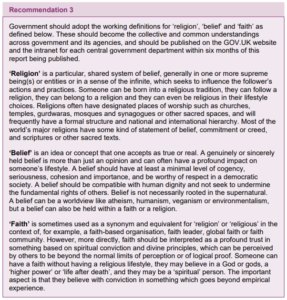
The first trope is clear in the definitions of “religion”, “belief” and “faith” which the report presents in Recommendation #3. Several commentators have already critiqued this (see for example, this thread by Rudi Elliot Lockhart, former CEO of the Religious Education Council of England and Wales)—but I will summarise briefly here.